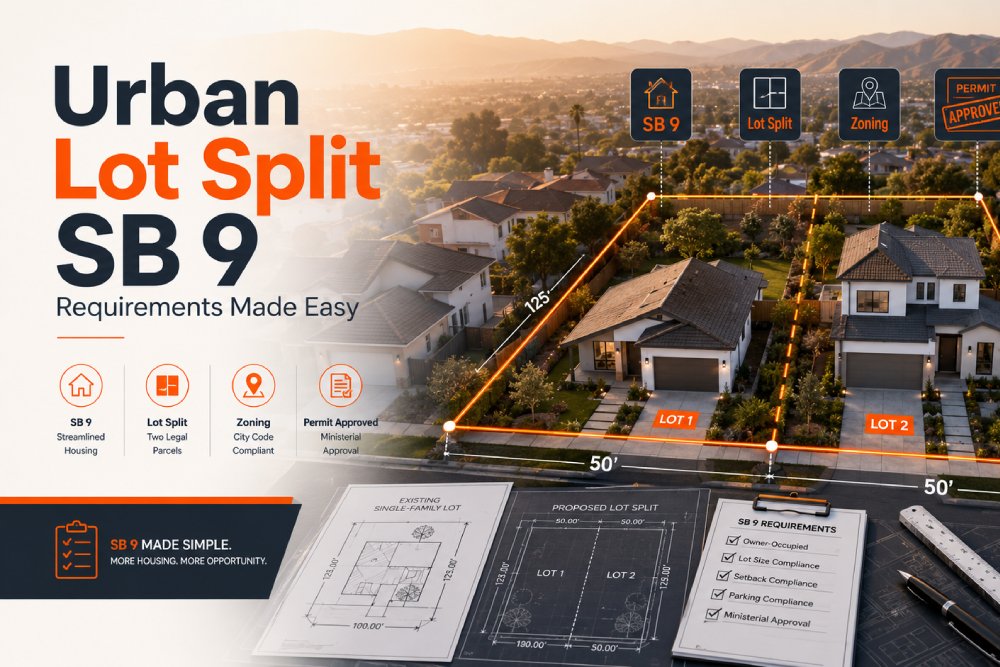
Many California homeowners want to know whether an SB 9 urban lot split is worth it. The short answer is yes for many properties. It can help you create more housing, prepare for rental income, or improve the value of your land.
Table of Contents
Yet the process can still feel confusing. Every city has its own checklist. Forms vary. And planning terms can sound technical if you do not work in real estate.
This guide explains SB 9 urban lot split rules in a clear and simple way. You will see plain steps, tables, and short examples. The goal is to help you understand what SB 9 expects and how homeowners like you can meet those expectations without stress.
Let’s start with the basics.
What SB 9 Means and Who It Helps
California passed SB 9 to make it easier for homeowners to add more housing on single-family lots. The law allows two main things:
Urban lot splits
Duplexes on single-family parcels
The process must follow “ministerial approval.” This means the city uses objective, written rules instead of holding long hearings or applying personal judgment.
Who SB 9 Helps Most
SB 9 can work well for:
Homeowners who want to split a lot for family housing.
Small investors who want modest development.
Owners looking for long-term rental income.
People planning retirement housing or downsizing.
Key Benefits in Simple Terms
Shorter review times compared to standard development.
Clear rules and objective standards.
Potential for more units on the same land.
A chance to increase property value in the long run.
Simple Table: What SB 9 Allows
| SB 9 Option | What It Means | Typical Result |
|---|---|---|
| Duplex | Build two homes on one lot | 2 units |
| Urban Lot Split | Divide one lot into two | 2 lots |
| Lot Split + Duplex | Duplex on each new lot | Up to 4 units |
SB 9 is open to many owners, but some basic conditions must be met. Those requirements are the foundation of the next section.
Key Eligibility Rules for an SB 9 Urban Lot Split
Not every lot qualifies. SB 9 is strict about zoning, lot history, and owner commitments. But once you understand these rules, the process becomes easier to follow.
SB 9 Eligibility Flowchart 🔹
Is your property zoned Single-Family?
Does lot meet minimum size & split ratio?
Check fire, flood, and historic restrictions
Eligible for SB 9 Split ✅
Below are the core requirements in simple language.
Zoning and Location Requirements
Your lot must:
Be in a single-family residential zone.
Be inside a city or urbanized area defined by the state.
Not be in a restricted area like very high fire-risk zones, certain historic districts, or environmentally sensitive places.
If you are unsure about your zoning, check your city’s zoning map. Nearly every city planning website offers a zoning lookup tool.
Lot Size and Split Ratio Rules
SB 9 sets clear conditions for how a lot can be divided.
Each new lot must be at least 1,200 sq ft, or
Each lot must be at least 40% of the original lot, and the split must be “balanced.”
Cities can add design standards, but they cannot stop an SB 9 split without a valid health or safety reason.
Here is a simple table to help understand the safe range:
| Original Lot Size | Minimum Size of Each New Lot | Notes |
|---|---|---|
| 5,000 sq ft | 2,000 sq ft each | Meets 40% rule |
| 6,000 sq ft | 2,400 sq ft each | Plenty of room |
| 3,200 sq ft | 1,200 sq ft each | Hits state minimum |
Owner-Occupancy Affidavit
For urban lot splits, the owner must sign a form stating they will live on one of the lots for at least three years. This rule helps prevent large-scale speculation.
Key points:
You sign an affidavit as part of the application.
You can live in an existing home or one of the new units once built.
This rule applies only to lot splits. It does not apply to duplex-only projects.
One-Time Use Rule
You can only split a parcel once under SB 9. You also cannot split next-door lots you own if it appears to create a large subdivision. The state intended SB 9 for small-scale development, not major tract projects.
Step-by-Step SB 9 Urban Lot Split Process (Ministerial Approval Explained)
Now that you know the core eligibility rules, it is time to understand the actual process. Most cities follow the same general steps, but each city may have its own forms and objective design standards.
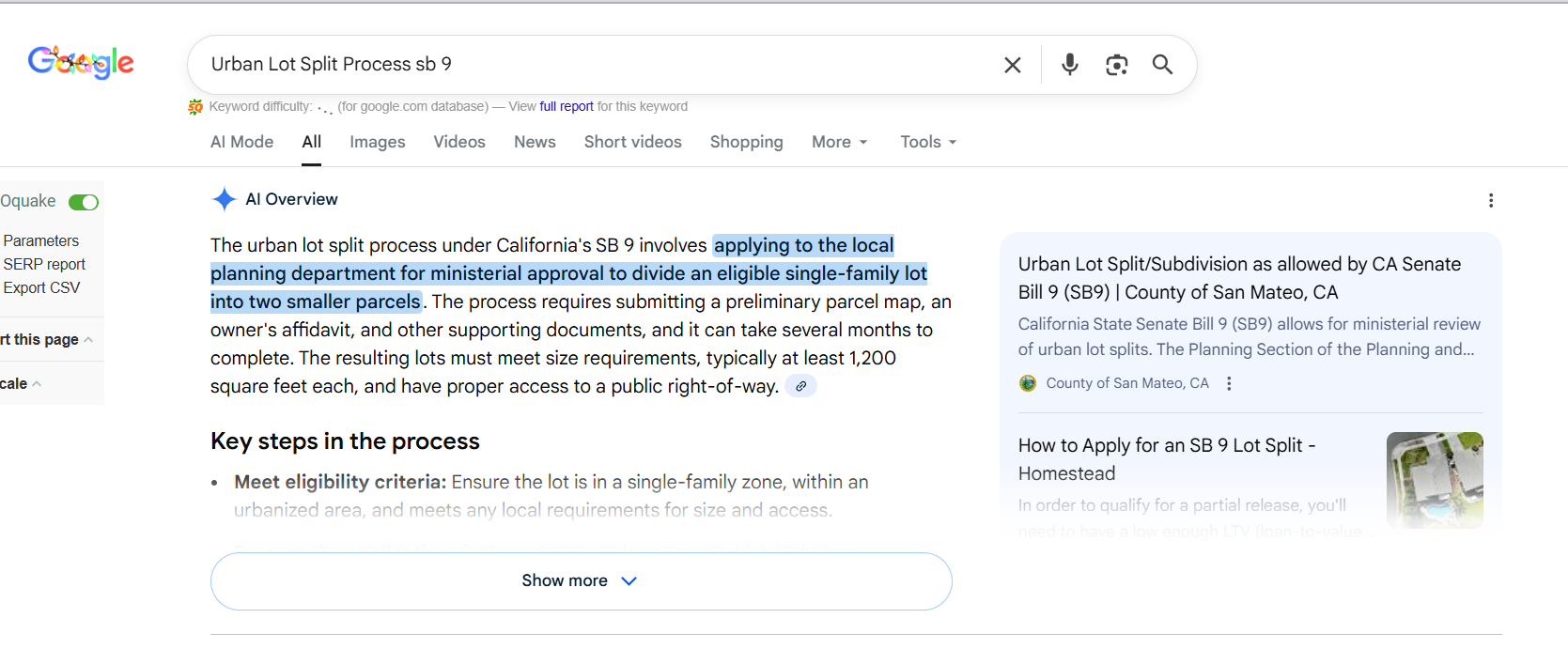
The good news: the steps are direct and predictable.
Step 1: Pre-Application Research
Before preparing drawings or spending money, take time to check a few items. These early steps save you time later.
Confirm zoning and General Plan designations.
Read your city’s SB 9 packet or checklist.
Check for easements, utility lines, or restrictions in your title report.
Look for any HOA rules if your neighborhood has a homeowners’ association.
Review maps for fire zones or historic designations.
Assess basic site conditions such as slopes or unusual shapes.
These checks help you understand whether your lot meets the basic criteria.
Step 2: Required Paperwork and Drawings
Every city requires a similar set of documents. Keeping them organized speeds up your approval.
Typical documents include:
Owner-occupancy affidavit, signed and often notarized.
Tentative Parcel Map prepared by a licensed surveyor or civil engineer.
Site plan showing structures, setbacks, driveways, and utilities.
Existing conditions plan with measurements.
Title report showing easements and restrictions.
Basic architectural sketches if you plan to build new homes right away.
Utility and drainage notes, often required by public works.
Some cities also require a tenant history affidavit if the property has been rented in the last three years.
Step 3: Submittal, Review Timeline, and Fees
Once your documents are ready, you submit them to the planning department. The review is ministerial, so planners check each item against written rules.
Most SB 9 applications go through these simple stages:
Application submittal
Completeness check
Technical review
Corrections, if any
Approval and conditions
Recordation of the parcel map
Review times vary, but SB 9 approvals are often faster than traditional subdivisions.
Typical fees include:
Application deposit
Map review fees
Engineering review
Recording fees
Building permit fees (if building homes right away)
SB 9 Combinations and Development Options (How Many Units You Can Build)
Many homeowners ask the same question: “How many homes can I build with SB 9?” The answer depends on whether you are adding a duplex, splitting your lot, or doing both. SB 9 has several possible combinations. Some are simple. Others need more planning. But all remain within small-scale housing.
Basic SB 9 Development Paths
Here are the main choices available under the law:
Duplex only
Build two homes on your single-family lot without splitting the land.Urban lot split only
Divide the lot into two legal parcels. Each parcel gets its own APN.Urban lot split + new units
After splitting, build a home on each lot.Urban lot split + duplexes
This is the largest outcome allowed. Each new lot can support a duplex. That means up to four homes total.
What Cities Commonly Allow
Cities must allow these combinations as long as the project meets objective zoning standards. Some cities also allow ADUs on SB 9 lots after the split, but this varies. Many local rules limit ADUs on SB 9 parcels, so it is important to confirm with the planning department early.
SB 9 Lot Size Distribution 📊
4,800
sq ft
5,000
sq ft
3,000
sq ft
2,600
sq ft
2,400
sq ft
Source: California SB 9 Guidelines
Simple Examples
A 6,000 sq ft lot may split into two 3,000 sq ft lots. Each may support a home or duplex.
A deep lot may create a front lot and a rear lot with flag-lot access.
A corner lot may allow cleaner driveways and easier parking design.
In simple terms, SB 9 offers flexibility. You can build a little or build more. It depends on your goals, your budget, and your site.
Typical SB 9 Urban Lot Split Checklist
This section gives you a clear checklist you can use before applying. Every city has its own version, but most follow the same structure. Use this list to keep your documents organized and avoid delays.

Planning and Zoning Checks
Confirm your zoning is single-family.
Check your General Plan designation.
Review city SB 9 objective design standards.
Confirm that your lot has not been split before.
Ensure the site is not in a restricted area such as a high fire-hazard zone or historic district.
Property and Site Checks
Measure the lot to confirm it meets the minimum size.
Calculate the 40/60 split ratio.
Check topography and basic site layout.
Review any easements in your title report.
Look for driveway access and utility placements.
Required Documents
Tentative Parcel Map
Owner-occupancy affidavit
Site plan with property lines and setbacks
Existing conditions plan
Title report
Utility and drainage notes
Tenant history affidavit (if rentals exist)
Application forms and city checklists
Submittal and Fees
Application deposit
Map review fees
Engineering review
Recording fees
Once these steps are complete, you move into formal review. Cities look at each box and verify compliance. Clean, organized applications tend to get approved faster.
Common Pitfalls, Red Flags, and How to Avoid Them
Even strong SB 9 projects run into small issues. Many of these problems are predictable, and most can be avoided with early preparation. This section highlights the most common mistakes and how to handle them.
Pitfall 1: Incomplete or Disorganized Applications
Cities require detailed maps, forms, and affidavits. Missing even one item can delay review.
How to avoid it: Follow the city’s checklist line by line. Keep each document labeled. Ask your surveyor or designer to confirm measurements twice.
Pitfall 2: Not Checking HOA or Private Restrictions
Some neighborhoods have covenants or HOA rules that limit lot splits, even if SB 9 allows them. Owners often discover this late.
How to avoid it: Review your CC&Rs and talk to the HOA early. If you do not have an HOA, check your title report for recorded restrictions.
Pitfall 3: Assuming You Can Request Variances
SB 9 is ministerial. Cities cannot apply subjective rules, but they also will not give variances that break setbacks, height rules, or parking standards.
How to avoid it: Keep your design within written standards. If the plan needs a variance, reconsider the layout or speak to a design professional.
Pitfall 4: Overlooking Tenant Protections
If the lot has renters, cities may require extra steps before approval. Some cities need affidavits, tenant notices, or relocation plans.
How to avoid it: Check your property’s rental history. Be honest in the tenant affidavit. Ask the planning department about tenant rules upfront.
Pitfall 5: Driveway, Parking, or Utility Conflicts
Some lots have narrow access, utility poles, or sewer lines in difficult places. These issues often slow the process.
How to avoid it: Have your surveyor highlight utilities early. Review public-works standards for driveways and sewer connections. Simple adjustments in the site plan often fix these issues.
SB 9 vs ADU Comparison 🏠
- Units Allowed: SB 9: 2 units per lot | ADU: 1 ADU + 1 JADU
- Owner-Occupancy: Required for SB 9 | Not required for ADU
- Parcel Creation: SB 9: new lots possible | ADU: stays on same lot
- Timeline: SB 9: ~4–8 months | ADU: ~3–6 months
- Cost: SB 9: higher due to lot split | ADU: lower construction cost
How Cities Implement SB 9 (Local Variations You Should Expect)
SB 9 is a state law, but cities still apply local standards. These rules must stay objective and written. They cannot rely on personal judgment or long hearings. Still, every city adds its own flavor. This is why SB 9 feels slightly different in Los Angeles, San Diego, or San José.
Local Standards You Will See in Most Cities
Cities often apply standards like:
Lot coverage limits
Setback requirements
Height limits
Parking placement rules
Driveway and fire access guidelines
Utility connection standards
Cities may also list design rules for windows, rooflines, or building colors. These must be objective and apply to everyone.
What Stays the Same Everywhere
Despite local differences, the state requires uniform treatment of SB 9 projects. Cities must:
Allow ministerial review
Apply only objective standards
Avoid subjective hearings
Review applications within reasonable timelines
Allow both lot splits and duplexes if the property qualifies
This helps ensure that homeowners get predictable results regardless of where they live.
Cities With Additional SB 9 Guidelines
Many cities now publish their own SB 9 guides. These documents explain local rules in plain language. They often include sample site plans, setback charts, and step-by-step instructions.
If your city offers one, read it. It saves time and answers most early questions. Many homeowners discover layout ideas they had not considered before.
Legal Landscape and Recent Court Developments
SB 9 is still a young law. Cities, homeowners, and state agencies continue to test how far it goes. A few court cases have shaped how cities handle approvals. These cases also make it clearer what cities cannot require.

State Guidance Reinforcing Ministerial Review
California’s Housing and Community Development Department (HCD) reminds cities that they must follow the law as written. This includes:
Allowing lot splits and duplexes without discretionary hearings
Avoiding subjective design requirements
Avoiding “poison pill” rules that make SB 9 impossible
Reviewing applications on written, measurable standards
When a city tries to add barriers, the state usually steps in.
Notable Court Trends
Courts tend to support property owners when:
A city denies SB 9 applications without citing objective standards
A city uses subjective language like “neighborhood character”
A city tries to apply stricter rules to SB 9 lots than other lots
Judges have made it clear that cities must follow the structure of SB 9. They cannot treat SB 9 projects like traditional subdivisions.
What Homeowners Should Take From This
You do not need to follow court cases closely. But understanding the trend helps. The state expects cities to honor the law. If your project meets the objective rules, approval should follow. This gives many homeowners confidence before starting the process.
Financing, Taxes, and Insurance Considerations
An SB 9 lot split is not only a planning decision. It also affects your finances, taxes, and long-term costs. These factors matter even if you plan a small project.
Financing for SB 9 Projects
Homeowners usually fund SB 9 work in one of these ways:
Cash or savings
Construction loans
Home equity loans or HELOCs
Private lenders
Partner financing
Traditional banks often offer construction loans for SB 9 projects, especially when you build new homes after the split.
Tax Effects to Know
A lot split usually creates two new APNs. That means:
Property taxes may change for each new lot
Future sales may have separate tax bases
Each lot becomes a distinct taxable parcel
Transfer taxes apply if you sell one of the parcels
If you build new units, the county will reassess the improvements. Consider speaking with a tax professional early.
Insurance After a Lot Split
Insurance changes once you split your land or build new homes.
Expect differences in:
Policy structure (you may need two policies)
Coverage type for new units
Liability coverage
Builder’s risk insurance during construction
Your insurance agent can explain each step. It is better to adjust coverage early instead of waiting until the project starts.
SB 9 Application Checklist ✅
- 🟠 Verify property zoning and eligibility
- 🟠 Prepare parcel map and site plan
- 🟠 Include owner-occupancy affidavit
- 🟠 Submit application to city planning department
- 🟠 Respond quickly to any corrections requested
- 🟠 Record final parcel map with the county
Understanding SB 9’s Urban Lot Split Process Step-by-Step
SB 9 may seem procedural at first. But once you see it broken into steps, the process feels much more doable. Here is a clear walkthrough of how most homeowners and small developers complete an urban lot split under California law.
Step 1: Confirm Your Property Meets Basic Eligibility
Before you prepare any forms, confirm your parcel qualifies. A quick check can save time and prevent denials later.
Key items to review:
Your property must be in a single-family residential zone.
It must be within an urbanized area or an urban cluster.
The parcel cannot be part of a historic district.
The land cannot be used for rent-controlled units.
No tenant evictions—voluntary or not—within the past three years.
No part of the parcel may be in high-risk hazard zones, such as floodways.
If you are unsure about zoning, the city’s GIS map is usually the easiest way to check.
Step 2: Prepare Your Lot Split Application
Once you confirm eligibility, the next step is preparing your application. Each city has its own version, but most ask for the same core items.
Your application may require:
A tentative parcel map, drawn by a licensed surveyor.
A site plan showing both new lots.
Right-of-way dedication info, if the city requires it.
Verification that each parcel will have independent services,
such as water and sewer.A signed owner-occupancy affidavit for the 3-year requirement.
Impact fees or filing fees.
Many cities also allow digital submittals now, which speeds things up.
Step 3: Submit the Application and Wait for Ministerial Review
After submission, the city reviews the application. The good news: SB 9 makes this a ministerial process. That means no public hearing and no subjective opinions. The city must approve the split if you meet all requirements.
During review, the city typically checks:
Lot sizes
Setbacks
Parking requirements
Environmental constraints
Utility access
Owner occupancy affidavit
Parcel map accuracy
If something is missing, they send a correction list. Responding quickly can keep your timeline on track.
SB 9 Urban Lot Size, Setbacks, and Design Rules
Even when a property is eligible, SB 9 requires you to follow certain design rules. These rules keep each new lot functional and safe.
Required Minimum Lot Size After a Split
SB 9 allows you to divide your parcel almost in half. But the city can set a minimum lot size, as long as it does not exceed 1,200 square feet.
Here is a simple table showing how typical lots divide:
Table 1 – Example Lot Split Scenarios
| Original Lot Size | Minimum Parcel 1 | Minimum Parcel 2 | Notes |
|---|---|---|---|
| 4,800 sq ft | 2,400 sq ft | 2,400 sq ft | Common suburban parcel ratio |
| 5,000 sq ft | 2,500 sq ft | 2,500 sq ft | Even split allowed |
| 3,000 sq ft | 1,500 sq ft | 1,500 sq ft | Still above 1,200 sq ft limit |
| 2,600 sq ft | 1,300 sq ft | 1,300 sq ft | Both parcels legal |
| 2,400 sq ft | 1,200 sq ft | 1,200 sq ft | Minimum size under SB 9 |
These sizes may vary by city, but the state controls the minimums.
SB 9 Setback Requirements
SB 9 uses very small setbacks compared to most zoning rules. This makes it easier to fit housing on compact lots.
Standard SB 9 setbacks:
4-foot side setbacks
4-foot rear setbacks
No front setback reductions (local rules apply)
Existing homes do not need to move
Garages often need compliance with fire rules
Many homeowners appreciate the flexibility since older homes rarely fit modern setback standards.
Parking Requirements Under SB 9
Parking rules are also simplified. This helps reduce construction costs and supports more walkable areas.
Below is a quick comparison.
Table 2 – SB 9 Parking Rules
| Housing Type | Parking Requirement | Exceptions |
|---|---|---|
| Urban lot split homes | 1 space per unit | No parking required if within ½ mile of transit |
| Units on narrow lots | City may reduce parking | Varies by parcel width |
| Additions to existing home | Usually no new parking | Confirm with local rules |
If your property is near public transit, your project may require zero parking—a major cost saver.
Owner-Occupancy Rule and Why It Matters
SB 9 includes an owner-occupancy requirement to prevent speculative land flipping. It applies only to urban lot splits, not SB 9 duplexes.
What the Rule Requires
The owner must sign an affidavit stating they will live in one unit for a minimum of three years.
This applies from the day the city approves the split.
It does not mean you must live in the property before applying.
Many homeowners choose to live in the front home while renting the rear home. This often helps offset project costs.
When the Rule Does Not Apply
The rule is waived if:
You are only building a duplex without splitting the lot.
You are a nonprofit or community land trust.
The city chooses not to require the affidavit (rare).
Cities enforce the rule through recorded documents, so be prepared to sign before approval.
Easements, Access, and Utility Service Requirements
SB 9 projects must show that each new lot will have safe access and reliable services. Cities review this early in the process because access and utilities affect long-term use.
Access Requirements for Urban Lot Splits
Each parcel must have legal access to a public street. This may be direct frontage or a shared access easement.
Common access setups include:
Both lots with street frontage (simple and preferred)
Rear lot served by a shared driveway
A recorded access easement that ensures long-term use
Flag-lot configuration, where a narrow strip connects the rear parcel to the street
Cities look for clear documentation. A surveyor or civil engineer usually prepares the exhibit.
Utility Requirements
Each lot must support basic utilities. These include water, sewer, electricity, and sometimes stormwater systems.
You may need:
A separate water connection
A new sewer lateral to the main line
Updated electrical service, especially for all-electric homes
A drainage plan if the city requires stormwater control
Proof that each lot can connect without crossing a neighbor’s property
It helps to check with local utility companies early. Response times can affect your project schedule.
Shared Easements
Some projects need easements to manage shared driveways, drainage, or utilities. These documents must be recorded before the parcel map is finalized.
Typical shared easements include:
Access easements
Utility easements
Drainage easements
Maintenance agreements for shared driveways
Cities want these written clearly so future owners do not face disputes.
Environmental and Historic Property Restrictions
SB 9 projects avoid discretionary review, but cities must still check whether certain protections apply. Some parcels cannot use SB 9 because of these restrictions.

Environmental Restrictions
A property may be limited if it sits in:
Very high fire hazard severity zones
Floodways or FEMA-designated high-risk flood zones
Hazardous waste sites
Protected species habitat
High-risk earthquake fault zones
Many of these areas have workarounds, such as mitigation or upgraded construction. However, some are absolute disqualifiers.
Historic Property Limitations
Cities cannot allow SB 9 lot splits on:
Officially designated historic landmarks
Homes in a historic district
Parcels listed on the state’s historic registry
If only one structure on the lot is historic, cities sometimes still limit the split. Always check with the planning department first.
When Restrictions Do Not Apply
SB 9 does allow projects when:
The property is near, but not inside, a protected zone
The risk level can be reduced with upgrades
Only a small portion of the parcel has constraints
Cities must give written findings if they deny a project based on environmental or historic rules.
How Cities Handle SB 9 Applications (Procedures and Timelines)
Each city follows the same state law, but their internal procedures differ. Still, most planning departments use a similar review timeline.
Submittal and Intake Review
After you submit your application, staff performs an intake check. They confirm the application is complete. If anything is missing, they request corrections. Once complete, the application moves to formal review.
Ministerial Review Timeline
SB 9 requires cities to review urban lot splits within 60 days. Since the process is ministerial, they cannot delay for public hearings.
During the 60-day review, planners evaluate:
Lot size compliance
Zoning and setbacks
Utility plans
Owner occupancy documentation
Recorded easements
Parcel map accuracy
Environmental restrictions
Most cities respond sooner if everything is prepared cleanly.
Final Map Approval and Recording
Once you receive approval, the next step is preparing the final parcel map. A surveyor completes the technical drawings. The city signs off, and the county records the map.
After recording:
The lots officially exist as separate parcels
You can apply for building permits for each lot
You may sell each parcel individually
This is the milestone most property owners look forward to.
Quiz: Is Your Property Eligible for SB 9? 🤔
Answer the questions to see if your lot qualifies for a split:
- Is your property zoned single-family residential?
- Does your lot meet minimum size requirements?
- Is your property free of historic or environmental restrictions?
- Have you avoided tenant evictions in the last 3 years?
- Do you plan to occupy one unit for at least 3 years?
Check Eligibility with Our Experts
Construction Rules After the Split (What You Can Build)
Once the lot split is approved and recorded, you can begin planning construction. SB 9 allows more flexibility than most traditional zoning rules.
What You Can Build on Each New Lot
Each new parcel created under SB 9 can support up to two residential units. This means you can build:
A duplex
Two detached single-family homes
A single-family home + ADU, depending on local rules
A small-lot style home on compact parcels
Many homeowners choose a duplex because it offers strong rental potential and works well on smaller lots.
Height, Size, and Design Standards
SB 9 does not remove all local design rules. Cities may still apply objective standards that do not prevent housing. This means no subjective design reviews, but clear, measurable rules still apply.
Typical objective standards include:
Maximum height limits (often 25–30 feet)
Roof pitch requirements
Window placement rules for privacy
Lot coverage caps
Floor area ratio (FAR) limits
Landscaping or tree requirements
If a rule would stop you from building two units, cities must give flexibility, but only to the extent needed.
Fire and Safety Rules
All SB 9 units must meet local fire codes, which may require:
Fire sprinklers
Fire-rated walls for duplexes
Driveway width for fire truck access
Turning radius requirements for narrow streets
These safety rules remain fully enforceable.
Costs, Fees, and Timelines for SB 9 Urban Lot Splits
Most homeowners ask the same questions: “How much will this cost?”, “How long will it take?”, and “What fees should I expect?” This section gives a practical overview.

Typical SB 9 Lot Split Costs
Costs vary by city and parcel size. However, most projects fall into similar ranges.
Common expenses include:
Survey and parcel map: $8,000–$20,000
Civil engineering: $3,000–$12,000
City application fees: $1,500–$5,000
Utility connection costs: $10,000–$25,000
Legal or title fees for easements: $1,000–$3,000
Building design and permits: Varies by project type
Total costs often fall between $20,000 and $40,000 before construction.
SB 9 Timeline Overview
For most properties, the entire process takes four to eight months.
A typical timeline looks like this:
1–2 months:
Surveying
Preparing the parcel map
Gathering documents
2 months:
City review and corrections
1–2 months:
Final map preparation
Recording with the county
Once recorded, you can apply for building permits. Construction adds its own timeline depending on what you build.
Factors That Slow Down a Project
Some things extend the schedule, such as:
Slow responses from utility companies
Missing documents
Drafting errors on parcel maps
Complex easements
Environmental review clarifications
Planning ahead helps keep the project on track.
SB 9 vs. Other Development Options
California offers multiple housing development paths. SB 9 is popular, but it is not the only option. Here is how it compares with other common routes.
SB 9 vs. Traditional Subdivision
A traditional subdivision can take years, requires environmental review, and includes public hearings. SB 9 avoids these steps and uses ministerial approval.
Key differences:
Subdivisions require CEQA; SB 9 does not
Subdivisions need public hearings; SB 9 does not
Subdivisions take a year or more; SB 9 takes months
Subdivisions are costly; SB 9 is far more affordable
For small parcels, SB 9 is almost always faster and cheaper.
SB 9 vs. ADUs
ADUs remain extremely useful, especially for adding space without splitting land. However, SB 9 allows two units per lot, while typical ADU rules allow only one ADU and one JADU.
SB 9 advantages:
Separate lots
Higher resale value
More financing options
ADU advantages:
No owner-occupancy rule
Lower construction cost
Works even on small lots
Many homeowners use both tools together, depending on their goals.
Real-World Examples of Urban Lot Splits
Seeing how SB 9 works in real life helps homeowners understand the value. Below are simple, practical scenarios that reflect how people are actually using the law.
Example 1: Standard Single-Family Lot in Los Angeles
A homeowner in Los Angeles had a 5,000-square-foot lot. They submitted a ministerial SB 9 application and split it into two parcels. Each new parcel now supports a home.
What they built:
A new 2-bedroom home on the rear lot
Light upgrades to the existing front home
Outcome:
Strong rental income
Higher total property value
Two independent parcels for future sale
This type of project is common in urban neighborhoods with alley access.
Example 2: Corner Lot in Sacramento
A corner parcel makes access easier. A homeowner with a 6,000-square-foot lot created two equal lots.
What made it smooth:
Two street frontages
Simple utility tie-ins
No need for a shared driveway
Outcome:
Homeowner sold the rear parcel
New owner built a modest duplex
Both homes sold quickly due to high demand
Corner lots often produce the cleanest SB 9 splits.
Example 3: Narrow Parcel in San Diego
A long and narrow parcel needed a flag-lot design. The city approved a shared driveway easement.
What they built:
A tall, narrow 3-bedroom home in the back
A renovated existing home in the front
Outcome:
Unexpectedly strong resale value
Two homes appealing to buyers seeking privacy
Even non-standard lots can work with the right plan.
SB 9 Tax Effects and Financing Options
Many homeowners worry about taxes and financing. SB 9 does affect both, but often in good ways.

Property Tax Impacts
Splitting a lot does not raise your taxes on the existing home. Only the new construction is assessed at current market value.
Common tax changes include:
Existing home: Keeps its Prop 13 base
New unit: Assessed separately
Split lots: Each parcel gets its own tax bill
This structure keeps long-term costs manageable.
Financing an SB 9 Project
You have several financing paths. The right one depends on whether you plan to build, sell, or rent the new unit.
Common financing options:
Home equity lines of credit (HELOC)
Construction loans
Cash-out refinancing
New parcel selling to fund construction
Investor partnerships
Builder financing programs
Because SB 9 properties can produce strong rental income, many lenders see them as lower-risk.
Renting vs. Selling After the Split
Once the project is complete, you can:
Rent both units
Live in one and rent the other
Sell one parcel
Sell both as two homes
Renting gives steady income. Selling gives immediate capital. Both are viable depending on your financial goals.
Common Mistakes to Avoid When Pursuing an SB 9 Urban Lot Split
Even though SB 9 is meant to be simple, a few mistakes can slow down or derail a project. These are the issues cities call out most often.
Mistake 1: Submitting an Incomplete Parcel Map
Cities reject many applications because the map is missing details. Work with a licensed surveyor familiar with SB 9 requirements.
Mistake 2: Overlooking Utility Access
Some parcels need upgraded sewer service or additional utility easements. Check with utility providers early to avoid delays.
Mistake 3: Ignoring Owner-Occupancy Rules
If you forget to sign the affidavit, the city cannot approve your application. Submit it with your first packet.
Mistake 4: Not Reviewing Environmental Constraints
A quick GIS review saves time. Many denials happen because owners assumed they were outside risk zones.
Mistake 5: Waiting Too Long to Hire Professionals
Surveyors, civil engineers, and planners often have busy schedules. Early engagement keeps the project on track.
Mistake 6: Assuming SB 9 Overrides All Local Rules
SB 9 offers flexibility, but not total exemption. Objective standards still apply.
Avoiding these errors keeps the process smooth and predictable.
Tips for a Smooth and Successful SB 9 Project
Many SB 9 projects go smoothly when homeowners follow a few practical steps. These tips help keep your timeline short and your budget predictable.
Tip 1: Start With a Zoning and GIS Check
Before spending money, confirm your parcel is eligible. City zoning maps and GIS layers show:
Environmental constraints
Historic districts
Slope areas
Hazard zones
A five-minute check can save months.
Tip 2: Gather All Documents Before Submitting
Cities move faster when your first submittal is complete.
Prepare these early:
Parcel map
Site plan
Utility info
Owner-occupancy affidavit
Easement drafts
A clean package often gets approvals with fewer correction rounds.
Tip 3: Talk to Utility Providers Early
Utility clearance can take time. Calling early helps you avoid delays later in the process.
Tip 4: Consider Long-Term Use
Before you split, think about what you want the new parcels to become. Ask yourself:
Will I rent or sell the new home?
Do I want a duplex or two detached homes?
Is privacy important?
Do I need a large yard?
This makes design choices easier.
Tip 5: Work With Pros Who Have SB 9 Experience
Surveyors, engineers, and planners who understand SB 9 laws make the process faster. They also help avoid common denial issues.
How SB 9 Is Impacting Housing Across California
SB 9 is still new, but the results are already visible. Homeowners and small developers are using the law to add more housing in areas where single-family zoning once limited options.
Rise in Small-Scale Developments
Cities are seeing more:
Duplexes
Side-by-side homes
Rear-yard infill housing
Cottage-style developments
These homes fit well into existing neighborhoods.
More Entry-Level Housing
SB 9 homes are often smaller than traditional new construction. This keeps sale prices more manageable for first-time buyers.
Opportunities for Homeowners
SB 9 is helping homeowners:
Build wealth
Create rental income
Provide housing for family
Sell part of their property while keeping the rest
This flexibility did not exist under older zoning rules.
Increased Interest From Small Builders
Small builders are completing many SB 9 projects. They like the shorter timelines and predictable approvals.
Key Resources for SB 9 Homeowners and Developers
If you want deeper guidance, these resources are helpful. They offer state-level standards and city-specific rules.
State Resources
California Department of Housing and Community Development (HCD) SB 9 Guidelines
State Zoning and Housing Element Laws
Map portals for environmental risk zones
Local City Resources
Most cities publish:
SB 9 application packets
Objective development standards
Planning department checklists
Zoning code summaries
GIS mapping tools
Look for these on your city’s planning or building department website.
Professional Support
You may also want help from:
Licensed surveyors
Civil engineers
Architects
Urban planning consultants
Local SB 9 permitting specialists
They ensure your documents meet city requirements on the first try.
Conclusion: Why SB 9 Is a Smart Choice for Homeowners
SB 9 makes urban lot splits simpler, faster, and more predictable. It offers homeowners a clear path to:
Create additional housing
Increase rental or resale income
Maximize property value
Build family-friendly or investment units
The law balances flexibility with safety, zoning, and city standards. By understanding eligibility, setbacks, owner-occupancy rules, and utility requirements, homeowners can confidently pursue small-scale development without unnecessary delays.
SB 9 is not just a legal framework—it is an opportunity. Small investments, careful planning, and professional support can turn a single-family lot into a versatile, income-producing property.
Partner with JDJ Group Today!
If you are considering an SB 9 urban lot split in California, expert guidance can make all the difference.
Our expert team of land use consultants at JDJ Consulting helps homeowners and developers:
Understand SB 9 eligibility and requirements
Prepare complete and accurate parcel maps
Navigate city approvals and design standards
Optimize the value of your property
Start planning your SB 9 project today. Call us at (818) 793-5058 or contact us online to schedule a consultation. Let’s make your property work harder for you—efficiently and safely.
SB 9 Urban Lot Split FAQs
Can SB 9 be combined with ADU plans on a single-family lot?
Yes. California Senate Bill 9 allows you to split your lot or build a duplex. Many cities also let you add ADU plans afterward. This can increase residential dwelling units and rental income.
What does a land surveyor do for an SB 9 Urban Lot Split Application?
A land surveyor measures your lot, prepares the Tentative Parcel Map, and checks flag lots or easements. Their work ensures City staff and County Planning staff can approve the ministerial approval process smoothly.
Are coastal zone or high fire hazard areas allowed under SB 9?
Some areas have limits. Coastal zone or high fire hazard lots may require a Habitat Statement Form or follow conservation easement rules. Cities check hazard conditions, wetlands areas, and compliance with the California Environmental Quality Act.
How do utility standards and development impact fees affect SB 9 projects?
Each new parcel must meet water and sewer standards, parking and driveway rules, and fire standards.
Cities may charge development impact fees. These steps protect safety and ensure County ordinance compliance.
Can City Council or City staff apply discretionary review to SB 9 projects?
No. SB 9 uses ministerial approval, a streamlined process. There are no public hearings or discretionary reviews. City staff and City Council must follow objective rules.
Can I sell a lot after an SB 9 split?
Yes. Once the Final Map is recorded, each parcel gets its own APN. You can sell one lot, keep the other, or rent both. California’s housing shortage makes small-scale splits attractive to buyers.
Do SB 9 rules affect tenant evictions?
Yes. You cannot apply for a split if there were tenant evictions in the past three years. Cities may ask for a tenant history affidavit. This protects renters while supporting new residential dwelling units.
How does SB 9 help with California’s housing crisis?
SB 9 creates middle housing and small-scale SB 9 subdivisions on single-family lots. It offers faster permitting, more units, and flexibility for homeowners. Governor Newsom signed SB 9 on January 1, 2022, to boost housing statewide.
Key SB 9 Resources for Homeowners and Developers
California Department of Housing and Community Development (HCD) – SB 9 Fact Sheet
Provides an official overview of SB 9, including eligibility, rules, and limitations.
https://www.hcd.ca.gov/sites/default/files/docs/planning-and-community/sb-9-fact-sheet.pdfAssociation of Bay Area Governments (ABAG) – SB 9 Checklist & Overview
A model application checklist for two-unit developments and urban lot splits, useful for understanding city requirements.
https://abag.ca.gov/tools-resources/digital-library/sb-9-application-checklist-upd-3-2025docxSouthern California Association of Governments (SCAG) – SB 9 Ministerial Approval Guide
Regional guidance on lot splits and duplex approvals, explaining development paths under SB 9.
https://scag.ca.gov/sites/default/files/2024-05/senate_bill_9_-_ministerial_approval_of_duplexes_and_urban_lot_splits.pdfSanta Clara County Planning Department – SB 9 Page
Background on local SB 9 rules, lot-split requirements, and compliance information.
https://plandev.santaclaracounty.gov/services/planning-services/senate-bill-9City of Rancho Santa Margarita – SB 9 Checklist & Application
Sample city application packet and workflow for SB 9, showing fees and submission requirements.
https://www.cityofrsm.org/DocumentCenter/View/8616/SB-9-Checklist-Application–RequirementsCity of Los Angeles – SB 9 Urban Lot Split Application
Example of a large city’s application form and procedural requirements for SB 9 projects.
https://planning.lacity.gov/odocument/32efd74d-1f8f-44a2-9000-a53554b110f2/SB_9_Urban_Lot_Split_Application.pdf