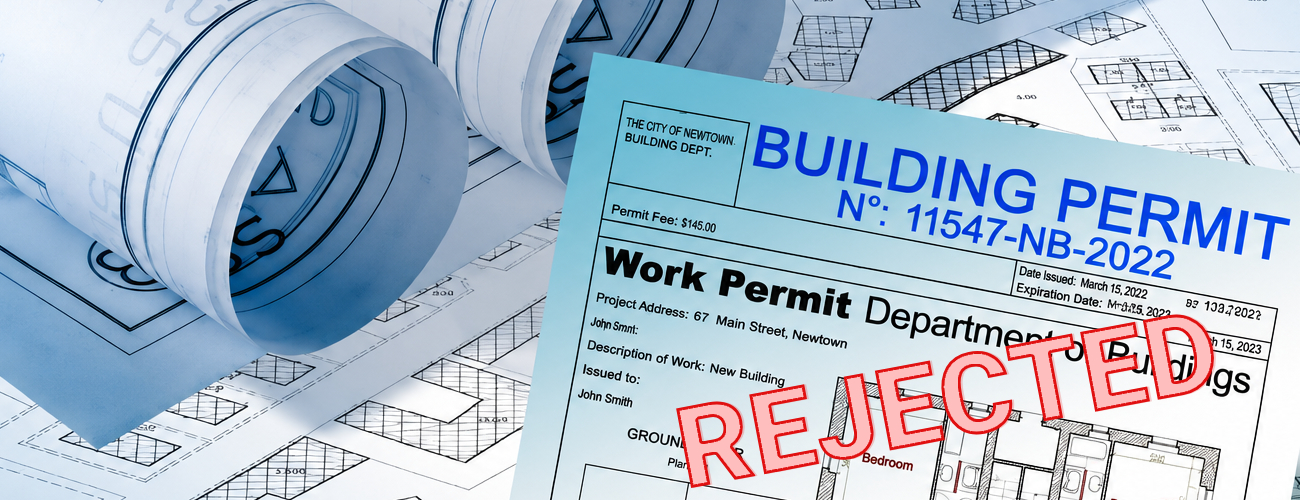
Getting a building permit should be a simple part of the construction process. Yet, many property owners and developers end up dealing with repeated revisions, long delays, and rejected applications. A permit rejection does more than slow down a project.
It can increase costs, disrupt construction schedules, and create problems with contractors, investors, and project timelines. In many cases, the issue is not the project itself. It is the way the application was prepared and submitted.
The good news is that most permit rejections can be avoided. Simple mistakes like missing documents, zoning conflicts, incomplete plans, or code compliance issues are often the main reason applications get denied.
In this guide, we will explain the most common building permit rejection reasons and practical ways to avoid them. With the right preparation, you can improve your chances of faster approval and keep your project moving forward with fewer setbacks.
Table of Contents
Key Takeaways
- Incomplete applications are one of the most common causes of approval delays.
- Missing documents, inaccurate plans, and outdated information can lead to repeated revisions.
- Zoning conflicts and code compliance issues often create unexpected setbacks during review.
- Clear communication between project teams, consultants, and reviewers can help prevent unnecessary problems.
- Careful planning before submission can save time, reduce costs, and improve project timelines.
- Reviewing local requirements early helps avoid avoidable mistakes later in the process.
- Organized documentation and accurate drawings can improve the chances of faster approval.
- Professional guidance may help simplify complex projects and reduce delays.
Why Permit Applications Get Rejected So Often
Permit rejections are more common than most people expect. This is not because projects are flawed. It is usually because the application does not meet the city’s review standards.
Every permit goes through a detailed review process. City officials check for safety, zoning compliance, and code requirements. They also look for clarity. If something is missing or unclear, they cannot approve it.
In many cases, reviewers are not trying to reject your application. They are trying to protect public safety and ensure everything follows local rules. That said, there is a pattern behind most rejections. Once you understand it, the process becomes much easier.
The Real Goal of Permit Reviewers
Permit reviewers follow a clear checklist. Their job is not to slow you down. Their job is to confirm that your project is safe, legal, and clearly documented.
Here is what they focus on:
Safety compliance: The structure must meet all safety standards. This includes fire safety, structural integrity, and accessibility.
Code adherence: Every project must follow building codes. These codes change over time, so outdated plans can cause issues.
Clear and complete plans: Reviewers rely on your documents. If your plans are unclear, they cannot approve them.
Think of it this way. Your application is your communication with the city. If that communication is incomplete, the review process stops.
The Most Common Pattern Behind Rejections
Across different cities and project types, one issue shows up again and again: incomplete or unclear submissions.
Applicants often assume that basic documents are enough. However, permit reviewers expect a full package. Missing even one key detail can trigger a rejection or a request for revisions.
Here is a simple breakdown of what typically goes wrong:
| Issue Type | What Happens | Result |
|---|---|---|
| Missing documents | Key files are not included | Immediate rejection |
| Unclear drawings | Plans lack detail or labels | Review delays |
| Inconsistent data | Information does not match across documents | Request for correction |
| Outdated forms | Old versions of applications are used | Application not accepted |
As you can see, most of these issues are preventable. They come down to preparation, not complexity.
Incomplete or Missing Documentation
If there is one reason that stands above all others, it is this: incomplete documentation. This is the most common cause of permit rejection across all types of projects. It affects small residential jobs and large commercial developments alike. When a reviewer opens your application, they expect a complete package. If anything is missing, the process stops right there.

What “Incomplete” Actually Means
Many applicants think their submission is complete. However, from a reviewer’s perspective, even small gaps can be a problem.
Here are common examples of what “incomplete” looks like:
Missing site plans
No engineer or architect stamp
Incomplete application forms
Lack of structural calculations
No clear project description
Even one missing item can delay the entire review.
To make this clearer, here is a quick checklist:
| Required Document | Purpose | What Happens If Missing |
|---|---|---|
| Site plan | Shows layout and property details | Application rejected |
| Construction drawings | Explains design and structure | The review cannot proceed |
| Engineer/architect stamp | Confirms compliance and safety | Application flagged |
| Calculations | Proves structural integrity | Delays or rejection |
| Completed application form | Basic requirement | Not processed |
This is why preparation matters so much. A complete submission saves weeks, sometimes months.
How to Avoid This
Avoiding this issue is simple in theory, but it requires discipline. Start with a checklist. Before you submit anything, confirm that every required document is included. Do not rely on memory. Use a written list.
Next, review your package as if you are the reviewer. Ask yourself:
Do all documents match the others?
Are all sections filled out?
Are signatures and stamps included?
Finally, consider working with professionals. Permit expeditors and consultants deal with these requirements every day. They know what cities expect and can catch issues early.
Incorrect or Inconsistent Plans and Drawings
After incomplete documentation, the next major issue is problems with plans and drawings. Your drawings are the core of your application. They tell the city what you plan to build and how it will function. If these plans are incorrect or inconsistent, the reviewer cannot trust them. That leads to delays, revisions, or rejection.
Common Drawing Mistakes
Many drawing errors are simple, but they have a big impact.
Here are some of the most common ones:
Conflicting dimensions between plans
Missing labels or notes
Lack of detail in key areas
Incorrect scale
Missing sections or elevations
These issues may seem minor. However, for a reviewer, they raise serious concerns.
Why Inconsistency Gets You Rejected
Consistency is critical in permit applications. Every document should support the others. For example, if your floor plan shows one dimension and your elevation shows another, the reviewer cannot determine which is correct. This creates uncertainty, and uncertainty leads to rejection.
Here is a simple example:
| Plan Type | Shown Measurement | Issue |
|---|---|---|
| Floor plan | 20 feet wide | |
| Elevation drawing | 18 feet wide | Conflict between documents |
Even small mismatches like this can stop the approval process.
Example Issues You Should Watch For
To avoid problems, pay attention to these common inconsistencies:
Floor plans do not match elevations
Site plans conflict with building layouts
Notes are missing or unclear
Measurements differ across sheets
The fix is straightforward. Review all drawings together, not separately. Check for alignment across every document. Also, use clear labels and detailed notes. The easier your plans are to understand, the smoother the review process will be.
Not Following Local Zoning and Regulations
Zoning is one of the most overlooked parts of the permit process. Yet, it is also one of the fastest ways to get rejected. Many applicants focus on design first. They invest time in drawings and layouts. However, they forget to confirm if the project is even allowed on that property.
Every city has its own zoning rules. These rules control how land can be used and what can be built. If your project does not meet these rules, the application will not move forward.
Common Zoning Issues That Cause Rejection
Zoning problems are usually clear. Still, they are often discovered too late.
Here are some of the most common issues:
Setback violations: The building is too close to property lines.
Height restrictions exceeded: The structure is taller than allowed.
Wrong land use: The property is not approved for that type of project.
Parking requirements not met: Not enough parking spaces included in the plan.
Density limits exceeded: Too many units or structures on the lot.
These issues are not minor. In most cases, they lead to immediate rejection or require major redesign.
Why Zoning Issues Lead to Immediate Rejection
Zoning is a legal requirement. It is not flexible in most cases. If your project does not meet zoning rules, the city cannot approve it. Even if your design is perfect, it will not pass review.
Here is a quick breakdown:
| Zoning Issue | What It Means | Outcome |
|---|---|---|
| Setback violation | Too close to boundaries | Rejection or redesign |
| Height violation | Exceeds allowed height | Plan revision required |
| Land use conflict | Not allowed use | Application denied |
| Parking shortage | Does not meet minimum spaces | Delays and corrections |
This is why zoning should always come before design. It sets the limits for everything else.
How to Avoid Zoning Problems
The best way to avoid zoning issues is to start with research.
Before you design anything, confirm:
What is the zoning classification of the property
What uses are allowed
What are the height and setback limits
Any special overlays or restrictions
If the rules are unclear, do not guess. Reach out to the local planning department or work with a consultant. In many cases, a quick zoning check can save weeks of redesign later.
Missing Supporting Documents and Approvals
A complete permit application often requires more than just drawings and forms. Many projects need additional reports and approvals from other departments. This is where many applications fall short. Applicants submit the main documents but forget the supporting ones. As a result, the review process stops until everything is provided.
Examples of Supporting Documents You May Need
The exact requirements depend on the project. However, some documents are commonly required:
Environmental impact reports
Fire department approval
Soil or geotechnical reports
Energy compliance documents
Drainage or grading plans
Each of these plays a role in how the city evaluates your project.
Why These Documents Are Often Missed
There are a few common reasons:
Applicants assume basic documents are enough
Requirements vary by project and location
Some approvals must come from other departments first
Because of this, missing documents are easy to overlook.
Here is a simple reference table:
| Supporting Document | Purpose | Impact If Missing |
|---|---|---|
| Fire approval | Confirms fire safety compliance | Review paused |
| Soil report | Evaluates ground conditions | Structural concerns |
| Environmental report | Assesses environmental impact | Delay or rejection |
| Energy compliance | Meets efficiency standards | Application incomplete |
As you can see, these are not optional items. They are critical for approval.
Quick Checklist Before Submission
To avoid delays, use this quick checklist:
Mechanical plans included
Electrical layouts complete
Plumbing plans submitted
Required reports attached
External approvals obtained
Taking a few extra hours to confirm these details can save weeks in the review process.
Non-Compliance with Building Codes
Building codes are at the core of every permit review. They ensure that structures are safe, functional, and built to standard. If your project does not meet code requirements, it will not be approved. It is that simple.

Common Code Violations
Code violations can happen in many ways. Some are technical, while others are due to missing details.
Here are some of the most common issues:
Fire safety requirements not met
Improper exit or egress design
Structural elements not compliant
Accessibility standards ignored
Electrical or plumbing code violations
These issues can appear in both small and large projects.
Example Problems That Lead to Rejection
To understand this better, consider a few examples:
A building without proper emergency exits
Missing fire-rated walls where required
No calculations for load-bearing structures
Incorrect stair dimensions
Even one of these issues can delay approval.
Here is a quick overview:
| Code Issue | Why It Matters | Result |
|---|---|---|
| Fire safety gap | Risk to occupants | Immediate correction required |
| Structural error | Unsafe design | Rejection or redesign |
| Missing egress | Emergency risk | Approval denied |
| Accessibility issue | Legal non-compliance | Delays and revisions |
How to Stay Code-Compliant
The best approach is to plan for compliance from the start.
Here are a few practical steps:
Work with licensed architects and engineers
Use updated building codes, not outdated ones
Double-check critical areas like exits and fire safety
Include all required calculations and details
Also, review your plans carefully before submission. Small mistakes can lead to major delays.
Poorly Prepared or Outdated Application Forms
Application forms may seem simple. However, they are often the first point of failure in the permit process. Many rejections happen before the review even begins. The reason is basic—forms are incomplete, incorrect, or outdated. Even if your plans are perfect, a flawed application form can stop everything.
Common Form Errors That Cause Rejection
These mistakes are easy to make, but they create immediate issues:
Missing required fields
Incorrect property details
Mismatched information across documents
Missing signatures
Using outdated versions of forms
These errors may seem small. Still, they signal carelessness to the reviewer.
Why Form Accuracy Matters
The application form is not just paperwork. It connects all parts of your submission. If the form says one thing and the drawings say another, the reviewer cannot proceed. This creates confusion and delays.
Here is a quick breakdown:
| Form Issue | What It Causes | Outcome |
|---|---|---|
| Missing fields | Incomplete submission | Application rejected |
| Wrong property info | Data mismatch | Review delayed |
| No signature | Not legally valid | Not processed |
| Outdated form | Does not meet current requirements | Returned application |
As shown above, these issues are avoidable. They require attention, not expertise.
Simple Fixes That Make a Big Difference
To avoid problems with forms:
Always download the latest version from the city website
Fill out every required field
Double-check names, addresses, and project details
Make sure all signatures are included
Before submission, review the form alongside your drawings. Everything should match clearly.
Lack of Detail or Clarity in Project Scope
One common issue is unclear project descriptions. Many applicants assume that drawings alone are enough. In reality, reviewers need a clear explanation of what you are building. If your scope is vague, the reviewer has to guess. That leads to delays or rejection.
What Reviewers Expect to See
A clear project scope should answer basic questions:
What is being built or modified?
Where is the work taking place?
What is the purpose of the project?
What changes are being made to the structure?
Without these details, your application feels incomplete.
Problems Caused by Vague Applications
When the scope is unclear, several issues arise:
Reviewers request more information
Multiple revision cycles begin
Approval timelines increase
In some cases, the application may be rejected outright.
Here is a simple comparison:
| Description Type | Example | Result |
|---|---|---|
| Vague scope | “Renovation work” | The reviewer asks for clarification |
| Clear scope | “Interior renovation of 1,500 sq ft office, including electrical and plumbing updates” | Faster review |
Clear communication saves time. It also builds trust with the reviewer.
How to Write a Clear Project Description
To improve your scope:
Be specific about the work
Include size, location, and purpose
Mention all systems involved (electrical, plumbing, structural)
Avoid generic terms
Think of your description as a summary of your entire project. If someone reads only that section, they should understand what you are doing.
Ignoring Local Permit Requirements
Every city has its own permit process. Requirements vary by location, project type, and scope. Ignoring these differences is a common mistake. Many applicants assume the process is the same everywhere. It is not.
Why Local Requirements Matter
Local authorities set their own rules. These include:
Required documents
Application formats
Review procedures
Permit types
If you submit the wrong information, your application will not move forward.
Common Mistakes Applicants Make
Here are some frequent issues:
Applying for the wrong permit type
Missing required documents
Not following submission guidelines
Ignoring local checklists
These mistakes often lead to delays or rejection.
How to Stay on Track
To avoid these problems:
Review the city’s official permit guidelines
Use their checklist as a reference
Confirm the correct permit type before applying
Contact the department if anything is unclear
Taking time to understand local requirements can prevent major setbacks.
Errors in Site Plans
Site plans are one of the most important parts of your application. They show how your project fits within the property. If the site plan is incorrect or incomplete, the reviewer cannot evaluate zoning, layout, or compliance.

Common Site Plan Issues
Many site plans fail due to missing or incorrect details:
Incorrect scale
Missing property lines
No setback measurements
Utilities not shown
Driveways or access points missing
These issues make it difficult for the reviewer to assess the project.
Why Site Plans Are Critical
Site plans provide a full picture of the property. They help reviewers understand:
Building placement
Distance from boundaries
Access and circulation
Utility connections
Without this information, approval is not possible.
How to Improve Your Site Plan
Here are a few simple tips:
Use an accurate scale and measurements
Clearly label all elements
Include setbacks, utilities, and access points
Ensure consistency with other drawings
A well-prepared site plan speeds up the review process and reduces back-and-forth corrections.
Poor Communication with Permit Authorities
Communication plays a bigger role than most people realize. Even a strong application can face delays if communication breaks down. Permit reviewers often provide comments or request changes. How you respond can affect your timeline.
Common Communication Mistakes
These issues happen frequently:
Ignoring review comments
Delayed responses
Providing incomplete answers
Not asking questions when confused
These actions slow down the process.
Why Communication Matters
The permit process is not one-sided. It is a back-and-forth exchange. If you respond quickly and clearly, your application moves forward. If not, it gets stuck.
Here is a quick overview:
| Communication Issue | Impact | Result |
|---|---|---|
| Slow response | Review paused | Delays |
| Ignored comments | Issues unresolved | Rejection risk |
| Incomplete reply | More questions | Longer timeline |
Best Practices for Better Communication
To keep things moving:
Respond to comments as soon as possible
Address every point clearly
Provide updated documents when needed
Stay professional and direct
Good communication can reduce review time and improve your chances of approval.
Starting Work Before Permit Approval
This mistake is more common than you might think. Many property owners begin work early to save time. However, this often creates bigger problems. Starting construction without approval does not speed things up. In most cases, it leads to penalties, delays, and even permit rejection.
Why This Is a Major Mistake
Permit approval is not just a formality. It is a legal requirement.
When you start work without approval:
The city may issue a stop-work order
Inspectors may flag the project
You may need to undo completed work
This creates more cost and stress than waiting for approval.
Real Consequences You Should Know
Here is what can happen if you move forward too early:
| Action Taken | Immediate Result | Long-Term Impact |
|---|---|---|
| Start construction early | Stop-work notice issued | Project delays |
| Ignore the permit process | Fines or penalties | Legal issues |
| Build without approval | Work may need removal | Increased costs |
These are not rare situations. They happen often, especially on fast-moving projects.
What You Should Do Instead
The solution is simple:
Wait until your permit is approved
Plan your project timeline realistically
Use the waiting period to prepare materials and schedule
A short delay at the start can prevent major setbacks later.
Quick Summary of All Common Permit Rejection Reasons
At this point, you have seen the most common reasons permits get rejected. Most of them are preventable with the right preparation. Here is a quick summary to keep everything in one place:
Top 10 Reasons Permits Get Rejected
Incomplete or missing documents
Incorrect or inconsistent drawings
Zoning violations
Missing supporting approvals
Building code non-compliance
Incorrect or outdated forms
Vague project scope
Ignoring local requirements
Site plan errors
Poor communication with reviewers
Each of these issues can delay your project. Together, they create serious setbacks.
Simple Overview Table
| Category | Main Issue | Solution |
|---|---|---|
| Documentation | Missing items | Use a checklist |
| Plans | Errors or conflicts | Review carefully |
| Zoning | Rule violations | Verify before design |
| Codes | Non-compliance | Follow current standards |
| Communication | Delays or confusion | Respond quickly |
This table gives you a quick reference before submission. It is a simple way to catch issues early.
How to Get Your Permit Approved Faster
Now that you know what causes rejections, the next step is improving your process. Getting a permit approved faster is not about rushing. It is about being prepared and accurate from the start.
Pre-Submission Checklist
Before you submit your application, go through this checklist:
All required documents are included
Drawings are complete and consistent
Zoning rules are verified
Building codes are followed
Forms are filled out correctly
Supporting reports are attached
Taking time here can save weeks later.
Pro Tips That Make a Real Difference
Experienced professionals follow a few simple practices:
Review everything twice before submission
Keep documents clear and well-organized
Address potential issues early
Stay updated with local requirements
Small improvements in preparation lead to faster approvals.
A Simple Workflow You Can Follow
Here is a clear step-by-step approach:
| Step | Action | Benefit |
|---|---|---|
| Research | Understand zoning and rules | Avoid major issues |
| Prepare | Gather all documents | Complete submission |
| Review | Check for errors | Fewer revisions |
| Submit | Send an accurate application | Smooth process |
| Respond | Address comments quickly | Faster approval |
This process keeps things simple and organized.
When to Hire a Permit Expediting Service
Some projects are straightforward. Others are more complex and require extra attention. If your project falls into the second category, working with professionals can make a big difference.
Signs You May Need Help
You should consider hiring experts if:
Your project involves multiple approvals
You are working under a tight deadline
You have faced rejection before
The project is large or complex
These situations often require deeper knowledge of the process.
Benefits of Professional Support
Permit expeditors and consultants can:
Identify issues before submission
Handle communication with city departments
Reduce delays and revisions
Improve approval timelines
They bring experience that helps avoid common mistakes.
Final Thoughts: Avoid Delays and Get Approved the First Time
Permit rejections can feel frustrating. However, they are usually preventable. Most issues come down to preparation, clarity, and attention to detail. When your application is complete and accurate, the process becomes much smoother.
Focus on the basics:
Provide complete documentation
Ensure your plans are clear and consistent
Follow zoning and code requirements
Communicate effectively with reviewers
Taking these steps puts you in a strong position from the start.
Need Help Avoiding Permit Rejections?
At JDJ Consulting, we help property owners, developers, and businesses get permits approved faster. From zoning research to full application preparation, our team handles the details so you do not have to.
If you want to avoid delays and move your project forward with confidence, reach out to us today.
- Phone number: (818) 793-5058
- Email: sales@jdj-consulting.com
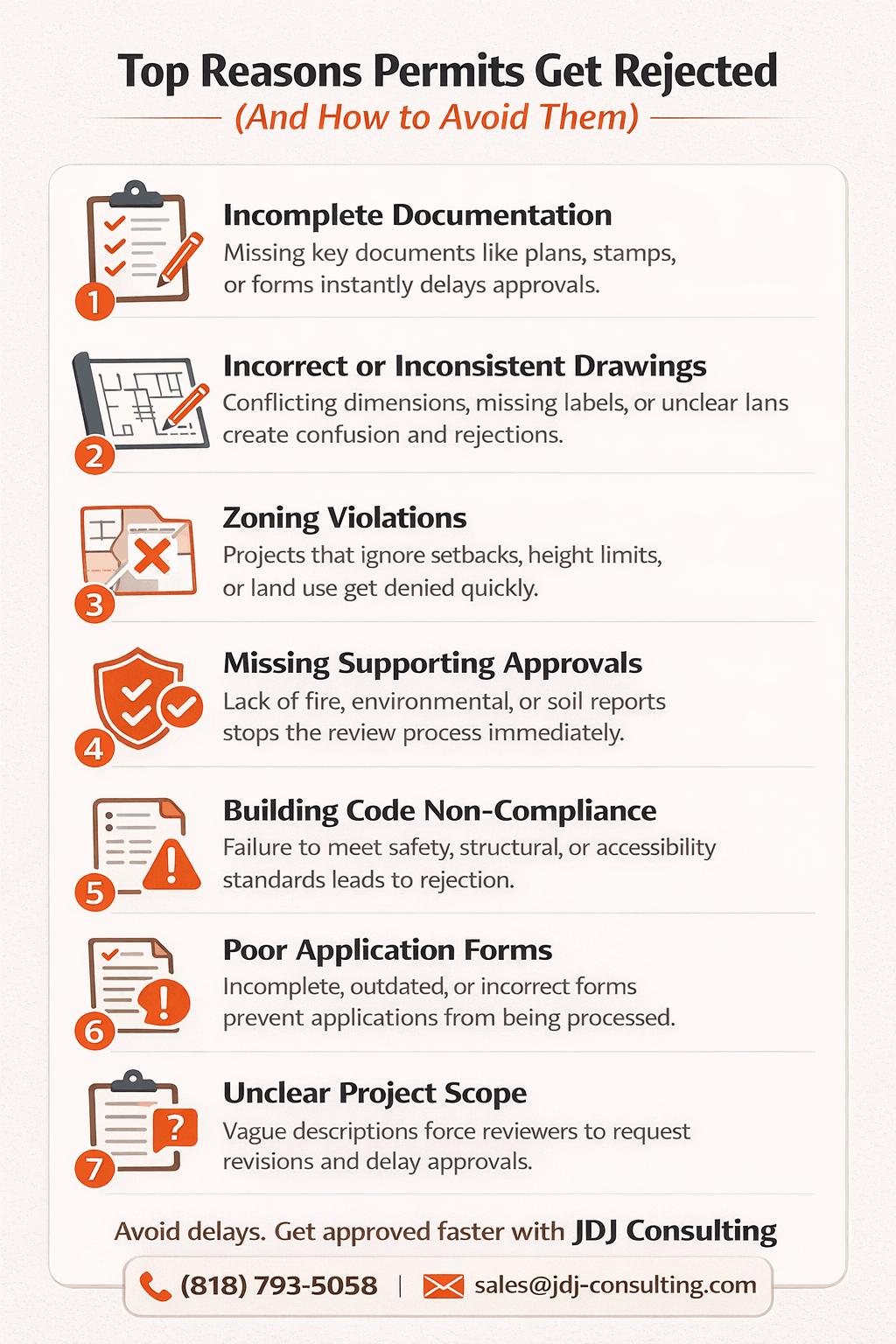
Top reasons permits get rejected—and how to avoid delays with expert guidance from JDJ Consulting.