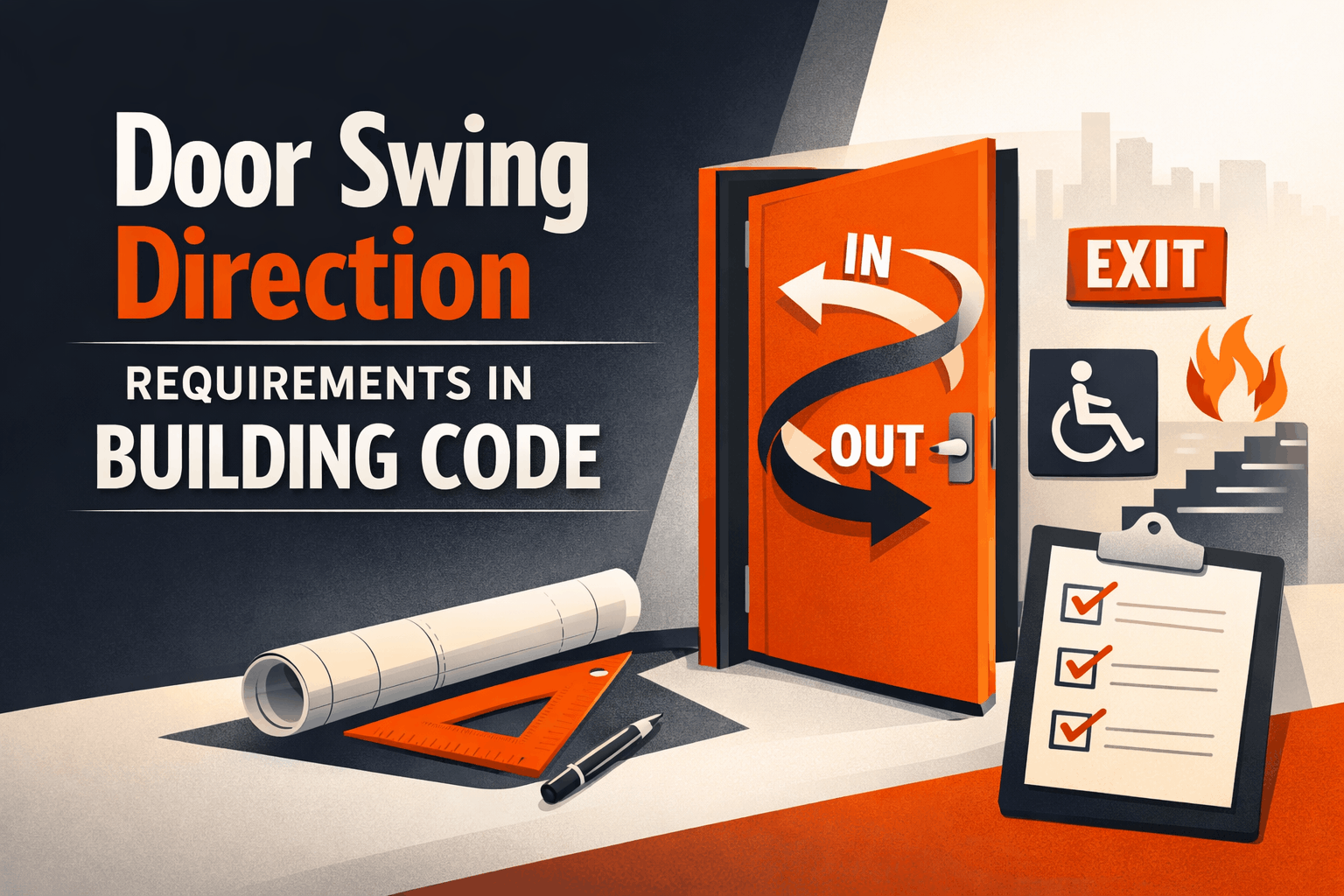
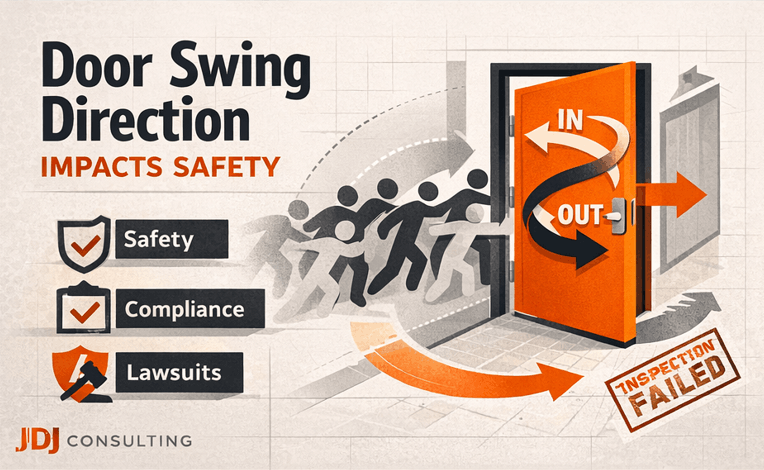
Doors seem simple. They open and close. But in construction, door swing direction is a serious code issue. It affects safety, accessibility, inspections, and even lawsuits.
If a door swings the wrong way, a project can fail inspection. Worse, it can create a life safety hazard during an emergency.
In this guide, we will explain door swing requirements in plain language. You will learn how building codes regulate door direction, when doors must swing outward, and what applies to homes versus commercial buildings.
Let’s start with the basics.
Why Door Swing Direction Matters in Building Code
Door swing direction is not about preference. It is about safety, function, and legal compliance. Building codes focus heavily on how people exit a space. During a fire or emergency, doors must allow fast movement without obstruction. That is where swing direction becomes critical.
Safety First — How Door Swing Impacts Emergency Egress
In many commercial buildings, doors must swing in the direction of egress. That means they must open outward, toward the path people use to exit.
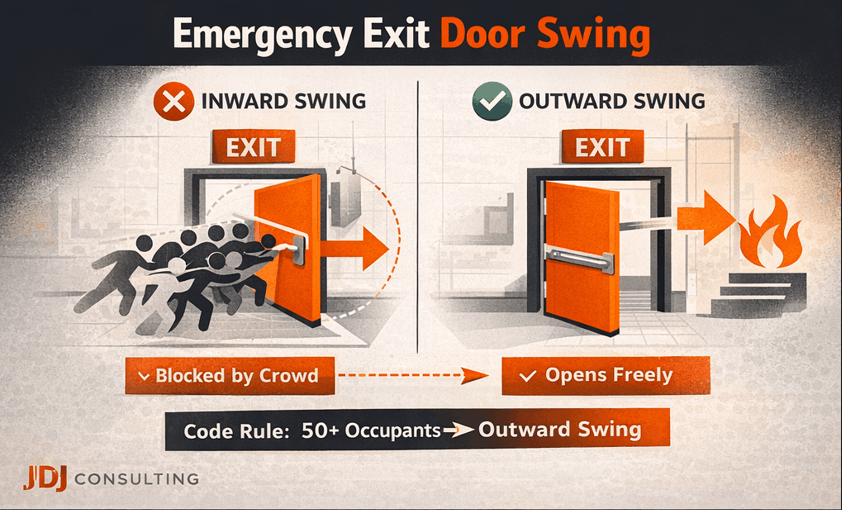
Why? Because when a crowd pushes toward an exit, an inward swinging door can become blocked. People can press against it and prevent it from opening. This has caused serious tragedies in the past.
Most building codes require outward swing when:
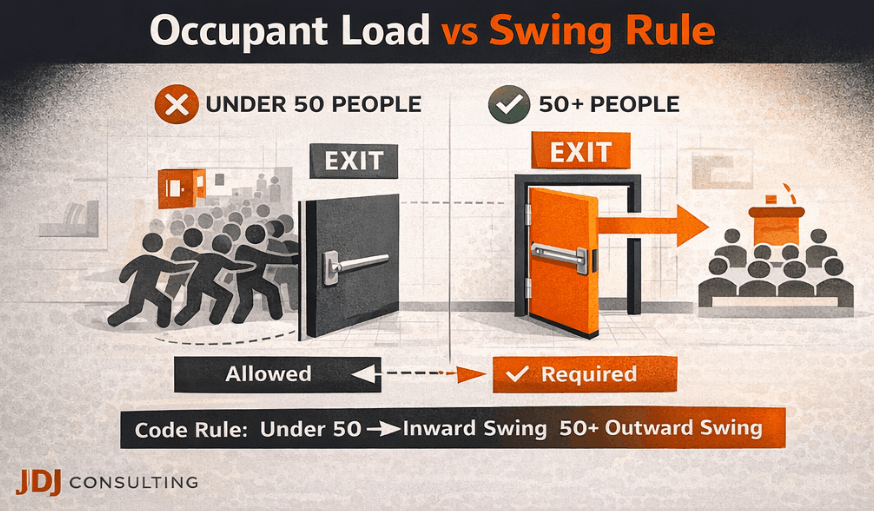
The occupant load is 50 people or more
The space is classified as assembly (restaurants, churches, theaters)
The area is considered high hazard
Residential homes usually do not require outward-swinging front doors. However, egress doors must still meet size and clearance rules.
Here is a simple breakdown:
| Building Type | Occupant Load | Required Swing Direction | Reason |
|---|---|---|---|
| Restaurant or church | 50+ | Outward | Fast crowd evacuation |
| Office under 50 occupants | Under 50 | Either (usually inward) | Lower risk |
| Single-family home | N/A | Typically inward | Space efficiency |
| High hazard industrial | Any | Outward | Life safety |
Even when not required, many designers still choose outward swing for added safety in certain commercial spaces.
Accessibility and ADA Considerations
Door swing is also regulated under accessibility standards. The Americans with Disabilities Act (ADA) does not always require a specific swing direction. However, it requires proper clearance on both the pull and push sides of the door. If a door swings into required maneuvering space, it may violate accessibility rules.
For example:
A wheelchair user needs clear floor space beside the latch side.
The minimum clear opening width is typically 32 inches.
A 60-inch turning radius must be maintained in many accessible rooms.
If the door swing blocks that space, the layout fails compliance. This is common in small restrooms. Designers often place fixtures too close to the door arc. During inspection, this becomes a correction notice. Proper planning prevents that issue.
Structural and Space Planning Implications
Door swing also affects everyday usability. Consider these common problems:
A bathroom door hits the toilet.
A bedroom door blocks a closet.
A mechanical room door cannot fully open because of equipment clearance.
An electrical panel has a door swinging into its required working space.
Electrical panels, for example, require 36 inches of clear working space in front. A door cannot reduce that clearance. That is why door placement should be reviewed early in design, not after framing.
International Building Code (IBC) Door Swing Requirements
The International Building Code (IBC) applies mainly to commercial buildings and multi-family projects. It includes clear rules about when doors must swing outward. Understanding these rules helps avoid inspection delays.
When Doors Must Swing in the Direction of Egress
Under the IBC, doors serving certain occupancies must swing in the direction of travel.
This typically applies when:
The occupant load is 50 or more
The space is classified as assembly occupancy
The space contains high hazard materials
Examples include:
Churches
Schools
Restaurants
Conference rooms
Auditoriums
If 50 people or more are expected in a room, the exit door must swing outward. This is one of the most common code violations in small commercial remodels. Business owners often convert a space without recalculating occupant load. Then the inspector requires door replacement before approval.
Occupant Load and Door Swing Rules
The occupant load determines many life safety rules, including door width, number of exits, and swing direction. Occupant load is calculated based on square footage and the use of the space.
For example:
Assembly without fixed seats may require 15 square feet per person.
Office areas may use 150 square feet per person.
If your calculation reaches 50 occupants or more, the door must swing outward.
Here is a simplified comparison:
| Space Type | Square Feet | Occupant Load Factor | Estimated Occupants | Swing Required |
|---|---|---|---|---|
| 750 sq ft restaurant dining | 15 sq ft/person | 50 occupants | Yes | Outward |
| 3,000 sq ft office | 150 sq ft/person | 20 occupants | No | Flexible |
| 1,200 sq ft classroom | 20 sq ft/person | 60 occupants | Yes | Outward |
This shows how quickly a small space can trigger outward swing requirements.
Panic Hardware and Exit Devices
When occupant load reaches certain thresholds, panic hardware is also required. Panic hardware allows a door to open when pressure is applied to a horizontal bar. It prevents doors from being locked against egress.
These devices are required in:
Assembly occupancies
Educational facilities
Certain high hazard areas
If panic hardware is required, the door must swing outward. Inward swing doors cannot function properly with panic devices in emergency crowd situations. This detail is often overlooked in tenant improvements.
International Residential Code (IRC) Door Swing Guidelines
The International Residential Code (IRC) applies to single-family homes and duplexes. It is different from the International Building Code. The rules are less strict in some areas, but safety still comes first.
In residential construction, door swing direction is usually more flexible. However, there are still requirements for egress, landings, fire separation, and clearance.
Let’s break it down clearly.
Front Entry Door Requirements
Every home must have at least one egress door. This is typically the front door.
Under the IRC, the required egress door must:
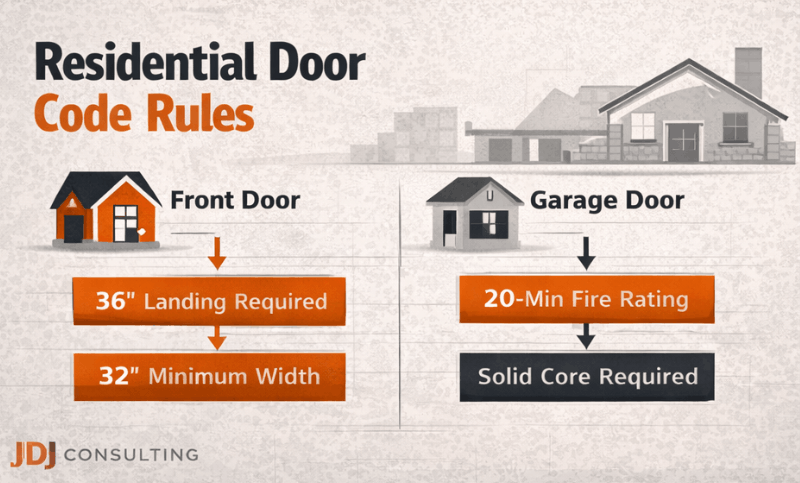
Provide a clear opening width of at least 32 inches
Provide a minimum height of 78 inches
Open from the inside without a key or special knowledge
The code does not require the front door to swing outward. Most residential front doors swing inward for security and weather protection. However, there are landing requirements that affect swing direction.
There must be a landing on each side of the exterior door. The landing must:
Be at least as wide as the door
Extend at least 36 inches in the direction of travel
If the door swings outward, the landing must still provide safe footing. In cold climates, snow buildup can also influence design decisions. In short, while inward swing is common in homes, proper landing depth is what inspectors focus on most.
Bedroom and Interior Door Rules
Interior doors in homes are rarely regulated by swing direction alone. Instead, the code focuses on safe egress and minimum sizes. For bedrooms, emergency escape is usually provided by a window, not the door. That means the bedroom door can swing inward or outward unless local rules say otherwise.
However, most bedroom doors swing inward for these reasons:
Better hallway clearance
Reduced obstruction in narrow corridors
Standard residential practice
One important consideration is hallway width. A door that swings into a required hallway clearance can create a problem.
Hallways in homes must generally be at least 36 inches wide. If multiple doors swing into that space at once, it can feel cramped. While not always a direct violation, poor layout can create usability issues.
Closets and small storage rooms are even more flexible. Many use bi-fold or sliding doors to avoid swing conflicts.
Garage-to-House Door Code Rules
The door between a garage and the home is one of the most regulated residential doors.
This door must:
Be at least 1-3/8 inches thick solid wood
Or be a 20-minute fire-rated door
Or be steel
The purpose is to slow fire spread from the garage into the living space. The IRC does not require a specific swing direction for this door. However, many builders choose inward swing toward the house.
Why? Because it prevents the door from blocking garage vehicle space. It also avoids interference with garage storage systems.
Some jurisdictions also require:
Self-closing hinges
Tight weatherstripping
Proper door sealing
Here is a quick summary of key IRC door considerations:
| Door Location | Swing Required? | Special Requirements |
|---|---|---|
| Front entry | No (usually inward) | 32″ clear width, landing required |
| Bedroom | No | Must allow egress via window |
| Bathroom | No | Must not block required fixture clearance |
| Garage to house | No | Fire-rated or solid core required |
Even though the IRC allows flexibility, practical design still matters. Poor swing planning can create daily frustration for homeowners.
ADA Door Swing Requirements Explained Simply
When a building is open to the public, accessibility laws apply. The Americans with Disabilities Act (ADA) sets standards to ensure people with mobility limitations can enter and move through a space safely.
Unlike fire code, ADA rules do not always demand a specific swing direction. Instead, they focus on clearance and maneuvering space. That said, door swing can easily create compliance problems if not planned carefully.
Let’s break it down in simple terms.
Minimum Clearance on Pull Side and Push Side
The ADA requires enough clear space around a door so a wheelchair user can approach, open, and pass through it.
The clear width of the door opening must be at least 32 inches when measured from the face of the door to the stop with the door open at 90 degrees. However, width is only part of the rule. There must also be proper latch-side clearance. This space allows someone to pull the door open without backing up awkwardly.
Here is a simplified table of common ADA clearance requirements:
| Door Approach Type | Minimum Latch-Side Clearance | Notes |
|---|---|---|
| Pull side, front approach | 18 inches | Most common requirement |
| Push side, front approach | 12 inches | If closer and latch present |
| Clear opening width | 32 inches minimum | Door open at 90 degrees |
If a door swings into this required clearance area, it may violate ADA standards.
This happens often in:
Small retail shops
Medical exam rooms
Office restrooms
Renovated tenant spaces
Even a few inches of error can cause inspection delays.
Maneuvering Space for Wheelchairs
Beyond latch clearance, ADA standards require maneuvering space. In many accessible rooms, a 60-inch turning radius must be maintained. This allows a wheelchair to turn around fully.
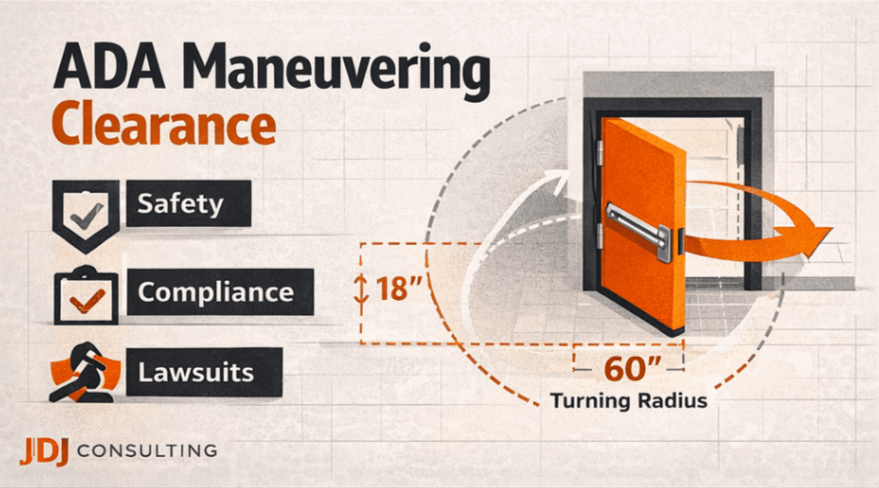
If a door swings into that turning circle and reduces the clear floor space, the layout is not compliant. This is common in accessible restrooms.
For example:
The toilet requires side clearance.
The sink requires knee clearance.
The door swing cannot overlap these required spaces.
In tight layouts, designers often switch to:
Out-swing doors
Sliding doors
Pocket doors (if compliant hardware is used)
Out-swing restroom doors are common in commercial spaces because they protect interior clearance. However, outward swing must not block corridor egress. Everything works together.
Automatic Doors and Compliance Options
In some buildings, especially healthcare facilities and larger commercial spaces, automatic doors help meet accessibility standards. Automatic or power-assisted doors reduce the force needed to open a door.
ADA limits opening force for interior hinged doors to 5 pounds maximum. Heavy doors without closers adjusted properly often fail this test.
Automatic operators are commonly used in:
Hospitals
Government buildings
Large office entrances
Grocery stores
They are not always required. But in high-traffic public buildings, they improve accessibility and reduce complaints. Another key point is hardware height.
Door handles, pulls, latches, and panic devices must typically be mounted between 34 and 48 inches above the finished floor. Round door knobs are not compliant in most public buildings. Lever handles are required because they are easier to operate.
Common ADA Door Swing Mistakes
Here are issues inspectors frequently flag:
Door swings into required wheelchair turning space
Not enough latch-side clearance
Clear opening less than 32 inches
Door closer requires too much force
Panic hardware mounted too high
These are preventable mistakes. Planning door swing early in the design phase saves time and money later.
Door Swing Rules for Commercial Buildings
Commercial buildings follow stricter rules than single-family homes. Life safety drives most decisions. The larger the occupant load, the tighter the requirements.
Door swing is closely tied to egress capacity, fire rating, and hardware type. Even small mistakes can delay inspections or require door replacement.
Let’s go through the most common commercial scenarios.
Assembly Occupancies (Churches, Restaurants, Event Spaces)
Assembly occupancies include places where people gather. Examples include:
Restaurants
Churches
Banquet halls
Conference rooms
Theaters
If the occupant load is 50 people or more, exit doors must swing outward in the direction of egress. This rule exists for one reason: crowd pressure. In an emergency, people move toward the exit.
If the door swings inward, it can become pinned shut by the crowd. Outward swing prevents that problem. In many assembly spaces, panic hardware is also required. The door must open with one motion, without keys or tight grasping.
Double doors are common in larger venues. In that case:
At least one leaf must provide the required clear width.
If both leaves are active, hardware must allow full egress capacity.
Here’s a simplified overview:
| Assembly Space | Occupant Load | Door Swing Required | Panic Hardware Required |
|---|---|---|---|
| Small café | Under 50 | Flexible | Not usually |
| Restaurant dining hall | 50+ | Outward | Yes |
| Church sanctuary | 50+ | Outward | Yes |
| Banquet facility | 100+ | Outward | Yes |
Many renovation projects fail inspection because owners did not update door swing after increasing seating capacity.
Schools and Educational Buildings
Educational buildings fall under specific occupancy classifications. Classrooms with 50 or more occupants must have doors that swing in the direction of egress. In many cases, that means outward into the corridor. However, corridor width becomes critical.
If a classroom door swings outward into a hallway, the corridor must still maintain required egress width. This often requires recessed door alcoves or careful layout planning. Another common issue is security hardware.
Some schools install barricade devices for lockdown situations. Many of these devices violate building and fire codes because they:
Require special knowledge to remove
Prevent free egress
Disable fire-rated door assemblies
Inspectors are strict about this. Fire-rated corridor doors must also:
Self-close
Latch properly
Maintain fire labeling
Swing direction alone is not enough. The entire assembly must function correctly.
Healthcare Facilities and Hospitals
Healthcare buildings have additional concerns. Patient safety and infection control influence door design.
In hospitals:
Patient room doors often swing inward to protect corridor space.
However, required egress paths must remain clear.
Some doors must allow quick staff access during emergencies.
Wider door openings are common in healthcare to allow stretcher access. Clear width may exceed the 32-inch minimum required elsewhere.
Automatic doors are frequently used at:
Main entrances
Emergency departments
Surgical areas
In certain treatment rooms, door swing must not interfere with required medical equipment clearance. Because healthcare occupancies are complex, door layout should always be reviewed with both code officials and facility planners.
Mixed-Use and Tenant Improvement Projects
Commercial tenant improvements are one of the most common areas where door swing errors occur. A space may have previously been:
A retail store
A small office
A storage area
When the occupancy changes, the door swing requirement may change too.
For example:
A former office suite with 20 occupants converts into a fitness studio with 75 occupants. That triggers:
Outward swing requirement
Panic hardware
Possibly additional exit doors
Failing to reassess door swing during change of occupancy is a costly mistake.
Fire Code and Egress Door Requirements
Fire code and building code work together. While the building code focuses on construction, the fire code focuses on ongoing safety. Door swing plays a major role in both.
When inspectors review a building, they look closely at egress doors. These doors must allow people to exit quickly and safely during an emergency. Let’s clarify what that means.
What Is an Egress Door?
An egress door is a door that leads to a safe exit path. This could mean:
Directly to the outside
Into an exit corridor
Into a stairwell
Into an exit passageway
Not every door is an egress door. Storage room doors, closets, and private offices may not count unless they are part of the required exit path.
Egress doors must meet strict requirements:
They must open from the inside without keys.
They cannot require special knowledge to operate.
They must provide the required clear width.
They must swing in the direction of egress when occupant load is 50 or more.
If panic hardware is required, it must function properly and not be chained or locked. Blocking or altering an egress door is one of the fastest ways to fail a fire inspection.
Fire-Rated Door Assemblies
Some doors are required to resist fire for a specific period of time. These are called fire-rated door assemblies.
Common fire ratings include:
20-minute
45-minute
60-minute
90-minute
The rating depends on the wall and occupancy classification.
For example:
Garage-to-house doors in homes typically require a 20-minute rating or solid-core construction.
Commercial corridor doors may require 20-minute ratings.
Stairwell doors often require 90-minute ratings.
Fire-rated doors must:
Have an approved label
Self-close
Self-latch
Not be wedged open
Swing direction may also matter. For example, stairwell doors in commercial buildings usually swing into the stair enclosure. This protects the exit path and keeps corridors clear.
Here is a simplified overview:
| Door Location | Typical Fire Rating | Swing Consideration |
|---|---|---|
| Residential garage door to house | 20-minute or solid core | Usually inward |
| Commercial corridor door | 20-minute | Must not reduce corridor width |
| Stairwell door | 60–90 minute | Usually swings into stair |
| Mechanical room | Varies | Must maintain clearance |
Improper modifications, such as installing non-rated hardware or trimming the door excessively, can void the fire rating.
Common Fire Code Violations
Inspectors see the same mistakes repeatedly. Here are common door-related violations:
Door swings inward in a 50+ occupant space
Panic hardware missing or disabled
Exit door chained or locked during business hours
Door blocked by furniture or storage
Fire-rated door wedged open
Self-closing device removed or broken
Door reduces required stair or corridor width
Another common issue involves floor mats or rugs that block door swing. Even temporary obstructions can be cited. Fire marshals take egress seriously. These are life safety systems, not optional design features.
Exit Stairwell Door Rules
Stairwells are protected exit enclosures. Doors serving stairwells must:
Be fire-rated
Self-close and latch
Swing in the direction of egress travel
In most cases, this means the door swings into the stairwell. The reason is simple. If the door swings outward into a corridor, it could block evacuation traffic.
In multi-story buildings, stairwell doors are one of the most critical safety components. Improper swing direction here can prevent certificate of occupancy approval.
Why Early Planning Prevents Costly Corrections
Changing door swing after framing is expensive.
It may require:
Reframing rough openings
Replacing doors and hardware
Patching drywall
Reworking electrical or wall finishes
In commercial spaces, correcting swing direction late in construction can delay opening by weeks. The best time to verify door swing is during plan review, before permits are issued.
Door Landing and Floor Level Requirements
Door swing is only part of compliance. The floor levels and landings around the door also matter. Inspectors often check landings before anything else. If the landing depth or height is wrong, the project may fail immediately.
These rules apply to both residential and commercial buildings, though commercial standards are stricter. Let’s simplify what you need to know.
Exterior Door Landing Rules
Every required egress door must have a landing on both sides. In residential construction under the IRC:
The landing must be at least 36 inches deep in the direction of travel.
The width must be at least as wide as the door.
The landing must not slope more than allowed by code.
The floor or landing on the interior side cannot be more than 1.5 inches lower than the top of the threshold. This prevents tripping hazards.
For exterior doors, there is one exception. In many homes, the exterior landing can be lower than the threshold, but only if the door does not swing outward over stairs.
If a door swings outward and there are stairs directly outside, a proper landing is required before the first step. This rule prevents someone from stepping backward and falling down stairs while opening the door.
Here’s a simplified breakdown:
| Condition | Landing Required? | Notes |
|---|---|---|
| Interior side of egress door | Yes | 36-inch minimum depth |
| Exterior door with stairs | Yes | Landing required before steps |
| Exterior door swinging inward | More flexible | Local rules may vary |
| Commercial exit door | Yes | Strict compliance required |
Commercial buildings usually require full landing compliance on both sides, regardless of swing direction.
Threshold Height Limits
Threshold height is another detail that often causes confusion.
In residential construction:
The interior floor must not be more than 1.5 inches below the top of the threshold at required egress doors.
In commercial buildings and ADA-accessible spaces:
Thresholds generally must not exceed 1/2 inch in height.
Changes in level must be beveled if over 1/4 inch.
This is especially important for accessibility. A high threshold can create a tripping hazard and block wheelchair access. Weather protection must still be maintained. That is why many entry doors use low-profile thresholds combined with proper flashing and drainage systems.
Door Swing and Stair Safety
Door swing direction directly affects stair safety. A door must not swing over a step unless there is a proper landing. Imagine opening a door and immediately stepping onto a stair tread. That creates a serious fall risk.
For residential homes:
If the door swings outward, there must be a landing at least 36 inches deep before the first stair.
For commercial buildings:
Exit discharge areas must provide stable footing.
Doors cannot reduce required stair width.
This is commonly seen in small office renovations where a door swings outward into a narrow exterior stair landing. Inspectors often require reconfiguration.
Floor Elevation Changes in Remodels
Remodels create unique problems. When flooring is replaced, new materials can raise the finished floor height. That can reduce required door clearance or change threshold height compliance.
Common examples include:
Adding tile over existing flooring
Installing thicker hardwood
Adding carpet with heavy padding
Even small changes can affect door operation and required clearances.
During remodel planning, always verify:
Door undercut clearance
Threshold height
Landing depth
ADA bevel requirements
Common Landing and Threshold Violations
Inspectors often cite:
Landing too small (less than 36 inches)
Door swinging directly over stairs
Threshold higher than allowed
Sloped landing surface
Exterior concrete pad poured too low
These are not cosmetic issues. They are safety hazards. Correcting them after construction may require demolition and repouring concrete, which increases cost significantly.
Local Amendments and State Variations
Many people assume the building code is the same everywhere. It is not.
Most states adopt a version of the International Building Code (IBC) or International Residential Code (IRC). However, cities and counties often make amendments.
These local changes can affect:
Door swing direction
Landing requirements
Fire ratings
Hardware rules
Accessibility standards
That is why confirming local rules before construction is critical.
Why Local Codes May Override Model Codes
Model codes are a starting point. Local governments adjust them based on:
Climate conditions
Wind and hurricane risk
Seismic activity
Population density
Fire department access
For example:
In coastal or hurricane-prone regions, some jurisdictions require outward-swinging exterior doors for wind pressure resistance. An outward door can resist forced entry during storms more effectively when properly rated.
In dense urban areas, stricter fire separation rules may require additional fire-rated door assemblies. In high-rise cities, stairwell and exit door rules may be more detailed than the base IBC.
Even the occupant load threshold for certain uses may vary depending on amendments. You cannot rely only on national code summaries found online. They may not reflect your local requirements.
How to Check Your Local Building Department Requirements
Before finalizing plans, confirm the adopted code version and local amendments.
Here is a simple checklist:
Identify which code edition your jurisdiction uses (example: 2018 IBC or 2021 IRC).
Check for published local amendments.
Confirm accessibility standards adopted (ADA plus state-specific rules).
Speak with the plan review department if the project is commercial.
Many building departments publish amendments on their website. Others require direct contact. When in doubt, ask for clarification in writing. This protects you during inspections.
Working With the Authority Having Jurisdiction (AHJ)
The Authority Having Jurisdiction (AHJ) is the building official or fire marshal responsible for enforcing the code. Their interpretation matters.
Two cities using the same code edition may interpret certain door swing details differently. For example:
One jurisdiction may strictly enforce outward swing in borderline occupant load cases.
Another may allow flexibility with documented occupant calculations.
Open communication early in the design process prevents costly corrections later. During plan review, inspectors typically check:
Occupant load calculations
Egress door swing direction
Hardware type
Fire ratings
Landing compliance
If corrections are required, addressing them before construction begins saves time and money.
Why Assumptions Cause Inspection Failures
One of the most common mistakes is assuming that a previous project in another city sets the standard. Codes change every three years. Amendments change more often. A door layout that passed inspection five years ago may not pass today.
Common assumption errors include:
Thinking residential rules apply to mixed-use buildings
Ignoring change-of-occupancy triggers
Forgetting to update swing direction after increasing seating capacity
Using hardware not approved locally
Even experienced contractors verify local rules before proceeding.
When to Seek a Professional Code Review
Certain projects benefit from professional code consultation:
Change of occupancy (retail to restaurant, office to assembly)
Large tenant improvements
Healthcare or educational facilities
High occupant load assembly spaces
Multi-family residential developments
A professional review can confirm:
Proper swing direction
Required number of exits
Hardware compliance
Fire separation integrity
The cost of a review is usually far less than the cost of replacing non-compliant doors after inspection.
Common Door Swing Mistakes That Cause Inspection Failures
Most door swing violations are not complex. They happen because someone overlooked a detail during planning. The problem is not the rule. The problem is timing. Many issues are discovered after doors are installed. Let’s go through the most common mistakes inspectors see.
Swinging Into Required Clearance Areas
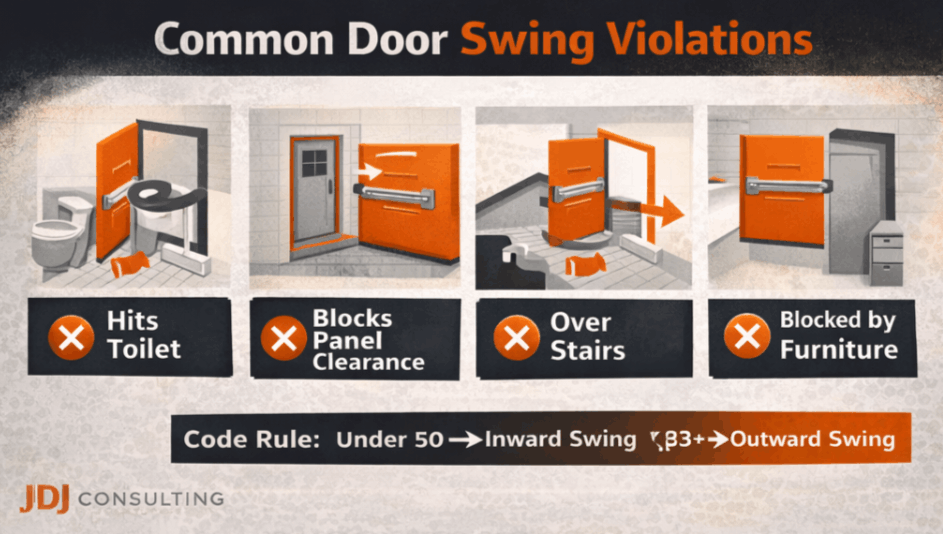
One of the biggest issues is doors swinging into spaces that must remain clear.
This includes:
Electrical panel working space (36 inches required in front)
Required corridor width
Stair landing depth
ADA turning radius in restrooms
Required fixture clearance near toilets or sinks
For example, an electrical panel must have clear working space in front of it. A door cannot swing into that 36-inch clearance area.
In ADA restrooms, the door cannot reduce the required turning circle or latch-side clearance. These conflicts usually happen in tight layouts. The solution is simple: review door arcs carefully during plan review, not after framing.
Incorrect Swing Direction for Occupant Load
This mistake is common in tenant improvement projects. A space may start as a small office. Later, it becomes:
A restaurant
A training room
A fitness studio
A church gathering space
If the occupant load reaches 50 or more, exit doors must swing outward. If the original door swings inward, it will fail inspection.
Here is a quick reminder:
| Occupant Load | Door Swing Requirement |
|---|---|
| Under 50 | Flexible (depends on occupancy) |
| 50 or more | Must swing in direction of egress |
| Assembly occupancy | Usually outward |
| High hazard occupancy | Outward required |
Failing to update door swing during occupancy changes is one of the costliest mistakes.
Blocking Doors With Furniture or Storage
Even if the door swing direction is correct, placement can create problems.
Inspectors often cite:
Exit doors blocked by shelving
Storage placed behind outward-swinging doors
Furniture reducing clear egress width
Decorative items interfering with panic hardware
In retail spaces, seasonal displays sometimes block exit discharge areas. This is a fire code violation. Egress paths must remain clear at all times, not just during inspection.
Missing or Incorrect Panic Hardware
If panic hardware is required, the door must open with one motion.
Common violations include:
Installing a standard knob instead of panic hardware
Adding secondary locks or slide bolts
Chaining doors during business hours
Installing hardware that requires tight grasping or twisting
If panic hardware is required, it must:
Be mounted at proper height
Release the latch when pressed
Not require keys for exit
Improper hardware can delay occupancy approval.
Fire-Rated Door Assembly Problems
Fire-rated doors must remain intact.
Frequent violations include:
Removing the self-closing device
Propping doors open
Painting over the fire label
Cutting the door for new hardware
Installing non-rated vision panels
If a fire-rated door assembly is modified without approval, its rating may be void. Replacing a non-compliant fire-rated door can be expensive.
Door Swing Over Stairs Without Landing
This is a serious safety issue. If a door swings outward and there are stairs immediately outside, a proper landing must be provided. Without a landing, someone could step backward and fall while opening the door.
Inspectors check this closely in:
Basement entries
Small commercial exterior exits
Renovated side entrances
Correcting this issue after concrete is poured can require demolition.
Poor Coordination Between Trades
Sometimes door swing problems are not design errors. They are coordination failures.
Examples include:
Electrical conduit installed where door hardware needs clearance
Plumbing fixtures placed inside door arc
HVAC equipment blocking mechanical room door swing
Security systems interfering with panic hardware
Clear communication between trades prevents these conflicts.
How to Avoid These Mistakes
Prevention is much easier than correction.
Before installation:
Confirm occupant load calculations.
Verify required swing direction.
Review door arcs on final floor plans.
Check landing depth and stair relationships.
Confirm hardware type and fire ratings.
During inspection preparation:
Remove obstructions from egress paths.
Test all panic hardware.
Ensure fire-rated doors self-close and latch.
Confirm ADA clearances remain intact.
Door swing compliance is manageable when addressed early.
Planning Door Swing During the Design Phase
Most door swing problems start on paper. If the layout is wrong during design, the mistake follows the project all the way to inspection. Changing swing direction after framing costs time and money. Good planning prevents that.
Let’s look at how to get it right from the beginning.
Reading Floor Plans Correctly
On architectural plans, doors are shown with an arc. That arc shows the swing direction. The hinge side is marked at one end of the door symbol. The curved line shows how the door opens.
Common mistakes when reviewing plans:
Ignoring the door arc completely
Assuming swing direction can be changed later
Overlooking conflicts with adjacent walls or fixtures
Failing to review egress path width
When reviewing a floor plan, check:
Does the door swing into required clearance space?
Does it block hallway width?
Does it interfere with plumbing fixtures?
Does it reduce stair landing depth?
Does it conflict with electrical panel clearance?
Always review the door schedule as well. The schedule confirms:
Door size
Fire rating
Hardware type
Location
A mismatch between the floor plan and door schedule can cause confusion in the field.
Using Software to Test Door Clearance
Modern design software makes door planning easier. Architects and designers often use CAD or BIM programs to model door swing. These tools help identify conflicts before construction.
Benefits of modeling door swing digitally:
Visual confirmation of clearance
Accurate occupant load calculations
ADA maneuvering space verification
Stair and landing relationship review
Three-dimensional modeling is especially helpful in:
Small restrooms
Mechanical rooms
Commercial kitchens
Medical treatment rooms
Even simple software tools can help confirm that a door arc does not overlap required clearance. For small projects, printed plans with scaled measurements can also work. The key is careful review.
Coordinating With Architects and Contractors
Door swing decisions should not be made in isolation.
They involve:
The architect
The contractor
The electrical designer
The plumbing designer
The fire protection consultant
For example:
An architect may design a door swinging outward into a corridor. However, the contractor must confirm that corridor width remains compliant after finishes are installed. Similarly, the electrical contractor must ensure panel clearance remains intact. Clear coordination avoids last-minute changes.
Planning for Future Use Changes
It is smart to think ahead. Even if a space currently has an occupant load under 50, consider future expansion.
For example:
A small meeting room could later become a training room.
A retail shop could become a small café.
A storage room could become an assembly area.
Planning outward swing early may prevent costly rework later. This is especially important in commercial buildings where tenant turnover is common.
Reviewing Door Hardware Early
Door swing and hardware work together. Before finalizing plans, confirm:
Whether panic hardware is required
Whether the door must be fire-rated
Whether self-closing devices are required
Whether accessibility hardware standards apply
Hardware conflicts can force swing changes late in construction. For example, panic hardware typically requires outward swing in high-occupancy spaces.
Conducting a Pre-Inspection Walkthrough
Before scheduling final inspection, conduct your own walkthrough.
Check every required egress door:
Confirm swing direction
Open and close each door fully
Test panic hardware
Measure clear width
Verify latch-side clearance
Ensure fire-rated doors self-close
This simple step prevents failed inspections and reinspection fees. Door swing planning is not complicated. It just requires attention to detail. When addressed early, compliance becomes part of the design process rather than a last-minute correction.
Final Thoughts on Door Swing Compliance
Door swing requirements exist for one reason: safety. They protect people during emergencies. They support accessibility and prevent injuries caused by poor layout decisions.
Whether you are building a home, renovating a retail space, or designing a large commercial facility, always verify:
Occupant load
Egress path
Accessibility clearance
Fire rating requirements
Local amendments
Most violations happen because someone assumed a rule instead of confirming it. When in doubt, consult your local Authority Having Jurisdiction (AHJ). Early clarification saves time and money. Proper planning leads to smooth inspections, safer buildings, and fewer costly corrections. Door swing may seem like a small detail. In building code compliance, it is not.