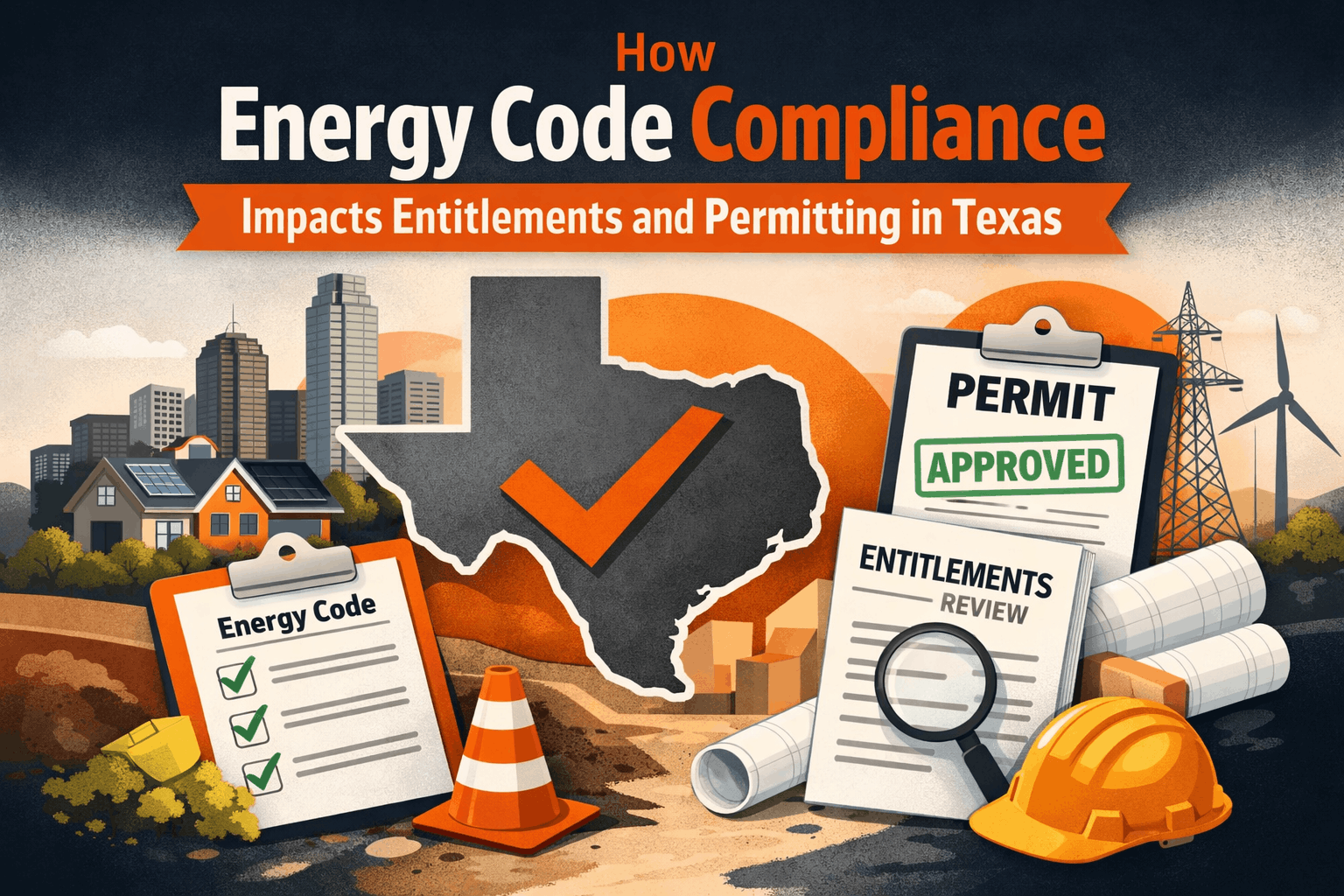
Energy code compliance is no longer just a technical step in construction. In Texas, it plays a direct role in how fast a project gets approved. Energy code compliance in Texas is now a key factor in how projects move through approvals.
If you are a developer, architect, or contractor, this affects you early. It starts before permits. In many cases, it even affects whether your project moves forward at all.
Buildings use a large share of energy in Texas. Because of this, cities and state agencies are paying closer attention to how buildings are designed. They want to see efficient systems, better insulation, and proper documentation. This is where energy codes come in.
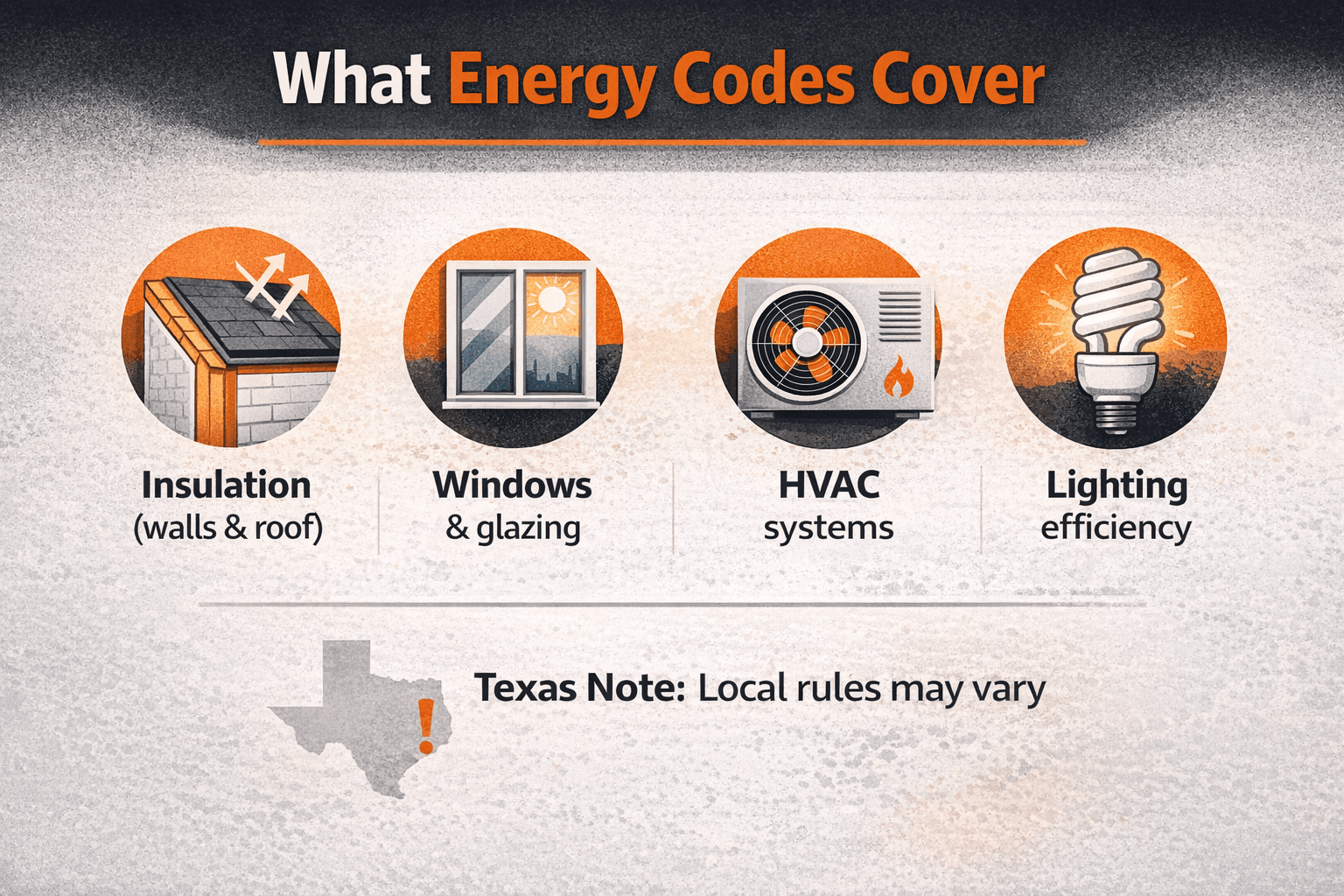
At a basic level, energy codes set minimum standards for how buildings use energy. These rules cover areas like:
- Insulation levels
- Window performance
- HVAC systems
- Lighting efficiency
Now, here is where things shift. These requirements are not checked only at the end. They are reviewed during:
- Entitlements
- Plan review
- Permitting stages
If your project does not meet energy requirements, the city may not approve your plans. This can delay permits. In some cases, it can force redesign. Because of this, energy compliance is no longer a “later step.” It is part of the approval process from the beginning.
Let’s look at how it connects to real project outcomes:
| Factor | Without Energy Compliance | With Proper Compliance |
|---|---|---|
| Plan approval | Delays or rejection | Faster approvals |
| Design process | Rework required | Smooth progression |
| Project cost | Higher due to delays | More predictable |
| Permitting timeline | Extended | Streamlined |
In simple terms, energy compliance helps keep your project moving. Without it, you risk delays, added costs, and repeated submissions.
Another important point is how Texas works. Unlike some states, Texas allows cities to adopt their own versions of energy codes. This creates variation. So, a project in Dallas may have different requirements than one in Austin or Fort Worth.
That means teams must plan carefully. You cannot assume the same approach will work everywhere. Because of this complexity, many teams now treat energy compliance as part of strategy, not just paperwork.
In the next section, we will break down what energy code compliance actually means in Texas, in simple terms.
What Is Energy Code Compliance in Texas? (Simple Breakdown)
Energy code compliance may sound technical, but the idea is simple. It means your building meets certain energy efficiency standards set by code.
These standards are based on national models. Texas uses them as a baseline, then cities adjust as needed.
Understanding the Texas Energy Code Framework
Texas mainly follows two key standards:
These codes define how buildings should perform in terms of energy use.
They apply to:
- New construction
- Major renovations
- Additions to existing buildings
So, even if you are not building from scratch, you may still need to comply.
Each code covers different parts of a building:
| Building Component | What the Code Regulates |
|---|---|
| Walls and roofs | Insulation levels |
| Windows | Heat gain and loss |
| HVAC systems | Efficiency ratings |
| Lighting | Power limits and controls |
These requirements are checked during design and permitting. If something does not meet the standard, it must be fixed before approval.
Statewide vs Local Code Adoption in Texas
This is where things get more complex. Texas sets a minimum energy code. However, cities can adopt stricter rules.
This means:
- The state provides a baseline
- Local jurisdictions can go beyond it
For example:
- One city may follow the base IECC
- Another may require higher efficiency levels
- Some may add local amendments
Because of this, there is no single rulebook for all of Texas.
Here is a simple comparison:
| Level | Role |
|---|---|
| State of Texas | Sets minimum energy code |
| Cities | Modify and enforce code locally |
| Inspectors | Review compliance during permits |
This creates a fragmented system. While it allows flexibility, it also increases risk for project teams. If you assume the wrong code version, your plans may be rejected.
That is why early research is important. You must confirm:
- Which code version applies
- Whether local amendments exist
- What documentation is required
Key Compliance Methods Used in Projects
To meet energy codes, projects usually follow one of three paths. Each method offers a different way to show compliance.
1. Prescriptive Path
This is the simplest method.
- Follow fixed requirements
- Use standard values for insulation, windows, and systems
- No complex calculations
Best for:
- Smaller projects
- Straightforward designs
2. Performance Path
This method is more flexible.
- Uses energy modeling
- Compares your design to a baseline building
- Allows trade-offs between systems
For example:
- Better HVAC can offset lower insulation
Best for:
- Larger or complex buildings
3. Energy Rating Index (ERI) Path
Mostly used for residential projects.
- Provides a score based on energy use
- Lower score means better efficiency
Best for:
- Homes and residential developments
Each method has pros and cons:
| Method | Flexibility | Complexity | Use Case |
|---|---|---|---|
| Prescriptive | Low | Low | Simple projects |
| Performance | High | Medium–High | Commercial buildings |
| ERI | Medium | Medium | Residential |
Choosing the right path depends on your project type, budget, and timeline. However, one thing stays the same. No matter which path you choose, you must submit proof during permitting. If the documentation is missing or incorrect, the permit process can stop.
How Energy Codes Fit Into the Entitlements Process
Before permits, projects go through entitlements. This is where land use and planning approvals happen. Energy codes are now part of this stage, even though many teams overlook it.
What Are Entitlements in Real Estate Development?
Entitlements are approvals that allow you to build on a property.
They usually include:
- Zoning approvals
- Land use approvals
- Site plan approvals
Without entitlements, you cannot move forward. This stage defines what you can build, how large it can be, and how it fits the area.
Where Energy Compliance Enters Early Planning
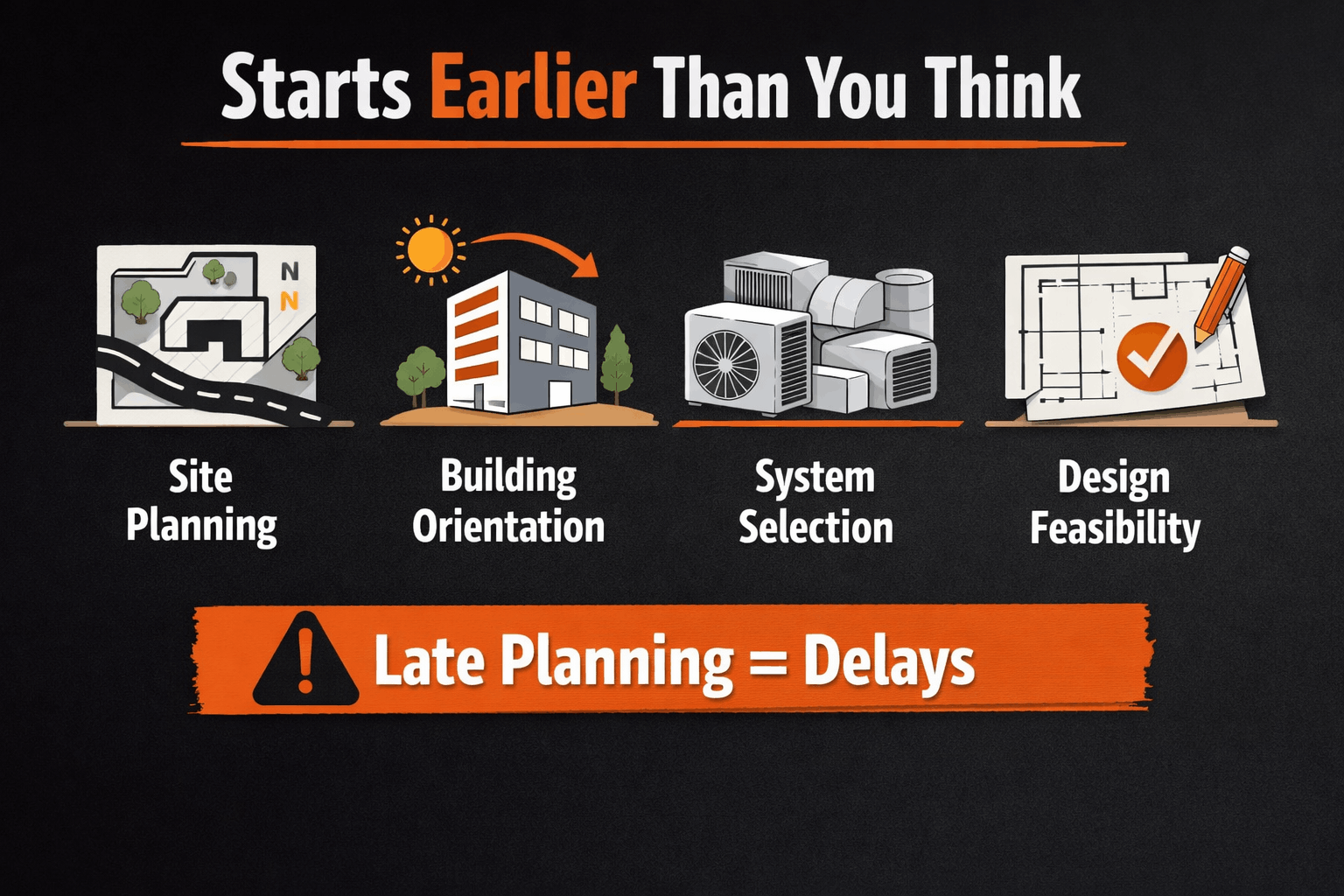
Energy compliance starts earlier than many expect.
It can affect decisions like:
- Building orientation
- Window placement
- Material selection
- Mechanical system choices
For example:
- A building facing the wrong direction may increase heat gain
- This can make compliance harder
- It may require design changes later
So, energy planning should start during:
- Feasibility studies
- Concept design
- Site planning
When teams ignore this, problems show up later.
Why Non-Compliance Can Delay Entitlements
If energy requirements are not considered early, projects often face delays.
Here are common issues:
- Missing energy strategy in early plans
- Conflicts with local energy amendments
- Incomplete documentation
This leads to:
- Review comments from authorities
- Requests for revisions
- Longer approval timelines
Common early-stage mistakes:
- Assuming all cities follow the same code
- Waiting until permit stage for compliance
- Not involving energy consultants early
When these issues occur, teams must go back and adjust designs. This slows down entitlements and pushes the entire project timeline.
Role of Energy Code Compliance in Building Permitting
Once entitlements are approved, the project moves into permitting. This is where energy code compliance becomes more formal.
At this stage, cities review your plans in detail. They check if your design meets all required energy standards. If something is missing, your permit may be delayed or rejected.
In simple terms, permits are not approved without proper energy documentation.
Required Documentation for Permit Approval
Most Texas jurisdictions require clear proof of compliance. This is usually submitted along with your construction drawings.
Common documents include:
- COMcheck reports (for commercial projects)
- REScheck reports (for residential projects)
- Energy compliance forms
- Mechanical and lighting schedules
- Supporting calculations
These reports show that your building meets energy code requirements.
Here is a quick overview:
| Document Type | Purpose | When Required |
|---|---|---|
| COMcheck | Verifies commercial compliance | Commercial permits |
| REScheck | Verifies residential compliance | Residential permits |
| Energy forms | Summary of compliance data | Most projects |
| System specs | HVAC, lighting details | Plan review stage |
If any of these are missing, reviewers will ask for revisions. This adds time to your approval process.
Plan Review and Energy Code Checks
After submission, your plans go through a review process.
During this step, city officials check:
- Building envelope (walls, roof, insulation)
- Window performance
- HVAC efficiency
- Lighting power density
They compare your design against code requirements. If something does not match, you will receive comments. You must fix those issues and resubmit. This back-and-forth can slow things down. However, when plans are clear and accurate, approvals move faster.
Example: Texas Cities Requiring Energy Documentation
Different cities enforce these rules in slightly different ways.
Some examples:
- Dallas requires energy compliance forms before issuing permits
- Fort Worth allows both IECC and ASHRAE paths
- Austin often applies stricter efficiency standards
Because of these differences, teams must adjust their approach for each city. A single mistake, such as using the wrong code version, can delay approval.
Step-by-Step — How Energy Compliance Affects the Permitting Timeline
Energy compliance is not a single step. It affects the entire project timeline, from early design to final inspection. Understanding this flow helps avoid delays.
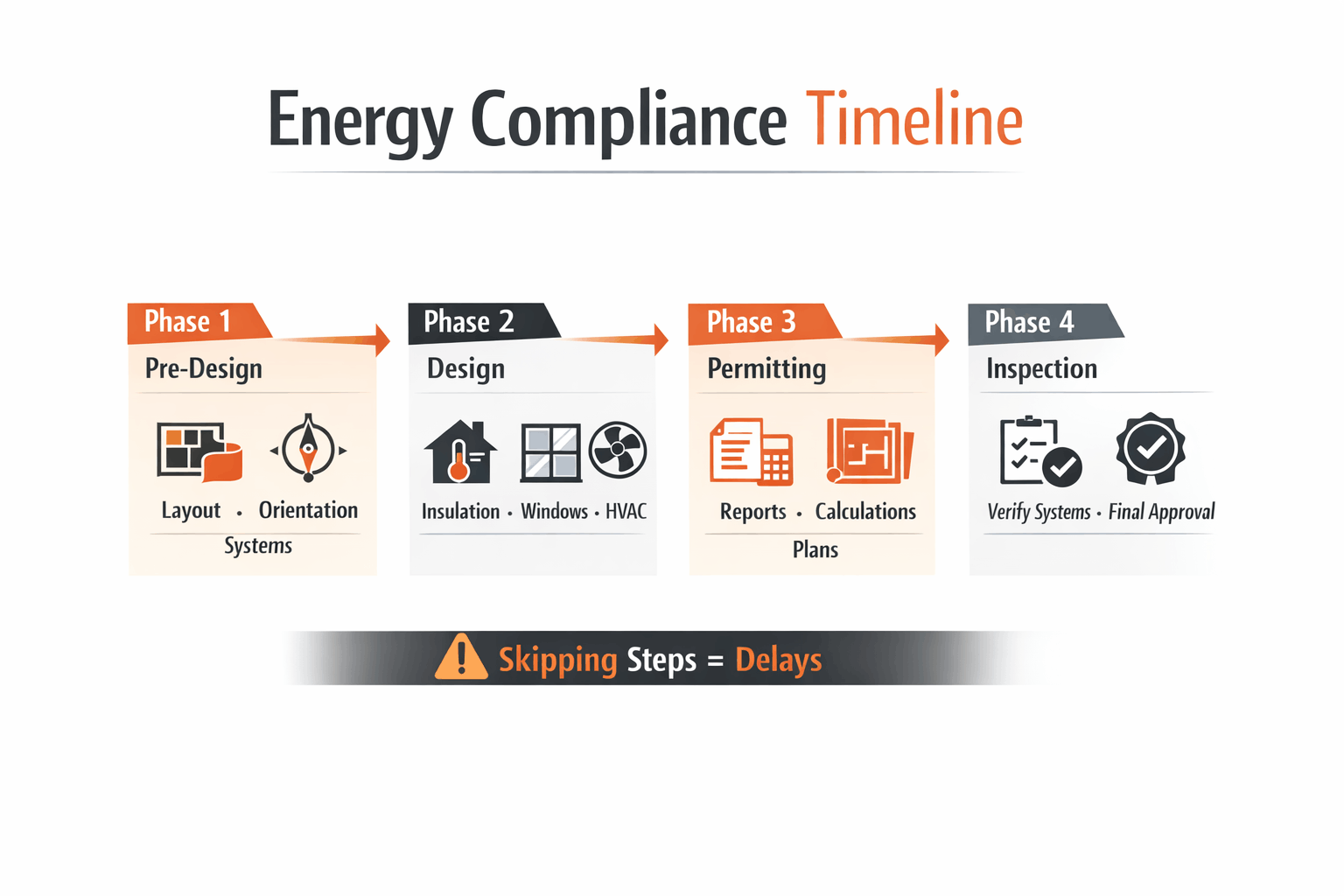
Phase 1 — Pre-Design and Feasibility
This is the earliest stage of the project.
Here, teams decide:
- Building layout
- Orientation
- Basic systems
Energy considerations should start here.
For example:
- Proper orientation can reduce cooling loads
- Better materials can improve efficiency
If ignored, problems appear later.
Phase 2 — Design Development
At this stage, details are added to the design.
This includes:
- Insulation values
- Window specifications
- HVAC system selection
Energy modeling may also be done here. If the design does not meet code, changes must be made. Making changes now is easier than during permitting.
Phase 3 — Permit Submission
This is where compliance becomes official.
Teams must submit:
- Energy reports
- Supporting calculations
- Complete drawings
If everything is correct, the review process moves smoothly. If not, revisions are required.
Phase 4 — Inspection and Approval
Even after permits are issued, compliance is still checked.
Inspectors verify:
- Installed systems match approved plans
- Equipment meets efficiency standards
Final approval depends on passing these checks.
Here is a simple timeline view:
| Phase | Energy Compliance Role | Risk if Ignored |
|---|---|---|
| Pre-design | Sets strategy | Design conflicts |
| Design | Integrates systems | Rework needed |
| Permitting | Verifies compliance | Approval delays |
| Inspection | Confirms installation | Failed inspections |
Local Jurisdiction Differences — The Biggest Challenge in Texas
One of the biggest challenges in Texas is variation between cities. There is no single process that works everywhere.
Why Texas Is Complex for Developers
Texas has many jurisdictions. Each city can adopt its own version of the energy code.
This creates:
- Different requirements
- Different enforcement levels
- Different documentation standards
For developers working in multiple cities, this adds complexity.
Examples of Local Variations
Here is how requirements can differ:
- Austin may require higher efficiency targets
- Dallas may focus on strict documentation
- Fort Worth may allow multiple compliance paths
Even small differences can impact your design.
For example:
- A window that meets code in one city may fail in another
- HVAC efficiency standards may vary
Impact on Multi-City Projects
For projects across multiple locations, these differences can create challenges.
Common issues include:
- Multiple compliance strategies
- Increased design coordination
- Higher consulting costs
Teams may need to:
- Adjust designs for each city
- Prepare separate documentation
- Track different code versions
This increases both time and risk.
Key takeaway:
Energy compliance in Texas is not just about meeting one standard. It is about understanding local rules and planning accordingly.
Common Energy Code Compliance Mistakes That Delay Permits
Even well-planned projects can face delays if energy compliance is not handled correctly. Most issues are not complex. They come from small gaps in planning, coordination, or documentation.
The good news is that these mistakes are avoidable.
Design-Stage Mistakes
Many problems start during design. Teams focus on layout and aesthetics, but overlook energy requirements.
Common design issues include:
- Ignoring climate zone requirements
- Using incorrect insulation values
- Selecting low-performance windows
- Oversizing or undersizing HVAC systems
These choices may seem minor at first. However, they can lead to non-compliance during review.
For example:
- A window with high heat gain may fail code
- This may require redesign
- That delays permitting
The earlier these issues are caught, the easier they are to fix.
Documentation Errors
Even if the design is correct, missing or incorrect documents can stop the permit process.
Common documentation mistakes:
- Missing COMcheck or REScheck reports
- Incomplete energy forms
- Incorrect system inputs in reports
- Mismatch between drawings and reports
Reviewers compare your documents with your plans. If they do not match, they will request revisions.
Here is a simple breakdown:
| Issue | What Happens | Result |
|---|---|---|
| Missing report | Review cannot proceed | Permit delay |
| Incorrect inputs | Compliance fails | Resubmission required |
| Mismatch in data | Reviewer flags errors | Back-and-forth review |
These delays can add days or even weeks to your timeline.
Coordination Failures
Energy compliance involves multiple teams:
- Architects
- Mechanical engineers
- Electrical designers
- Energy consultants
If these teams are not aligned, problems arise.
Examples:
- HVAC design does not match energy model
- Lighting plan exceeds power limits
- Envelope specs differ between drawings and reports
This leads to confusion during review.
Common coordination mistakes:
- Late involvement of energy consultants
- Poor communication between teams
- Last-minute changes without updating reports
When teams work in silos, compliance becomes harder.
Cost Implications of Energy Code Compliance
Energy compliance affects more than approvals. It also impacts project costs. However, the impact depends on how early it is addressed.
Upfront Costs vs Long-Term Savings
Meeting energy code may increase initial costs.
This can include:
- Better insulation
- High-performance windows
- Efficient HVAC systems
At first, this may seem like an added expense.
But over time, these features reduce:
- Energy bills
- Maintenance costs
- System wear
So, while upfront costs may rise, long-term savings often balance them.
Cost Impact on Permitting and Entitlements
Delays in permitting can be expensive.
When approvals are delayed:
- Construction timelines shift
- Financing costs increase
- Holding costs rise
On the other hand, smooth approvals help control costs.
Here is a comparison:
| Scenario | Cost Impact |
|---|---|
| Delayed permit approval | Higher due to rework and time loss |
| Proper compliance from start | Lower due to fewer revisions |
| Late design changes | Increased construction cost |
| Early energy planning | Better cost control |
This shows that compliance is not just about meeting code. It also affects financial outcomes.
ROI Perspective for Developers
Energy-efficient buildings often perform better in the market.
They offer:
- Lower operating costs
- Better tenant comfort
- Higher property value
For commercial projects, this can improve leasing potential. For residential projects, buyers often prefer efficient homes. So, energy compliance can support long-term returns.
Benefits of Early Energy Code Integration
When energy compliance is considered early, projects move more smoothly. It reduces risk and improves coordination.
Faster Approvals and Reduced Risk
Early planning helps avoid surprises during review.
Benefits include:
- Fewer plan revisions
- Faster permit approvals
- Less back-and-forth with reviewers
This keeps the project on schedule.
Improved Project Efficiency
When teams plan together from the start, coordination improves.
This leads to:
- Better system integration
- Fewer design conflicts
- Clear documentation
As a result, the project moves forward without unnecessary delays.
Stronger Compliance Confidence
Early integration builds confidence in your design.
You know that:
- Systems meet code
- Documents are accurate
- Inspections will go smoothly
This reduces stress during later stages.
Quick summary of benefits:
- Faster permitting
- Lower risk of redesign
- Better cost control
- Smoother inspections
At this stage, it becomes clear that energy code compliance is not just a requirement. It is a tool that helps projects stay on track.
How JDJ Consulting Supports Energy Code Compliance in Texas
Energy code compliance can feel complex, especially in Texas where each city may have different rules. This is where a structured approach makes a big difference.
JDJ Consulting works with developers, architects, and project teams to simplify this process. The goal is simple: reduce delays and keep projects moving.
Strategic Role in Entitlements and Permitting
Energy compliance is not just about reports. It starts early and continues through permitting.
JDJ Consulting supports projects at key stages:
- Early feasibility and planning
- Code research based on city requirements
- Review of design against energy standards
By getting involved early, issues can be identified before they affect approvals.
For example:
- If a design does not meet local code, it can be adjusted early
- This avoids redesign during permitting
This approach helps align energy compliance with the overall project strategy.
Services That Support Compliance
JDJ Consulting provides practical services that directly support approvals.
These include:
- Energy modeling for performance path compliance
- COMcheck and REScheck documentation
- Review of envelope, HVAC, and lighting systems
- Coordination with architects and engineers
- Support during plan review and revisions
Each service focuses on making compliance clear and accurate.
Here is how these services help:
| Service | How It Helps |
|---|---|
| Energy modeling | Confirms design meets performance targets |
| Compliance reports | Required for permit approval |
| Design review | Identifies issues early |
| Team coordination | Reduces conflicts between systems |
| Permit support | Speeds up review process |
Value for Developers and Architects
Working with an experienced consultant helps reduce uncertainty.
Key benefits include:
- Fewer permit delays
- Clear understanding of local requirements
- Better coordination across teams
- Predictable project timelines
This is especially useful for projects across multiple cities in Texas. Instead of reacting to issues, teams can plan ahead.
Future Trends in Texas Energy Codes and Permitting
Energy codes continue to evolve. Over time, requirements are becoming stricter. Understanding these trends helps teams prepare for future projects.
Upcoming Code Updates
Energy codes are updated regularly.
New versions often include:
- Higher efficiency standards
- Improved building performance targets
- Updated testing and verification methods
This means projects must keep up with changing requirements. Designs that worked a few years ago may not meet current standards.
Increasing Local Stringency
Many Texas cities are moving beyond minimum requirements.
This includes:
- Stricter insulation and glazing standards
- Higher HVAC efficiency requirements
- More detailed compliance checks
Cities are focusing more on sustainability and long-term performance. As a result, compliance is becoming more detailed.
Digital Permitting and Compliance Tools
Permitting is also changing.
Many cities now use digital systems for:
- Plan submissions
- Compliance checks
- Review comments
Energy modeling tools are also improving.
These tools help:
- Identify issues early
- Improve accuracy
- Reduce manual errors
Over time, this will make compliance more data-driven.
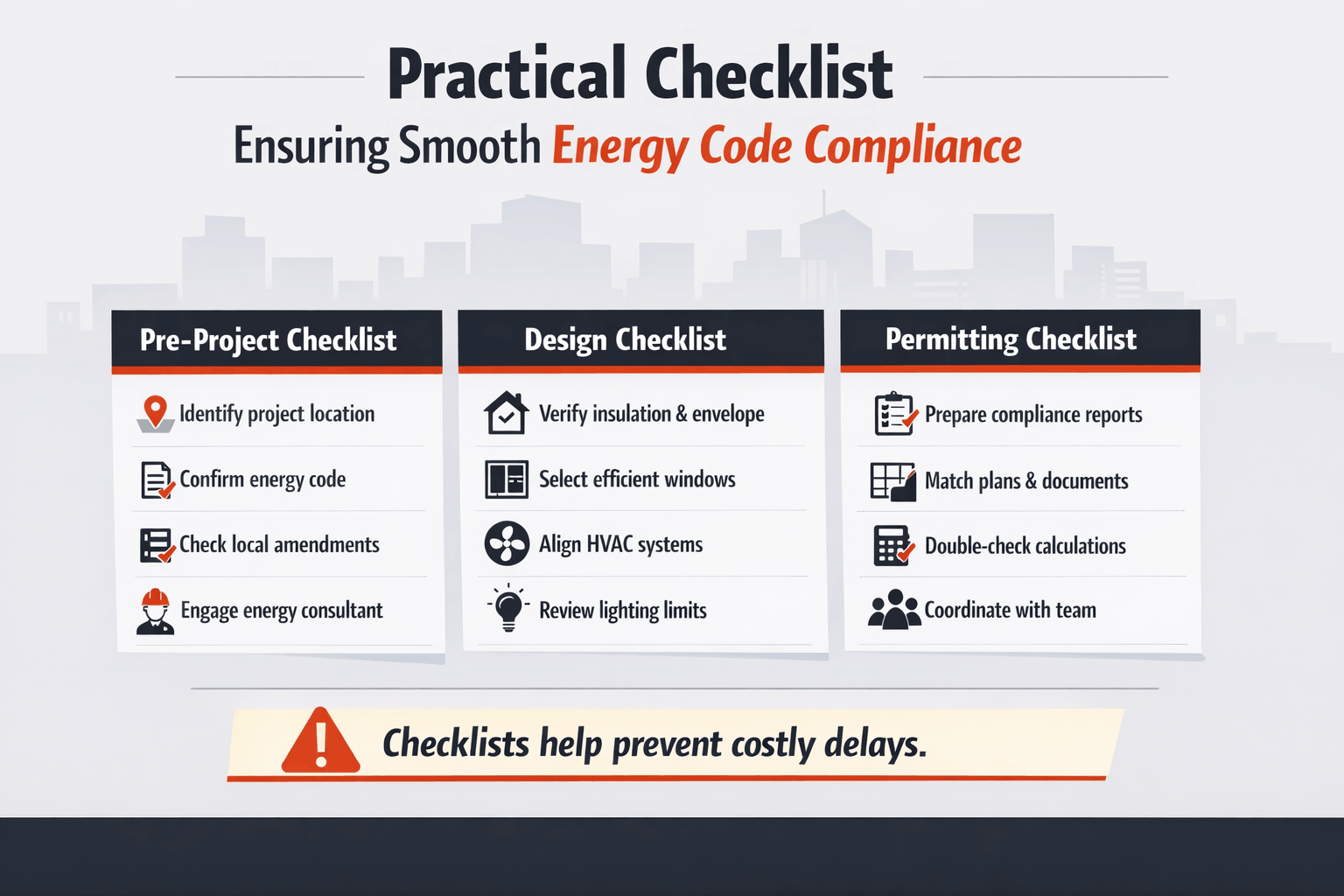
Practical Checklist — Ensuring Smooth Energy Code Compliance
A simple checklist can help avoid common issues. This keeps your project organized from start to finish.
Pre-Project Checklist
Before design begins:
- Identify the project location
- Confirm the applicable energy code
- Check for local amendments
- Engage an energy consultant early
These steps set a strong foundation.
Design Checklist
During design:
- Verify insulation and envelope requirements
- Select compliant windows and glazing
- Align HVAC systems with efficiency standards
- Review lighting power limits
- Run energy modeling if needed
This ensures the design meets code before submission.
Permitting Checklist
Before submitting for permits:
- Prepare COMcheck or REScheck reports
- Ensure drawings match compliance documents
- Double-check all inputs and calculations
- Coordinate with all design teams
This reduces review comments and delays.
Conclusion — Energy Code Compliance Impacts Entitlements
Energy code compliance is now a key part of development in Texas.
It affects:
- Entitlements
- Permits
- Project timelines
- Overall costs
Projects that ignore it often face delays and added expenses. On the other hand, projects that plan for it early move more smoothly. The main takeaway is simple: Energy compliance should be treated as part of the design and approval strategy, not just a requirement. When handled correctly, it supports faster approvals, better coordination, and more predictable outcomes.
Need Help With Energy Code Compliance?
If you’re planning a project in Texas, getting energy compliance right early can save time and avoid delays. JDJ Consulting helps with code requirements, compliance reports, and permit support—so your project stays on track.
Call: (818) 793-5058
Email: sales@jdj-consulting.com
FAQS: How Energy Code Compliance Impacts Entitlements
What is energy code compliance in Texas?
Energy code compliance in Texas means your building meets minimum efficiency standards set by state and local codes. These rules are based on IECC and ASHRAE guidelines and apply to both new construction and major renovations.
It usually covers:
Insulation and building envelope
HVAC system efficiency
Lighting performance
To move forward, projects must show proof through reports and calculations. If compliance is not demonstrated, the project may not pass review or receive approval.
How does energy code compliance affect permitting in Texas?
Energy compliance is a required part of the permitting process in most Texas cities. When you submit plans, reviewers check if your design meets energy standards.
If there are issues:
Plans may be rejected
Additional documentation may be requested
Revisions may delay approval
This means compliance directly affects how quickly permits are issued. Projects with clear and accurate documentation usually move faster.
Why is energy compliance important during entitlements?
Energy compliance affects early planning decisions, even before permits. During entitlements, factors like building layout and orientation are decided.
If energy requirements are ignored:
Design changes may be needed later
Approval timelines may increase
Planning early helps avoid redesign and ensures the project aligns with local requirements from the start.
What documents are required for energy code compliance?
Most projects must submit specific documents to prove compliance. These are reviewed along with construction drawings.
Common documents include:
COMcheck reports for commercial buildings
REScheck reports for residential projects
Energy compliance forms and calculations
These documents show how the building meets code requirements. Missing or incorrect documents can delay the permit process.
What is COMcheck and why is it required?
COMcheck is a widely used tool for commercial buildings. It helps confirm that a project meets energy code requirements.
It evaluates:
Building envelope performance
Lighting efficiency
Mechanical systems
Cities often require COMcheck reports before approving permits. If the report is incomplete or incorrect, the review process may stop until it is fixed.
What is REScheck used for in Texas?
REScheck is used for residential buildings to verify energy compliance. It simplifies the process by checking key efficiency measures.
It reviews:
Insulation levels
Window performance
Overall energy efficiency
This tool is commonly required for single-family homes and low-rise residential projects. It helps ensure the design meets code before construction begins.
Do all Texas cities follow the same energy code?
No, Texas has a statewide baseline, but cities can adopt their own versions or add stricter rules.
This means:
Requirements may vary by location
Some cities enforce higher efficiency standards
Because of this, it is important to check local codes before starting a project. Using the wrong code version can lead to delays or rejected plans.
What are the main energy compliance paths in Texas?
There are three common ways to meet energy code requirements, depending on the project.
These include:
Prescriptive path with fixed requirements
Performance path using energy modeling
ERI path mainly for residential buildings
Each method offers a different level of flexibility. The right choice depends on the size, type, and complexity of the project.
How early should energy compliance be considered?
Energy compliance should be considered at the very beginning of a project. Waiting until the permit stage often leads to problems.
It should start during:
Feasibility studies
Concept design
Early planning helps align design decisions with code requirements. This reduces the risk of redesign and speeds up approvals.
What happens if a project fails energy code review?
If a project does not meet energy code requirements, the city will issue comments during plan review.
You may need to:
Revise the design
Update calculations or reports
Resubmit documents
This process can take time and delay permits. Fixing issues early is the best way to avoid these setbacks.
How do local amendments impact energy compliance?
Local amendments can modify standard energy code requirements. Cities may adopt stricter rules or add additional steps.
These changes may include:
Higher efficiency targets
Extra documentation requirements
If these are not considered, your project may fail review. Understanding local amendments is key to avoiding delays.
Does energy compliance increase construction costs?
Energy compliance can increase upfront costs due to better materials and systems.
Examples include:
Higher-quality insulation
Efficient HVAC equipment
Advanced windows
However, these improvements often reduce long-term energy costs. Over time, savings on utilities and maintenance can offset the initial investment.
Can energy compliance speed up permitting?
Yes, proper energy compliance can help speed up the permitting process. When documents are complete and accurate, reviewers can approve plans more quickly.
Benefits include:
Fewer review comments
Reduced need for revisions
This helps projects stay on schedule and avoid unnecessary delays.
What role do energy consultants play in projects?
Energy consultants help ensure your project meets all code requirements. They work with design teams to review and improve plans.
Their role includes:
Preparing compliance reports
Conducting energy modeling
Interpreting local codes
They also help resolve issues during plan review, which can save time and reduce risk.
How does energy modeling help with compliance?
Energy modeling is used in the performance path to evaluate building efficiency. It compares your design to a standard reference building.
This allows:
Flexibility in design choices
Trade-offs between systems
For example, better HVAC systems can offset other areas. This approach is useful for complex or large projects.
What are common mistakes that delay permits?
Many permit delays are caused by simple mistakes that can be avoided with better planning.
Common issues include:
Missing compliance reports
Incorrect data in calculations
Poor coordination between teams
These problems lead to review comments and resubmissions. Addressing them early helps keep the project on track.
Is energy compliance required for renovations?
Yes, energy code compliance applies to many renovation projects, especially major upgrades or additions.
This may involve:
Updating insulation
Replacing HVAC systems
Improving lighting efficiency
The exact requirements depend on the scope of work, but compliance is often required before permits are approved.
How do inspections relate to energy compliance?
Energy compliance does not end with permits. Inspectors check if the building is constructed as approved.
They verify:
Installed systems match the plans
Equipment meets efficiency standards
If issues are found, corrections may be required before final approval is granted.
What are the benefits of energy-efficient buildings?
Energy-efficient buildings offer both short-term and long-term benefits. They improve performance and reduce operating costs.
Key benefits include:
Lower energy bills
Improved indoor comfort
Higher property value
These advantages make energy-efficient buildings more attractive to tenants and buyers.
How can JDJ Consulting help with energy compliance?
JDJ Consulting supports projects throughout the compliance process, from early design to final approval.
Services include:
Energy modeling and analysis
Preparation of compliance reports
Coordination during permitting
This helps reduce delays, improve accuracy, and ensure smoother approvals for your project.