Real estate deals in Texas can move fast. Prices shift, demand changes, and opportunities come and go quickly. But one thing should never be rushed—due diligence.
In simple terms, due diligence is the process of checking everything before you buy a property. It helps you confirm that the numbers make sense, the legal status is clear, and the property is in good condition. Without it, even a promising deal can turn into a costly mistake.
Texas offers strong growth in cities like Houston, Dallas, and Austin. However, that growth also brings risks. Property taxes are high, zoning rules vary by city, and market conditions can differ block by block. This is why careful analysis is not optional—it is essential.
Whether you are an investor, developer, or lender, due diligence helps you make informed decisions. It gives you clarity, reduces uncertainty, and puts you in a better position to negotiate.
In this guide, we will break down what real estate due diligence services include, why they matter in Texas, and how to approach them step by step.
What Are Real Estate Due Diligence Services?
Real estate due diligence services cover a full review of a property before a deal is finalized. The goal is simple: confirm that what you see—and what you are told—is accurate.
These services combine financial analysis, legal checks, physical inspections, and market research. Each part answers a different question. Together, they give you a complete picture of the property.
Simple Definition (No Jargon)
Due diligence means doing your homework before buying real estate.
It involves checking:
The property’s financial performance
Legal ownership and documents
Physical condition
Market position
Think of it as a detailed inspection—not just of the building, but of the entire investment.
Why Due Diligence Matters in Texas Real Estate Deals
Texas is a strong market, but it comes with specific challenges. Skipping proper checks can lead to serious issues later.
Here’s why due diligence is critical:
It reduces risk: You uncover hidden problems early
It supports better pricing: You can renegotiate if issues arise
It protects your investment: You avoid properties with legal or structural issues
It improves confidence: You move forward with clear data
In Texas, the due diligence period is often negotiated during the contract phase. This gives buyers a limited window to review everything. If something does not add up, they can step back or adjust the deal terms.
Who Needs Due Diligence Services?
Due diligence is not just for large investors. It applies to anyone making a real estate decision.
Common users include:
Real estate investors – to validate returns and risks
Developers – to assess land, zoning, and feasibility
Lenders – to confirm the property supports the loan
Private equity firms – to evaluate large or complex portfolios
Even experienced professionals rely on structured due diligence. It ensures consistency and reduces reliance on assumptions.

What’s Included in Real Estate Due Diligence Services? (Full Breakdown)
Due diligence is not a single task. It is a combination of several detailed reviews. Each one focuses on a different part of the property.
Most professional services divide due diligence into key categories. These include financial, legal, physical, environmental, market, and operational analysis.
1. Financial Due Diligence (Underwriting & Cash Flow Analysis)
Financial review is often the starting point. It answers one main question: does the property make financial sense?
Key areas include:
Rent roll analysis
Income verification
Expense review
Cash flow projections
Here’s a simple breakdown:
| Financial Item | Why It Matters |
|---|---|
| Rent Roll | Confirms current income and tenant stability |
| NOI (Net Operating Income) | Shows true profitability |
| Operating Expenses | Identifies hidden or rising costs |
| Lease Terms | Highlights risk from short-term or weak tenants |
A small error in financial assumptions can change the entire investment outcome. That is why this step is handled with care.
2. Legal Due Diligence (Ownership & Risk Protection)
Legal checks confirm that the property can be transferred without issues.
This includes:
Title search
Review of liens or claims
Easements and restrictions
Lease agreements
Contract terms
If ownership is unclear or if there are disputes, the deal can become risky. Legal due diligence ensures there are no surprises after closing.
3. Physical & Technical Due Diligence
This step focuses on the actual condition of the property.
It typically involves:
Building inspections
Structural assessments
HVAC and electrical systems review
Roof and foundation checks
Capital expenditure (CapEx) planning
Here’s a quick overview:
| Component | What to Check |
|---|---|
| Structure | Cracks, stability, safety issues |
| Systems | HVAC, plumbing, electrical condition |
| Roof | Age, leaks, replacement timeline |
| Maintenance | Deferred repairs and future costs |
A property may look fine at first glance. However, detailed inspections often reveal hidden repair costs.
4. Environmental Due Diligence
Environmental checks are especially important for commercial and land deals.
They include:
Phase I environmental site assessment
Soil and groundwater testing (if needed)
Review of past land use
Compliance with environmental regulations
If contamination is found, cleanup costs can be very high. This step helps avoid that risk.
5. Market & Location Analysis
A good property in the wrong market can still perform poorly.
Market analysis looks at:
Local demand and supply
Population growth
Rental trends
Nearby developments
Economic activity
This helps you understand whether the property will perform well over time—not just today.
6. Operational Due Diligence
This step focuses on how the property is managed.
It includes:
Property management review
Vendor contracts
Tenant quality
Lease enforcement practices
Strong operations support steady income. Weak management can lead to vacancies and higher costs.
Texas-Specific Due Diligence Requirements You Must Know
Real estate due diligence in Texas follows the same core principles as other states. However, there are a few local factors that can directly affect your deal. Ignoring them can lead to inaccurate assumptions or unexpected costs.
Due Diligence Period in Texas (30–90 Days Typical)
In Texas, the due diligence period is negotiated as part of the purchase contract. It is often called the option period in residential deals, but the concept applies to commercial transactions as well.
During this time, the buyer can:
Inspect the property
Review financial and legal documents
Cancel the contract if needed
Typical timelines range from:
30 days for smaller or simpler properties
60–90 days for larger or complex commercial deals
The key point is timing. If you miss this window, your ability to exit the deal becomes limited. That is why a structured process is important from day one.

Title Insurance in Texas
Title insurance is a standard part of real estate transactions in Texas. It protects buyers and lenders from ownership issues that may not be visible upfront.
There are two main types:
Owner’s policy – protects the buyer
Lender’s policy – protects the financing institution
Common issues covered include:
Undisclosed liens
Ownership disputes
Errors in public records
Without proper title review and insurance, you may inherit legal problems tied to the property.
Zoning & Land Use Regulations in Texas Cities
Zoning rules in Texas can vary widely by city. This makes local research essential.
Here’s a quick comparison:
| City | Zoning Approach | What It Means |
|---|---|---|
| Houston | No formal zoning | Relies on deed restrictions and land use rules |
| Dallas | Strict zoning laws | Clear use limitations and approvals required |
| Austin | Highly regulated | Focus on growth control and development limits |
For investors and developers, this directly affects:
What you can build
How you can use the property
Future expansion plans
A property that looks suitable may not align with local regulations. Always verify zoning before moving forward.
Property Tax Considerations in Texas
Texas does not have a state income tax, but property taxes are relatively high. This has a direct impact on investment returns.
Key points to review:
Current tax rate
Historical increases
Potential reassessment after purchase
Available exemptions
Higher taxes can reduce net income and affect your valuation. This is why tax projections should be part of your financial due diligence.
Real Estate Due Diligence Checklist (Step-by-Step Guide)
A structured checklist helps ensure nothing is missed. It also keeps the process organized, especially when multiple teams are involved.
Pre-Offer Stage
Before making an offer, you should complete initial screening.
Focus on:
Market research
Comparable property analysis
Basic financial review
Location assessment
At this stage, the goal is simple: decide whether the deal is worth pursuing.
Under Contract Stage
Once the contract is signed, detailed due diligence begins.
Key tasks include:
Collecting property documents
Reviewing leases and financials
Conducting inspections
Performing legal checks
This is the most active phase. Most risks are identified here.
Pre-Closing Stage
Before closing, final checks are completed.
These include:
Verifying all documents
Confirming repairs or conditions
Reviewing updated financials
Ensuring financing is in place
This step ensures everything is aligned before funds are transferred.
Complete Due Diligence Checklist
| Stage | Key Tasks |
|---|---|
| Pre-Offer | Market research, initial financial review, location analysis |
| Under Contract | Legal review, inspections, document verification |
| Pre-Closing | Final approvals, financing checks, risk confirmation |
Real Estate Due Diligence Process (Step-by-Step Workflow)
A clear process helps reduce delays and confusion. It also ensures that each part of due diligence is completed in the right order.
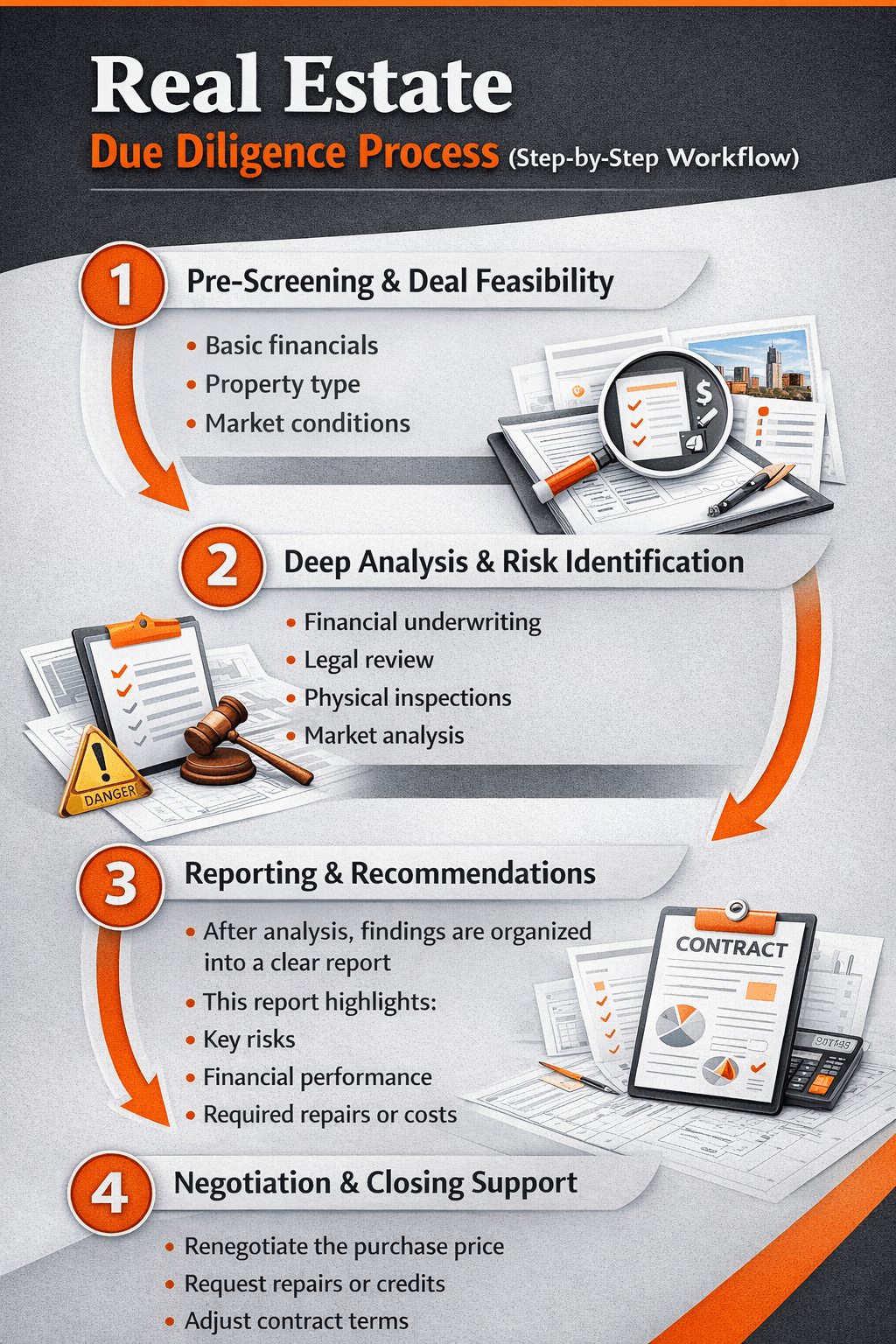
Step 1: Pre-Screening & Deal Feasibility
This is the first filter.
You review:
Basic financials
Property type
Market conditions
The goal is to decide whether the deal meets your investment criteria. If it does not, you save time by stepping away early.
Step 2: Deep Analysis & Risk Identification
This is the core of due diligence.
It includes:
Financial underwriting
Legal review
Physical inspections
Market analysis
Each area is examined in detail. Any risks or inconsistencies are documented.
Step 3: Reporting & Recommendations
After analysis, findings are organized into a clear report.
This report highlights:
Key risks
Financial performance
Required repairs or costs
Legal concerns
Based on this, you can decide whether to proceed, renegotiate, or exit the deal.
Step 4: Negotiation & Closing Support
The final step focuses on action.
You may:
Renegotiate the purchase price
Request repairs or credits
Adjust contract terms
Due diligence gives you leverage. Instead of guessing, you rely on verified data to support your position.
Types of Real Estate Due Diligence Services in Texas
Not all properties require the same level of review. The scope of due diligence depends on the asset type, deal size, and investment strategy. In Texas, different property types come with different risks, so the approach must be tailored.
Commercial Real Estate Due Diligence
Commercial properties require the most detailed analysis. These include office buildings, retail centers, and industrial assets.
Key focus areas:
Lease structures and tenant stability
Long-term income performance
Maintenance and capital expenditure needs
Market demand for the asset type
Since these deals often involve larger investments, even small issues can have a significant financial impact.
Residential Due Diligence
Residential properties are usually simpler, but they still require careful review.
Typical checks include:
Property condition
Comparable sales in the area
Rental potential (if applicable)
Title and ownership verification
While the process is less complex than commercial deals, skipping steps can still lead to costly mistakes.
Land & Development Due Diligence
Land deals come with a different set of risks. There is no existing income, so the focus shifts to future potential.
Important areas include:
Zoning and land use approval
Access to utilities
Soil condition and topography
Permits and development restrictions
A piece of land may look promising, but if it cannot be developed as planned, the investment loses value.
Portfolio Due Diligence
Portfolio transactions involve multiple properties at once. This adds complexity and requires a structured approach.
Key considerations:
Consistency of financial data across properties
Risk exposure across locations
Operational efficiency
Tenant diversification
In these cases, standardization is important. Each property must be reviewed using the same criteria to ensure accurate comparisons.
Common Risks Identified During Due Diligence
Due diligence is designed to uncover risks before they become problems. Some issues are minor, while others can completely change the direction of a deal.
Financial Red Flags
Financial issues are among the most common findings.
These may include:
Overstated rental income
Underreported expenses
Irregular cash flow
Short-term leases with high turnover risk
Even small discrepancies can affect valuation and expected returns.
Legal Risks
Legal problems can delay or block a transaction.
Common issues include:
Title defects
Unresolved liens
Disputes over ownership
Non-compliant lease agreements
These risks must be addressed before closing. Otherwise, they may transfer to the buyer.
Physical Risks
Physical condition often reveals hidden costs.
Typical concerns:
Structural damage
Outdated systems
Deferred maintenance
Safety issues
Repair costs can quickly add up, especially if problems are not identified early.
Environmental Risks
Environmental issues are less visible but can be severe.
They may involve:
Soil contamination
Hazardous materials
Regulatory violations
These risks can lead to high cleanup costs and legal liability. That is why environmental checks are critical, especially for commercial and land deals.
How Due Diligence Impacts Investment Decisions
Due diligence is not just about finding problems. It directly shapes how you move forward with a deal.

Helps You Renegotiate Price
When issues are identified, you gain leverage.
For example:
Repair costs can justify a price reduction
Weak financials can support revised terms
This allows you to align the deal with actual conditions rather than assumptions.
Helps You Avoid Bad Deals
Some risks cannot be fixed easily. In such cases, walking away is often the best decision.
Due diligence gives you the clarity to:
Identify deal-breaking issues
Avoid long-term losses
Protect your capital
Helps You Structure Financing
Lenders rely on accurate data. Strong due diligence makes financing smoother.
It helps:
Validate income projections
Support loan applications
Reduce lender risk concerns
This can lead to better loan terms and fewer delays.
Benefits of Hiring Professional Due Diligence Services
While some investors handle parts of due diligence on their own, professional services bring structure and depth to the process.
Saves Time & Reduces Stress
Due diligence involves multiple tasks happening at once. Professionals manage timelines, coordinate inspections, and organize data efficiently.
This allows you to focus on decision-making rather than chasing documents.
Access to Industry Experts
A complete review often requires input from different specialists.
These may include:
Financial analysts
Legal advisors
Inspectors and engineers
Professional services bring these experts together in one process.
Better Risk Assessment
Experienced teams know where to look and what to question.
They can:
Identify hidden risks
Validate assumptions
Provide realistic projections
This leads to more accurate investment decisions.
Stronger Investment Decisions
At the end of the process, you have clear, verified information.
This helps you:
Move forward with confidence
Negotiate effectively
Avoid costly surprises
Why Choose JDJ Consulting for Real Estate Due Diligence in Texas
Choosing the right partner can make a significant difference in how smooth and effective your due diligence process is.
Our Expertise in Texas Markets
We understand the local dynamics across major Texas markets. From property taxes to zoning differences, our approach reflects real conditions on the ground.
Comprehensive Service Offering
We cover all aspects of due diligence, including:
Financial analysis
Market research
Risk assessment
Investment support
This ensures nothing is overlooked.
Data-Driven Insights
Our process is based on verified data, not assumptions. We focus on clear analysis that supports better decision-making.
Fast Turnaround & Accuracy
Time matters in real estate deals. We work within your deadlines while maintaining accuracy and attention to detail.
Call to Action:
Request a consultation to discuss your next deal
Get a customized due diligence checklist for your project

Cost of Real Estate Due Diligence Services in Texas
The cost of due diligence services can vary based on several factors. Understanding these can help you plan your budget more effectively.
Factors That Affect Pricing
Property size and type
Complexity of the deal
Number of reports required
Timeline and urgency
A small residential deal will cost less than a large commercial or portfolio transaction.
Typical Cost Ranges
While exact pricing varies, here is a general idea:
| Property Type | Estimated Cost Range |
|---|---|
| Residential | $1,000 – $5,000 |
| Small Commercial | $5,000 – $15,000 |
| Large Commercial | $15,000+ |
These costs should be seen as part of your investment protection, not just an expense.
Final Thoughts: Why Due Diligence Is Non-Negotiable in Texas Real Estate
Real estate in Texas offers strong opportunities, but it also requires careful evaluation. Every property comes with its own set of risks, and those risks are not always visible at first glance.
Due diligence helps you see the full picture. It gives you the data needed to make informed decisions, protect your investment, and move forward with confidence.
Whether you are buying a single property or managing a large portfolio, a structured due diligence process is essential. It is not just a step in the transaction—it is the foundation of a successful investment.
Let’s Talk About Your Next Deal
If you’re working on a property in Texas and want a second set of eyes, we’re here to help. No pressure. No complicated process. Just a clear conversation about your deal and what you need. Whether you’re still reviewing numbers or already under contract, we can step in and support your due diligence from start to finish.
You can reach us directly:
Phone: (818) 793-5058
Email: sales@jdj-consulting.com
Or, if you prefer, you can share your details here and we’ll get back to you:
Contact page: https://jdj-consulting.com/contact-us/
Even if you just have a quick question, feel free to reach out. It’s always better to clarify things early than deal with surprises later.
Frequently Asked Questions (FAQs)
What is real estate due diligence in a purchase agreement?
In Real Estate, due diligence is the evaluation process that takes place after signing a purchase agreement and before finalizing the purchase price.
During this inspection period, buyers:
Review financial and legal documents
Inspect the property condition
Confirm the deal meets expectations
This stage protects buyers from unexpected risks before closing.
What is the inspection period in real estate?
The inspection period (also called the inspection contingency period or inspection window) is a negotiable period where buyers can fully evaluate the property.
Common timelines include:
5–10 days for smaller or simple deals
7–10 days in fast-moving markets
10–14 days for standard transactions
14–21 days for complex properties
This timeline is agreed upon in the purchase agreement.
What is a diligence fee and how does it work?
A diligence fee (or diligence money) is paid by the buyer to secure the diligence window.
Key details:
Paid directly to the seller
Usually non-refundable
Gives access to the full inspection window
This structure is widely used in North Carolina real estate transactions.
What is the option period in real estate?
The option period is another type of negotiable period that allows the buyer to cancel the contract for any reason.
It includes:
Payment of an option fee
Flexibility to renegotiate the purchase price
Time to complete inspections and due diligence
This period functions similarly to a diligence window, depending on the market.
What happens during the diligence window?
During the diligence window, buyers complete all critical evaluations.
This includes:
Property inspections within the inspection window
Reviewing financial performance
Verifying legal and title details
Coordinating with lending services
Findings during this time may lead to price adjustments or contract changes.
Can you cancel a deal during the inspection period?
Yes, buyers can usually cancel the deal during the inspection contingency period without major penalties.
Common reasons:
Major repair issues
Financial concerns
Problems discovered during inspections
After this negotiable period ends, cancellation becomes more difficult.
What is an appraisal gap clause?
An appraisal gap clause (often written as an appraisal gap clause) protects sellers when the appraised value is lower than the purchase price.
It means:
The buyer agrees to cover the difference
The deal proceeds without renegotiation
This is common in competitive markets where bidding drives prices higher.
What role does attorney review play in real estate contracts?
In some states, attorney review is part of the contract process after signing the purchase agreement.
During this stage:
Attorneys review terms and conditions
Suggest revisions if needed
Ensure legal protection for both parties
This step adds security to the overall Real Estate transaction.
How do competitive markets affect due diligence terms?
In competitive markets, buyers often adjust their terms to make offers more attractive.
Common strategies:
Shortening the inspection period
Increasing the diligence fee
Offering higher purchase price
Adding an appraisal gap clause
These changes can strengthen offers but increase buyer risk.
What is the difference between diligence fee and option fee?
Both fees relate to the due diligence stage, but they serve different purposes:
Diligence fee → Paid upfront to secure the diligence window
Option fee → Pays for the right to cancel during the option period
The structure depends on the location and contract terms.
What happens after the inspection period ends?
Once the inspection period or diligence window ends:
The contract becomes more binding
The buyer may lose the ability to exit freely
The deal progresses toward closing
At this stage, all major risks should already be identified.
Why is due diligence critical before finalizing a purchase?
Due diligence ensures that the purchase price reflects the true condition and value of the property.
It helps:
Identify hidden issues
Validate financial assumptions
Reduce legal and financial risks
Without it, buyers may face costly surprises after closing.
Who helps manage due diligence in real estate?
A team of professionals typically manages the process.
This may include:
Real estate consultants
Legal advisors
Inspectors
Financial experts
Lending services providers
Their combined expertise ensures a thorough and accurate review.
How can buyers protect themselves during due diligence?
To reduce risk during the inspection window, buyers should:
Carefully review the purchase agreement
Use the full inspection period
Work with experienced professionals
Analyze all findings before final decisions
A structured approach leads to better outcomes in Real Estate deals.