Texas Building code plays a big role in how homes and commercial spaces are built and approved. Whether you are planning a new build or making upgrades, you need to follow the right rules from the start. If not, you may face delays, extra costs, or failed inspections.
Each city or county may follow a different code with its own local changes. These rules cover safety, wiring, plumbing, HVAC systems, insulation, and fire protection. Inspectors check each part during the project.
This guide explains the basics in simple terms. It will help you understand permits, inspections, and how to get your project approved without delays.
Which codes apply and who enforces them Texas Department of Licensing and Regulation
Local governments normally adopt a set of model codes. These are the rules most builders follow. Cities and counties can add amendments. So a house in one town may follow slightly different rules than a house in the next town over.
At the state level, agencies set minimums and manage some specific programs. For industrialized housing, the state adopted newer model-code editions that took effect July 1, 2024.
At the insurance and safety level, state rules have been updated to reference the 2024 International Residential Code and 2024 International Building Code, with updated effective dates in 2026. These changes give cities and jurisdictions a clear timeline to adopt and implement the newer editions.
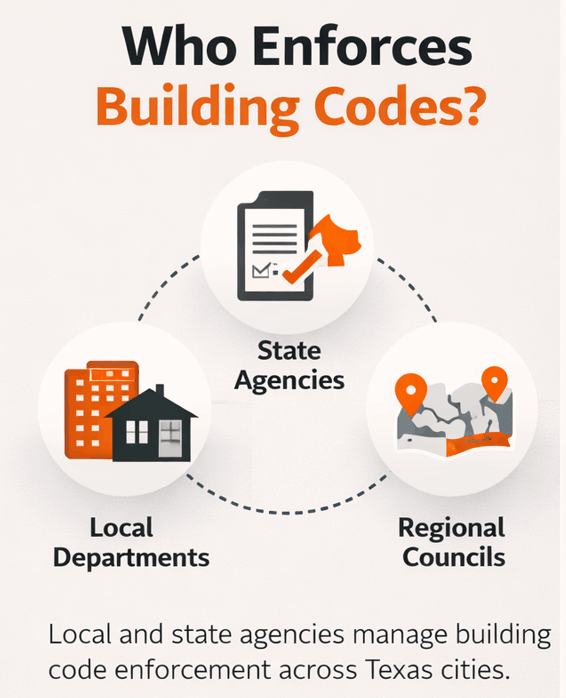
Quick local vs. state checklist
Local building department issues permits.
State agencies publish rules and program guides.
Regional councils may recommend amendments.
Key changes in recent code updates (what to watch for) International Residential Code
The model codes are updated every few years. Many Texas jurisdictions are moving from earlier editions to the 2024 editions. That brings changes in structure, fire safety, and energy-related rules.
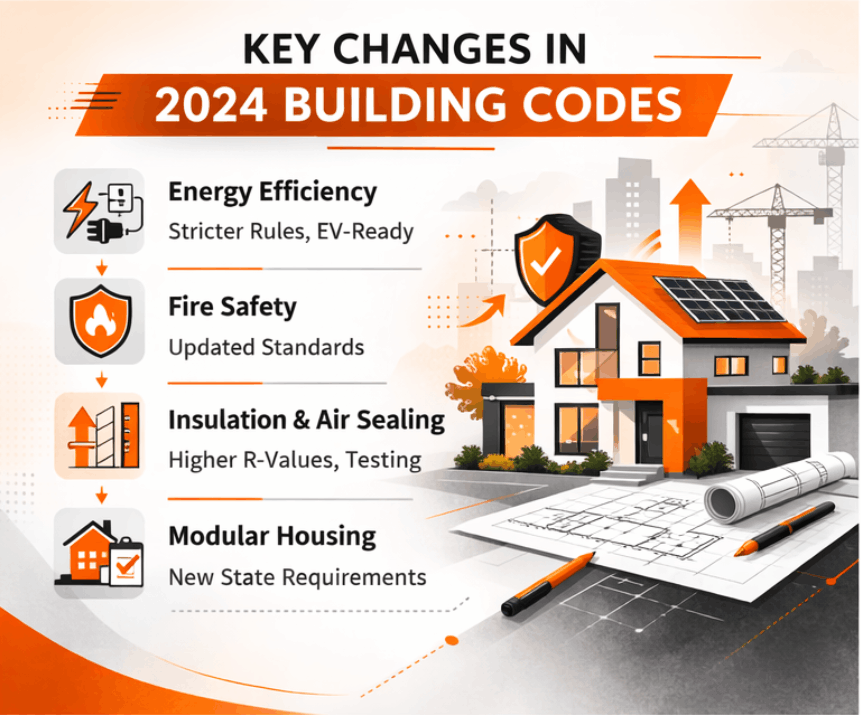
Here are the common themes you’ll see in many places:
Stronger energy provisions and new electric-ready rules. These affect wiring, EV readiness, and rooftop systems.
Updated insulation, air-sealing, and testing requirements for homes. These raise minimum efficiency.
Clarified rules for industrialized and modular housing. These took effect in mid-2024 for those building types.
Local amendments that change details — especially in older cities that keep some local requirements.
Table — Quick code comparison (summary)
| Topic | Typical older code (e.g., 2018/2021) | 2024 I-Codes (what changed) |
|---|---|---|
| Energy basics | Baseline insulation, older air-leakage limits | Tighter air-leakage, new appliance/EV-ready rules. |
| Structural rules | Standard prescriptive spans and loads | Updated references and clearer seismic/wind provisions in some areas. |
| Modular/industrialized housing | Separate state rules (varied) | State adoption clarified requirements; effective July 1, 2024. |
| Electrical code | 2020/2023 NEC in many places | Local updates reference newer NEC editions (check your city). |
Note: Table entries summarize common patterns. Always check the local building department for final, binding rules.
Permits, inspections, and common checkpoints
Permits protect safety and value. They also let you avoid fines and rework. Here is a short, practical guide.
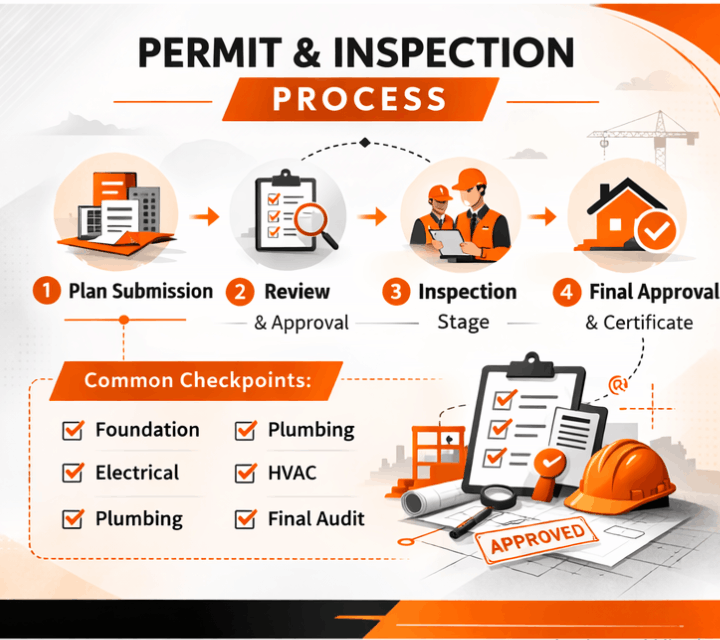
Step-by-step: typical permit flow
Submit plans and forms to the local building department.
Wait for plan review and any correction requests.
Receive permit and post it on site.
Arrange inspections (foundation, framing, electrical, final).
Obtain final approval and certificate of occupancy (if required).
Most cities have an online portal. Some still use in-person plan drops. Expect local differences in timelines and fees.
Table — Common permit checklist (one-page)
| Item | Why it matters | Typical owner or contractor action |
|---|---|---|
| Site plan | Shows setbacks and drainage | Provide scaled drawing |
| Foundation plan | Ensures proper footings and anchors | Submit engineered or prescriptive plan |
| Electrical layout | Shows circuits, EV-ready conduit | Mark panel, meter, and major loads |
| Insulation & envelope notes | Needed for energy compliance | Show R-values and sealing details |
| Final inspection request | Triggers official sign-off | Schedule once work is complete |
Pro tips
Start early. Permit review can take days to weeks.
Use the building department’s checklist. It cuts back-and-forth.
If your project is modular or industrialized, check the state program rules first.
Electrical, plumbing, and mechanical basics you should not ignore
Building codes in Texas also cover your home’s core systems. This includes electrical wiring, plumbing lines, and HVAC units. Each system must meet safety standards before you move in.
Local inspectors check these systems at different stages. So, it is smart to plan early and avoid delays later.
Electrical system basics
Electrical work must follow the National Electrical Code (NEC) as adopted by your city. Most Texas cities follow recent NEC editions with local amendments.
Here are a few common checks during inspection:
Proper grounding and bonding
Correct breaker sizes
GFCI outlets in kitchens and bathrooms
AFCI protection in bedrooms
Safe panel location and labeling
If your panel is overloaded, you may need an upgrade. Also, EV-ready wiring is now required in some new builds. So, check local rules before installing chargers later.
Table — Common electrical inspection points
| Inspection Item | What the Inspector Checks | Why it Matters |
|---|---|---|
| Service panel | Breaker size and wiring | Prevents overloads |
| GFCI outlets | Kitchen and bathroom safety | Reduces shock risk |
| Grounding system | Proper earth connection | Stops voltage surges |
| AFCI breakers | Bedroom circuits | Prevents fire risk |
| Conduit and wiring | Correct material use | Ensures durability |
Short tip: Never cover your panel with cabinets or drywall. Inspectors need full access at all times.
Plumbing system basics
Plumbing must follow state and local plumbing codes. Inspectors focus on health and water safety.
They usually check:
Pipe material type
Water pressure levels
Drainage slope
Vent pipe placement
Leak protection systems
Backflow prevention is also important. It stops dirty water from mixing with clean supply lines. Good plumbing layout also saves water over time. This helps reduce monthly utility bills.
Mechanical (HVAC) system basics
HVAC systems must meet ventilation standards. Inspectors review airflow and equipment placement.
They often check:
Duct sealing
System sizing
Exhaust vent placement
Fresh air intake
Thermostat controls
Improper ductwork can waste energy. It can also raise cooling costs in Texas summers. So, make sure ducts are sealed and insulated.
Table — HVAC inspection checklist
| Component | Inspector Focus | Common Issue Found |
|---|---|---|
| Air ducts | Sealing quality | Air leakage |
| Exhaust fans | Proper venting | Moisture buildup |
| Furnace or AC | Correct sizing | Poor cooling |
| Filters | Access space | Hard maintenance |
| Thermostat | System control | Wiring errors |
Simple advice: Do not install HVAC units in tight attic spaces without clearance. Inspectors must verify safe installation.
Energy efficiency and insulation requirements
Texas heat can be extreme. So, energy rules are now stricter in many areas.
Homes must meet minimum insulation levels. They must also reduce air leakage. This helps lower electricity use. It also improves indoor comfort.
What inspectors usually review
Energy compliance checks may include:
Wall insulation rating
Attic insulation depth
Window efficiency
Door sealing
Air leakage testing
Builders may need blower door tests. These tests measure air leaks in your home. Better sealing means less AC use in summer.
Table — Typical insulation R-value guide
| Area of Home | Recommended R-Value |
|---|---|
| Attic | R-30 to R-60 |
| Walls | R-13 to R-21 |
| Floors | R-13 to R-19 |
| Crawl space | R-19 |
| Duct insulation | R-6 to R-8 |
Higher R-values give better thermal resistance. So, your home stays cooler without extra AC use.
Simple ways to improve efficiency
Seal attic air gaps
Use double-pane windows
Install weather stripping
Insulate ducts
Add radiant barriers
These steps may reduce energy bills. They also help pass inspection faster.
Fire safety rules every Texas project should meet
Fire safety is a key part of building codes in Texas. Inspectors review these items before final approval. So, do not leave them for the last stage.
Smoke alarms must be installed in:
Every bedroom
Hallways outside sleeping areas
Each floor of the home
Carbon monoxide alarms may also be required. This depends on fuel-burning appliances in the home.
Common fire safety checks
Inspectors often review:
Smoke alarm placement
Emergency escape windows
Fire-rated doors (if required)
Garage-to-home wall protection
Stairway clearance
Escape windows must open fully. They must also meet size limits for safe exit. Garage walls that connect to living space must be fire-rated. This slows fire spread if a vehicle catches fire.
Table — Basic fire safety requirements
| Safety Item | Minimum Requirement | Why it Matters |
|---|---|---|
| Smoke alarms | Each bedroom and floor | Early fire warning |
| Egress windows | Openable and sized | Safe emergency exit |
| Fire doors | Rated where needed | Slows fire spread |
| Garage wall | Fire-resistant board | Protects living space |
| Stair clearance | Code width | Fast evacuation |
Quick tip: Do not install smoke alarms too close to vents. Airflow may affect their performance.
Accessibility basics in residential and commercial builds
Accessibility rules help people move safely. These rules apply more in commercial buildings. However, some homes must follow them too. Doorways must allow easy entry. Hallways must offer safe passage. Bathrooms may need grab bar support. Ramps may be needed in public spaces.
Inspectors may check:
Door width
Ramp slope
Floor level changes
Handrail height
Switch and outlet height
Entry ramps must not be too steep. Handrails must be firmly fixed. Accessible switches must be within reach range. This improves daily use for all occupants.
Table — Common accessibility measurements
| Feature | Typical Code Range |
|---|---|
| Door width | 32 inches clear |
| Ramp slope | 1:12 ratio |
| Hallway width | 36 inches min |
| Handrail height | 34–38 inches |
| Switch height | 15–48 inches |
Even when not required, these features help future use. They also add value to the property.
Final compliance checklist before project handover
Before you close the project, review all work. Final inspections depend on this step. Missing items can delay approval. So, check each system carefully.
Pre-handover checklist
Electrical system labeled
Plumbing leak-free
HVAC tested
Insulation installed
Smoke alarms working
Windows sealed
Doors aligned
Permit closed
Also, keep all inspection reports on file. You may need them during resale. If your project passes all checks,
you may receive a Certificate of Occupancy. This document allows legal use of the building.
Table — Final inspection readiness
| System | Ready to Inspect? |
|---|---|
| Electrical | Yes / No |
| Plumbing | Yes / No |
| HVAC | Yes / No |
| Fire safety | Yes / No |
| Insulation | Yes / No |
| Structural | Yes / No |
| Permit status | Open / Closed |
Final tip: Schedule your inspection early. It helps avoid last-minute delays.
Get Expert Help with Texas Building Code Compliance
Need help with permits, inspections, or meeting Texas building code requirements? Our team is here to make the process simple and stress-free for you.
Call us at (818) 793-5058 or email sales@jdj-consulting.com to speak with an expert today. You can also visit our Contact Page to get started with your project.
Frequently asked questions about Texas building codes
Many builders and homeowners have the same concerns. Below are short, clear answers to common questions.
Do all Texas cities follow the same building code?
No, they do not. Each city or county adopts its own code edition. Most follow International Building Codes. However, they may add local amendments. So, always check with your local building office first.
Is a permit required for small home upgrades?
In many cases, yes. Permits may be needed for:
Electrical panel upgrades
Plumbing changes
HVAC replacement
Room additions
Structural wall removal
Cosmetic work like painting may not need approval. Still, ask before starting any project.
What happens if you build without a permit?
You may face:
Project delays
Fines
Stop-work notices
Failed inspections
Trouble during resale
In some cases, you may need to remove the work. Then rebuild it to meet code.
How long does permit approval take?
It depends on the project size. Small upgrades may take a few days. New construction may take weeks. Plan reviews often need corrections. So, submit documents early.
Can you schedule inspections online?
Most Texas cities now offer online portals.
You can:
Apply for permits
Upload drawings
Schedule inspections
Track approval status
Check your city website for access details.
Are energy-efficient features required?
Yes, in many jurisdictions. New homes must meet:
Insulation levels
Window efficiency
Air sealing limits
HVAC performance standards
These rules help lower energy use.
Who issues the Certificate of Occupancy?
Your local building department does.
You receive it after:
Final inspection approval
Code compliance checks
Permit closure
Without this certificate, the building may not be legally occupied.