What Is a Building Permit and Why Do You Need One?
A building permit is an official approval from a local authority. It allows you to begin construction or certain types of work on a property.
The permit confirms that your project follows:
Safety standards
Without a permit, even a small project can turn into a costly problem later.
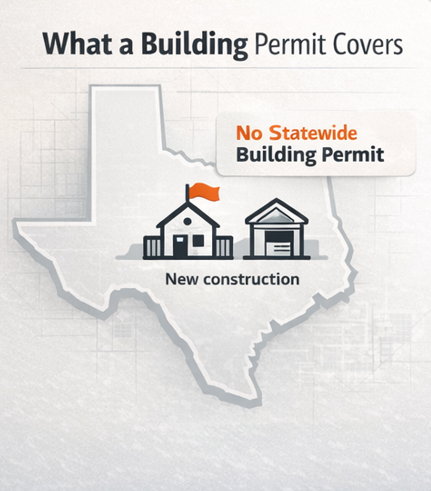
What a Building Permit Covers
A permit usually applies to work such as:
New construction
Home additions
Structural changes
Electrical, plumbing, or HVAC work
Commercial build-outs
Each city or county decides what work requires a permit. Some minor repairs may be exempt. Major work is not.
Why Permits Matter More Than People Think
Permits are not just paperwork. They protect you and everyone who uses the building.
Here is why permits matter:
They help ensure the building is safe to use
They reduce liability risks
They are often required for insurance claims
They prevent delays during inspections or resale
Skipping a permit can cause serious trouble. In many cases, cities can issue fines or require demolition of unapproved work.
Common Permit Misunderstandings
Many owners assume permits are optional. That is rarely true.
Here are a few common myths:
“It’s my property, so I don’t need approval.”
“The contractor handles everything automatically.”
“Small projects never need permits.”
In reality, responsibility often falls on the property owner. Even if a contractor applies for the permit, you are still accountable.
Who Issues Building Permits in Texas?
Texas handles building permits differently than some other states. There is no single statewide permit office for normal construction projects. Instead, permits are issued by local jurisdictions.
City Governments Issue Most Permits
If your property is inside city limits, the city issues the permit.
This usually happens through:
Large cities often have online portals. Smaller cities may require in-person visits.
Here is a general comparison.
| Location of Property | Who Issues the Permit | Where You Apply |
|---|---|---|
| Inside city limits | City government | City building or development department |
| Outside city limits | County or special district | County engineering or planning office |
| Special use projects | State or regional agency | Separate state or environmental office |
Each city sets its own rules. That is why requirements in Dallas may differ from Austin or Houston.
Counties Handle Permits in Unincorporated Areas
If your property is outside city limits, the county may issue the permit.
However, this depends on the county. Some counties have limited authority. Others manage full permitting through engineering or development offices.
In rural areas, you may deal with:
County engineering departments
Fire marshal or emergency service districts
Floodplain or environmental offices
This makes it important to confirm jurisdiction before applying.
State Agencies May Still Be Involved
Even though cities and counties issue most permits, some projects require state approval too.
This often applies to:
Elevator and accessibility compliance
Certain commercial or industrial projects
Environmental or stormwater controls
These approvals do not replace a building permit. They work alongside it.
Here is a simple breakdown.
| Authority Type | Role in Construction |
|---|---|
| City or County | Issues the main building permit |
| State agency | Reviews specific systems or regulations |
| Utility provider | Approves service connections |
Knowing who does what helps avoid delays later.
Where Can You Apply for a Building Permit in Texas?
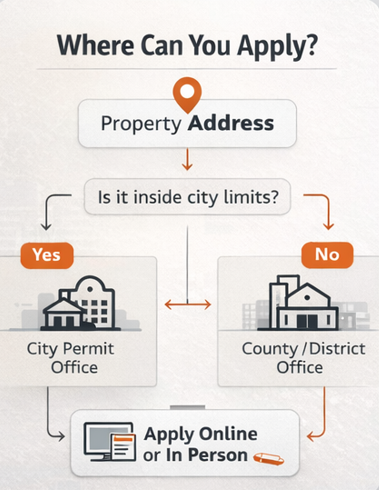
The exact place to apply depends on your property’s address. This is the most important step. Everything else flows from this.
Step One: Confirm Your Property Location
Before applying, confirm whether your property is:
Inside city limits
Outside city limits
In a special zoning or overlay district
A simple address search on the city or county website usually answers this.
Applying Within City Limits
If the property is in a city, you will apply through that city’s permitting office.
Most cities offer:
Online application portals
In-person permit counters
Phone or email support
Large metro areas often allow you to upload plans, pay fees, and schedule inspections online.
Smaller cities may still rely on paper submissions.
Applying Outside City Limits
For unincorporated areas, you may need to contact:
County engineering department
County planning office
Fire marshal or emergency service district
Some counties issue permits directly. Others only regulate certain aspects like septic systems or floodplains.
Always confirm before starting work.
Typical Information You Will Need
Most permit offices ask for similar documents:
Property address and legal description
Construction plans or drawings
Contractor details
Owner authorization
Missing documents are the most common cause of delays.
Types of Building Permits You May Need in Texas
Not all permits are the same. The type you need depends on the kind of work you are doing and how the property is used. Cities and counties separate permits to keep reviews clear and inspections organized.
Understanding the category early helps you avoid applying for the wrong permit.
Residential Building Permits
Residential permits apply to single-family homes, duplexes, and small residential projects. These are the most common permits issued across Texas.
You will usually need a residential permit for:
New home construction
Room additions or expansions
Garage or carport construction
Structural repairs
Roof replacements (in many cities)
Even small changes can trigger a permit if they affect structure or safety.
Trade Permits for Residential Projects
Many cities issue separate trade permits for specific systems. These permits often require licensed professionals.
Common trade permits include:
Electrical permits
Plumbing permits
Mechanical or HVAC permits
In some cases, these are issued alongside the main building permit. In others, they are pulled separately by licensed contractors.
Commercial Building Permits
Commercial permits apply to properties used for business or public access. These permits usually involve more review and longer timelines.
Examples include:
Office buildings
Retail spaces
Restaurants
Warehouses
Medical or educational facilities
Commercial permits often involve multiple departments. Fire, zoning, accessibility, and utilities may all review the plans.
Interior Alteration Permits
Interior work still counts as construction in most cities. If the work affects layout, exits, or systems, a permit is required.
Interior alteration permits are common for:
Tenant improvements
Office remodels
Retail build-outs
Restaurant renovations
Even if no walls move, permit approval may still be required.
Here is a simple overview.
| Permit Type | Common Use | Typical Review Level |
|---|---|---|
| Residential building | Homes and additions | Standard |
| Trade permits | Electrical, plumbing, HVAC | Licensed review |
| Commercial building | Business properties | Detailed |
| Interior alteration | Remodels and build-outs | Moderate to high |
What You’ll Need to Apply for a Building Permit
Permit offices review hundreds of applications every month. Clear and complete submissions move faster. Incomplete ones slow down quickly.
Knowing what to prepare saves time.
Basic Documents Most Cities Require
Most jurisdictions ask for the same core items. Requirements vary, but the basics stay consistent.
You will usually need:
Completed permit application
Construction plans or drawings
Property ownership information
Contractor details
Permit fees
Some cities accept digital plans. Others still require printed sets.
Construction Plans and Drawings
Plans do not always need to be complex. However, they must clearly show the scope of work.
Plans often include:
Floor plans
Structural details
Electrical or plumbing layouts
Commercial projects usually require stamped plans from licensed professionals.
Contractor and License Information
For many permits, licensed contractors must be listed.
This commonly applies to:
Electrical work
Plumbing systems
Mechanical installations
Some cities allow homeowners to pull their own permits. Others restrict this based on project type.
Always confirm local rules before applying.
Fees and Payment Timing
Permit fees vary by location and project size. Some fees are flat. Others are based on valuation.
You may pay:
At application
After plan approval
Before inspections
Here is a general fee overview.
| Project Type | Typical Fee Range | Notes |
|---|---|---|
| Small residential work | Low to moderate | Often flat fee |
| Home addition | Moderate | Based on square footage |
| Commercial project | Higher | Based on valuation |
| Interior remodel | Varies | Depends on scope |
Fees are not refundable once reviews begin in most cities.
Owner vs. Contractor Applications
Who applies matters.
Contractors often pull permits for technical work
Owners may apply for basic residential projects
Commercial permits usually require professional involvement
Even when a contractor applies, the owner remains responsible for compliance.
How the Building Permit Application Process Works in Texas
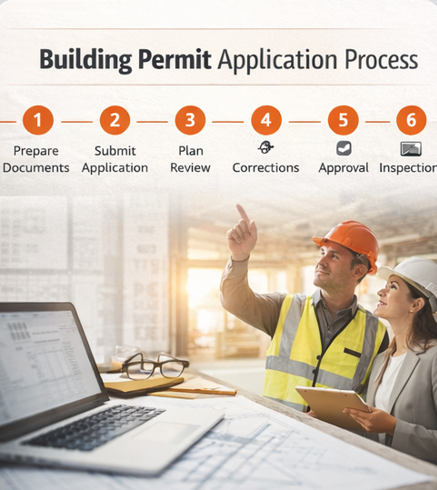
Once you know which permit you need and where to apply, the process follows a fairly standard path. Details vary by city or county, but the steps below apply almost everywhere in Texas.
Understanding the flow helps you plan timelines and avoid surprises.
Step 1: Prepare and Review Your Documents
Before submitting anything, review the local permit checklist. Most delays happen here.
Take time to confirm:
The correct permit type
Required drawings and forms
Contractor license details
Application fees
If something is missing, the application will stop before review even begins.
Step 2: Submit the Application
Applications are submitted in one of two ways:
Online through a city or county portal
In person at the permitting office
Online systems are common in large cities. Smaller jurisdictions may still rely on counter submissions.
After submission, you will receive a case or permit number. Keep this for tracking.
Step 3: Plan Review by the Authority
Once accepted, the application enters plan review.
During this stage, reviewers check for:
Building code compliance
Zoning and land use rules
Fire and life safety standards
Accessibility requirements (for commercial projects)
Residential reviews are often faster. Commercial reviews usually involve multiple departments.
Step 4: Corrections and Resubmittals
If reviewers find issues, they will issue comments.
This is normal. Most projects receive at least one round of comments.
You will need to:
Address each comment clearly
Update plans or documents
Resubmit for approval
Clear responses help move the project forward faster.
Step 5: Permit Approval and Issuance
Once all reviews pass, the permit is approved.
You may need to:
Pay remaining fees
Pick up approved plans
Post the permit at the job site
Only after this step can construction legally begin.
Inspections, Approvals, and Final Sign-Off
A permit does not end with approval. Inspections are required at key stages of construction.
Skipping inspections can stop a project immediately.
Required Inspections During Construction
Inspection schedules vary, but most projects include:
Foundation or footing inspection
Framing inspection
Trade inspections (electrical, plumbing, HVAC)
Final inspection
Each inspection confirms the work matches the approved plans.
Scheduling Inspections
Inspections are usually scheduled:
Online through the permit portal
By phone or email
Most cities require at least one business day’s notice.
Work should not continue past a stage until it passes inspection.
Failed Inspections and Corrections
If an inspection fails, the inspector will note the issue.
You must:
Correct the problem
Request a reinspection
Pass before moving forward
Repeated failures can delay timelines and increase costs.
Final Inspection and Certificate of Occupancy
For many projects, especially commercial ones, a final approval is required.
This may include:
Final building inspection
Fire inspection
Accessibility sign-off
Once approved, the city may issue a Certificate of Occupancy. This allows the building to be legally used.
Common Permit Problems and How to Avoid Them
Most permit issues are preventable. They usually come from missing details or misunderstanding local rules.
Frequent Mistakes Property Owners Make
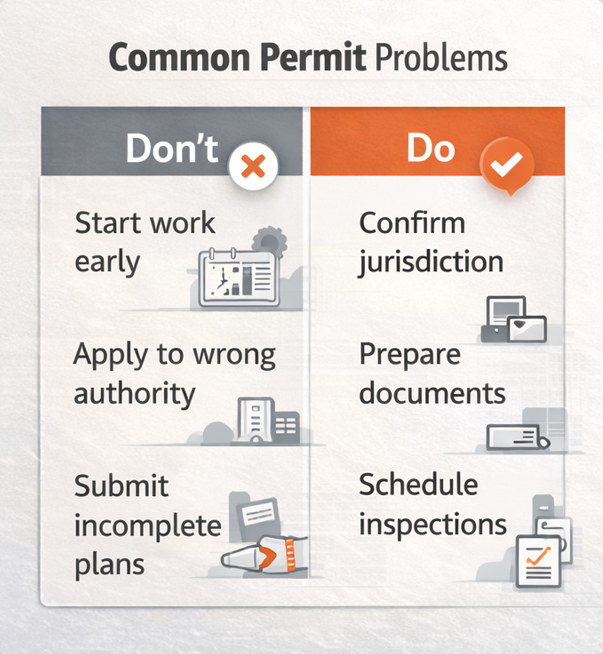
Some common problems include:
Applying to the wrong authority
Submitting incomplete plans
Ignoring zoning limits
Starting work before permit approval
These mistakes lead to delays, stop-work orders, or fines.
How to Keep Your Project on Track
Simple steps can prevent major issues:
Confirm jurisdiction early
Read local checklists carefully
Respond clearly to review comments
Track permit expiration dates
Permit approvals are time-limited. Letting a permit expire can force a full reapplication.
When Professional Help Makes Sense
Complex projects benefit from expert guidance.
This is especially true for:
Commercial construction
Interior build-outs
Projects with multiple permits
Tight construction schedules
Working with a permitting consultant helps reduce back-and-forth with local offices.
Special Permit Situations in Texas
Not every project fits neatly into standard permit categories. Understanding these special cases can save time, money, and stress. Cities and counties have exceptions, and some projects may require multiple permits or approvals from different authorities.
Projects That May Not Require a Permit
Some minor work does not require a permit. However, the rules vary by city and county, so always confirm before starting work.
Typical examples include:
Minor cosmetic repairs (painting, flooring, cabinetry)
Non-structural landscaping or fences under a certain height
Small accessory structures in some cities (like sheds under a size limit)
Certain agricultural buildings outside city limits
Even if a permit is not required, work must still meet building codes and safety standards.
When Multiple Permits Are Required
Some projects involve several types of work. This is common in commercial construction or major residential remodels.
Commercial projects often need:
Building permit
Electrical, plumbing, and mechanical permits
Fire code approval
Accessibility compliance (ADA)
Utility connections and inspections
Large residential projects may need:
Main building permit
Trade permits for plumbing, electrical, and HVAC
Septic or drainage permits (if outside city sewer)
Managing multiple permits can be challenging, which is why professional help is often beneficial.
Permit Timing Considerations
Permit processing time varies. Some factors that affect timing include:
Project complexity
Jurisdiction workload
Completeness of plans
Local review schedules
Tip: Submit well-prepared plans and documents to reduce back-and-forth.
| Factor Affecting Timing | Typical Impact |
|---|---|
| Small residential work | Few days to 2 weeks |
| Major home addition | 2–6 weeks |
| Commercial construction | 4–12 weeks or more |
| Corrections/resubmissions | Add 1–3 weeks per round |
Tips to Avoid Delays and Complications
Even with careful planning, projects can face delays. Here are practical steps to keep things on track:
Check local requirements early – Each city or county has unique rules.
Prepare complete documentation – Incomplete applications are the most common cause of delays.
Hire licensed professionals – Many permits require licensed tradespeople to submit applications.
Schedule inspections promptly – Don’t wait until the last minute.
Stay organized – Keep copies of all applications, receipts, and correspondence.
Working with a Permitting Consultant
For complex projects, a permitting consultant can:
Review plans for compliance
Submit applications correctly
Communicate with city or county offices
Track inspections and approvals
This helps ensure your project progresses smoothly and avoids costly mistakes.
Tips to Speed Up the Permit Process in Texas
Getting a building permit can sometimes feel slow or confusing. However, there are clear steps you can take to keep the process moving efficiently.
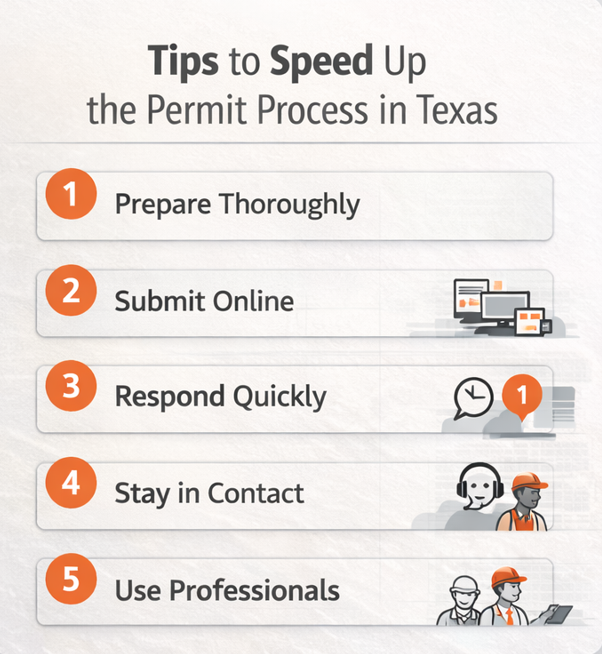
1. Prepare Thoroughly Before Applying
Review the local permit checklist carefully.
Confirm which permits are required for your project.
Gather all necessary documents, drawings, and contractor licenses.
Make sure plans are complete, clear, and professional.
Tip: Double-check your submission. Missing items are the top reason for delays.
2. Submit Applications Online When Possible
Many Texas cities and counties now offer online portals. Online submissions:
Reduce paperwork
Allow faster tracking of your application
Enable electronic plan review and approvals
For example, cities like Austin, Dallas, and Houston allow property owners or contractors to submit plans digitally and schedule inspections online.
3. Respond Quickly to Corrections
Most permit applications require at least one round of corrections.
Respond to reviewer comments clearly and promptly.
Ensure all updates match the requested changes.
Quick responses keep the review moving and prevent unnecessary resubmissions.
4. Stay in Contact with the Permit Office
Ask questions if something is unclear.
Confirm receipt of documents.
Track inspections and approvals regularly.
Maintaining open communication often prevents small issues from turning into big delays.
5. Use Professionals for Complex Projects
Licensed contractors, architects, or permitting consultants can reduce errors.
They understand local codes, submission requirements, and inspection expectations.
Professional involvement often shortens review timelines.
Key Takeaways
| Tip | Why It Helps |
|---|---|
| Prepare all documents | Reduces errors and resubmissions |
| Apply online | Faster processing and tracking |
| Respond quickly to corrections | Keeps the review moving |
| Stay in touch with authorities | Prevents delays and miscommunication |
| Hire professionals | Ensures compliance and smoother approvals |
Conclusion – Your Next Steps
Applying for a building permit in Texas may seem overwhelming, but understanding the process makes it manageable. Here’s a quick summary:
Confirm your property location – Inside city limits or unincorporated county?
Identify the permit type – Residential, commercial, or trade permits.
Prepare complete documents – Plans, applications, contractor info, fees.
Submit application – Online or in-person, following the local checklist.
Respond to review comments – Make corrections quickly.
Schedule inspections – Ensure work meets building codes at each stage.
Obtain final approval or Certificate of Occupancy – Legally allows occupancy or use.
With proper planning, patience, and attention to detail, the permit process can proceed smoothly. For complex projects, professional guidance is highly recommended.