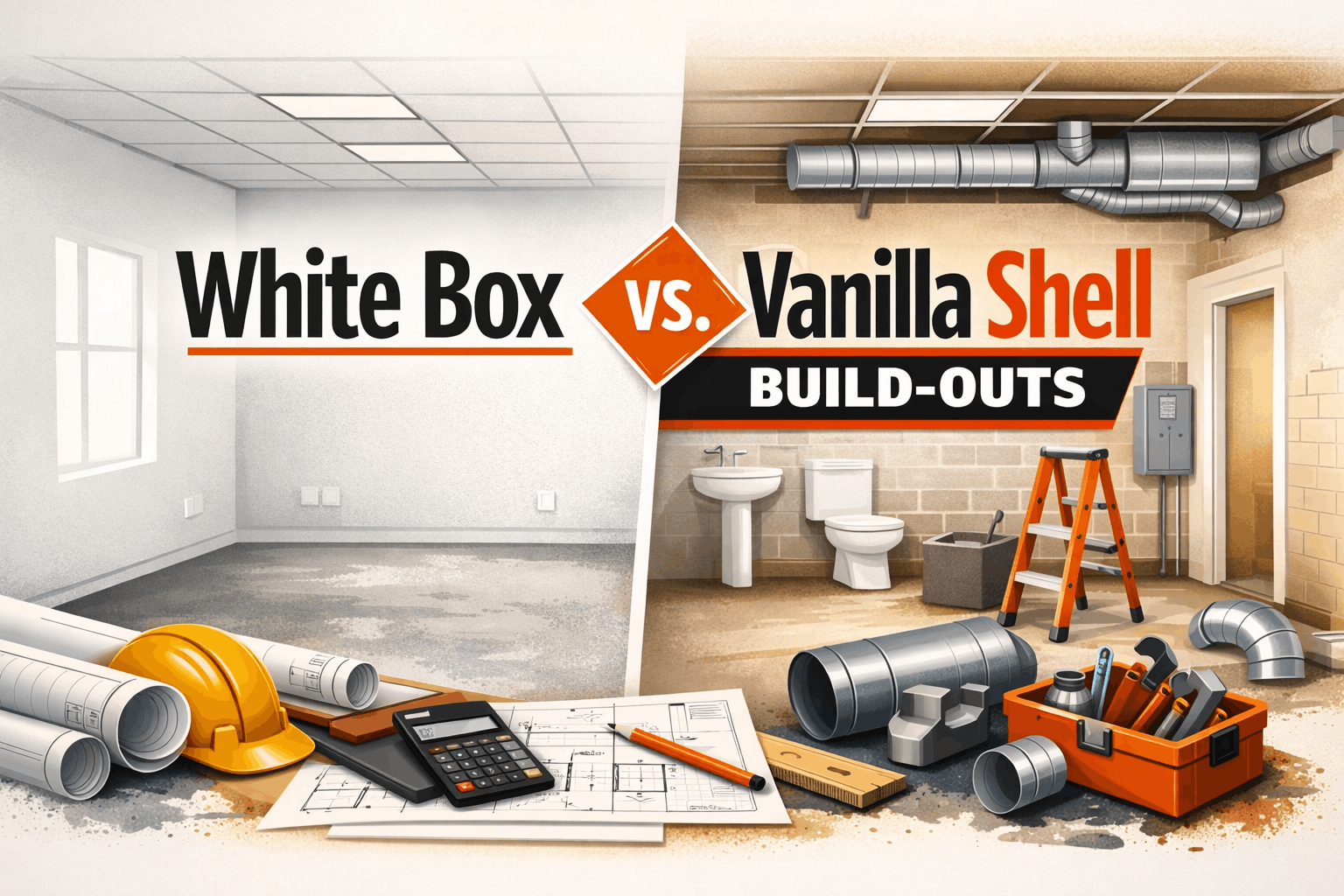
Commercial spaces are rarely delivered fully finished. In most cases, landlords provide a basic interior condition and expect tenants to complete the rest. This process is called a build-out.
If you are opening a retail store, office, restaurant, or clinic, you will likely hear terms like white box, vanilla shell, or tenant improvements during lease discussions. These terms describe how finished the space is before construction begins.
The level of completion matters more than many tenants realize. It affects:
-
Construction cost
-
Permit requirements
-
Opening timeline
-
Design flexibility
For example, a restaurant may require major plumbing and kitchen systems. Meanwhile, a small office may only need partitions and flooring. Because of these differences, landlords often deliver spaces in different conditions.
Two of the most common delivery conditions are:
-
White box space
-
Vanilla shell space
Both provide basic infrastructure. However, they differ in how much construction is already completed. Understanding the difference helps tenants plan budgets and avoid unexpected delays.
In this guide, we explain how commercial build-outs work. We also compare white box and vanilla shell spaces so business owners can make better leasing decisions.
What Is a Commercial Build-Out?
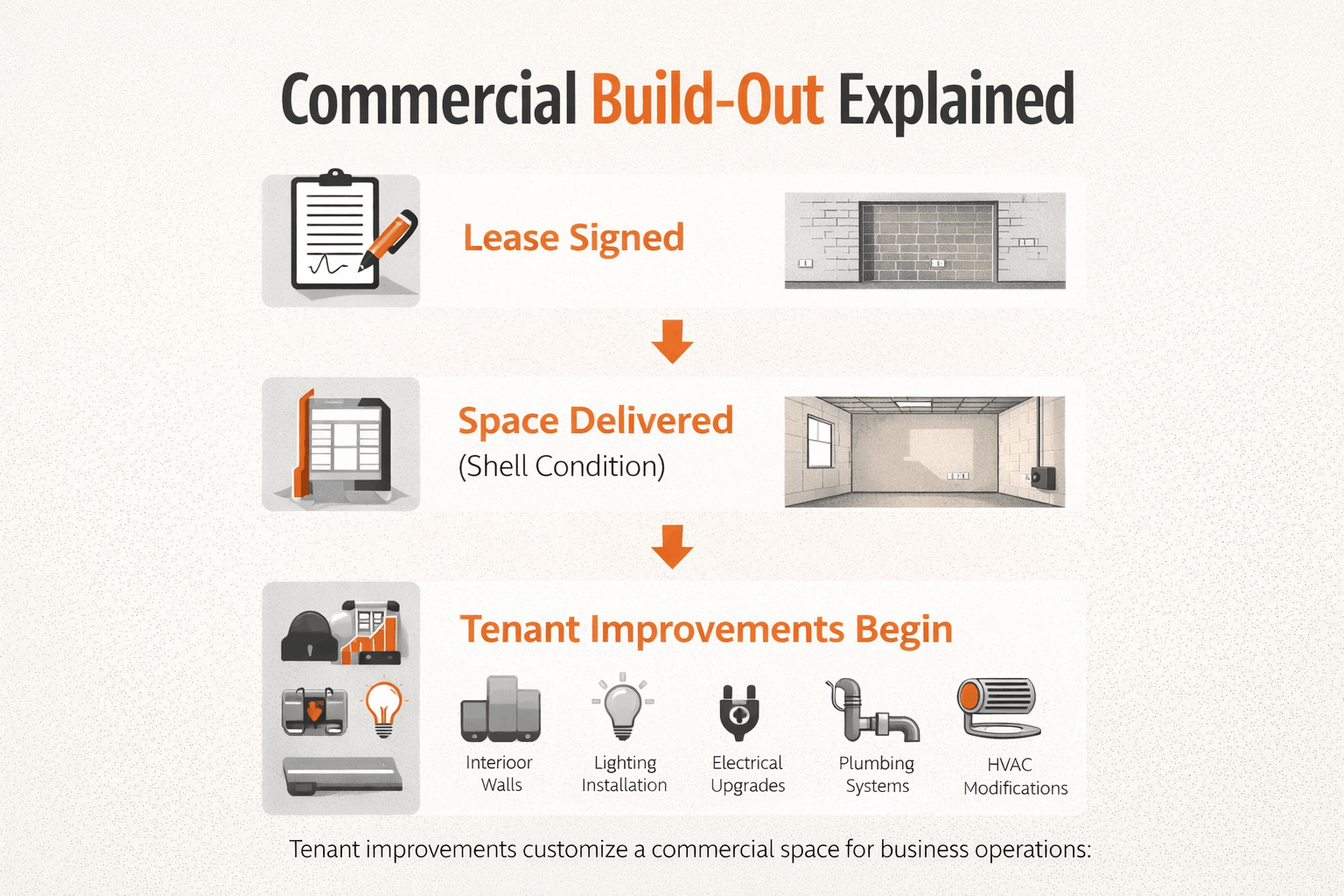
A commercial build-out refers to the construction work needed to prepare a leased space for a tenant’s operations. It usually happens after the lease is signed but before the business opens.
Landlords rarely finish the space for a specific tenant. Instead, they deliver a partially completed interior. The tenant then customizes the space according to their business needs.
This construction work may include:
-
Interior walls
-
Flooring installation
-
Electrical upgrades
-
Plumbing systems
-
Lighting installation
-
HVAC modifications
Build-outs are common in retail centers, office buildings, restaurants, and medical spaces.
Without a proper build-out plan, projects can face delays, budget overruns, and permit issues. That is why understanding the condition of the space is essential before signing a lease.
Definition of a Tenant Build-Out in Commercial Real Estate
A tenant build-out, often called tenant improvements (TI), refers to the interior construction completed for a specific tenant.
The goal is simple. The space must support the tenant’s daily operations.
For example:
-
A law office may need private offices and meeting rooms.
-
A restaurant requires kitchens, plumbing, and grease traps.
-
A retail store may install display areas and storage rooms.
Because each business has different requirements, tenant improvements vary widely. Some projects are simple. Others involve significant construction work.
Typical tenant improvement work may include:
-
Installing interior partitions
-
Adding electrical outlets
-
Building restrooms
-
Installing specialty lighting
-
Upgrading HVAC systems
-
Creating customer areas
In many leases, landlords provide a Tenant Improvement Allowance (TIA). This allowance helps cover part of the construction cost. However, the tenant often pays for additional upgrades beyond the allowance. Understanding the build-out scope early helps avoid confusion later in the project.
Why Build-Out Conditions Matter for Tenants and Landlords
The condition of a commercial space affects several parts of the project.
- First, it impacts the construction budget. A space that already includes lighting and HVAC will cost less to finish than an empty shell.
- Second, it affects the construction timeline. Spaces that require major work may take months to complete.
- Third, the space condition influences permit requirements. Extensive construction often requires more inspections and approvals.
For landlords, the delivery condition can help attract different types of tenants. Some businesses prefer a blank canvas. Others want a space that requires minimal work.
Below is a simplified comparison of common space delivery conditions.
| Space Condition | Description | Typical Tenant Work |
|---|---|---|
| Cold Dark Shell | Bare structure with minimal utilities | Full interior construction |
| Gray Shell | Basic building systems installed | Interior walls and finishes |
| White Box | Simple finished interior | Custom layout and finishes |
| Turnkey Space | Fully finished space | Minimal changes before opening |
As shown above, white box and vanilla shell spaces fall in the middle. They provide basic infrastructure but still allow customization. Because of this balance, these two conditions are very common in commercial leasing.
Common Types of Commercial Space Delivery
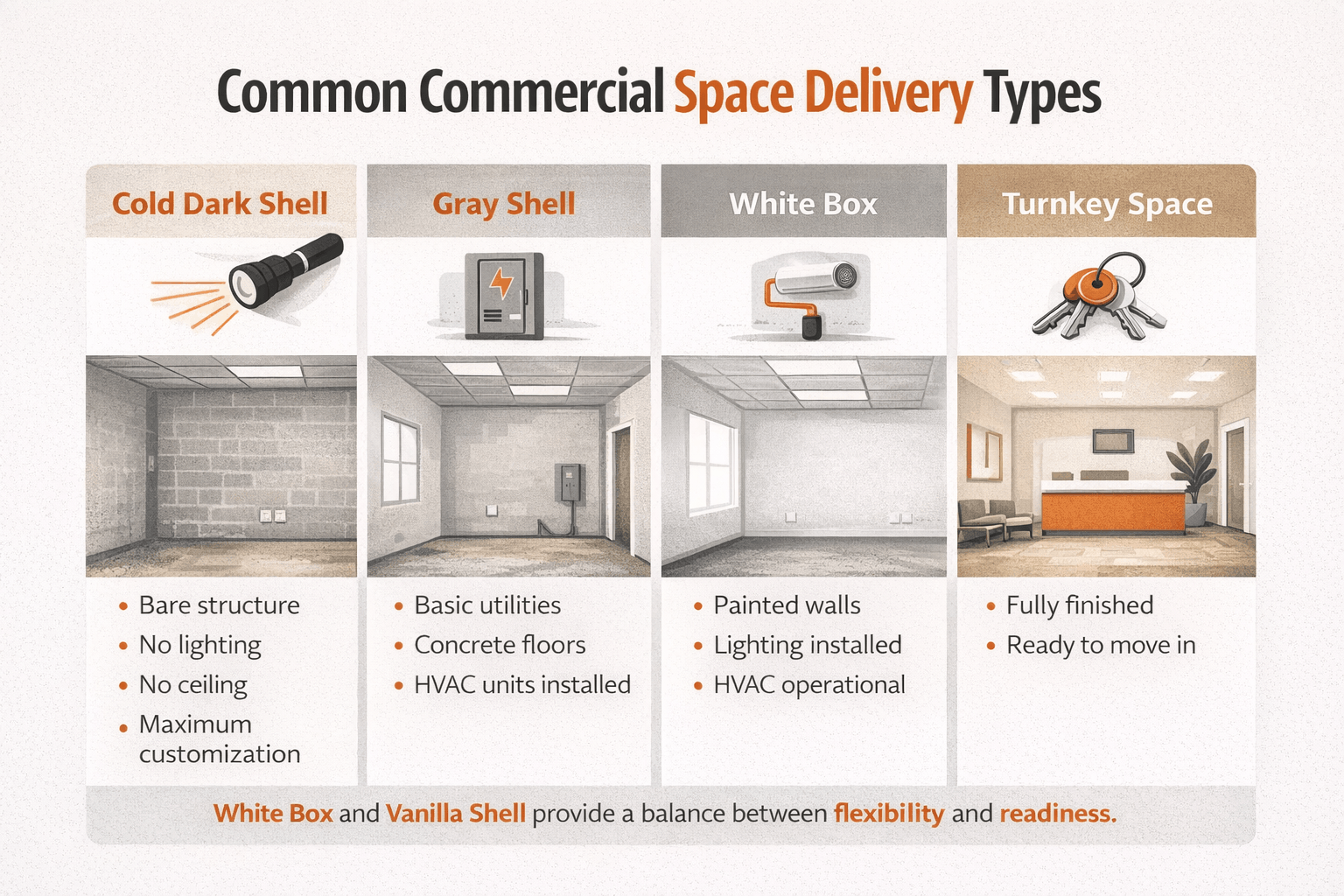
Commercial spaces are typically delivered in four main conditions. Each one requires a different level of construction. Understanding these terms helps tenants ask the right questions during lease negotiations.
1. Cold Dark Shell
This is the most unfinished type of space.
It usually includes:
-
Bare concrete floors
-
Exposed structural walls
-
No ceilings
-
No lighting
-
Limited utilities
Tenants must complete nearly all interior construction. These spaces offer maximum flexibility but also require the highest investment.
2. Gray Shell
A gray shell includes some basic systems, but the interior remains unfinished.
Typical features include:
-
Exterior walls completed
-
Electrical service to the unit
-
Basic plumbing stubs
-
HVAC units installed but not connected
-
Concrete floors
Tenants still complete most interior construction.
3. White Box
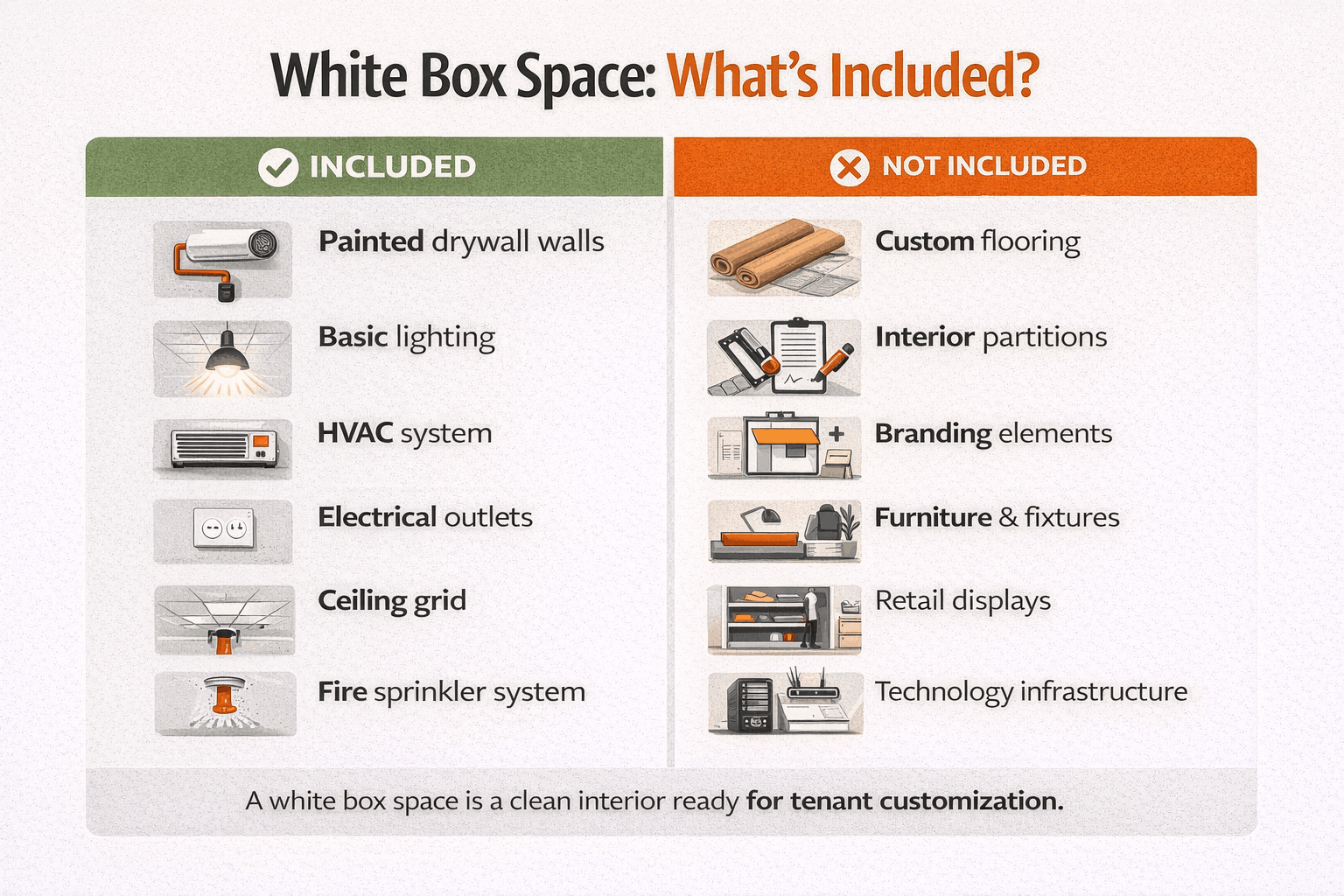
A white box space provides a simple finished interior.
It usually includes:
-
Painted drywall walls
-
Basic lighting
-
Ceiling systems
-
HVAC installed and functioning
-
Electrical outlets
Tenants mainly focus on layout and branding.
4. Turnkey Space
Turnkey spaces are fully finished.
They may already include:
-
Office partitions
-
Flooring
-
Lighting
-
HVAC
-
Restrooms
In many cases, tenants can move in with minimal work.
The table below summarizes the level of completion for each type.
| Delivery Condition | Level of Completion | Flexibility for Tenants |
|---|---|---|
| Cold Dark Shell | Very low | Very high |
| Gray Shell | Low | High |
| White Box | Medium | Moderate |
| Turnkey | High | Low |
Because white box and vanilla shell spaces offer a balance between flexibility and readiness, they are among the most common options in retail and office leasing.
What Is a White Box Build-Out?
A white box build-out refers to a commercial space that has basic interior construction completed by the landlord. The space is clean, simple, and ready for tenant customization.
Many landlords prepare spaces this way because it makes them easier to lease. Instead of delivering a raw shell, they complete the basic interior work first. This creates a neutral space that different businesses can adapt to their needs.
The term “white box” comes from the typical appearance of the space. Walls are often painted white, lighting is installed, and the interior looks clean but empty.
However, the space is not ready for immediate use. Tenants still need to complete their own build-out.
For example, a retail tenant may still need to add:
-
Interior display walls
-
Flooring materials
-
Branding and signage
-
Storage areas
-
Checkout counters
An office tenant may install:
-
Private offices
-
Meeting rooms
-
Reception areas
-
Workstations
In simple terms, a white box space provides the basic infrastructure, while the tenant completes the final layout and finishes. This setup gives businesses flexibility while reducing the amount of construction required compared to a raw shell.
Typical Features Included in a White Box Space
Although the exact features may vary by landlord, most white box spaces include several basic systems already installed. These elements allow tenants to begin their interior build-out without starting from scratch.
Common features include:
-
Finished drywall walls
-
Basic interior lighting
-
HVAC system installed and operational
-
Electrical outlets and wiring
-
Drop ceiling or drywall ceiling
-
Fire sprinkler system
-
Concrete or prepared flooring
-
Code-compliant restrooms
-
Electrical panel and service
These improvements create a space that is structurally complete and ready for customization. The table below shows common components included in most white box deliveries.
| Component | Typically Included in White Box | Purpose |
|---|---|---|
| Drywall Walls | Yes | Creates finished interior surfaces |
| Ceiling Grid | Yes | Supports lighting and HVAC systems |
| Basic Lighting | Yes | Provides general illumination |
| HVAC System | Yes | Ensures heating and cooling |
| Electrical Outlets | Yes | Allows equipment installation |
| Restrooms | Often | Meets building code requirements |
| Flooring Finish | Usually No | Installed by tenant |
While the infrastructure is present, the interior still feels empty. That is intentional. It allows each tenant to design the space according to their business needs.
What Is NOT Included in a White Box
Even though the space looks finished at first glance, many important elements are still missing. These components are typically installed during the tenant improvement phase.
Items usually not included in a white box space include:
-
Interior partition walls
-
Specialty flooring materials
-
Custom lighting designs
-
Built-in shelving or displays
-
Furniture and fixtures
-
Technology infrastructure
-
Decorative finishes
-
Branding elements
For example, a clothing store may add:
-
Display racks
-
Dressing rooms
-
Custom lighting
-
Branded walls
Meanwhile, a medical office may need:
-
Exam rooms
-
Plumbing lines for sinks
-
Medical equipment spaces
-
Privacy partitions
Because each business has unique needs, landlords leave these elements for tenants to install. This approach keeps the base construction simple while allowing flexibility for different industries.
Advantages of White Box Spaces
White box spaces offer several benefits for both tenants and landlords.
- First, they reduce the amount of construction required compared to raw shell spaces. Basic systems like HVAC and lighting are already installed.
- Second, they allow design flexibility. Tenants can still shape the interior layout to fit their operations.
- Third, white box spaces often speed up the leasing process. A clean interior makes it easier for potential tenants to visualize their business in the space.
Some of the main advantages include:
-
Lower initial construction work
-
Faster tenant improvements
-
Flexible interior design options
-
Attractive presentation for prospective tenants
-
Reduced preparation costs for landlords
Because of these advantages, white box spaces are common in shopping centers, retail strips, and mixed-use buildings.
Disadvantages of White Box Spaces
Despite their advantages, white box spaces are not always the best option for every tenant. Some businesses require extensive customization. In those cases, the existing finishes may need to be removed before construction begins. This can add unnecessary costs.
For example, a restaurant may need:
-
Commercial kitchen ventilation
-
Grease traps
-
Heavy plumbing systems
These requirements often involve major modifications to the existing infrastructure.
Other disadvantages include:
-
Some installed features may not match the tenant’s design
-
Tenants may pay to remove existing finishes
-
Construction still required before opening
-
Higher rent in some buildings due to pre-installed systems
Because of these factors, tenants should carefully review the space condition before signing a lease. A clear understanding of the white box scope helps avoid unexpected construction work.
What Is a Vanilla Shell Build-Out?
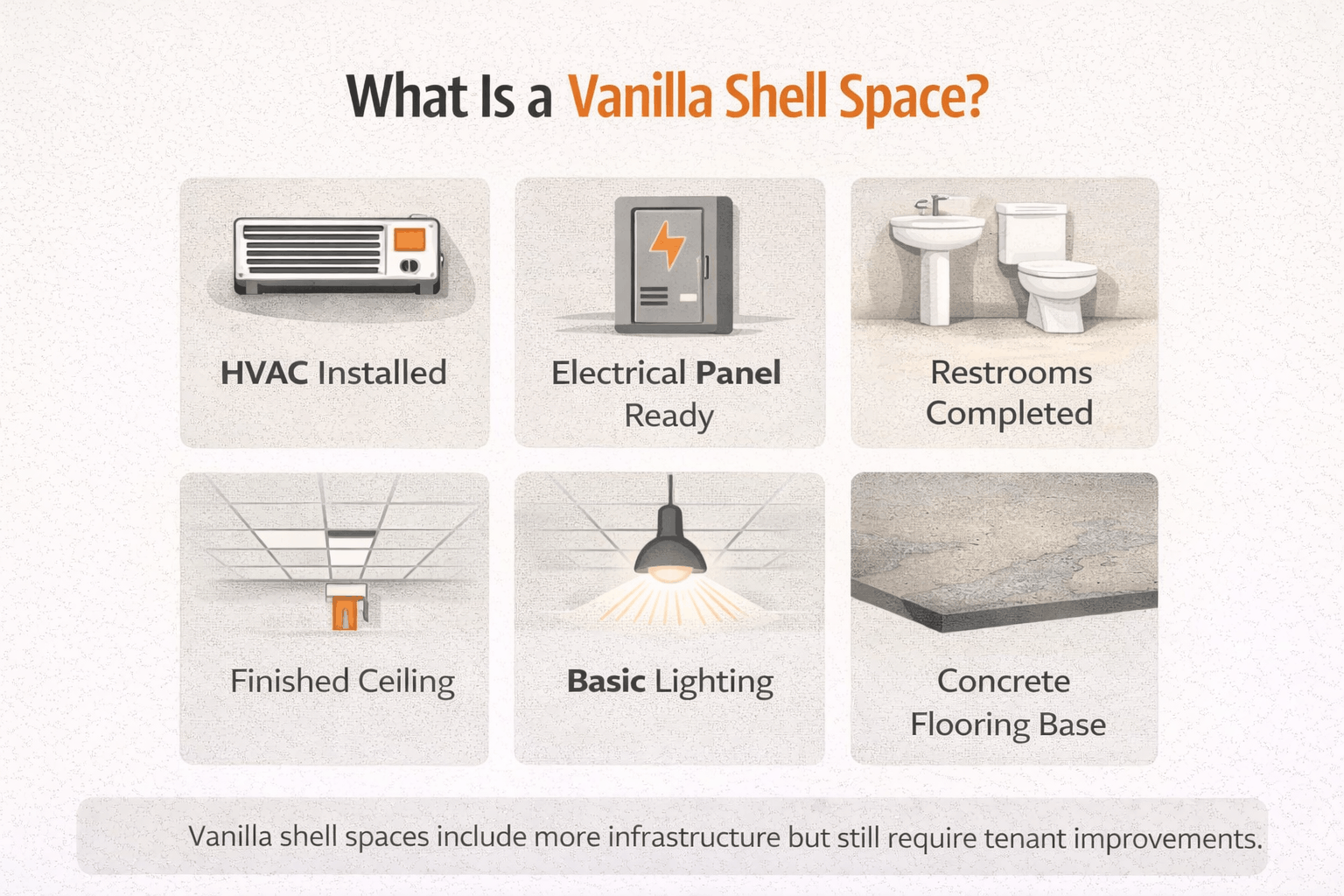
A vanilla shell build-out refers to a commercial space delivered with several basic interior systems already installed. It is more finished than a raw shell but still requires tenant improvements before the business can open.
In many markets, the terms vanilla shell and white box are sometimes used interchangeably. However, some landlords treat them as slightly different conditions.
A vanilla shell space typically includes more complete building systems than a gray shell. At the same time, it still leaves room for tenant customization.
For example, a landlord may deliver the space with:
-
HVAC installed and operational
-
Electrical panels and outlets
-
Restrooms built and functional
-
Walls painted and finished
-
Ceiling systems installed
Even with these improvements, tenants still need to complete their own layout and finishes.
For instance, a retail store may still add:
-
Display areas
-
Fitting rooms
-
Checkout counters
-
Storage rooms
Meanwhile, an office tenant might build:
-
Conference rooms
-
Private offices
-
Reception areas
-
Workstations
The goal of a vanilla shell delivery is simple. It prepares the space so tenants can begin their build-out faster while still maintaining flexibility.
Typical Features of a Vanilla Shell Space
The exact features of a vanilla shell space can vary by building and landlord. However, most include a set of standard systems that make the interior usable with fewer upgrades.
These improvements help reduce the amount of work required during tenant construction.
Common features include:
-
HVAC system fully installed
-
Electrical service and panel
-
Finished ceilings or ceiling grid
-
Basic lighting fixtures
-
Fire sprinkler system
-
Completed restrooms
-
Drywall walls painted in neutral colors
-
Electrical outlets installed
-
Concrete or basic flooring base
These elements create a space that feels mostly complete, even though final customization is still required.
The table below summarizes what is usually included in a vanilla shell delivery.
| Component | Typical Vanilla Shell Condition | Purpose |
|---|---|---|
| HVAC System | Installed and operational | Provides heating and cooling |
| Electrical Panel | Installed | Supports equipment and lighting |
| Ceiling System | Completed | Covers structural systems |
| Lighting Fixtures | Basic lighting installed | Provides general illumination |
| Restrooms | Usually completed | Meets building code requirements |
| Flooring | Concrete or base flooring | Allows tenant to install final flooring |
Because these systems are already installed, tenants can focus on layout and design instead of major infrastructure work.
What Tenants Still Need to Complete
Even though vanilla shell spaces include several improvements, they are not ready for immediate use. Tenants still need to complete a variety of interior features to support their operations.
Typical tenant improvements include:
-
Interior partition walls
-
Flooring finishes such as tile or carpet
-
Custom lighting systems
-
Storage areas
-
Reception desks
-
Retail display fixtures
-
Branding elements and signage
-
Furniture and equipment installation
The type of work depends heavily on the business.
For example:
Retail stores may need
-
Display walls
-
Product shelving
-
Checkout counters
-
Fitting rooms
Office tenants may add
-
Conference rooms
-
Private offices
-
Break rooms
Medical tenants often require
-
Exam rooms
-
Additional plumbing lines
-
Specialized equipment spaces
Because of these requirements, most vanilla shell spaces still require construction permits and inspections before opening.
Industries That Commonly Use Vanilla Shell Spaces
Vanilla shell spaces are popular in many commercial industries because they balance flexibility with readiness. Businesses that need moderate customization often prefer this type of space.
Common industries include:
-
Retail stores
-
Professional offices
-
Medical clinics
-
Fitness studios
-
Beauty salons
-
Financial services offices
Retail centers often deliver units in vanilla shell condition because it allows different types of tenants to move in without major structural work.
For example, a clothing store and a phone retailer may both use the same basic shell but install different layouts and finishes. This flexibility helps landlords lease spaces faster while still meeting tenant needs.
Why Landlords Often Deliver Vanilla Shell Spaces
Landlords use vanilla shell delivery for several practical reasons.
- First, it makes spaces more appealing to prospective tenants. A clean and partially finished interior is easier to imagine as a functioning business.
- Second, it reduces the time required for tenant construction. With basic systems already installed, build-outs can start immediately.
- Third, it keeps construction costs predictable for landlords. Instead of customizing every space, they create a standard starting point for all tenants.
Some key benefits for landlords include:
-
Faster leasing cycles
-
Reduced vacancy periods
-
Lower preparation costs compared to full build-outs
-
Flexibility for different tenant industries
Because of these advantages, vanilla shell delivery has become common in modern retail and office developments.
White Box vs. Vanilla Shell: Key Differences
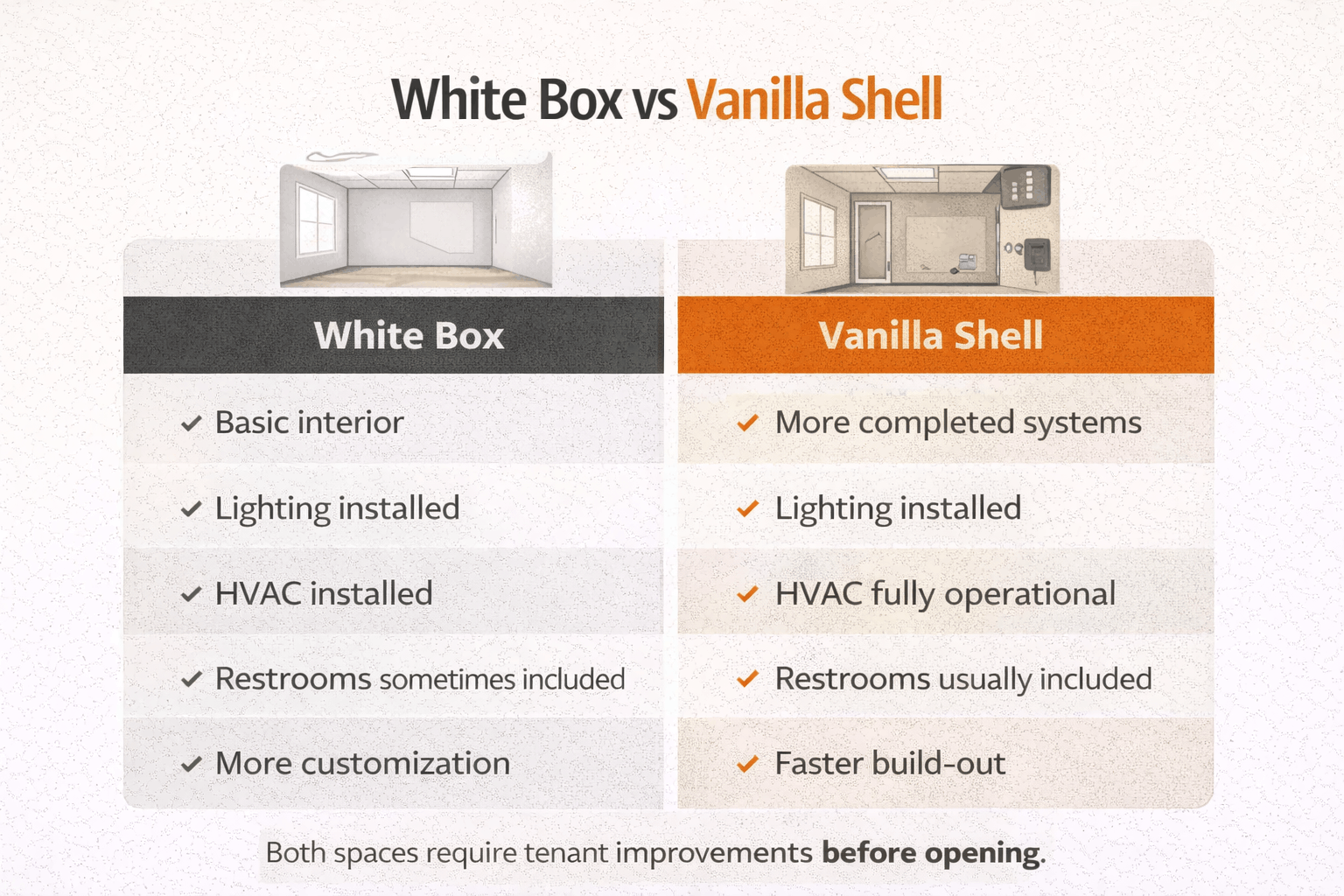
Many tenants assume white box and vanilla shell mean the same thing. In practice, the terms are often used interchangeably. However, some landlords and developers define them slightly differently.
Both space conditions include basic interior construction. Both also require tenant improvements before a business can open. The difference usually comes down to how much work has already been completed.
A white box space is typically delivered with a simple finished interior. Walls are painted, lighting is installed, and the space looks clean but empty.
A vanilla shell space may include a few additional systems or more complete infrastructure. For example, restrooms and HVAC systems may already be fully installed and operational.
Because of these variations, tenants should always confirm exactly what is included in the delivery condition before signing a lease.
The table below highlights the most common differences.
| Feature | White Box Space | Vanilla Shell Space |
|---|---|---|
| Interior Walls | Basic drywall finish | Drywall finish |
| Lighting | Basic lighting installed | Basic lighting installed |
| HVAC System | Often installed | Installed and operational |
| Electrical Outlets | Installed | Installed |
| Restrooms | Sometimes included | Usually included |
| Flooring | Concrete or unfinished | Concrete or basic flooring base |
| Tenant Work Required | Moderate | Moderate but slightly less |
Even with these distinctions, the final build-out requirements often depend on the tenant’s business type. For example, a retail boutique may only need partitions and flooring. Meanwhile, a restaurant could require major plumbing and ventilation work.
Because definitions vary across markets, it is important to review the landlord’s construction specifications carefully.
How Construction Scope Differs Between the Two
Another way to understand the difference is by looking at the construction scope required for each condition. White box spaces usually provide a neutral interior. They are designed to look clean but unfinished.
Vanilla shell spaces may feel slightly closer to completion. Some infrastructure work may already be done, which can shorten the tenant improvement process.
Below is a simplified comparison of construction scope.
| Construction Element | White Box | Vanilla Shell |
|---|---|---|
| HVAC Equipment | Installed | Installed and connected |
| Electrical Systems | Basic outlets | Fully connected systems |
| Plumbing | May be limited | Often includes restrooms |
| Ceiling Systems | Installed | Installed |
| Fire Protection | Installed | Installed |
| Interior Layout | Completed by tenant | Completed by tenant |
As the table shows, both conditions still require tenant construction. However, vanilla shell spaces sometimes reduce the amount of mechanical work required.
How Each Option Affects Construction Timeline
Construction timelines often depend on the space condition.
White box spaces typically require more tenant improvements, which may extend the build-out schedule. Tenants must design their layout, obtain permits, and complete interior construction.
Vanilla shell spaces can shorten timelines slightly because certain systems are already in place.
Still, the final timeline depends on several factors, including:
-
Tenant design complexity
-
Permit approvals
-
Contractor availability
-
Inspection schedules
-
Specialty installations
For example, an office tenant may finish a build-out within a few weeks. A restaurant, however, may need several months of construction due to kitchen systems and ventilation.
Because timelines vary widely, tenants should evaluate the delivery condition carefully before signing a lease.

Why Definitions Can Vary by Market
One challenge with these terms is that they are not strictly standardized. Different landlords may use the same term but mean different things.
For example:
-
One landlord may call a space white box even if restrooms are included.
-
Another landlord may use vanilla shell to describe the same condition.
-
In some markets, the term warm shell is also used.
Because of this variation, tenants should always ask for a detailed list of included systems.
Important questions to ask include:
-
Is the HVAC system fully installed and operational?
-
Are restrooms already built?
-
Are electrical panels and outlets included?
-
Is lighting installed throughout the space?
-
Is the ceiling finished or exposed?
Clarifying these details helps avoid surprises during construction planning.
Which Option Offers More Flexibility?
From a design perspective, both space conditions offer flexibility. However, white box spaces may allow slightly more customization. Because fewer systems are pre-installed, tenants can design their layout without needing to modify existing finishes.
Vanilla shell spaces, on the other hand, may include systems that influence the layout. For example, restroom locations or HVAC placements may already be fixed. Still, both options allow tenants to customize the interior according to their operational needs.
The right choice depends on factors such as:
-
Business type
-
Construction budget
-
Desired opening timeline
-
Lease terms
Understanding these differences early can help tenants plan their build-out more efficiently.
White Box vs. Vanilla Shell Cost Comparison
Construction cost is one of the most important factors when choosing between a white box and a vanilla shell space. Even though both options require tenant improvements, the total cost can vary depending on how much work is already completed.
In general, a space with more installed systems will require less additional construction. However, the final cost also depends on the tenant’s design and operational requirements.
For example, a small office may only need partitions, flooring, and furniture. A restaurant, on the other hand, may require plumbing, kitchen ventilation, and specialized electrical systems. Because of these differences, build-out costs can vary significantly from one project to another.
Still, we can look at typical ranges to understand how these space conditions affect construction budgets.
Average Build-Out Costs
Tenant improvement costs are often calculated per square foot. This approach helps tenants estimate the total budget before construction begins.
White box spaces usually require more interior work than vanilla shell spaces. However, the difference is not always dramatic.
The table below shows common cost ranges for commercial build-outs.
| Build-Out Type | Typical Cost Per Square Foot | Description |
|---|---|---|
| White Box Improvements | $10 – $40 | Interior layout, flooring, and finishes |
| Vanilla Shell Improvements | $20 – $80 | Layout, design finishes, and moderate upgrades |
| Full Custom Build-Out | $80 – $250+ | Extensive systems, plumbing, and specialty construction |
These ranges depend on several factors, including location, labor costs, and building condition. Retail stores often fall in the lower range, while medical facilities and restaurants tend to require higher investment. Because of these variations, tenants should always obtain contractor estimates early in the planning process.
Factors That Influence Build-Out Costs
Even within the same space condition, costs can vary widely. Several construction factors affect the final budget. Below are some of the most common cost drivers.
1. HVAC Modifications
Even if HVAC systems are installed, tenants may need adjustments. For example, a restaurant may require additional ventilation systems.
2. Plumbing Installation
Businesses that require sinks, restrooms, or kitchens will need plumbing work. This can significantly increase costs.
3. Electrical Capacity
Retail stores and offices may require additional outlets, data wiring, or equipment connections.
4. Interior Layout Construction
Partition walls, storage areas, and meeting rooms add labor and material costs.
5. Flooring and Finishes
Tenants often install tile, carpet, wood flooring, or specialty finishes.
6. Permit and Inspection Fees
Commercial construction typically requires multiple permits and inspections.
These factors often determine whether a build-out remains within budget.
Tenant Improvement Allowance (TIA)
Many commercial leases include a Tenant Improvement Allowance, often called TIA. This allowance is a financial contribution from the landlord that helps cover build-out expenses. Instead of paying for all construction work themselves, tenants may receive a specific amount per square foot.
For example, a lease might include:
-
$20 per square foot in tenant improvement allowance
-
$40 per square foot for high-demand retail spaces
The tenant can then use this budget for approved construction work.
Below is a simplified example of how TIA may work.
| Space Size | TIA Offered | Total Allowance |
|---|---|---|
| 1,500 sq ft | $25 per sq ft | $37,500 |
| 2,000 sq ft | $30 per sq ft | $60,000 |
| 3,000 sq ft | $40 per sq ft | $120,000 |
If construction costs exceed the allowance, the tenant usually pays the remaining balance. Because of this, tenants should review the lease carefully and confirm:
-
What work the allowance covers
-
Whether unused funds can be applied elsewhere
-
How reimbursement is structured
A clear understanding of tenant improvement allowances helps businesses avoid unexpected costs during construction.
Planning a Realistic Build-Out Budget
Before signing a lease, tenants should estimate the total build-out cost. This process usually involves several steps.
- First, review the space delivery condition carefully. Determine what systems are already installed and what work remains.
- Second, consult with architects or contractors to create a preliminary construction plan.
- Third, review permit requirements and inspection schedules, which can affect both cost and timeline.
Finally, compare the estimated construction cost with the tenant improvement allowance offered by the landlord. Careful planning helps prevent budget overruns and construction delays.
How Build-Out Permits Work for White Box and Vanilla Shell Spaces
Even when a space is delivered as a white box or vanilla shell, most tenants still need construction permits before starting their build-out.
Local governments require permits to ensure commercial spaces meet building codes, safety regulations, and zoning rules. These permits allow city officials to review construction plans before work begins.
Without proper permits, tenants may face serious problems later. Construction can be stopped, fines may be issued, and the business may not receive approval to open. Because of this, permit planning should begin early in the build-out process.
Most commercial build-out projects follow a similar approval path. The tenant or contractor submits plans to the city, waits for review, and then schedules inspections during construction. Although the exact process varies by city, the steps are generally similar across many jurisdictions.
When Construction Permits Are Required
Permits are required whenever a tenant modifies or installs building systems inside the space. Even simple improvements may require approval.
For example, permits are typically required for:
-
Constructing interior walls
-
Installing electrical wiring or outlets
-
Adding plumbing fixtures
-
Modifying HVAC systems
-
Installing commercial kitchens
-
Changing fire protection systems
Some minor cosmetic changes may not require permits. However, anything that affects building systems usually requires city approval. In most cases, tenants cannot begin construction until the permit application has been reviewed and approved.
Common Permits Required for Tenant Improvements
Commercial tenant improvements often require several types of permits. Each permit focuses on a specific system within the building.
Below are the most common permits involved in build-out projects.
| Permit Type | Purpose | Example Work Covered |
|---|---|---|
| Building Permit | Approves structural and interior construction | Walls, framing, layout changes |
| Electrical Permit | Reviews electrical systems | Wiring, outlets, lighting installation |
| Mechanical Permit | Covers HVAC work | Air conditioning, ventilation |
| Plumbing Permit | Approves water and drainage systems | Sinks, restrooms, kitchen plumbing |
| Fire Permit | Reviews fire protection systems | Sprinklers, alarms |
Depending on the business type, additional approvals may also be required.
For example:
-
Restaurants may need health department approval.
-
Medical facilities may require special equipment permits.
-
Retail stores may need signage permits.
Understanding these requirements early helps avoid delays during construction.
Inspection Process for Commercial Build-Outs
After permits are approved, construction can begin. However, city inspectors must verify that the work meets building code requirements. These inspections happen at different stages of construction.
Typical inspections include:
-
Framing inspection for interior walls
-
Electrical inspection before wiring is covered
-
Plumbing inspection for water systems
-
Mechanical inspection for HVAC installations
-
Final inspection before occupancy approval
If any part of the project fails inspection, corrections must be made before the project can continue.
Once all inspections are completed successfully, the city may issue a Certificate of Occupancy (CO) or Certificate of Completion. This document confirms that the space meets building regulations and is safe for business operations.
Typical Commercial Build-Out Permit Timeline
Permit approval timelines vary depending on the city and the complexity of the project.
However, most projects follow a similar timeline.
| Project Phase | Typical Duration | What Happens |
|---|---|---|
| Plan Preparation | 2–4 weeks | Architects prepare construction drawings |
| Permit Submission | 1–2 days | Plans submitted to city department |
| Plan Review | 2–6 weeks | City reviews building systems |
| Construction Phase | 4–12 weeks | Contractors complete build-out work |
| Final Inspection | 1–2 weeks | City verifies compliance |
Because plan reviews can take several weeks, tenants should start the permit process early. Delays in plan approval can push back construction schedules and business opening dates.
Why Permit Planning Is Important
Many commercial tenants underestimate how complex the permit process can be. Even small projects may involve multiple departments and inspections.
Without proper planning, tenants may encounter issues such as:
-
Incomplete permit applications
-
Plan corrections requested by the city
-
Inspection failures during construction
-
Delays in receiving occupancy approval
These problems can extend construction timelines and increase project costs. Working with experienced professionals can help avoid these challenges. Permit consultants, architects, and contractors often coordinate the application process to ensure that plans meet city requirements from the beginning.
How to Choose Between White Box and Vanilla Shell Spaces
Choosing between a white box and a vanilla shell space is not always straightforward. Both options provide a partially finished interior. Both also require tenant improvements before a business can open.
The best choice usually depends on three main factors:
-
The type of business
-
The construction budget
-
The opening timeline
For some tenants, a flexible interior layout is the top priority. Others prefer a space that already includes more building systems so they can start construction faster. Because commercial leases often involve long commitments, tenants should evaluate the space carefully before making a decision.
Questions Businesses Should Ask Before Leasing
Before signing a lease, tenants should ask several important questions about the space condition. These questions help clarify how much construction will be required.
Some helpful questions include:
-
What systems are already installed in the space?
-
Is the HVAC system fully operational?
-
Are restrooms already built and connected?
-
Does the space include finished ceilings and lighting?
-
Is electrical capacity sufficient for the business equipment?
-
Are any tenant improvements required by the landlord?
It is also helpful to review construction drawings or landlord specifications. These documents describe exactly what is included in the space delivery.
A clear understanding of these details helps tenants estimate construction costs more accurately.
When a White Box Space Makes Sense
White box spaces work well for businesses that need a high level of customization. Since the interior is simple and neutral, tenants can design their layout without major restrictions.
Retail stores often prefer this type of space because it allows them to create a unique customer environment. White box spaces are also useful for businesses that plan significant interior construction.
Examples include:
-
Restaurants that require kitchen installations
-
Medical offices with specialized rooms
-
Retail brands with custom store layouts
-
Fitness studios needing open floor plans
Because fewer interior features are pre-installed, tenants have more freedom to design the space according to their operational needs.
When a Vanilla Shell Is a Better Option
Vanilla shell spaces are often a better choice for businesses that want faster construction timelines. Since several building systems are already installed, tenants can focus mainly on layout and finishing work. This can reduce the amount of infrastructure work required during the build-out.
Businesses that often prefer vanilla shell spaces include:
-
Professional offices
-
Financial service providers
-
Small retail shops
-
Beauty salons
-
Service-based businesses
For these businesses, the existing infrastructure helps reduce construction time and simplify the build-out process.
Comparing Both Options for Tenants
The decision between white box and vanilla shell spaces often comes down to the balance between flexibility and convenience.
The table below summarizes how the two options compare from a tenant’s perspective.
| Factor | White Box Space | Vanilla Shell Space |
|---|---|---|
| Design Flexibility | Higher flexibility | Moderate flexibility |
| Existing Infrastructure | Basic systems | More complete systems |
| Build-Out Timeline | Longer in many cases | Often shorter |
| Tenant Construction Work | Moderate to high | Moderate |
| Best For | Custom retail or restaurants | Offices and standard retail |
Understanding these differences helps tenants make more informed leasing decisions.
Why Early Planning Matters
Many businesses rush into lease agreements without fully understanding the construction requirements. However, early planning can prevent major problems later in the project.
Before committing to a space, tenants should:
-
Review the delivery condition carefully
-
Estimate the tenant improvement costs
-
Confirm permit requirements
-
Discuss construction timelines with contractors
This preparation helps ensure that the chosen space matches the business’s operational needs and budget.
Common Mistakes Tenants Make With Shell Spaces
Commercial build-outs involve many moving parts. Without proper planning, tenants may encounter delays, cost increases, or design problems. Understanding common mistakes can help businesses avoid these issues.
Assuming All White Box Spaces Are the Same
One of the most common mistakes is assuming that every white box space includes the same features. In reality, landlords may define white box conditions differently.
For example, one space may include:
-
HVAC systems
-
Restrooms
-
Ceiling grids
Another space labeled as white box may only include:
-
Painted walls
-
Basic lighting
-
Electrical service
Because of this variation, tenants should always request a detailed list of included systems before signing a lease.
Underestimating Build-Out Costs
Another frequent mistake is underestimating how much the build-out will cost. Even simple tenant improvements can become expensive once materials, labor, and permits are included.
Costs may increase due to:
-
Design changes during construction
-
Unexpected building conditions
-
Additional code requirements
-
Specialty installations
For this reason, it is important to create a realistic construction budget early in the process. Working with architects and contractors can help provide more accurate cost estimates.
Ignoring Permit and Code Requirements
Some tenants assume they can begin construction immediately after signing a lease. In most cases, this is not possible. Commercial construction usually requires multiple permits and inspections.
Failure to obtain proper approvals may lead to:
-
Construction delays
-
Fines from local authorities
-
Inspection failures
-
Delays in opening the business
Understanding permit requirements early in the planning stage helps ensure a smoother build-out process.