Los Angeles is a city full of opportunities for property owners. If you own a lot, you may have many questions: what you can build, whether you can split your lot, and how laws like SB 9 or AB ___ affect your options.
This guide answers the most common questions about developing your property in Los Angeles. We will cover zoning, state laws, lot splits, and the most advantageous pathways for development. By the end, you’ll have a clearer picture of what’s possible on your lot.
What Determines What You Can Build on Your Lot in Los Angeles
Before considering any development, the first question is: what can I legally build?
The answer depends largely on zoning and local regulations. Zoning rules determine the type of structures allowed in a specific area. They also affect height, density, and the number of units you can build.
Zoning — Why “Single-Family,” “Multi-Family,” and Other Designations Matter
Zoning classifications in Los Angeles shape your development options:
Single-family (R1): Typically allows only one primary home per lot. Some lots may allow accessory dwelling units (ADUs).
Multi-family (R2, R3, R4, etc.): Allows multiple units, including duplexes, triplexes, or larger apartment buildings.
Special purpose zones: Includes commercial-residential or mixed-use areas. Rules vary depending on the designation.
Table 1: Common Los Angeles Residential Zoning Types
| Zoning Type | Units Allowed | Common Restrictions |
|---|---|---|
| R1 (Single-Family) | 1 home, plus potential ADU | Setbacks, height limits, parking requirements |
| R2 (Two-Family) | Duplex | Similar to R1, may allow ADU on each unit |
| R3-R4 (Multi-Family) | 3–4+ units | Density limits, parking, setbacks |
| Mixed-Use | Varies | Residential + commercial use, parking, height |
Understanding your zoning helps you plan what’s feasible. Local building and environmental restrictions may also apply, such as fire zones, flood zones, or historic overlays.
How New Laws Are Changing Build Options
Recent state legislation has changed the development landscape in Los Angeles. For example, SB 9 allows certain single-family lots to build additional units or split into multiple parcels.
Even if your zoning appears restrictive, state laws can provide new opportunities. However, other limitations, like environmental hazards, historic property protections, or community overlays, may still affect what you can build.
New laws often allow two units per lot in previously single-family zones.
Lot splits may be allowed, creating more buildable lots.
Local codes may still require setbacks, parking, and design compliance.
Table 2: Summary of Build Options Based on Zoning and SB 9
| Lot Type | Traditional Build | Build With SB 9 |
|---|---|---|
| Single-Family (R1) | 1 home | 2 homes, possibly split into 2 lots |
| Duplex (R2) | 2 homes | 2 homes + ADUs, split possible in some cases |
| Larger Multi-Family (R3-R4) | 3–4+ homes | Density unchanged by SB 9, must follow local code |
| Mixed-Use | Varies | May allow extra units under local incentives |
Understanding Senate Bill 9 (SB 9) — What It Means for LA Homeowners and Developers
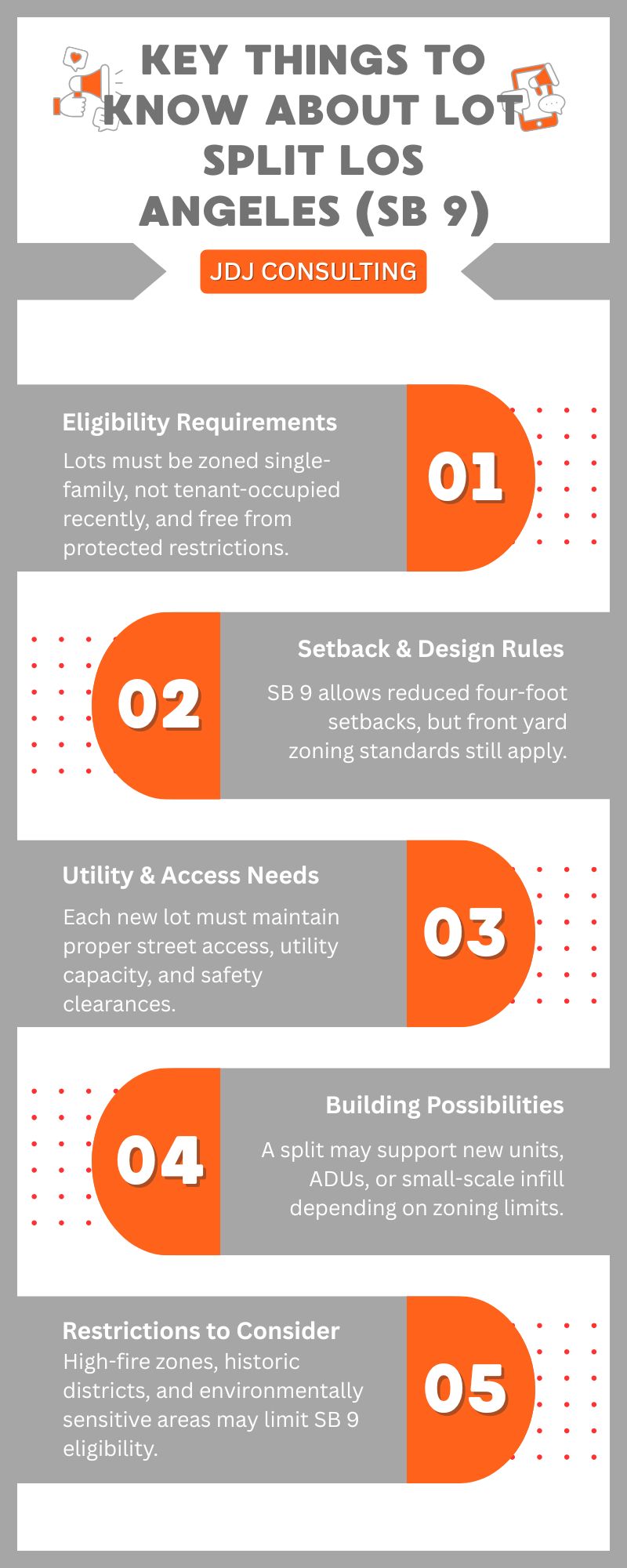
SB 9 is a California law designed to increase housing supply. It allows eligible homeowners to add units or split lots in areas previously limited to single-family homes.
Can You Split Your Lot in Los Angeles? What Lot Splits Look Like Under SB 9
Lot splitting is a key feature of SB 9, giving property owners new flexibility. Here’s how it works in Los Angeles.
Eligibility Criteria for a Lot Split in LA Under SB 9
Lot must be zoned single-family residential.
Not in restricted areas like historic districts, flood zones, or conservation areas.
Lot size must allow each new parcel to be at least 1,200 sq ft and respect the 40/60 split rule.
Owner-occupancy affidavit is typically required for one of the units for three years.
What a Lot Split + Build-Out Could Look Like in Practice
After splitting your lot:
Each lot could host one single-family home or a duplex.
You might also be able to add ADUs depending on local rules.
The total number of units on your property can increase significantly compared to the original lot.
Table 3: Example Lot Split Configurations Under SB 9
| Original Lot | Possible Lot Split | Units per Lot | Total Units |
|---|---|---|---|
| 5,000 sq ft | 2 lots (~2,500 sq ft each) | 2 units per lot | 4 units |
| 4,000 sq ft | 2 lots (~2,000 sq ft each) | 1 duplex per lot | 4 units |
| 3,000 sq ft | 2 lots (~1,500 sq ft each) | 1 unit per lot + ADU | 4 units |
Visualizing the lot split helps you plan density, setbacks, and parking before starting construction.
Keep in mind, not all lots qualify, and additional local rules may apply.
What You Should Know About Lot Split Restrictions
Some lots cannot be split more than once under SB 9.
Properties with existing rent-controlled units may face limitations.
Environmental constraints or historic protections can prevent a split.
Always verify local Los Angeles Planning Department rules before proceeding.
Choosing the Most Advantageous Pathway for Your Property: 100% Affordable vs. Mixed-Income vs. Market / Mixed Use
Once you know your lot can support additional units or splits, the next decision is what type of development to pursue.

What Do We Mean by “Pathways”? (Affordable, Mixed-Income, Market-Rate)
100% Affordable: All units are restricted for lower-income households.
Mixed-Income: Some units are affordable, others are market-rate.
Market-Rate: Units are sold or rented at market price without income restrictions.
These pathways affect your financing options, approvals, and profitability.
Pros & Cons of 100% Affordable Housing Development
Pros
Eligible for government incentives, grants, and tax credits.
Can receive faster approvals and support from local authorities.
Helps meet community housing needs.
Cons / Challenges
Lower per-unit returns compared to market-rate units.
Regulatory requirements: long-term compliance, income verification.
May require subsidies or partnerships for financing.
Pros & Cons of Mixed-Income or Market-Rate / Mixed Use Development
Pros
Greater flexibility in pricing and unit types.
Higher potential returns on market-rate units.
Easier financing if market demand is strong.
Cons / Challenges
Must balance affordable unit requirements with profitability.
Can trigger community or regulatory challenges.
Local zoning and incentives may limit flexibility.
Which Pathway Makes Sense — Factors to Consider for Your Lot/Project
Lot size and zoning: How many units can fit legally?
Location: Proximity to transit, schools, and amenities affects value.
Regulatory environment: Incentives for affordable units, rent control, or historic protections.
Owner goals: Long-term rental income, selling units, or contributing to community housing.
Financing and cost: Construction costs, compliance, and expected returns.
Case Studies & Example Scenarios (Hypothetical)
Here are some real-world examples to help you visualize how development under SB 9 and other pathways could work.
1st Example: Single-family lot, 5,000 sq ft
Split into two 2,500 sq ft lots.
Build two single-family homes or duplexes on each lot.
Total potential units: 4.
2nd Example: Single-family lot with existing home, 4,000 sq ft
Keep original home, build duplex in backyard under SB 9.
Add ADU if local law allows.
Total potential units: 3–4.
3rd Example: Developer aiming for mixed-income
Combine one market-rate unit with one below-market/affordable unit.
Complies with local incentive programs.
Balances profitability and community impact.
Table 5: Hypothetical Development Scenarios
| Scenario | Lot Size | Split/Units | Total Units | Pathway |
|---|---|---|---|---|
| Example 1 | 5,000 sq ft | 2 lots | 4 units | Market-rate |
| Example 2 | 4,000 sq ft | 1 split + ADU | 3–4 units | Market + ADU |
| Example 3 | 3,500 sq ft | Mixed-income | 2 units | Mixed-Income |
These examples show how SB 9 and local rules create multiple development options. Each project depends on lot size, zoning, and goals.
Steps Forward — What You Should Do If You’re Considering Developing Your Lot

If you’re ready to act, here’s a roadmap:
Check zoning and restrictions: Review your lot’s zoning, overlays, and historical protections.
Evaluate feasibility: Determine lot size, shape, and potential units.
Choose your pathway: Decide between adding units, splitting the lot, or pursuing mixed-income/affordable housing.
Consult professionals: Work with architects, planners, and real estate attorneys to ensure compliance.
Estimate costs and returns: Include construction, permits, compliance, and expected income.
Submit your SB 9 application: Complete affidavits, permits, and building plans.
Following these steps ensures a clear, compliant, and financially sound development process.
Conclusion – Why This Matters for Los Angeles Lot Owners & Developers
SB 9 and related laws have changed what is possible for Los Angeles property owners. Single-family lots now have more flexibility, allowing additional units, lot splits, and mixed-use opportunities.
Success depends on:
Understanding zoning and local restrictions
Choosing the right development pathway
Planning carefully with professionals
Considering financial and regulatory factors
By evaluating your lot and making informed decisions, you can increase housing density, generate rental income, or create affordable housing. Los Angeles lots offer opportunities—but only if you plan thoughtfully and strategically.
Partner with the Best SB 9 Consultant Los Angeles, California
Thinking about what you can build on your Los Angeles lot? At JDJ Consulting, we help property owners like you figure out SB 9 rules, lot splits, and the best development pathway for your goals—whether that’s 100% affordable, mixed-income, or market-rate units. We’ll guide you through zoning, planning, and permits, making the process clear and stress-free.
- 12925 Riverside Dr Suite 302, Sherman Oaks, CA 91423
- (818) 793-5058
- sales@jdj-consulting.com
- Book your free consultation here: https://jdj-consulting.com/book-consultation/
Frequently Asked Questions About Lot Split Los Angeles
What is SB 9 and how does it affect Los Angeles lot development?
SB 9, effective January 1, 2022, allows eligible single-family lots in California to develop two units or perform an urban lot split. In Los Angeles, this means property owners can:
Build an additional unit without discretionary approvals.
Split a lot to create two parcels, each eligible for new construction.
SB 9 aims to increase housing supply while using a ministerial process, so no public hearings are required.
What does ministerial approval mean under SB 9?
A ministerial approval is non-discretionary, based purely on objective standards. City staff do not make subjective judgments; approvals are granted if the project meets clearly defined criteria. For SB 9:
No public hearings are required.
Projects complying with setbacks, height, and floor area rules are automatically approved.
CEQA review is generally not required.
What are objective standards in SB 9 projects?
Objective standards are measurable, quantifiable rules that do not rely on personal interpretation. Examples include:
Height and setback requirements
Lot width and frontage
Design materials or plane breaks
These standards ensure that the project is evaluated consistently and fairly. Any deviation that would physically prevent development may be eligible for a waiver.
Can I split my Los Angeles lot under SB 9?
Yes, eligible single-family lots can undergo an urban lot split:
Each new parcel must be at least 1,200 sq ft.
Neither lot may be less than 40% of the original lot.
After splitting, you can build up to two units per new lot, depending on zoning.
However, some restricted areas, like historic districts, may be excluded.
Do I need to provide parking for SB 9 units?
Typically, one covered parking space per unit is required. Exceptions apply if the property is:
Within ½ mile of a High-Quality Transit Corridor
Near a Major Transit Stop
Served by a car-share location
These exceptions allow developers to reduce costs while promoting transit-oriented housing.
Can waivers be requested for SB 9 objective standards?
Yes, waivers can be requested if a standard physically prevents an urban lot split or construction of two 800 sq ft units. Examples of waivable standards:
Height or front yard setback restrictions
Minimum lot width or street frontage
Material or plane break requirements
Waivers require review by City Planning or during building permit plan checks.
Can I include my existing home in an SB 9 Two Unit Development?
Yes, you can retain your existing dwelling and add a new unit, even if your existing home exceeds 800 sq ft. Waivers may still be requested for the new unit’s compliance with zoning standards. This allows owners to maximize development potential while preserving existing structures.
Are SB 9 projects allowed in Coastal Zones?
Yes, but SB 9 does not override the California Coastal Act. Coastal Zone projects must still follow Coastal Development Permit (CDP) procedures, including:
Public hearings
Discretionary approvals
SB 9 benefits apply only if other local and state regulations are met.
Can SB 9 be used on RSO (Rent Stabilized) properties?
RSO properties have specific limitations:
Units demolished or withdrawn under the Ellis Act are ineligible for 15 years.
Projects must retain RSO units to maintain eligibility.
Tenant protections, such as rent adjustments for lost amenities, may apply.
Consult LAHD guidance before proceeding with RSO sites.
Are there height or setback limits for SB 9 units?
Side and rear setbacks may be reduced to 4 feet.
Front yard setbacks follow the underlying zoning.
Existing structures or replacements in the same footprint do not require setbacks.
These relaxed standards make small-lot development feasible while maintaining neighborhood compatibility.
What is considered a demolition or alteration in SB 9?
Demolition: removing more than 25% of exterior walls.
Alteration: any construction beyond repairs or simple additions affecting habitable space.
Proper definitions ensure compliance with RSO rules and avoid triggering discretionary approvals.
Is a second unit under SB 9 considered an accessory building?
No. A second main unit is a primary dwelling, not an ADU or Junior ADU. It has full legal rights as a main residence and counts toward SB 9 unit limits.
Can SB 9 projects be built in earthquake fault zones?
Yes, as long as the project complies with seismic protection standards from:
California Building Standards Commission
Local building department
Developers must ensure that all construction meets state and local seismic codes.
Can I propose condominiums as part of an SB 9 Urban Lot Split?
No. Condominiums require:
Completion of the lot split.
Construction of units and Certificates of Occupancy.
Separate Parcel Map filing for condominium conversion.
The conversion process follows standard, not SB 9 streamlined procedures.
Are SB 9 projects subject to fire department requirements?
Yes. The LAFD may require:
Street/fire lane access within 150 ft of units
Fire hydrants within 300 ft
Compliance with Very High Fire Hazard Severity Zone rules
Planning ensures safety in single-family and two-unit developments.
How is “car share” defined for parking exemptions?
Car share refers to publicly accessible shared vehicles. If an SB 9 unit is near a designated car-share location, parking requirements can be waived, supporting transit-oriented and low-parking development.
Will utilities like water and power be available for new units?
Separate water and power are required for new lots after a split.
Developers should contact LADWP early for service estimates and potential equipment upgrades.
Existing units may share utility service, but each new lot needs independent connections.
Are easements required for SB 9 Urban Lot Splits?
Yes, easements may be required for:
Public utilities
Sewers, storm drains, or water systems
Streetlights or slope rights
Easements are determined by the City Engineer or other agencies and may be voluntary or required.
What fees are associated with SB 9 projects?
Parcel Map Urban Lot Split application fee: ~$3,978 (administrative review)
Impact fees: LAUSD Developer Fee, Park Fee, Affordable Housing Linkage Fee
Additional fees for permits or plan checks may apply
Budgeting upfront ensures no surprises during development.