Every building has a story. From planning to construction, every step needs careful attention. One of the most important steps before you can use or sell a property is obtaining a Certificate of Occupancy (CO).
Simply put, a CO is a legal document that proves your building is safe and meets all local codes. Without it, you cannot legally occupy the property. Whether you are a homeowner, property developer, or business owner, understanding the CO process can save you time, money, and potential legal issues.
In this guide, we will break down the entire process, explain why it matters, and provide practical steps to ensure a smooth approval.
Table of Contents
What Is a Certificate of Occupancy?
A Certificate of Occupancy, sometimes called a CO, is a formal document issued by your local building department. It confirms that your building is safe to occupy.
Think of it as a safety stamp. Before anyone moves in, the city or municipality must verify that your property meets all construction, fire, and zoning codes.
Even if your building looks complete, a CO is required to legally use it. Lenders, buyers, and tenants often request this certificate before completing any transactions.
Definition and Purpose
At its core, the CO is about safety and compliance. It shows that your building:
Follows all approved construction plans
Meets local building codes
Complies with life-safety rules, including fire exits, alarms, and structural stability
Without a CO, your building cannot be legally used. You may also face fines or other legal actions if someone occupies the building prematurely.
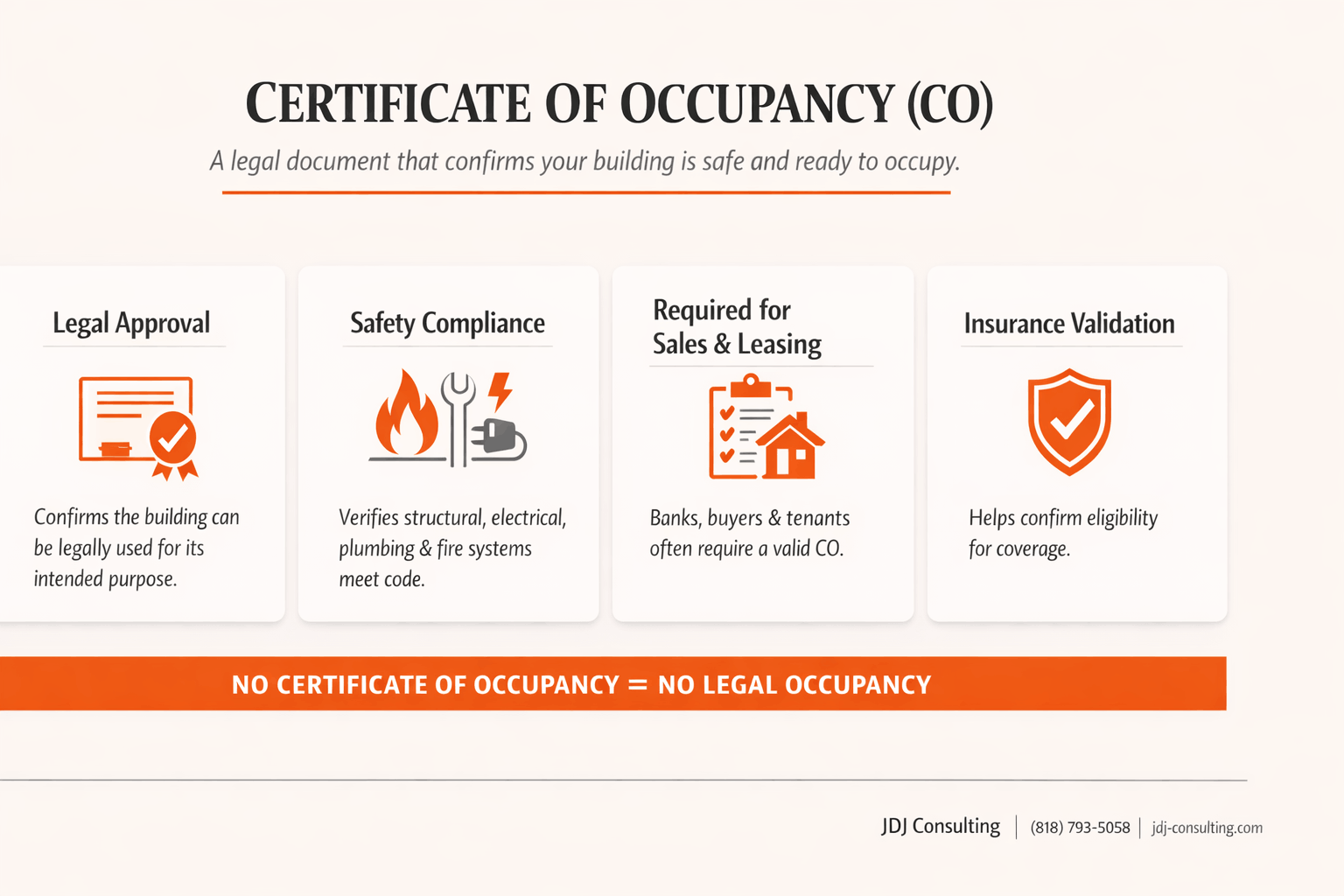
| Key Purpose of a CO | Explanation |
|---|---|
| Legal Occupancy | Confirms the building can be legally used for its intended purpose |
| Safety Verification | Ensures fire safety, structural integrity, and electrical compliance |
| Real Estate Transactions | Required by banks, buyers, and tenants during property sales or leases |
| Insurance Coverage | Helps validate insurance policies in case of accidents or damage |
A CO is more than a piece of paper. It is proof that your investment is safe, compliant, and ready for use.
Legal and Safety Importance
The CO is essential for both legal and safety reasons. It provides:
Liability Protection: Occupying a building without a CO may make you liable for accidents or damages.
Code Compliance: Local authorities check zoning, fire codes, and building regulations.
Insurance Requirements: Most insurance providers will not cover properties without a valid CO.
For example, if a commercial property lacks a CO, the tenant may face closure notices, and the landlord could be fined. Residential properties without a CO may not be eligible for a mortgage or insurance.
In short, a CO protects you, your occupants, and your property.
Who Issues the Certificate?
A Certificate of Occupancy is issued by your local building department or municipality.
They review all inspections and documents before issuing the certificate.
Depending on your city or state, additional approvals may be needed from fire departments, zoning authorities, or utility providers.
| Authority | Role in CO Process |
|---|---|
| Building Department | Reviews plans, inspections, and final application |
| Fire Department | Confirms fire safety compliance |
| Zoning Office | Ensures building is used as permitted in that area |
| Utility Providers | Confirms safe connection of water, electricity, and gas |
Each city has its own procedures, so it is important to check local requirements early in the planning process.
When Is a Certificate of Occupancy Required?
Knowing when a CO is required can prevent delays and legal issues. Not all buildings need one at all times, but several common situations trigger the requirement.
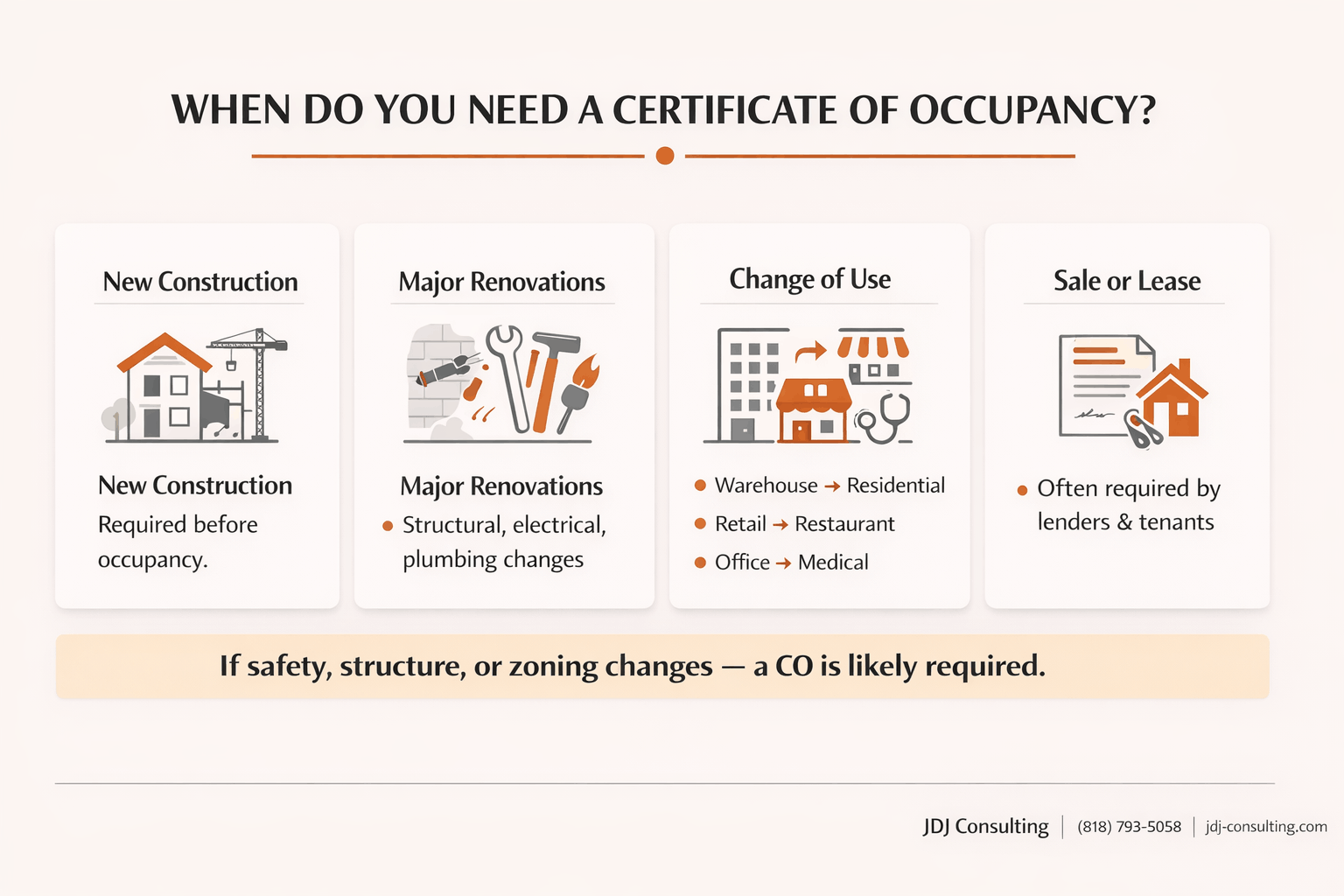
When is a CO required? Construction, renovations, use changes, or property sales and leasing.
New Construction Projects
Almost all new buildings need a Certificate of Occupancy before anyone can move in.
Residential homes, apartments, and commercial spaces all require a CO.
Even small additions may need approval if they change the building’s footprint or use.
For example, a new office building must pass multiple inspections before it can open to the public.
Major Renovations and Use Changes
Not every renovation triggers a CO, but significant changes often do. These include:
Structural changes: Adding a floor or removing walls
Electrical or plumbing upgrades: Large-scale modifications
Change of use: Converting a warehouse to residential units or office space
The key rule: if your changes affect safety, occupancy, or zoning, a CO may be required.
Ownership or Tenant Changes
A CO is sometimes necessary when:
Selling or leasing a property
Lenders request proof of compliance before approving a mortgage
Tenants require assurance that the building is safe and legal
Skipping this step can lead to delays in closing transactions or potential legal exposure.
| Situation | CO Requirement |
|---|---|
| New Construction | Required before occupancy |
| Major Renovation | Required if structural or safety changes are made |
| Change of Use | Required for any change in building function |
| Property Sale/Lease | Recommended or required by lender or tenant |
Being proactive about obtaining a CO ensures smooth transitions for both ownership and occupancy.
Step-by-Step Certificate of Occupancy Process
Obtaining a Certificate of Occupancy may seem complicated, but breaking it into clear steps makes it manageable. Knowing each stage helps avoid delays and extra costs.
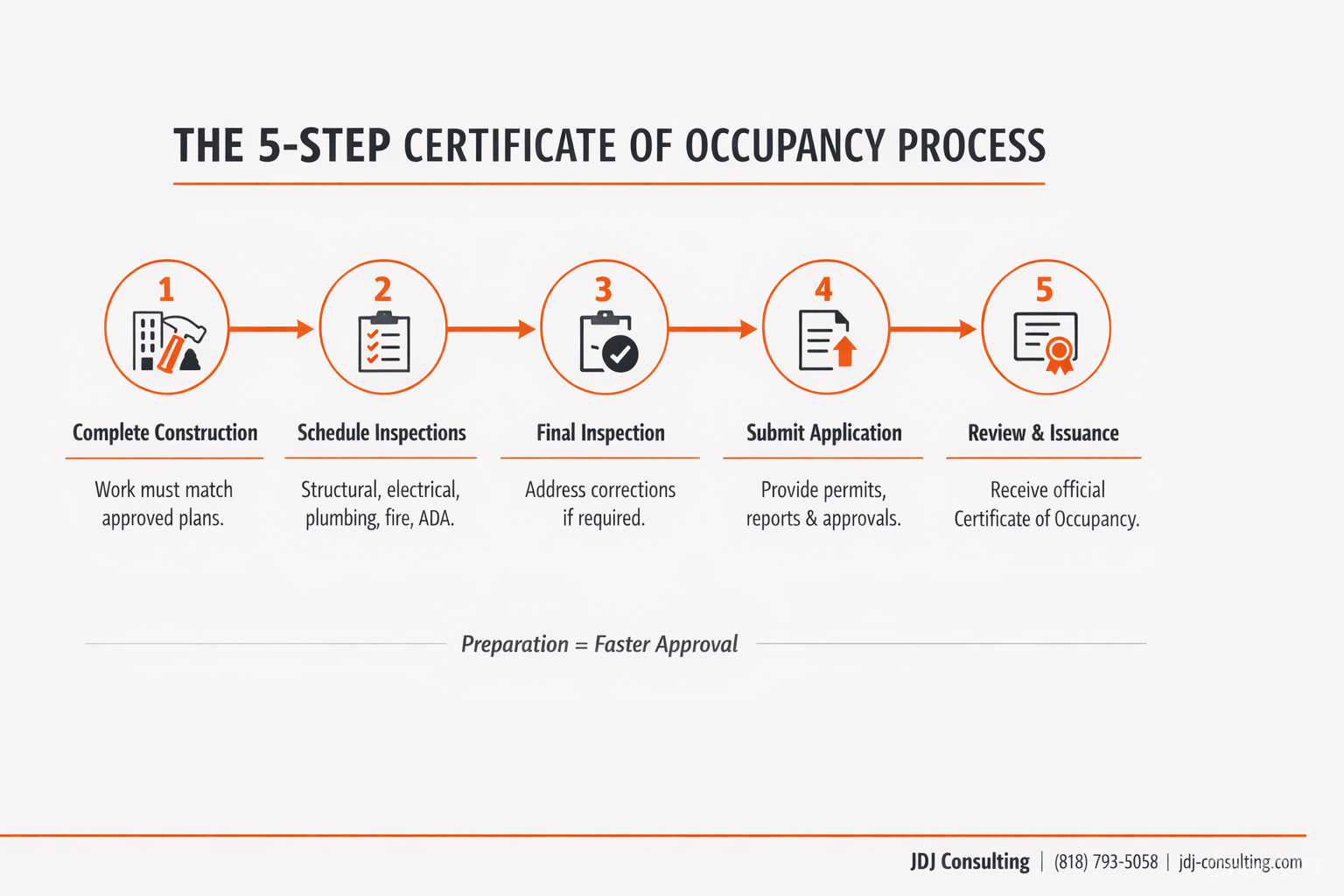
Understand the 5-step Certificate of Occupancy process to avoid delays and secure faster approval for your project.
Here’s a step-by-step look at how the process typically works.
Step 1 – Complete Construction and Plan Approval
Before applying for a CO, your construction must be fully finished according to the approved plans.
Ensure all work matches the blueprints submitted to the building department.
Any deviations may trigger additional inspections or corrections.
Check that permits for construction, electrical, plumbing, and mechanical work are properly closed.
Pro Tip: Keep a detailed checklist of completed work. This helps inspectors verify compliance faster.
Step 2 – Schedule All Required Inspections
Inspections are the backbone of the CO process. They confirm that your building is safe and code-compliant.
Typical inspections include:
| Inspection Type | Purpose |
|---|---|
| Structural | Ensures foundation, framing, and load-bearing elements are safe |
| Electrical | Verifies wiring, panels, and outlets meet code |
| Plumbing | Confirms safe installation of pipes, drains, and water systems |
| HVAC | Checks heating, ventilation, and air conditioning compliance |
| Fire Safety | Confirms smoke detectors, sprinklers, and alarms are installed and operational |
| Accessibility | Ensures compliance with ADA or local accessibility rules |
| Energy Code | Checks insulation, windows, and energy efficiency standards |
Schedule inspections with your local building department.
Coordinate timing so all inspections occur before submitting the CO application.
Keep copies of inspection reports for reference.
Step 3 – Final Inspection and Clearance
The final inspection is the last step before approval.
Inspectors will review all previous reports and examine the building in person.
They check that safety systems, structural elements, and finishes meet code requirements.
Any issues will be documented, and you must correct them before approval.
Tips for a smooth final inspection:
Walk through the property before the inspector arrives.
Ensure all utilities are operational (water, electricity, gas).
Keep all documentation handy, including previous inspection approvals.
A successful final inspection is a major milestone. It signals that your property is ready for occupancy and that you can move to the next stage: submitting the CO application.
Step 4 – Submit the CO Application
Once the building passes all inspections, you can apply for your Certificate of Occupancy.
Commonly required documents include:
Completed CO application form
Copies of all inspection reports
Approved construction plans
Permit numbers and closure confirmations
Submit the application to your local building department. Some municipalities allow online submission, while others require in-person filing.
Step 5 – Review and Issuance
After submission, the building department reviews your application.
They verify all inspections, permits, and documentation.
If corrections or clarifications are needed, they will notify you.
Once everything is complete, the CO is issued.
Your CO may be digital, printed, or both, depending on local rules. Keep it in a safe place, as you may need it for real estate transactions, insurance, or future renovations.
| Step | Action | Key Notes |
|---|---|---|
| 1 | Complete Construction | All work must match approved plans |
| 2 | Schedule Inspections | Structural, electrical, plumbing, fire, accessibility, energy |
| 3 | Final Inspection | Correct any issues before clearance |
| 4 | Submit Application | Include all forms and reports |
| 5 | Review & Issuance | Receive CO and store safely |
Following these steps carefully helps reduce delays and ensures your property is compliant and ready for use.
Step 6 – Common Delays and How to Avoid Them
Even with careful planning, some delays can occur:
Incomplete inspections: Missing reports can halt CO issuance.
Documentation errors: Incorrect forms or missing signatures cause back-and-forth with the building department.
Unapproved modifications: Changes to the original plan may require re-inspection.
Quick tips to avoid delays:
Verify all inspection dates and approvals in advance.
Keep all paperwork organized and accessible.
Hire a consultant or permit expeditor if your project is complex.
Common Challenges and How to Avoid Them
Even with careful planning, the Certificate of Occupancy process can have hurdles. Knowing these challenges ahead of time helps you prepare and prevents costly delays.
Incomplete or Missed Inspections
One of the most common reasons CO applications are delayed is incomplete inspections.
Missing inspections, like fire safety or energy compliance, can halt your approval.
Sometimes, contractors or builders assume a particular inspection is not required.
Tips to avoid this:
Review your local building department’s inspection checklist before scheduling.
Confirm all inspections have been completed and approved before applying.
Keep a calendar of inspection dates to avoid last-minute issues.
Documentation Errors
Incorrect or missing paperwork is another frequent challenge. Even small errors can cause weeks of delays.
Common mistakes include:
Missing signatures on forms
Wrong permit numbers
Submitting outdated plans
How to prevent these errors:
Double-check all documents before submission.
Make copies of inspection reports and permits for reference.
Consider a professional review of your application to ensure completeness.
Coordination Across Agencies
A Certificate of Occupancy often requires approval from multiple agencies. These may include:
Fire Department
Zoning Office
Utility Providers (water, electricity, gas)
Delays happen when approvals from one agency are missing or inconsistent with another.
Best practices:
Communicate with each agency early in the process.
Maintain a shared file with all approvals and inspection reports.
Use a permit expeditor or consultant for complex projects.
| Common Challenge | Cause | Prevention |
|---|---|---|
| Incomplete Inspections | Skipped or forgotten inspections | Review inspection checklist; schedule all inspections early |
| Documentation Errors | Wrong forms, missing signatures, outdated plans | Double-check all documents; maintain organized files |
| Multi-Agency Coordination | Conflicting requirements or delayed approvals | Communicate early with agencies; consider a professional expeditor |
Delays Due to Changes or Corrections
Even after inspections, some buildings need minor corrections. These could include:
Fixing a safety hazard noted by the inspector
Adjusting electrical or plumbing work
Correcting structural elements
Tips to minimize correction delays:
Walk through the property before the final inspection.
Address potential issues proactively with your contractor.
Keep all work documented and accessible for inspectors.
Budgeting and Scheduling Challenges
Unexpected delays can increase costs. Common causes include:
Scheduling conflicts for inspections
Extra labor costs for corrections
Extended permit processing times
How to manage this:
Include buffer time in your project schedule for inspections and corrections.
Maintain a contingency budget for minor changes.
Regularly check the building department’s processing timelines.
When to Seek Professional Help
For complex projects, hiring permit consultants or expeditors can save time and reduce stress. They help with:
Coordinating inspections across multiple agencies
Preparing and reviewing applications
Advising on local code compliance
Professional guidance ensures your CO process moves smoothly, especially for commercial properties, multi-family buildings, or renovations with multiple changes.
Summary Table: Key Challenges and Solutions
| Challenge | Impact | Solution |
|---|---|---|
| Missed Inspections | Delays in CO approval | Use a checklist, schedule inspections early |
| Documentation Errors | Re-submissions required | Review all forms, maintain organized files |
| Agency Coordination | Conflicting approvals | Communicate early, track approvals |
| Correction Requests | Additional work and cost | Pre-inspection walkthrough, proactive fixes |
| Budget/Timeline Overruns | Increased project cost | Buffer schedules, contingency funds |
| Complex Projects | Longer approval time | Hire permit expeditor or consultant |
Certificate of Occupancy Requirements by Jurisdiction
A Certificate of Occupancy (CO) isn’t one-size-fits-all. Requirements can differ depending on the city, state, and type of building. Understanding these differences early helps avoid unnecessary delays and confusion.
Typical Requirements in Major U.S. Cities
Each city may have its own CO process and required inspections. While the general steps remain similar, timelines, forms, and additional agency approvals can vary.
For example:
| City | Key Requirements | Notes |
|---|---|---|
| Los Angeles, CA | Structural, electrical, plumbing, fire, energy, and accessibility inspections | May include a fire marshal review for commercial buildings |
| Austin, TX | Zoning approval, all standard inspections, ADA compliance | Temporary CO possible for phased occupancy |
| Miami, FL | Coastal construction approval, hurricane safety review, standard inspections | Requires certificate from local flood control for certain properties |
Tip: Always check your local building department’s website for city-specific CO requirements. Early research can prevent delays later.
Residential vs. Commercial CO Rules
Requirements can also differ based on the building type:
Residential Buildings
Single-family homes: Usually simpler inspections, but still include safety, plumbing, electrical, and energy compliance.
Multi-family units: May need additional fire safety systems, accessibility compliance, and elevator inspections.
Commercial Buildings
Offices, retail, and industrial spaces: Require extensive inspections including fire alarms, sprinklers, structural integrity, accessibility, and energy compliance.
Mixed-use properties may require approvals from multiple departments, including zoning and fire safety.
| Building Type | Typical Inspections Required | Notes |
|---|---|---|
| Single-Family Residential | Structural, plumbing, electrical, HVAC, energy code | Usually quicker processing |
| Multi-Family Residential | All above plus fire safety and accessibility | Additional inspections for elevators and common areas |
| Commercial | Structural, electrical, plumbing, fire safety, ADA, energy | Multi-agency approvals may be needed |
| Mixed-Use | Combination of residential and commercial requirements | Coordination across departments recommended |
Temporary or Partial COs
In some situations, a full Certificate of Occupancy may not be immediately possible. This is where temporary or partial COs come in:
Temporary CO: Allows partial occupancy while minor corrections or inspections are pending.
Partial CO: Grants permission for specific areas of the building to be used, often in phased construction projects.
Use cases:
Retail spaces that want to open while upper floors are still under construction.
Apartment complexes where a few units are ready for tenants, but others are not.
Important: Temporary COs come with restrictions. Always check the expiration date and conditions to avoid fines or legal issues.
Key Takeaways
CO requirements vary widely by city, building type, and usage.
Residential buildings are generally simpler than commercial or mixed-use properties.
Temporary or partial COs can help manage phased occupancy but require careful compliance.
Always confirm your local building department rules before submitting an application.
Certificate of Occupancy vs. Completion Certificate: What’s the Difference?
Many property owners confuse a Certificate of Occupancy (CO) with a Completion Certificate (CC). While they are related, they serve different purposes.
Understanding the difference helps you avoid legal trouble, failed inspections, or delayed property closings.
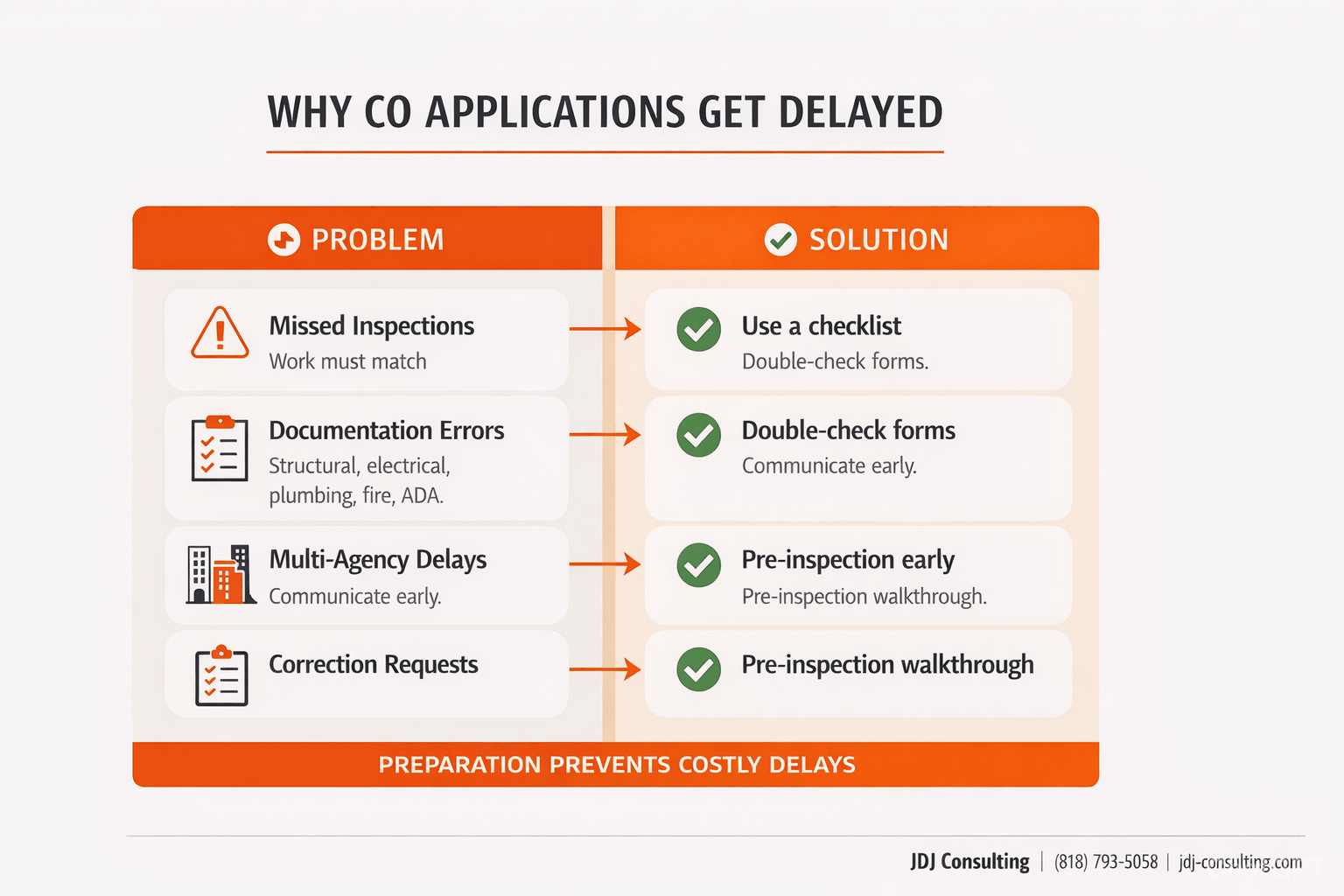
Preparation and early coordination help prevent costly Certificate of Occupancy delays.
Simply put:
A Completion Certificate confirms that construction work is finished according to approved plans.
A Certificate of Occupancy confirms that the building is safe and legally ready to be occupied.
Both documents matter. However, they are not interchangeable.
What Is a Completion Certificate?
A Completion Certificate is issued after construction is complete. It confirms that:
The project matches the approved architectural plans
Structural work meets building standards
The construction phase is officially closed
This certificate focuses on construction compliance, not occupancy.
In many jurisdictions, you cannot apply for a CO until the Completion Certificate is issued.
Think of it this way:
The CC says, “The building is built correctly.”
The CO says, “The building is safe to use.”
What Is a Certificate of Occupancy?
A Certificate of Occupancy goes one step further.
It confirms:
All required inspections have passed
Fire safety systems are operational
Utilities are safely connected
The building complies with zoning regulations
The property can legally be used for its intended purpose
Without a CO, the building cannot be legally occupied, even if construction is finished. That distinction is important.
Side-by-Side Comparison
Here is a clear breakdown of the differences:
| Feature | Completion Certificate (CC) | Certificate of Occupancy (CO) |
|---|---|---|
| Purpose | Confirms construction is complete | Confirms building is safe and legal to occupy |
| Issued After | Construction phase ends | Final inspections are passed |
| Focus | Structural and construction compliance | Safety, zoning, and occupancy compliance |
| Required for Occupancy | No | Yes |
| Used in Real Estate Transactions | Sometimes | Almost always |
This table shows why both documents matter. However, the CO is the final green light for occupancy.
When Are Both Required?
In many cities and counties, the process works in this order:
Construction is completed.
Completion Certificate is issued.
Final inspections are conducted.
Certificate of Occupancy is issued.
For commercial projects, multi-family developments, and mixed-use buildings, both documents are usually required. For small residential projects, the process may be combined, depending on local rules. That is why checking your local building department requirements early is critical.
Common Misunderstandings
Here are a few common misconceptions:
“I have a Completion Certificate, so I can move in.”
Not necessarily. You still need a CO in most cases.“The building looks finished, so it must be approved.”
Visual completion does not equal legal occupancy.“The CO is automatic after construction.”
It is not. You must apply and pass final inspections.
These misunderstandings can delay property closings, lease agreements, and business openings.
Why This Difference Matters for Property Owners
If you are:
Selling a property
Leasing commercial space
Applying for financing
Opening a retail or office location
The Certificate of Occupancy is usually the required document. Banks, insurers, and buyers often request proof of a valid CO before finalizing transactions.
Without it, deals can stall.
Practical Advice for Developers and Owners
To avoid confusion:
Confirm whether your jurisdiction separates CC and CO
Plan for both in your project timeline
Keep all inspection records organized
Avoid assuming occupancy approval
If your project involves multiple agencies or phased construction, professional support can help keep everything aligned.
Final Thoughts on CO vs. Completion Certificate
The Completion Certificate confirms your building is constructed properly. The Certificate of Occupancy confirms your building is safe and legal to use. Both are important. However, only the CO allows occupancy. Understanding this difference protects your investment and keeps your project compliant from start to finish.
How Long Does It Take to Get a Certificate of Occupancy?
One of the most common questions property owners ask is simple: How long will this take?
The honest answer is: it depends.
Processing times vary based on location, project size, inspection results, and how prepared you are. Still, understanding typical timelines helps you plan better.
Typical Timeline for a Certificate of Occupancy
For most projects, the CO process happens near the end of construction. If everything is in order, the timeline can be relatively smooth.
Here is a general estimate:
| Project Type | Estimated Time After Final Inspection |
|---|---|
| Single-Family Home | 3–10 business days |
| Small Commercial Space | 1–3 weeks |
| Multi-Family Development | 2–4 weeks |
| Large Commercial or Mixed-Use | 3–6+ weeks |
These estimates assume:
All inspections have passed
No corrections are pending
Documentation is complete
If issues arise, timelines can extend significantly.
Factors That Affect Processing Time
Several factors influence how quickly you receive your Certificate of Occupancy.
1. Inspection Results
If inspectors identify deficiencies, you must:
Correct the issue
Schedule a re-inspection
Wait for final approval
Even small corrections can add days or weeks.
2. Local Building Department Workload
Some cities process CO applications quickly. Others have longer backlogs, especially during peak construction seasons.
High-growth areas often experience:
Delayed inspections
Slower document reviews
Longer approval queues
Checking your local department’s average processing time early can help you plan realistically.
3. Completeness of Documentation
Missing paperwork is one of the biggest causes of delay.
Common issues include:
Incomplete application forms
Missing inspection approvals
Incorrect permit references
When documents are organized and complete, review time is usually shorter.
4. Type of Project
Larger or more complex projects require:
Multiple agency approvals
Fire marshal clearance
Accessibility compliance verification
Elevator inspections (for certain buildings)
The more moving parts involved, the longer the review may take.
Fast-Tracking Your Certificate of Occupancy
While you cannot control every factor, you can reduce delays with proper preparation.
Here are practical strategies that help:
Schedule inspections early and track them carefully
Conduct a pre-final walkthrough with your contractor
Confirm utilities are active before the final inspection
Keep a digital and physical file of all permits and reports
Submit a complete application the first time
For complex commercial or multi-agency projects, professional permit consultants can help coordinate approvals and prevent unnecessary back-and-forth.
Temporary CO Timeline
In some cases, you may qualify for a Temporary Certificate of Occupancy (TCO). This allows limited occupancy while minor issues are being resolved.
Typical TCO timelines:
| Scenario | Temporary CO Processing Time |
|---|---|
| Minor outstanding corrections | A few days to 1 week |
| Phased commercial occupancy | 1–2 weeks |
| Large multi-phase development | Depends on inspection clearance |
Keep in mind:
Temporary COs often have expiration dates
Conditions must be met before full approval
Extensions may require additional review
A temporary certificate can help maintain business schedules. However, it is not a long-term solution.
Planning Your Project Timeline
If you are developing property, timing matters. Here’s a simple rule: Never schedule move-in dates or business openings without buffer time.
Include extra time in your schedule for:
Re-inspections
Document corrections
Agency coordination
Unexpected compliance adjustments
Adding even two to three weeks of flexibility can prevent costly disruptions.
What Happens After Approval?
Once approved:
The Certificate of Occupancy is issued
You may receive a digital or printed copy
The document becomes part of your permanent property record
Keep multiple copies. You may need them for:
Real estate transactions
Insurance verification
Refinancing
Future renovations
Final Thoughts on CO Timelines
For simple residential projects, the process may take just a few days after final inspection. For larger commercial developments, it can take several weeks. Preparation is the key difference between a smooth approval and a frustrating delay.
When inspections are completed properly and documents are organized, the process tends to move faster and with fewer complications.
Special Considerations in the Certificate of Occupancy Process
Not all projects follow a standard path. Some buildings require extra review, additional approvals, or special inspections before a Certificate of Occupancy is issued.
If your project falls into one of these categories, planning ahead becomes even more important.
Historic or Landmark Properties
Historic buildings often require additional oversight.
If a property is designated as historic or located in a preservation district, you may need:
Approval from a historic preservation board
Design review clearance
Restrictions on exterior modifications
Specific materials or construction methods
These requirements can affect:
Renovation timelines
Inspection approvals
Final CO issuance
Even minor changes, such as window replacements or façade repairs, may require approval. For these projects, coordination between preservation authorities and the building department is essential.
Adaptive Reuse Projects
Adaptive reuse refers to converting a building from one use to another. For example:
Warehouse to residential lofts
Office building to apartments
Retail space to medical office
These projects often trigger new compliance requirements because the building’s occupancy classification changes.
This may require:
Updated fire protection systems
Increased accessibility compliance
Structural upgrades
Revised parking or zoning approvals
| Change Type | Potential CO Impact | Common Requirement |
|---|---|---|
| Industrial to Residential | Higher life-safety standards | Sprinkler systems, egress updates |
| Office to Medical | Specialized occupancy rules | ADA compliance, ventilation upgrades |
| Retail to Restaurant | Fire and health code review | Grease traps, fire suppression systems |
Because use changes affect safety codes, the building is reviewed under current regulations—not necessarily the standards in place when it was originally built. That often adds complexity.
Multi-Phase or Large Developments
Large developments are sometimes completed in phases.
For example:
A mixed-use project with retail on the ground floor and apartments above
A multi-building commercial complex
A large residential subdivision
In these cases, developers may apply for:
Partial Certificates of Occupancy
Temporary Certificates of Occupancy
This allows occupancy of completed sections while construction continues elsewhere.
However, conditions usually apply:
Separate utility connections
Clear separation of construction zones
Approved fire safety systems in occupied areas
Failure to maintain these conditions can result in revocation of the temporary approval.
Real Estate Transactions and CO Verification
A Certificate of Occupancy plays a major role in property transactions.
Buyers, lenders, and tenants often verify:
That a valid CO exists
That the use listed matches the intended use
That there are no outstanding violations
Problems can arise if:
The building’s use changed without updating the CO
Renovations were completed without proper permits
The CO is expired or missing
Before closing a transaction, due diligence should include confirming CO status with the local building department. This protects both buyers and sellers.
Older Buildings Without a Certificate of Occupancy
In some cases, older properties may not have a formal Certificate of Occupancy on record, especially if built decades ago.
Local rules vary, but options may include:
Applying for a retroactive CO
Providing alternative documentation
Completing new inspections to verify compliance
This situation often arises during refinancing or sale. It is important to address it early, as resolving missing records can take time.
Zoning and Use Compliance Issues
Even if a building passes safety inspections, zoning compliance must also align with occupancy.
Issues may occur if:
The property is used for a purpose not permitted in that zone
Parking requirements are not met
Setback or density limits were exceeded
Zoning violations can delay or prevent CO issuance. Confirming zoning alignment before final inspections reduces risk.
Final Thoughts on Special Situations
Most Certificate of Occupancy processes follow a predictable path. However, historic properties, adaptive reuse projects, phased developments, and real estate transactions often require additional coordination.
These projects demand:
Early planning
Clear documentation
Strong communication with local authorities
When handled properly, even complex cases can move forward efficiently.
Conclusion: Bringing It All Together
A Certificate of Occupancy is more than a final step. It is the legal confirmation that your building is safe, compliant, and ready to be used.
Throughout this guide, we covered:
What a CO is and why it matters
When it is required
The step-by-step approval process
Common challenges and how to prevent them
Differences between a CO and a Completion Certificate
Timelines and processing expectations
The role of professionals
Special considerations for complex projects
The key takeaway is simple: Preparation reduces delays.
Organized documentation, completed inspections, and early coordination with local authorities make the difference between a smooth approval and a prolonged process.
Need Help with Your Certificate of Occupancy?
Getting a Certificate of Occupancy can be stressful, especially if inspections or paperwork are delayed. JDJ Consulting helps property owners and developers keep the process smooth and compliant.
If you need support with inspections, permits, or CO approval, we’re ready to assist.
Let’s move your project forward with confidence.