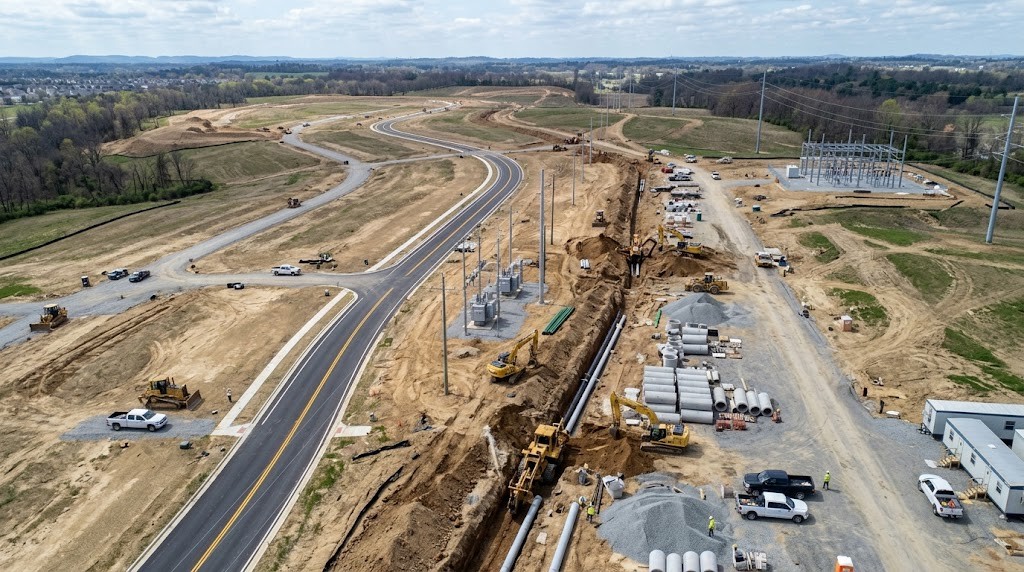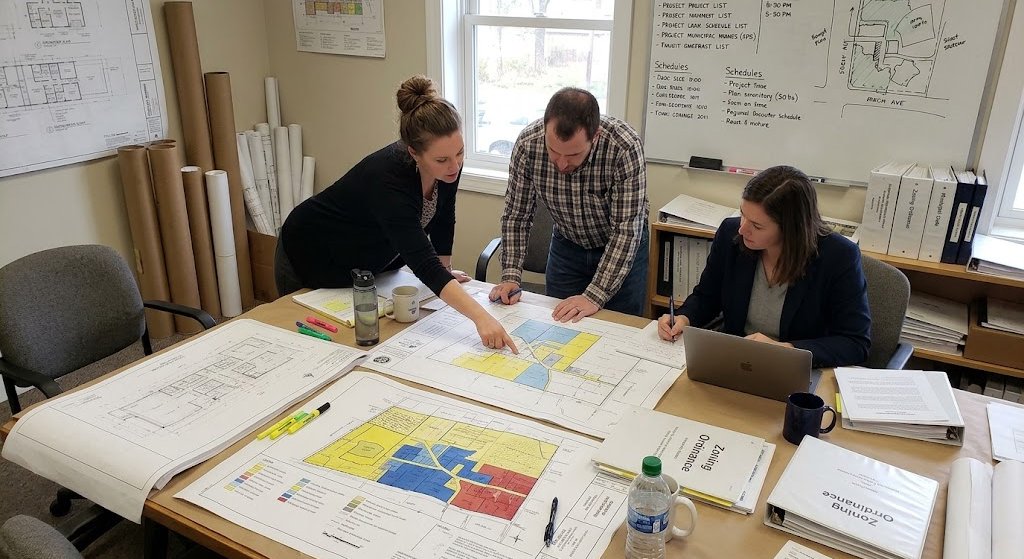

Removing a building may seem simple. You hire a contractor, bring in equipment, and start tearing down the structure. In Texas, however, demolition is a regulated process. Most cities require a demolition permit before any work begins.
A demolition permit gives the city legal approval to remove a structure. It ensures the project meets safety standards, environmental rules, and local building codes. Without this permit, a property owner can face fines, stop-work orders, or legal problems.
Texas does not issue demolition permits at the state level. Instead, each city or municipality manages its own permit system. Because of this, requirements can vary between places like Dallas, Houston, Austin, or smaller towns. Still, most cities follow a similar approval process.
Before demolition begins, several steps usually happen first. Utilities must be disconnected. Hazardous materials may require inspection. In some cases, the city also checks whether the building has historic value.
Property owners, developers, and contractors all deal with these requirements. The process can feel confusing if you have never applied for a permit before. This guide explains how demolition permits work in Texas. It also covers costs, timelines, and common mistakes that can delay projects.
If you are planning to remove a structure, understanding these rules early can save time and prevent expensive setbacks.
Table of Contents
What Is a Demolition Permit in Texas?
A demolition permit is official approval from a local building department that allows a structure to be removed. The permit confirms the city has reviewed the project and that the work meets local safety and environmental rules.
In Texas, most cities require permits for both residential and commercial demolition. Even smaller projects, like removing a detached garage, may need approval.
The goal is simple: protect public safety and ensure demolition work does not damage nearby properties, utilities, or the environment.
Definition of a Demolition Permit
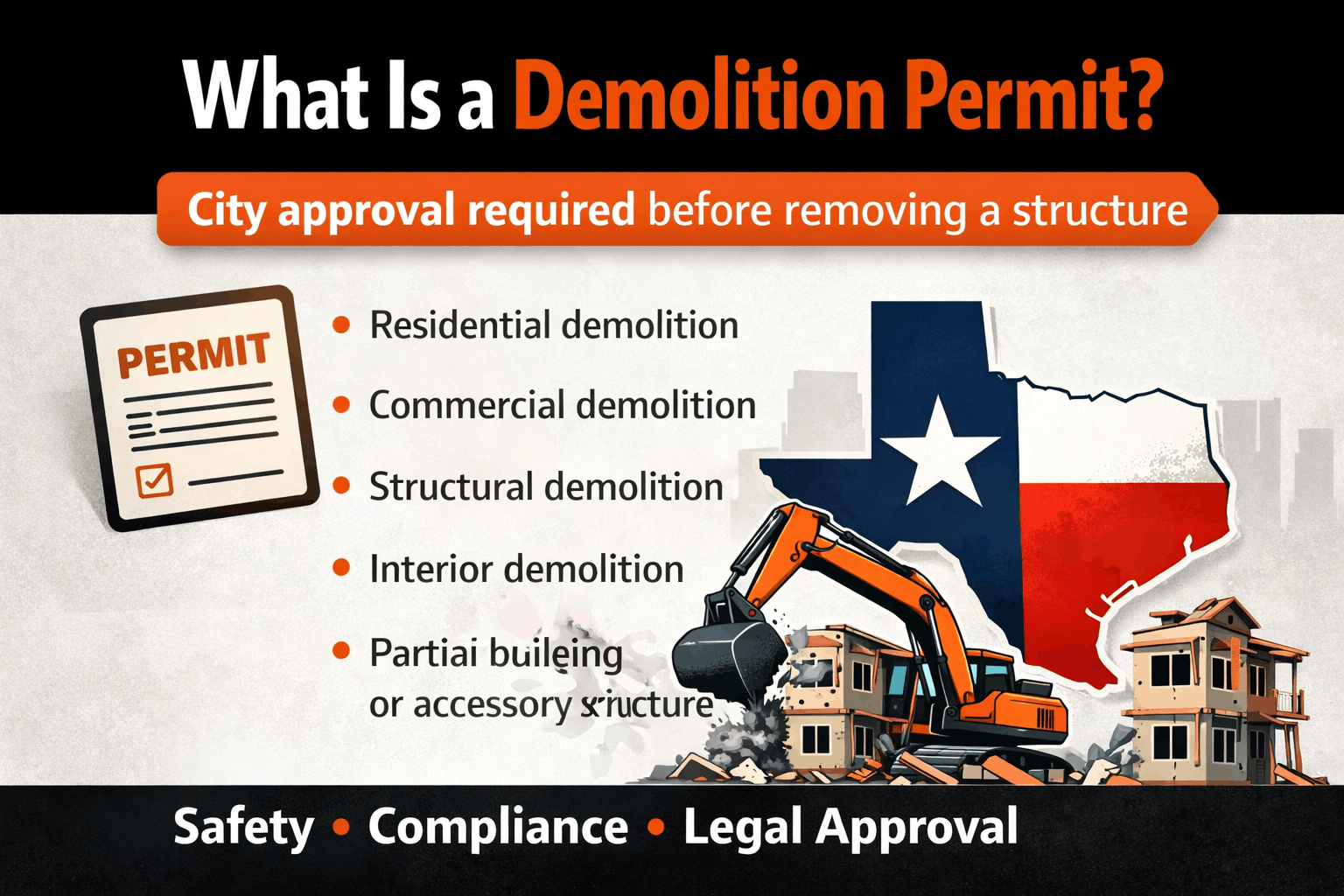
A demolition permit is a document issued by a city or county that authorizes the removal of a building or structure.
It applies to projects such as:
Tearing down a house
Removing a commercial building
Demolishing an old warehouse
Removing a detached garage or accessory structure
Partial demolition of structural sections
In most Texas cities, demolition permits fall under the building or development services department. Once approved, the permit allows contractors to proceed with demolition work according to local regulations.
The permit also ensures that inspections and safety checks happen before work starts.
Why Demolition Permits Are Required
Cities require demolition permits for several reasons. Safety is the biggest factor, but there are also environmental and infrastructure concerns.
Common reasons permits are required include:
Protecting workers and nearby residents
Preventing damage to surrounding buildings
Ensuring utility lines are safely disconnected
Managing construction debris and waste
Checking for hazardous materials like asbestos
Without these checks, demolition projects could create serious risks. For example, if a gas line remains active, heavy demolition equipment could trigger an explosion. If asbestos is present, improper removal could release dangerous fibers into the air. Permits help cities reduce these risks and keep projects organized.
Types of Demolition Covered by Permits
Not all demolition work is the same. Some projects remove entire structures, while others involve only parts of a building. Most Texas municipalities classify demolition into several categories.
| Type of Demolition | Description |
|---|---|
| Full Structure Demolition | Entire building is removed from the property |
| Partial Demolition | Certain structural parts such as walls or roofs are removed |
| Interior Demolition | Interior sections are removed without affecting exterior walls |
| Deconstruction | Materials are dismantled carefully for recycling or reuse |
Each type may require different inspections or documentation. For example, interior demolition might still require a permit if structural elements are affected. Cities often review these projects to ensure the remaining structure stays safe.
Who Issues Demolition Permits in Texas?
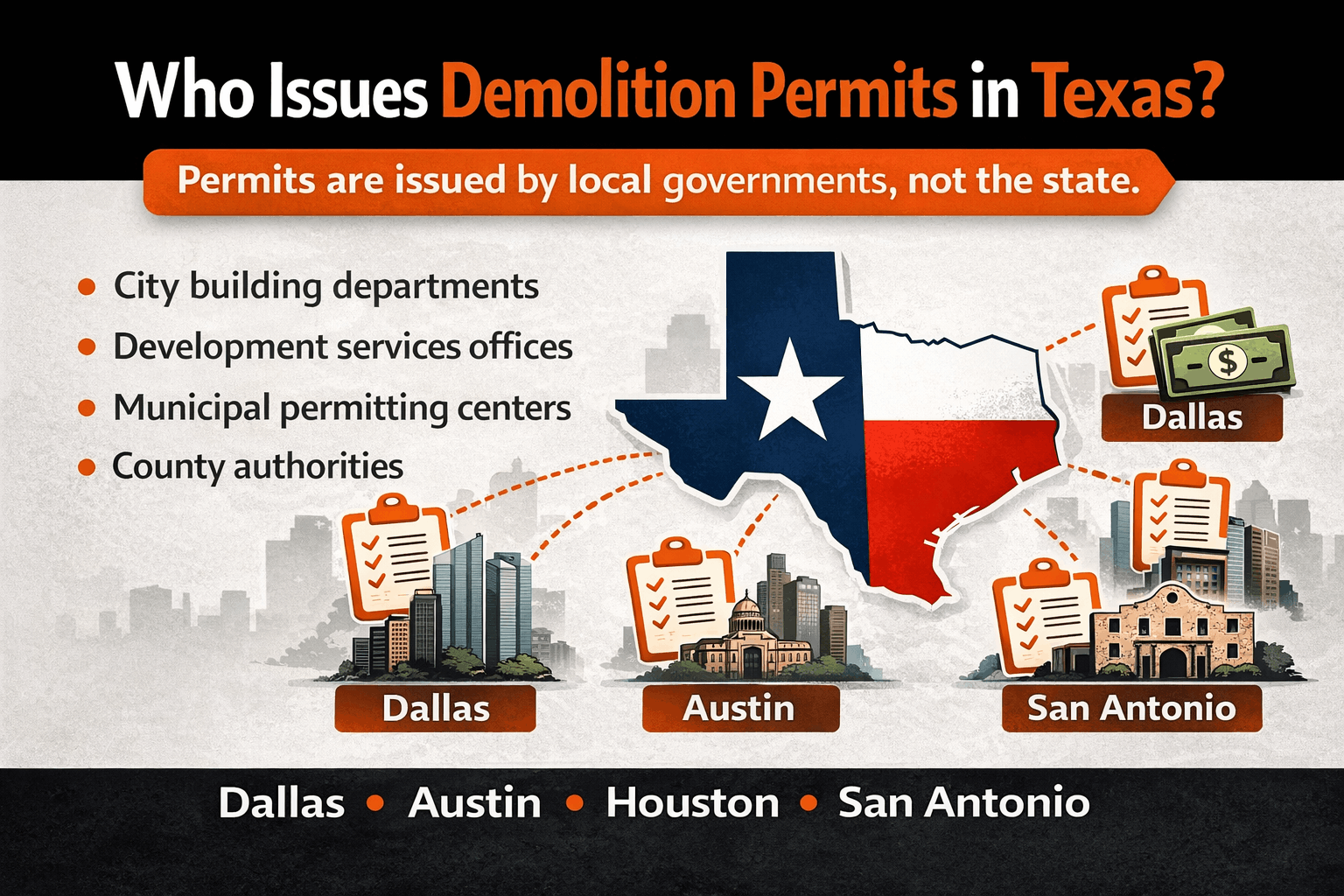
Many people assume Texas has one statewide permit office. In reality, demolition permits are issued by local governments. Each city or county sets its own rules, fees, and approval timelines. Because of this, the process in Dallas may differ from the process in Austin or Houston. Local building departments oversee demolition permits and inspections.
Local Governments Handle Demolition Permits
Demolition permits in Texas are usually managed by:
City building departments
Development services offices
Municipal permitting centers
County offices in unincorporated areas
These offices review permit applications, check project documents, and approve or deny demolition requests. They also handle inspections before and during demolition work. For example, many cities require proof that utilities have been disconnected before issuing the permit.
Examples of Major Texas Permit Systems
Large Texas cities have developed their own online permitting portals. These platforms allow contractors and property owners to submit applications digitally.
| Texas City | Permit System |
|---|---|
| Dallas | DallasNow Portal |
| Austin | AB+C Development Portal |
| Houston | Houston Permitting Center |
| San Antonio | Development Services Department |
Each system allows users to:
Submit permit applications
Upload required documents
Pay permit fees
Schedule inspections
Online systems have made the process faster, but requirements still vary between cities.
Role of Building Departments in Demolition Projects
Local building departments do more than issue permits. They also oversee safety and code compliance during demolition.
Their responsibilities often include:
Reviewing demolition applications
Verifying property ownership
Confirming utility disconnections
Ensuring environmental inspections are completed
Conducting pre-demolition inspections
These departments also enforce penalties if demolition begins without a permit. For example, a city may issue stop-work orders or fines if a structure is demolished without approval. Working with the local permitting office early in the process helps avoid these problems.
When Do You Need a Demolition Permit in Texas?
Most demolition projects in Texas require a permit. Cities want to ensure structures are removed safely and without harming nearby buildings, utilities, or public spaces.
Even if a project seems small, local regulations may still require approval. For example, removing an old garage or tearing down a small commercial building can still require a permit.
Because every city manages its own rules, the safest approach is to check with the local building department before starting work. In general, permits are required when demolition affects structural elements, utilities, or the exterior of a building.
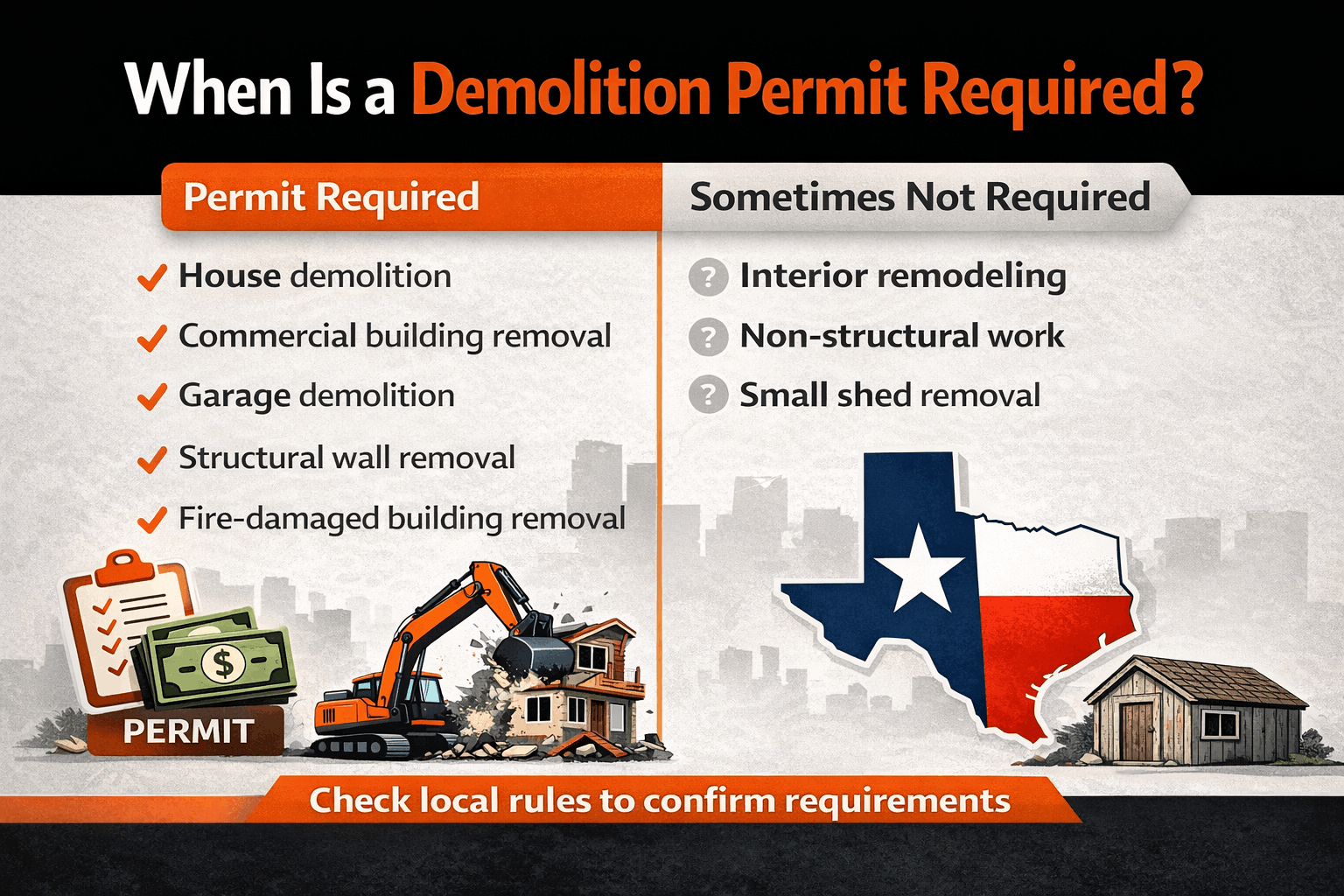
Projects That Require a Demolition Permit
Most cities require permits for projects that remove a structure or major part of a building.
Common examples include:
Full demolition of a residential house
Removal of a commercial building or office space
Demolition of a warehouse or industrial structure
Removal of detached garages or accessory buildings
Structural wall removal during renovations
Demolition of buildings damaged by fire or storms
Cities also review demolition projects to ensure utilities are disconnected and hazardous materials are handled properly. In dense urban areas, demolition permits help prevent damage to neighboring properties.
Situations That May Not Require a Permit
Some small demolition activities may not require permits. However, this depends on the city and the scope of the work.
Examples may include:
Removing non-structural interior fixtures
Demolishing cabinets or drywall during remodeling
Removing small sheds below local size limits
Interior renovations that do not affect structural walls
Still, property owners should confirm with the city before starting work. In some municipalities, even minor demolition work requires approval. Starting demolition without confirming permit requirements can cause delays later in the project.
Examples of Demolition Permit Requirements by Project Type
Cities usually evaluate permit requirements based on the type of project.
| Project Type | Permit Typically Required |
|---|---|
| House demolition | Yes |
| Commercial building demolition | Yes |
| Detached garage removal | Usually |
| Interior remodeling without structural changes | Sometimes no |
| Removing load-bearing walls | Yes |
These examples show why checking local rules is important. Each city may interpret demolition differently.
Demolition Permit Requirements in Texas
Before issuing a demolition permit, cities require several documents and safety confirmations. These requirements help ensure the project will not create hazards for workers or nearby residents.
While each municipality has its own checklist, most Texas cities ask for similar information. Applicants usually need to provide details about the property, the demolition contractor, and the scope of work.
Basic Information Required for a Permit Application
Most demolition permit applications require basic project details.
These typically include:
Property address
Property owner information
Contractor name and license details
Description of demolition work
Estimated project timeline
Cities use this information to verify that the project complies with local zoning and development rules. In many cases, applications must also include proof that the applicant has legal authority to demolish the structure.
Required Documents for Demolition Permits
Permit applications often require several supporting documents. These documents help the city review safety and environmental factors before approving demolition.
Common documents include:
Completed demolition permit application
Site plan showing the building location
Proof of property ownership
Utility disconnect confirmations
Waste disposal or debris removal plan
Contractor license information
Some cities may also require photographs of the existing structure. The table below summarizes common documentation requirements.
| Required Document | Purpose |
|---|---|
| Site plan | Shows location of structure on the property |
| Ownership proof | Confirms applicant has legal authority |
| Utility disconnect letters | Confirms electricity, gas, and water are shut off |
| Contractor information | Verifies licensed professionals are involved |
| Debris disposal plan | Ensures proper waste management |
Incomplete applications are one of the most common reasons demolition permits are delayed.
Asbestos and Hazardous Material Inspections
Environmental safety is a major part of demolition regulations. Many older buildings contain materials that require special handling. Before demolition begins, cities may require an asbestos inspection.
Asbestos was commonly used in building materials such as:
Insulation
Ceiling tiles
Floor tiles
Pipe coverings
If asbestos is present, certified contractors must remove it before demolition can proceed.
In addition to asbestos, inspectors may check for:
Lead-based paint
Hazardous chemicals
Industrial contaminants
These inspections protect workers and nearby residents from harmful exposure.
Step-by-Step Process to Get a Demolition Permit in Texas
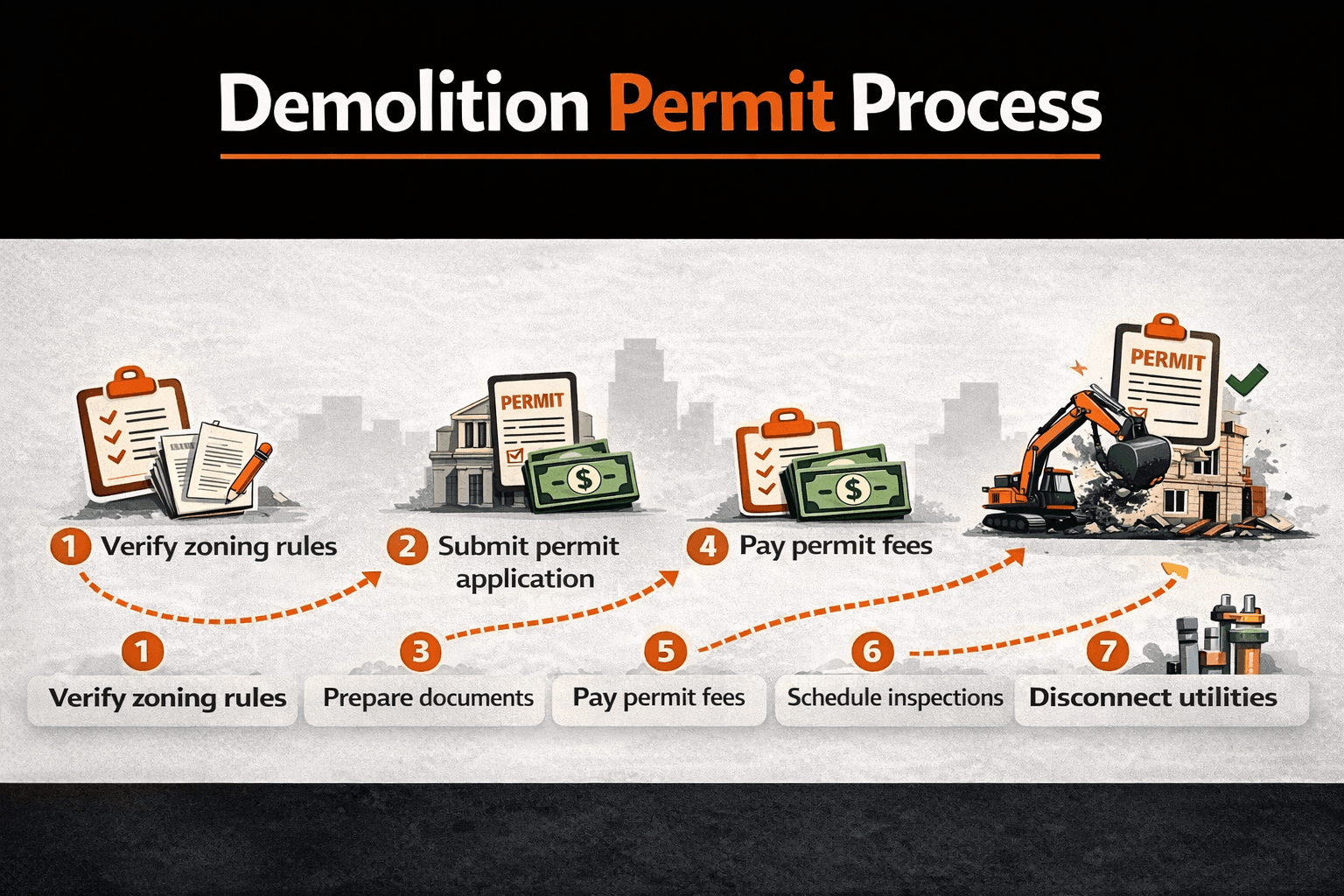
Applying for a demolition permit may seem complicated at first. However, the process usually follows a clear sequence. Understanding these steps can help property owners avoid delays and complete projects faster.
Most demolition permits follow a review process managed by the city building department.
Step 1: Verify Local Zoning and Regulations
Before applying for a permit, confirm the property’s zoning classification.
Some cities restrict demolition in certain areas, such as:
Historic districts
Conservation zones
Redevelopment areas
If the building is historic, the city may require additional review before approval. Checking zoning rules early prevents unexpected complications.
Step 2: Prepare the Required Documents
Once zoning is confirmed, the next step is gathering documentation.
Typical preparation tasks include:
Creating a site plan
Scheduling an asbestos inspection
Contacting utility companies for disconnection
Preparing permit application forms
Organizing documents in advance speeds up the permit review process.
Step 3: Submit the Permit Application
Most Texas cities now allow online permit submissions. Applicants upload documents through the city’s permit portal. However, some smaller municipalities still accept applications in person.
During submission, applicants usually provide:
Project details
Supporting documents
Contractor information
Once submitted, the building department begins reviewing the application.
Step 4: Pay Permit Fees
Permit applications usually require a processing fee.
The fee may depend on factors such as:
Size of the building
Type of structure
Location within the city
Payment is often required before the city begins the review process.
Step 5: Schedule Pre-Demolition Inspections
Some cities conduct inspections before issuing the final permit.
Inspectors may verify that:
Utilities are disconnected
Hazardous materials inspections are completed
Safety plans are in place
If issues are found, the city may request corrections before approving the permit.
Step 6: Confirm Utility Disconnections
Before demolition begins, utilities must be disconnected from the building.
This usually includes:
Electricity
Natural gas
Water
Sewer connections
Utility providers often issue confirmation letters, which must be submitted to the city.
Step 7: Receive Permit Approval
After reviewing documents and inspections, the city issues the demolition permit. Once approved, demolition contractors can begin work according to the approved scope.
The table below summarizes the general permit workflow.
| Step | Action |
|---|---|
| 1 | Verify zoning and local regulations |
| 2 | Prepare required documents |
| 3 | Submit permit application |
| 4 | Pay permit fees |
| 5 | Schedule inspections |
| 6 | Confirm utility disconnections |
| 7 | Receive demolition permit approval |
For many residential projects, the entire approval process can take several days to a few weeks, depending on the city and project complexity.
Demolition Permit Costs in Texas
One of the most common questions property owners ask is about the cost of a demolition permit. The price varies depending on the city, the size of the structure, and the type of demolition project.
In Texas, demolition permit fees are usually set by local municipalities. Because each city controls its own permit system, the exact cost may differ from one location to another.
For smaller residential projects, permit fees are often relatively low. Commercial demolitions, however, may require higher fees because the review process is more detailed. Understanding potential costs early helps property owners plan their budgets more accurately.
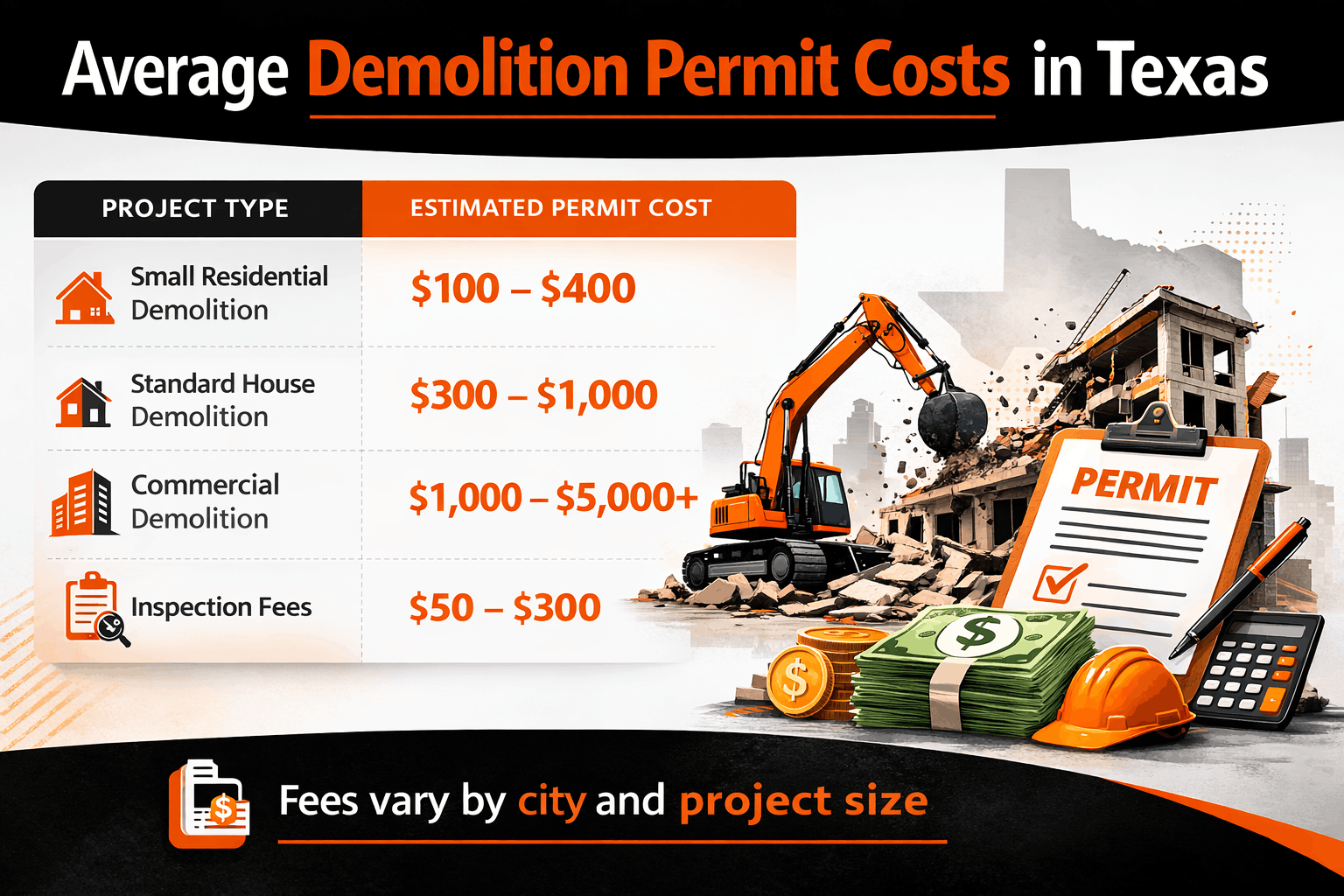
Average Demolition Permit Fees
Demolition permit costs depend on several factors. These include the building size, location, and whether the project is residential or commercial. Below is a general estimate of permit costs seen in many Texas cities.
| Project Type | Typical Permit Fee Range |
|---|---|
| Small residential demolition | $100 – $400 |
| Standard house demolition | $300 – $1,000 |
| Commercial building demolition | $1,000 – $5,000+ |
| Partial structural demolition | $150 – $800 |
| Inspection fees | $50 – $300 |
These numbers are general estimates. Some large cities charge additional review fees, especially for commercial developments. It is always best to check the exact fee schedule on the city’s permitting website.
Additional Costs to Expect
Permit fees are only one part of the overall demolition cost. Several other expenses may appear during the process.
Common additional costs include:
Asbestos inspection and testing
Hazardous material removal
Utility disconnection fees
Debris removal and landfill charges
Traffic control permits for urban projects
Environmental inspection reports
In some cities, contractors must also post a demolition bond. This bond ensures the site will be cleared and cleaned after the structure is removed. Because of these factors, total demolition costs can increase quickly if they are not planned carefully.
Cost Differences Between Texas Cities
Major cities often have more complex permit systems. As a result, fees and review processes may be higher.
For example:
Dallas may require additional documentation for older buildings
Austin may include historic preservation reviews
Houston often requires detailed utility confirmation
San Antonio may require site clearance inspections
Smaller towns usually have simpler processes and lower fees. Still, the approval timeline and requirements should always be confirmed with the local building department before starting the project.
Environmental and Safety Regulations for Demolition
Demolition projects must follow several environmental and safety regulations. These rules help protect workers, nearby residents, and surrounding properties.
Texas cities follow both local building codes and federal environmental regulations when reviewing demolition permits. Before demolition begins, inspections often confirm that hazardous materials and safety risks have been addressed.
Asbestos Regulations
Asbestos is one of the most important concerns during demolition. Many buildings constructed before the 1980s used asbestos-containing materials.
These materials may be found in:
Pipe insulation
Ceiling tiles
Floor tiles
Roofing materials
Wall insulation
Because asbestos fibers can cause serious health problems, demolition projects often require an inspection before work begins. If asbestos is present, licensed professionals must remove it using approved safety procedures.
Property owners may also need to submit asbestos inspection reports when applying for demolition permits.
Tree Protection and Environmental Compliance
Some Texas cities protect certain trees and natural features. If a demolition project affects these areas, additional approvals may be required.
Local environmental rules may include:
Tree preservation permits
Stormwater management plans
Erosion control measures
Soil protection requirements
For example, removing a structure near protected trees may require special barriers to prevent damage. These regulations help maintain environmental balance while allowing development to continue.
Construction Debris and Waste Disposal Rules
Demolition creates a large amount of waste material. Cities often regulate how debris must be handled and disposed of.
Common demolition waste includes:
Concrete
Brick and masonry
Wood framing
Metal materials
Roofing materials
Proper disposal helps prevent illegal dumping and environmental contamination. Some cities encourage recycling materials such as metal, concrete, or wood.
Below is a simplified overview of common demolition waste handling practices.
| Material Type | Typical Disposal Method |
|---|---|
| Concrete and masonry | Recycling facilities or construction landfills |
| Wood materials | Landfills or recycling centers |
| Metals | Scrap recycling facilities |
| Hazardous materials | Licensed hazardous waste disposal |
Following these rules ensures demolition projects remain compliant with local environmental laws.
Residential vs Commercial Demolition Permits
Demolition permits apply to both residential and commercial structures. However, the approval process may differ depending on the type of building. Commercial projects usually require more documentation and inspections. Residential demolition permits tend to have simpler requirements. Understanding these differences helps property owners prepare the right paperwork.
Residential Demolition Permits
Residential demolition permits are commonly required when removing structures such as:
Single-family homes
Duplex buildings
Detached garages
Small accessory structures
In many cases, residential permit applications require only a few documents.
Typical requirements include:
Property ownership verification
Utility disconnect confirmations
Demolition permit application form
Basic site plan of the property
Once approved, demolition contractors can begin work according to city guidelines. Residential permits are often approved faster than commercial permits because the projects are smaller and less complex.
Commercial Demolition Permits
Commercial demolition projects involve larger structures and higher safety risks. Because of this, cities require more detailed documentation.
Examples of commercial demolition projects include:
Office buildings
Retail spaces
Warehouses
Industrial facilities
Multi-story structures
Permit applications may require additional documents such as:
Structural engineering reports
Traffic control plans
Environmental impact assessments
Detailed demolition safety plans
These requirements help cities ensure large demolition projects are managed safely. Commercial demolition also requires careful planning because nearby buildings and infrastructure may be affected.
Historic Building Demolition Rules
Some Texas buildings have historic value. Cities often protect these structures through preservation laws. If a property is located in a historic district, demolition may require special approval before a permit is issued.
Historic review boards may evaluate:
Age of the building
Architectural significance
Cultural importance
Impact on surrounding historic areas
In some cases, property owners must attend review meetings before demolition is approved. These rules help preserve important structures while still allowing responsible development.
Common Mistakes When Applying for Demolition Permits
Many demolition projects face delays because of simple mistakes during the permit process. These errors often happen when property owners are unfamiliar with local regulations or skip important steps.
Taking time to understand the permit process can prevent costly setbacks. Below are some of the most common mistakes seen in demolition permit applications across Texas.
Starting Demolition Without a Permit
One of the most serious mistakes is beginning demolition work without an approved permit. Some property owners assume a permit is not necessary for smaller structures. However, most cities require approval before any structural demolition begins.
If demolition starts without a permit, the city may take several actions:
Issue a stop-work order
Require emergency inspections
Impose fines or penalties
Delay future construction permits
In severe cases, the city may also require the property owner to submit additional documentation before work can continue. Checking permit requirements early helps avoid these problems.
Submitting Incomplete Applications
Incomplete permit applications are another common issue. Missing documents can slow down the review process and push project timelines back.
Typical missing items include:
Utility disconnection confirmations
Site plans showing the structure location
Proof of property ownership
Contractor license information
Permit reviewers cannot approve demolition until all required documents are submitted. Before applying, it helps to review the city’s permit checklist carefully.
Not Disconnecting Utilities
Utility disconnection is a major safety requirement for demolition projects. Electricity, gas, and water lines must be shut off before demolition equipment arrives on-site.
Failing to disconnect utilities can create dangerous conditions. For example, active gas lines can cause explosions during demolition. Most cities require written confirmation from utility providers before issuing a demolition permit.
Ignoring Environmental Inspections
Older buildings may contain hazardous materials such as asbestos or lead-based paint. If these materials are present, they must be handled properly before demolition begins.
Skipping environmental inspections can lead to legal and safety problems. Property owners should always confirm whether inspections are required before submitting a permit application.
How Long Does It Take to Get a Demolition Permit in Texas?
The timeline for demolition permit approval varies by city. Some applications are approved quickly, while others require more detailed review.
In many cases, residential demolition permits are processed faster than commercial permits. Understanding the typical timeline helps property owners plan their projects more effectively.
Typical Permit Approval Timeline
Many Texas cities review demolition permit applications within a few business days. However, complex projects may take longer.
The table below shows general approval timelines.
| Permit Type | Typical Approval Time |
|---|---|
| Small residential demolition | 3–7 business days |
| Standard house demolition | 5–10 business days |
| Commercial demolition | 1–3 weeks |
| Historic structure review | 2–4 weeks or longer |
These timelines depend on the completeness of the application and the workload of the city’s permit office. Submitting accurate documentation often speeds up the process.
Factors That Can Delay Permit Approval
Several factors can extend the permit review timeline.
Common delays include:
Missing or incomplete documentation
Environmental inspection requirements
Historic preservation reviews
Utility disconnection delays
High permit application volume
Cities may also request additional information if the project affects nearby properties or infrastructure. Planning ahead helps prevent unexpected delays.
Why Hiring a Permit Consulting Firm Can Save Time
The demolition permit process can be confusing for property owners who are unfamiliar with local regulations. Each city has its own requirements, forms, and approval procedures.
As a result, many developers and contractors choose to work with permit consulting professionals. Permit consultants help ensure applications are complete and submitted the first time correctly.
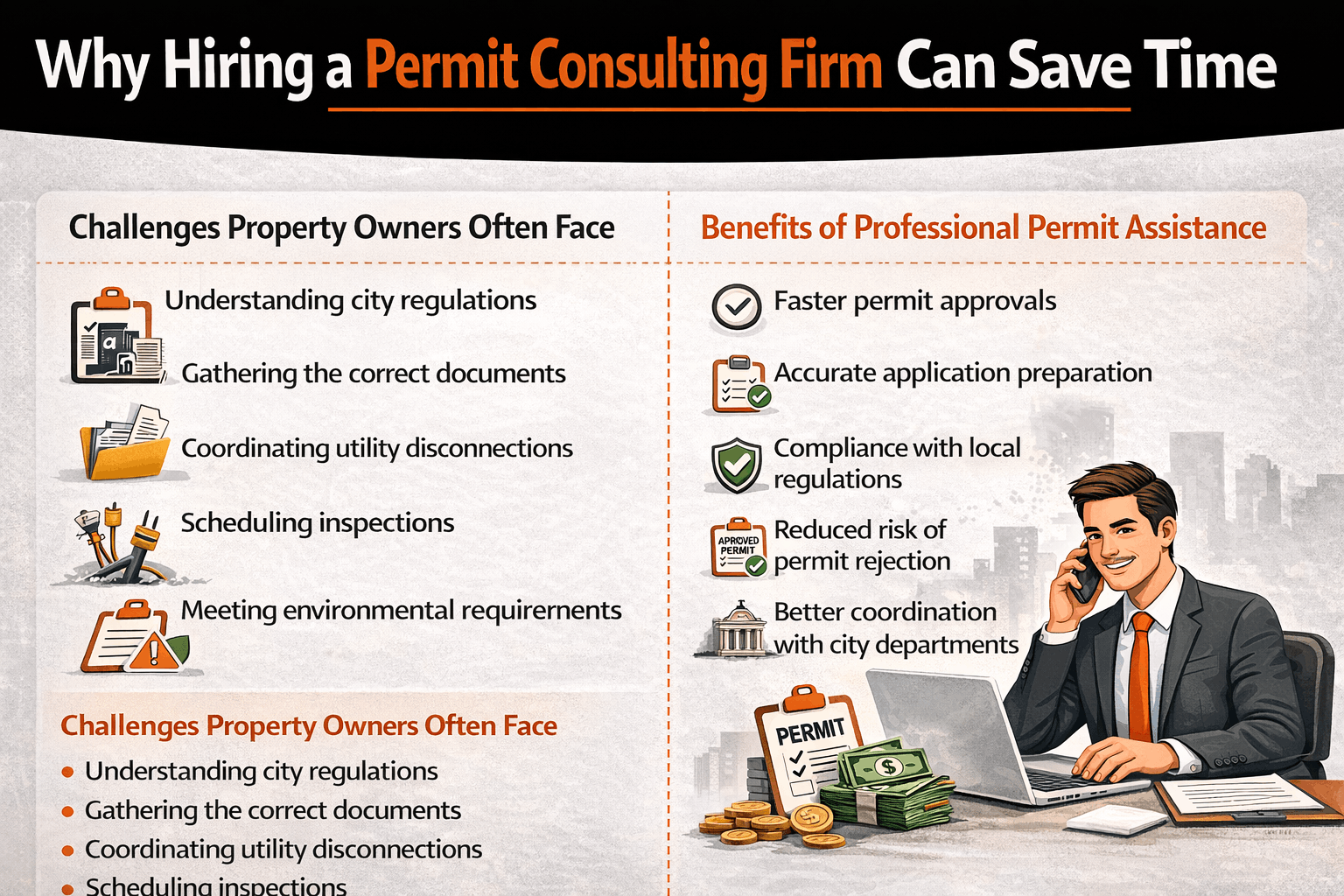
Challenges Property Owners Often Face
Without experience in permitting, applicants may struggle with several issues.
Common challenges include:
Understanding city regulations
Gathering the correct documentation
Coordinating utility disconnections
Scheduling inspections
Meeting environmental compliance requirements
These tasks take time and careful attention to detail. Mistakes can lead to delays that affect construction timelines.
Benefits of Professional Permit Assistance
Permit consulting services help simplify the approval process. Working with experienced professionals can provide several advantages:
Faster permit approvals
Accurate application preparation
Compliance with local regulations
Reduced risk of permit rejection
Better coordination with city departments
Consultants often communicate directly with city officials to resolve issues quickly. This support allows property owners and developers to focus on the construction phase of the project.
When Permit Consulting Services Are Most Helpful
Permit consulting services are especially useful for complex demolition projects.
Examples include:
Commercial property redevelopment
Urban construction projects
Demolition in historic districts
Large industrial demolition projects
Professional guidance can help prevent delays and keep projects on schedule.
Texas Demolition Permit Checklist
Before applying for a demolition permit, it helps to follow a simple preparation checklist. This ensures that all requirements are completed before submitting the application. Using a checklist can prevent delays during the review process.
Pre-Application Checklist
Before submitting a permit application, confirm the following steps are completed.
Verify property ownership
Confirm zoning regulations
Schedule asbestos inspection if required
Contact utility companies for disconnection
Prepare a site plan of the property
Completing these steps early helps streamline the permit process.
Permit Application Checklist
When submitting the permit application, most cities require the following documents.
Completed demolition permit application
Site plan showing building location
Utility disconnection confirmations
Contractor information
Proof of ownership
Submitting these documents together helps prevent delays during review.
Pre-Demolition Safety Checklist
Before demolition work begins, confirm that the project meets safety requirements.
Utilities fully disconnected
Environmental inspections completed
Safety barriers installed if needed
Proper demolition equipment on-site
Following this checklist helps ensure demolition begins safely and legally.
Final Thoughts on Demolition Permits in Texas
Demolition permits play an important role in construction and redevelopment projects across Texas. They help ensure buildings are removed safely while protecting nearby properties, utilities, and the environment.
Although permit requirements vary between cities, most demolition projects follow a similar process. Property owners must submit an application, provide supporting documents, disconnect utilities, and complete safety inspections.
Planning ahead can make the process much smoother. Gathering documents early and understanding local regulations helps prevent delays. For larger or more complex projects, professional permit consulting services can provide valuable guidance.
With proper preparation, property owners and developers can complete demolition projects safely, efficiently, and in full compliance with Texas regulations.
Get Expert Help With Demolition Permits
Permit applications, inspections, and city approvals can slow down a project. JDJ Consulting helps simplify the process so your demolition project stays on schedule.
Frequently Asked Questions About Demolition Permits in Texas
Do you need a permit to demolish a building in Texas?
Yes, most cities in Texas require a demolition permit before tearing down a structure. This applies to houses, garages, commercial buildings, and many accessory structures. Local building departments issue these permits to ensure demolition is done safely.
Cities usually review the project to confirm:
Utilities are disconnected
Hazardous materials inspections are completed
The demolition plan follows local codes
Starting demolition without a permit can result in fines, stop-work orders, or delays in future construction permits.
Who issues demolition permits in Texas?
Demolition permits in Texas are issued by local municipalities rather than the state government. Each city or county has its own building department or development services office responsible for reviewing permit applications.
These departments typically handle:
Application review
Documentation verification
Permit approvals
Inspections before demolition
Because rules vary by city, applicants should always check the requirements of the local building department where the property is located.
How long does it take to get a demolition permit in Texas?
The timeline depends on the city and the complexity of the project. In many cases, residential demolition permits are approved faster than commercial ones.
Typical timelines include:
Small residential demolition: 3–7 business days
Standard home demolition: 5–10 business days
Commercial demolition: 1–3 weeks
Delays may occur if documents are missing or environmental inspections are required. Submitting a complete application helps speed up the process.
How much does a demolition permit cost in Texas?
Permit fees vary depending on the city, the size of the structure, and the type of demolition project. Residential permits usually cost less than commercial permits.
Common cost ranges include:
Small residential demolition: $100–$400
House demolition permits: $300–$1,000
Commercial demolition permits: $1,000–$5,000 or more
Additional costs may include inspections, environmental testing, and utility disconnection fees.
Do you need an asbestos inspection before demolition in Texas?
Many demolition projects require an asbestos inspection, especially if the building was constructed before the 1980s. Older materials such as insulation, ceiling tiles, and pipe coverings may contain asbestos.
An asbestos survey typically:
Identifies hazardous materials
Determines if removal is required
Ensures safe demolition practices
If asbestos is found, licensed professionals must remove it before demolition can begin.
Can a homeowner apply for a demolition permit in Texas?
In many Texas cities, homeowners can apply for demolition permits themselves. However, some municipalities require a licensed contractor to be listed on the permit application.
Homeowners may need to provide:
Proof of property ownership
Utility disconnection confirmation
Contractor information (if applicable)
For complex projects, many property owners work with contractors or permit consultants to complete the process correctly.
What documents are required for a demolition permit in Texas?
Most demolition permit applications require several documents to verify safety and compliance.
Common documents include:
Demolition permit application form
Site plan showing the building location
Proof of property ownership
Utility disconnect confirmations
Contractor license details
Some cities may also require photos of the structure or environmental inspection reports.
Do I need a permit to demolish a garage in Texas?
Yes, many cities require a permit to demolish a garage or accessory structure. Even small buildings can affect utilities, drainage systems, or nearby properties.
Cities review these projects to ensure:
Utilities are safely disconnected
Debris disposal plans are in place
The demolition does not impact nearby structures
Permit requirements may vary depending on the size of the structure and local building codes.
What happens if you demolish a building without a permit?
Demolishing a building without the required permit can lead to serious consequences. Cities enforce strict rules to ensure public safety.
Possible penalties include:
Stop-work orders
Fines or penalties
Additional inspections
Delays in future construction permits
In some cases, property owners may also be required to submit extra documentation before work can continue.
Are demolition permits required for interior demolition?
Interior demolition may require a permit if the work affects structural elements of the building. Removing load-bearing walls, structural supports, or major systems often requires approval.
Minor interior demolition such as:
Removing cabinets
Taking down drywall
Replacing flooring
may not require a permit. However, it is always best to confirm with the local building department before starting work.
Do utilities need to be disconnected before demolition?
Yes, utilities must be disconnected before demolition begins. This is a critical safety requirement in most Texas cities.
Utilities that typically must be shut off include:
Electricity
Natural gas
Water service
Sewer connections
Utility companies often provide confirmation letters that must be submitted to the city before the demolition permit is issued.
Can demolition permits be applied for online in Texas?
Many large Texas cities now offer online permit application systems. These portals allow applicants to submit forms, upload documents, and pay fees digitally.
Online systems are available in cities such as:
Dallas
Austin
Houston
San Antonio
Smaller municipalities may still require in-person submissions, so applicants should check local procedures.
What inspections are required before demolition?
Cities often require inspections before approving demolition permits. These inspections help confirm that safety requirements are met.
Common inspections include:
Utility disconnection verification
Asbestos or environmental inspections
Site safety checks
In some cases, inspectors may visit the property to verify conditions before demolition begins.
Do commercial demolition projects require additional permits?
Yes, commercial demolition projects usually require more documentation and approvals. These projects often involve larger structures and higher safety risks.
Additional requirements may include:
Structural engineering reports
Traffic control plans
Environmental impact assessments
Detailed demolition safety plans
Cities review these projects carefully to ensure nearby buildings and infrastructure remain safe.
Can historic buildings be demolished in Texas?
Historic buildings may require special approval before demolition. Many cities protect older structures through historic preservation rules.
Before issuing a permit, cities may review:
The building’s age
Architectural significance
Cultural importance
Impact on historic districts
In some cases, property owners must attend review meetings or obtain approval from a preservation board.
How long is a demolition permit valid?
The validity period of a demolition permit varies by city. Many permits remain valid for several months after approval.
However, most cities require demolition work to begin within a certain timeframe. If the project does not start before the permit expires, the applicant may need to renew or reapply. Checking permit expiration dates helps prevent project delays.
Do demolition permits include debris removal requirements?
Yes, most cities require demolition projects to include a debris disposal plan. Construction waste must be handled properly to prevent environmental issues.
Common disposal practices include:
Transporting debris to approved landfills
Recycling materials such as metal or concrete
Following hazardous waste regulations
Cities may also inspect the site after demolition to ensure debris has been removed.
Can contractors apply for demolition permits on behalf of property owners?
Yes, licensed contractors often apply for demolition permits on behalf of property owners. Contractors are familiar with permit requirements and can help ensure the application is completed correctly.
Contractors typically handle:
Permit paperwork
Scheduling inspections
Coordinating utility disconnections
This approach helps streamline the demolition process and reduce delays.
Are demolition permits different from building permits?
Yes, demolition permits and building permits serve different purposes. A demolition permit allows the removal of a structure, while a building permit allows construction or renovation.
In redevelopment projects, both permits may be required.
For example:
First, a demolition permit removes the existing structure
Then, a building permit allows construction of the new structure
Each permit must be approved before work begins.
Why do cities regulate demolition projects?
Cities regulate demolition projects to protect public safety and maintain proper development standards.
Regulations help ensure that:
Utilities are safely disconnected
Hazardous materials are handled correctly
Debris is disposed of responsibly
Nearby buildings are not damaged
These rules help prevent accidents and keep communities safe while allowing construction and redevelopment to continue.