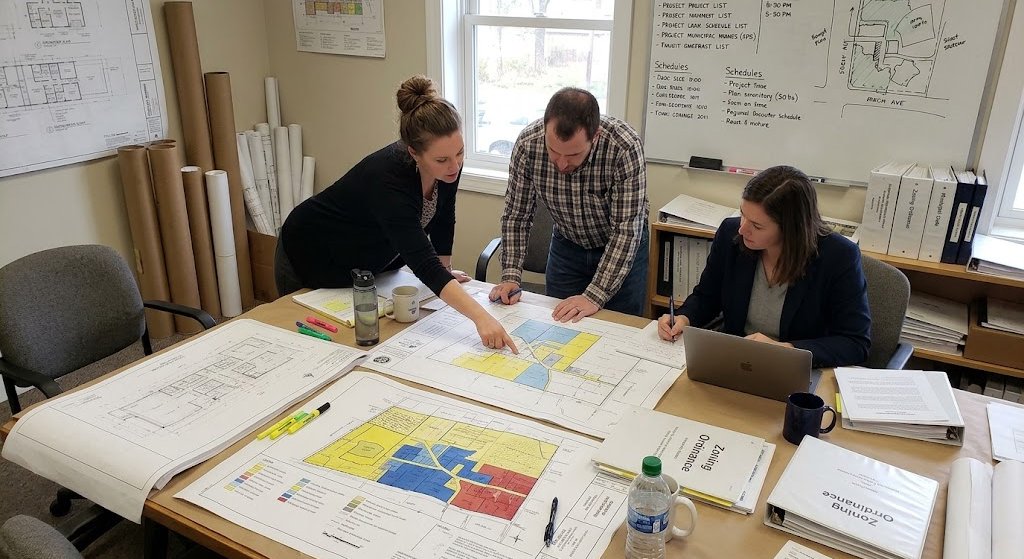

Phased permitting strategies help you start construction sooner instead of waiting months for full approval. Instead of submitting everything at once, you break permits into stages and move forward step by step. This keeps your project active while other parts are still under review.
Delays in permitting are common, especially on larger projects. That’s why many developers use this approach to save time and stay on schedule. In this guide, we’ll walk through how phased permitting works and when it makes sense for your project.
Table of Contents
What Is Phased Permitting in Construction? (Simple Explanation)
Phased permitting is a practical way to start construction sooner. Instead of waiting for one full permit, you submit and approve parts of the project in stages. This means work can begin while other sections are still under review.
In simple terms, you do not wait for everything to be perfect on paper. You move forward with what is ready. This approach works well for large or complex projects where time matters.
Many developers use phased permitting to reduce delays. It also helps teams stay active instead of waiting months for approvals.

Definition of Phased Permitting
Phased permitting is the process of breaking a construction permit into smaller approvals. Each approval covers a specific part of the project. For example, you might get approval for grading and foundation first. Then you submit plans for structure, followed by interiors and systems.
This approach allows construction to begin earlier. It also spreads out the review process.
Here is a simple breakdown:
Full permit = one complete approval before work starts
Phased permit = multiple approvals, each tied to a stage of work
Because of this structure, teams can plan better. They can also adjust later phases based on early feedback.
How Phased Permitting Differs from Traditional Permitting
Traditional permitting follows a linear path. You prepare all plans, submit them, wait for review, fix comments, and then get approval. Only after that can construction begin.
Phased permitting changes that sequence. It allows overlap between design, review, and construction.
Here is a clear comparison:
| Aspect | Traditional Permitting | Phased Permitting |
|---|---|---|
| Approval process | One full approval | Multiple staged approvals |
| Start of construction | After full permit | After first phase approval |
| Flexibility | Limited | High |
| Timeline | Longer upfront delay | Faster start |
| Risk handling | Late-stage issues | Early detection |
This difference is important. It affects both schedule and cost. With phased permitting, teams can respond faster. If a problem comes up, it is easier to fix early rather than later.
Relationship Between Phasing and Construction Workflow
Construction projects already follow phases. These often include site work, foundation, structure, and finishes. Phased permitting aligns with this natural sequence. Each permit phase matches a construction phase.
For example:
Site work permit → excavation and grading
Foundation permit → footings and slabs
Structural permit → framing and core systems
Interior permit → finishes and MEP systems
This alignment helps teams stay organized. It also reduces downtime between tasks.
Another benefit is parallel progress. While construction crews work on the foundation, designers can finalize structural drawings. At the same time, the next permit package moves through review.
This overlap saves time. It also keeps momentum steady across the project.
Why Phased Permitting Strategies Matter in Modern Development
Construction projects today are more complex than ever. There are more regulations, more stakeholders, and tighter deadlines. Because of this, waiting for a full permit can slow everything down. Phased permitting offers a better option. It allows projects to move forward without long pauses. This approach is not just about speed. It also improves planning, coordination, and cost control.

Increasing Complexity of Urban Projects
Urban development comes with many layers. Projects must meet zoning rules, building codes, and environmental standards. In cities like Los Angeles, approvals often involve multiple departments. Each one reviews a different part of the project. This adds time. It also increases the chance of revisions.
Phased permitting helps manage this complexity. Instead of handling everything at once, teams focus on smaller sections. This makes the review process more manageable. It also helps reduce errors. Smaller submissions are easier to review and correct.
Common Problems Developers Face Without Phasing
Without phased permitting, many projects face similar issues. These problems often lead to delays and higher costs.
Here are some common challenges:
Long waiting periods before construction starts
Multiple rounds of plan check corrections
Budget pressure due to idle crews
Delayed project timelines
Difficulty adjusting designs after submission
These issues can slow down even well-planned projects. For example, if one part of the design has a problem, the entire permit can be delayed. This affects everything, from scheduling to financing.
Key Benefits of Phased Permitting
Phased permitting offers several clear benefits. These advantages make it a strong choice for many projects.
Faster Project Timelines: The biggest benefit is time. You can start construction earlier. Instead of waiting months, work begins as soon as the first phase is approved. This keeps the project moving.
Improved Cash Flow: Costs are spread across different phases. This makes budgeting easier. Developers do not need to commit all funds at once. They can manage expenses based on progress.
Better Risk Management: Problems are easier to catch early. Each phase acts as a checkpoint. If an issue appears, it affects only a small part of the project. This reduces overall risk.
Operational Continuity: This approach works well for renovations and occupied buildings. For example, one section can stay open while another is under construction. This keeps business operations running.
Here is a quick summary of benefits:
| Benefit | Impact on Project |
|---|---|
| Faster start | Reduces overall timeline |
| Better cash flow | Improves financial planning |
| Early issue detection | Lowers risk |
| Flexible workflow | Adapts to changes easily |
Types of Phased Permitting Strategies
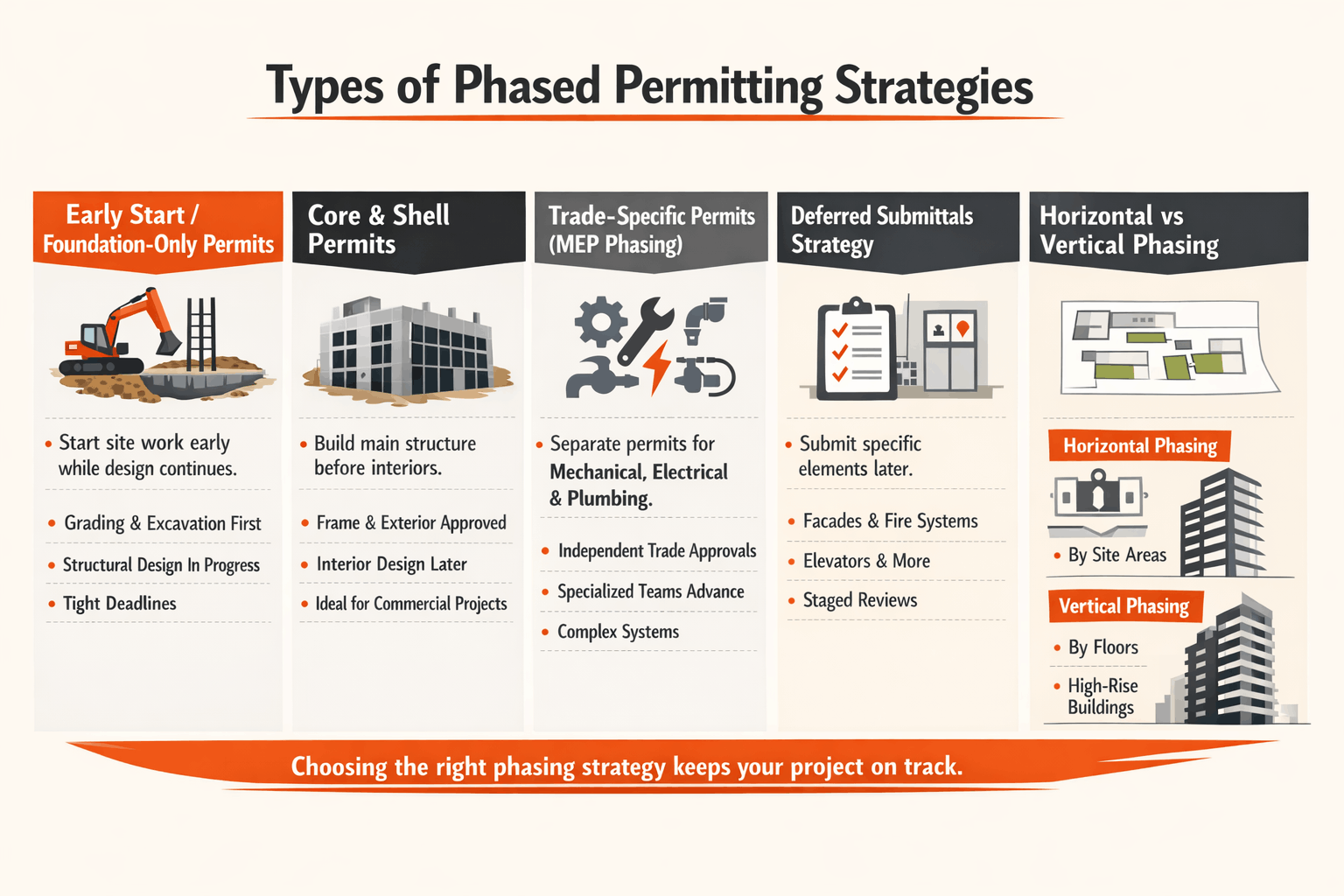
Not all phased permitting strategies are the same. Different projects use different approaches based on scope and complexity. Choosing the right type is important. It affects how smoothly the project moves forward.
Early Start / Foundation-Only Permits
This is one of the most common strategies. It focuses on starting site work early. Developers submit plans for grading, excavation, and foundation first. Once approved, construction begins right away. Meanwhile, the rest of the design continues.
This approach works well when:
Site work is straightforward
Structural design is still in progress
The project has tight deadlines
It helps reduce idle time at the beginning of the project.
Core & Shell Permits
In this strategy, the building structure is approved first. This includes the frame, exterior walls, and main systems. Interior work is submitted later as a separate phase. This method is common in commercial projects. It allows developers to complete the main structure while finalizing interior layouts.
Benefits include:
Faster structural progress
Flexibility in tenant design
Easier coordination for large buildings
Trade-Specific Permits (MEP Phasing)
Some projects separate permits by trade. These include mechanical, electrical, and plumbing systems. Each system is reviewed and approved independently. This approach allows specialized teams to move forward without waiting for full project approval.
It is useful when:
Systems are complex
Different teams handle different scopes
Coordination is critical
Deferred Submittals Strategy
In this approach, certain elements are submitted later. These are usually specialized components like facades, elevators, or fire systems. The main permit is approved first. Then deferred items are reviewed separately.
This helps avoid delays caused by complex details. However, it requires careful tracking. Missing a deferred approval can slow down later stages.
Horizontal vs Vertical Phasing
Phasing can also be based on layout. Horizontal phasing divides the project by area. For example, different sections of a site are approved separately. Vertical phasing divides the project by floors. Each level is permitted in stages.
Here is a simple comparison:
| Type | Description | Best Use Case |
|---|---|---|
| Horizontal phasing | Divides project by site areas | Large campuses or multi-building sites |
| Vertical phasing | Divides project by floors | High-rise buildings |
Both methods help manage large projects. The choice depends on design and construction needs.
These first sections set the foundation for understanding phased permitting. In the next part, we will break down the step-by-step process and real-world applications.
Step-by-Step Process of Implementing Phased Permitting
A phased permitting strategy works best when there is a clear plan. Without structure, it can create confusion instead of saving time. The goal is simple. Break the project into logical parts. Then move each part through approval and construction in a controlled way.
Below is a practical step-by-step process that many developers follow.
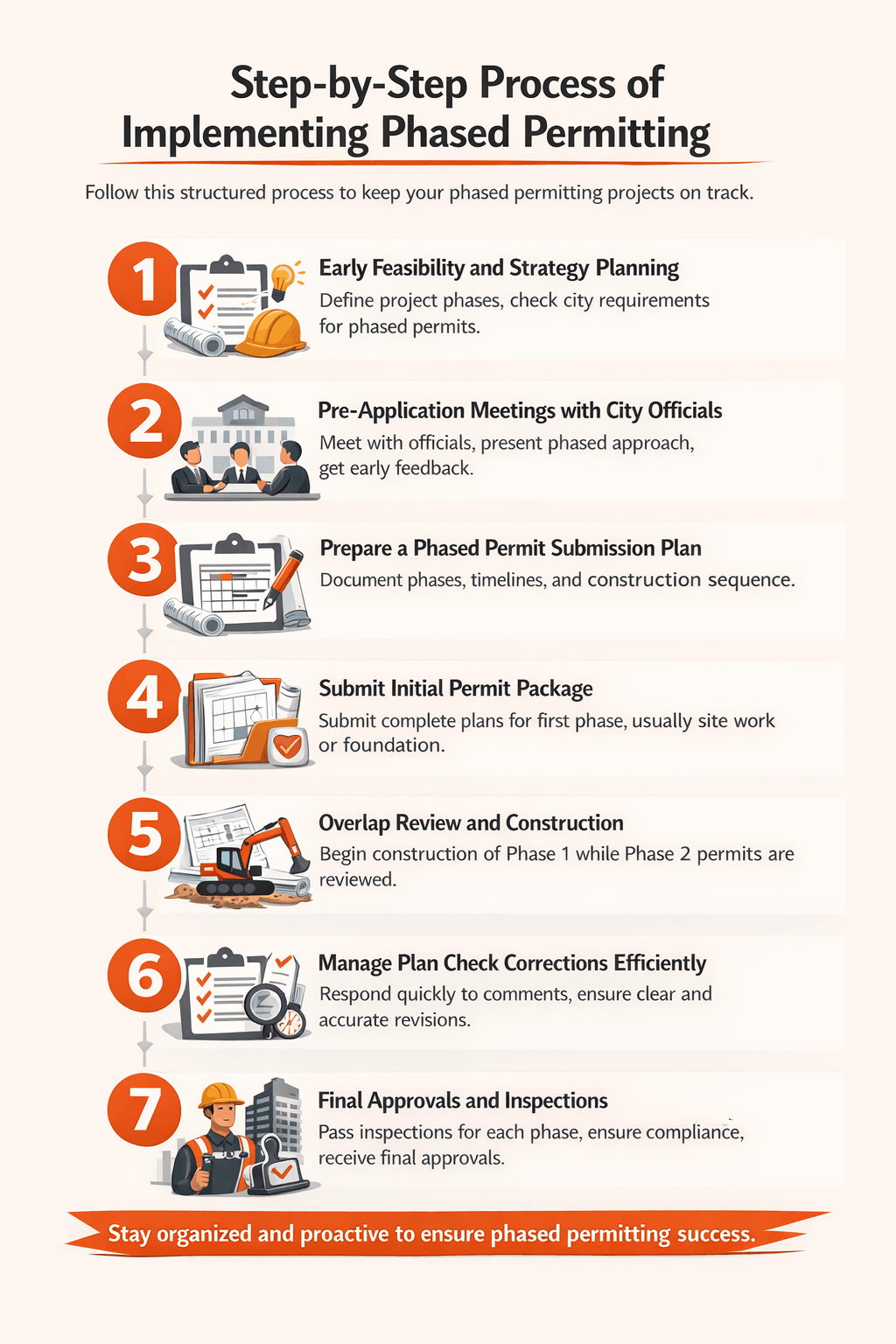
Step 1 – Early Feasibility and Strategy Planning
Every successful phased project starts with planning. This step defines how the project will be divided. You need to identify which parts of the project can move forward first. These are usually site work or foundation elements.
At the same time, check local rules. Not all cities allow phased permits for every project type.
Key questions to ask:
Which scopes are ready for early submission?
Can construction safely begin in phases?
What are the city’s requirements for phased approvals?
This step sets the direction for everything that follows. A weak plan here often leads to delays later.
Step 2 – Pre-Application Meetings with City Officials
Before submitting anything, it helps to meet with the city or permitting authority. This meeting is often overlooked. However, it can save weeks of back-and-forth later. During the meeting, you present your phased approach. You explain how the project will be divided and submitted.
City reviewers may give feedback right away. They might suggest changes to your phasing plan.
Benefits of this step:
Clear expectations from reviewers
Fewer surprises during plan check
Faster approvals in later stages
This step builds alignment early. It also reduces the risk of rejection.
Step 3 – Prepare a Phased Permit Submission Plan
Once the strategy is clear, the next step is documentation. You need a detailed submission plan. This outlines how each phase will move through review and construction.
A strong plan usually includes:
Scope of each phase
Timeline for submissions
Construction schedule
Team responsibilities
This document acts as a roadmap. It keeps everyone on the same page.
Here is a simple example:
| Phase | Scope | Submission Timing | Construction Start |
|---|---|---|---|
| Phase 1 | Grading & excavation | Month 1 | Month 2 |
| Phase 2 | Foundation | Month 2 | Month 3 |
| Phase 3 | Structure | Month 3 | Month 5 |
| Phase 4 | Interiors | Month 5 | Month 7 |
This type of planning improves coordination. It also helps avoid gaps between phases.
Step 4 – Submit Initial Permit Package
Now the process becomes active. You submit the first permit package. This is usually for site work or foundation. This package should be complete and well-prepared. Any missing details can slow down the entire process.
Focus on:
Clear drawings
Accurate specifications
Code compliance
A strong first submission builds momentum. It also sets the tone for future phases.
Step 5 – Overlap Review and Construction
This is where phased permitting shows its value. Once the first phase is approved, construction begins. At the same time, the next phase is under review. This overlap keeps the project moving.
For example:
Crews start excavation
Engineers finalize structural plans
The city reviews the next submission
This parallel workflow reduces downtime. It also shortens the overall timeline.
Step 6 – Manage Plan Check Corrections Efficiently
Plan check corrections are part of every project. The key is how quickly you respond. In phased permitting, delays in one phase can affect the next. So fast response is critical.
Best practices include:
Assign a dedicated team for corrections
Track comments carefully
Respond with clear revisions
Quick turnaround helps maintain progress. It also builds trust with reviewers.
Step 7 – Final Approvals and Inspections
Each phase must pass inspections before moving forward. Inspectors verify that work matches approved plans. If issues are found, they must be corrected before proceeding. Final approvals depend on all phases being complete and compliant. This step ensures quality. It also protects the project from future issues.
Real-World Examples of Phased Permitting in Action
Understanding the process is helpful. However, real-world examples make it clearer. Phased permitting is widely used across different project types. Each case shows how timing and planning come together.
Commercial Office Building Example
A developer plans a mid-rise office building. The full design is not ready, but the project must start quickly. They choose a phased approach.
Phase 1 includes:
Site clearing
Excavation
Foundation work
While construction begins, the structural design is finalized. Then Phase 2 is submitted and approved. This approach saves several months. It also allows early contractor involvement.
Warehouse Renovation Case
In a warehouse renovation, keeping operations running is important. The project is divided into zones. Each zone is permitted and built separately.
For example:
Section A is under construction
Section B remains operational
Section C is under review
This phased approach avoids full shutdown. It also maintains revenue during construction.
Mixed-Use Development Scenario
A mixed-use project includes retail and residential units. The developer wants retail spaces to open early. So they phase the project accordingly.
Phase breakdown:
Phase 1: Retail base and utilities
Phase 2: Structural work
Phase 3: Residential interiors
Retail tenants move in while upper floors are still under construction. This creates early income. It also improves project cash flow.
Key Takeaways from Real Projects
Across these examples, a few patterns stand out:
Early phases focus on site and structure
Later phases handle details and interiors
Overlapping work reduces total time
Strong coordination is essential
Phased permitting works best when planning and execution stay aligned.
Key Challenges in Phased Permitting (And How to Solve Them)
While phased permitting offers many benefits, it also comes with challenges. Understanding these issues early helps avoid problems later.
Coordination Complexity
Multiple phases mean multiple submissions. Each one must align with the others. Without coordination, teams can fall out of sync.
Common issues include:
Conflicting drawings
Missed deadlines
Communication gaps
Solution: Use a centralized project management system. Keep all teams connected and updated. Regular meetings also help maintain alignment.
Risk of Rework
Changes in later phases can affect earlier work. This can lead to rework. For example, a design update in the structural phase might impact the foundation.
Solution: Invest more time in early planning. Make sure key decisions are finalized before construction starts. Also, maintain flexibility where possible.
Regulatory Restrictions
Not all jurisdictions support phased permitting. Some cities require full approvals before construction begins.
Solution: Check local rules early. Speak with city officials before planning your strategy. If phased permitting is limited, adjust your approach accordingly.
Increased Documentation Load
Phased permitting requires more paperwork. Each phase needs its own submission and approval. This increases workload for the team.
Solution: Use digital tools to manage documents. Track submissions and approvals carefully. A structured system reduces errors and saves time.
Summary of Challenges and Solutions
| Challenge | Impact | Solution |
|---|---|---|
| Coordination issues | Delays and confusion | Centralized management |
| Rework risk | Increased costs | Strong upfront planning |
| Regulatory limits | Restricted phasing | Early consultation |
| Documentation load | More admin work | Use tracking tools |
These challenges are manageable. With the right approach, they do not outweigh the benefits.
Best Practices for Successful Phased Permitting Strategies
Phased permitting works best when there is strong planning and clear communication. Without these, even a good strategy can fall apart. The goal is to keep each phase connected. Every decision should support the overall project, not just one part of it.
Below are practical best practices used by experienced developers and consultants.
Plan the Entire Project Before Phasing
It may sound simple, but this step is often skipped. Even though permits are submitted in phases, the full project should be planned early. This includes design intent, structural systems, and major layouts.
If you only plan one phase at a time, problems will show up later. These issues often lead to rework or delays.
Instead, take time to:
Define the full scope of the project
Identify dependencies between phases
Lock key design decisions early
This creates a stable foundation for all future phases.
Prioritize Critical Path Activities
Not all tasks carry the same weight. Some activities directly impact the project timeline. These are called critical path activities. In phased permitting, the first phase should focus on these tasks.
For example:
Site work and grading
Foundation construction
Structural framework
If these move forward quickly, the rest of the project can follow without delays.
A simple way to think about it:
What work must happen first?
What delays everything else if it is late?
Focus on those elements first.
Maintain Strong Communication Across Teams
Phased permitting involves many teams. These include architects, engineers, contractors, and consultants. Each team works on different parts of the project. Without communication, mistakes can happen.
Common communication gaps include:
Design changes not shared across teams
Conflicting drawings between phases
Missed deadlines
To avoid this, set up a clear communication system.
Best practices include:
Weekly coordination meetings
Shared project dashboards
Clear responsibility for each phase
Strong communication keeps the project aligned. It also reduces confusion during approvals.
Work with Permit Expeditors
Permit expeditors play an important role in phased projects. They understand how local agencies review applications.
They can help:
Prepare submission packages
Track permit status
Respond to plan check comments
This support speeds up approvals. It also reduces errors in submissions. For complex projects, working with experienced consultants can make a big difference.
Align Permitting with Construction Schedule
Permitting and construction should move together. If they are not aligned, delays will happen. For example, if construction finishes a phase before the next permit is approved, crews may sit idle. To avoid this, match permit timelines with construction needs.
Here is a simple alignment example:
| Construction Activity | Permit Phase | Timing Goal |
|---|---|---|
| Excavation | Phase 1 | Approved before site work starts |
| Foundation | Phase 2 | Approved before excavation ends |
| Structure | Phase 3 | Approved before foundation completes |
| Interiors | Phase 4 | Approved before structural close |
This approach keeps work flowing without interruption.
Tools and Technology That Support Phased Permitting
Modern construction projects rely on digital tools. These tools help manage the complexity of phased permitting. They improve visibility, coordination, and speed.
Permit Tracking Software
Permit tracking tools help teams monitor progress in real time.
They show:
Submission status
Review timelines
Approval stages
This reduces guesswork. It also helps teams respond faster to delays.
Key benefits:
Better visibility across phases
Faster response to issues
Clear tracking of approvals
Project Management Platforms
Project management software connects all teams in one place.
These platforms help manage:
Schedules
Tasks
Documents
They also improve communication. Everyone can see updates as they happen. This is especially useful in phased permitting, where timing is critical.
Building Information Modeling (BIM)
BIM is a powerful tool for planning and coordination. It creates a digital model of the building. This allows teams to visualize how different phases connect.
With BIM, teams can:
Identify conflicts early
Plan construction sequences
Improve design accuracy
This reduces errors during both design and construction.
AI and Automation in Permitting
Some cities and firms are starting to use automation tools in permitting.
These tools can:
Review plans for code compliance
Flag missing information
Predict delays based on past data
While still evolving, these tools are becoming more common. They help speed up reviews and reduce manual work.
Cost Implications of Phased Permitting
Cost is always a key concern in construction. Phased permitting can affect both short-term and long-term expenses. When used correctly, it often leads to better cost control.
Upfront vs Long-Term Cost Comparison
Phased permitting may require more planning upfront. It can also involve multiple submission fees. However, it often reduces total project cost over time.
Here is a simple comparison:
| Cost Factor | Traditional Permitting | Phased Permitting |
|---|---|---|
| Initial design cost | Moderate | Slightly higher |
| Permit fees | Single fee | Multiple smaller fees |
| Delay costs | High | Lower |
| Rework costs | Higher risk | Lower if planned well |
| Total project cost | Moderate to high | Often lower |
The main savings come from reduced delays. Time savings often translate into cost savings.
Where Developers Save Money
Phased permitting helps control costs in several ways.
Key savings areas include:
Reduced idle labor time
Earlier project completion
Better use of equipment and resources
Improved financing flexibility
For example, starting construction earlier can reduce interest costs on loans. It can also bring revenue sooner in income-generating projects.
Hidden Costs to Watch Out For
While phased permitting offers benefits, there are some hidden costs to consider.
These include:
Rework due to design changes
Additional coordination effort
Multiple submission and review fees
If planning is weak, these costs can add up. The best way to avoid them is through strong early planning and clear phase definition.
Cost Management Tips for Phased Projects
To keep costs under control:
Finalize key design elements early
Track each phase budget separately
Monitor delays closely
Keep communication clear across teams
These steps help maintain financial control throughout the project. These sections cover the practical side of phased permitting. They show how to plan, manage, and control projects effectively.
Phased Permitting in Los Angeles (Local Insight for Developers)
Los Angeles is one of the most regulated construction markets in the U.S. Because of this, permitting often takes longer than expected. Phased permitting is widely used here to reduce delays and keep projects moving.
Why Los Angeles Projects Benefit from Phased Permitting
Projects in Los Angeles face several challenges:
Strict building codes
Multiple review departments
Long plan check cycles
High project costs
Waiting for full approval can slow down the entire project. In many cases, developers lose months before construction even begins. Phased permitting helps solve this problem. It allows early work, like grading and foundation, to begin while other plans are still under review.
This is especially useful for:
Mixed-use developments
Commercial buildings
Large residential projects
By starting early, developers can stay on schedule and reduce financial pressure.
LADBS and Plan Check Considerations
The Los Angeles Department of Building and Safety (LADBS) handles most building permits in the city.
Their review process includes multiple steps:
Plan submission
Initial review
Corrections and resubmittals
Final approval
Each phase of a project may go through this cycle. One important point is that corrections are common. Even small issues can delay approvals if not handled quickly.
To manage this process well:
Submit clear and complete drawings
Respond to corrections quickly
Keep communication open with reviewers
Also, some departments review specific systems, such as structural or mechanical. This makes coordination even more important in phased projects.
How JDJ Consulting Helps with Phased Permitting
Working with experienced consultants can make a big difference, especially in a complex market like Los Angeles. Firms like JDJ Consulting Group support developers through each phase of the permitting process.
Their role often includes:
Preparing phased permit strategies
Managing plan check submissions
Coordinating with city departments
Tracking approvals and timelines
This support helps reduce delays and improve project flow. It also allows developers to focus on construction while experts handle the permitting side.
When Should You Use a Phased Permitting Strategy?
Phased permitting is not the right choice for every project. It works best in specific situations. Understanding when to use it can save both time and money.
Ideal Project Types for Phased Permitting
Phased permitting works best for large or complex developments. These projects usually have multiple systems and longer timelines.
Common examples include:
High-rise buildings
Hospitals and healthcare facilities
Large commercial developments
Mixed-use projects
These types of projects benefit from early construction starts and flexible scheduling. They also have enough scale to justify the extra coordination.
Situations Where Phasing May Not Be Ideal
Smaller projects often do not need phased permitting. In some cases, it can even add unnecessary complexity.
Examples include:
Small residential homes
Simple tenant improvements
Minor renovations
For these projects, a full permit is usually faster and easier.
Here is a quick comparison:
| Project Type | Phased Permitting Suitability | Reason |
|---|---|---|
| High-rise building | High | Complex and time-sensitive |
| Mixed-use development | High | Multiple components |
| Commercial renovation | Medium | Depends on scope |
| Single-family home | Low | Simple approval process |
Choosing the right approach depends on project size, complexity, and timeline.
Phased Permitting vs Fast-Track Construction
Phased permitting is often confused with fast-track construction. While they are related, they are not the same. Understanding the difference helps in choosing the right strategy.
Key Differences Between the Two Approaches
Phased permitting focuses on approvals. Fast-track construction focuses on building faster by overlapping design and construction.
Here is a simple breakdown:
| Feature | Phased Permitting | Fast-Track Construction |
|---|---|---|
| Main focus | Permit approvals | Construction schedule |
| Approach | Break permits into phases | Overlap design and build |
| Risk level | Moderate | Higher |
| Flexibility | High | Very high |
Both methods aim to reduce project timelines. However, they do it in different ways.
When to Combine Both Strategies
In many large projects, developers use both strategies together.
For example:
Use phased permitting to start foundation work early
Use fast-track construction to begin structural work before full design completion
This combination can significantly reduce total project time. However, it also increases the need for coordination. Teams must stay aligned to avoid errors and rework.
Future Trends in Phased Permitting
The permitting process is changing. New tools and systems are improving how projects move through approvals. These trends are making phased permitting more efficient.
Digital Permitting Systems
Many cities are moving to online systems.
These platforms allow:
Digital plan submissions
Online tracking of permit status
Faster communication with reviewers
This reduces paperwork and speeds up the review process.
AI-Based Plan Review
Some agencies are testing automated plan review tools.
These tools can:
Check drawings for code compliance
Identify missing information
Flag potential issues early
While still developing, these systems are expected to improve efficiency over time.
Integrated Project Delivery (IPD)
Integrated Project Delivery focuses on collaboration. All key stakeholders work together from the start. This includes designers, contractors, and consultants.
This approach supports phased permitting by:
Improving communication
Reducing design conflicts
Aligning project goals
It creates a more connected workflow across all phases.
Final Thoughts: Is Phased Permitting Right for Your Project?
Phased permitting is a strong strategy when used in the right context. It helps projects start sooner, stay flexible, and manage risk more effectively. However, it requires planning and coordination.
Key Takeaways
Phased permitting allows early construction starts
It reduces delays by overlapping review and construction
It works best for large, complex projects
Strong planning and communication are essential
Quick Decision Checklist
Before choosing phased permitting, ask these questions:
Is the project large or complex?
Are timelines tight?
Can the project be divided into clear phases?
Is the local jurisdiction supportive of phased permits?
If the answer is yes to most of these, phased permitting may be a good fit.
Closing Note
Every project is different. The right permitting strategy depends on your goals, timeline, and location. If you are working in a complex market like Los Angeles, expert guidance can help you avoid delays and keep your project on track.
Need Help with Phased Permitting? Let’s Talk
If you’re planning a project and feeling unsure about permits, you’re not alone. Phased permitting can save time, but only when it’s planned the right way.
That’s where we can help.
At JDJ Consulting Group, we work closely with developers, architects, and contractors to keep projects moving. From early strategy to final approvals, we help you stay organized and avoid delays.
Whether you’re dealing with plan check corrections, tight timelines, or complex approvals, we’ll guide you step by step.
You don’t have to figure it out on your own.
Let’s keep it simple:
- Have questions about your project?
- Not sure if phased permitting is the right fit?
- Need help speeding up approvals?
Reach out, and we’ll walk you through it.
- Call us: (818) 793-5058
- Email: sales@jdj-consulting.com
A quick conversation can save you weeks of back-and-forth later.
FAQs About Phased Permitting Strategies
What is phased permitting in construction?
Phased permitting is a permitting strategy where building permits are issued in stages instead of waiting for full approval. This approach allows parts of a construction project to begin earlier while the rest of the permit application is still under review.
Instead of waiting for full permit approvals, you can:
Start site work or foundation with approved site plans
Submit the construction documents during ongoing construction activity
This method improves the overall permitting process and is commonly used in complex or large-scale developments.
How does phased permitting speed up construction projects?
Phased permitting allows the permitting process and construction activity to happen at the same time. This overlap reduces delays and keeps the construction schedule moving.
For example:
Crews begin excavation while structural construction plans are under review
Later phases move forward without interrupting earlier approved work
This approach shortens the overall project schedule and helps maintain consistent project management flow with fewer gaps in work.
What types of projects benefit most from phased permitting?
Phased permitting strategies work best for large or complex construction projects with multiple construction phases and high project complexity.
Common examples include:
High-rise buildings
Mixed-use developments
Hospitals and infrastructure projects
These projects often require coordination with multiple regulatory agencies, detailed construction documents, and extended review timelines, making phased approvals more efficient.
What are the risks of using phased permitting?
While phased permitting improves flexibility, it also introduces challenges in the development approval process.
Key risks include:
Design changes impacting earlier approved phased permits
Coordination issues between overlapping construction phases
Increased permitting requirements and documentation
To reduce risks, teams should follow a clear permitting roadmap, align with building code requirements, and maintain strong project management throughout the process.
Is phased permitting allowed in all cities?
No, phased permitting rules vary depending on local permitting requirements and the zoning process.
Before starting, you should:
Check local building permits regulations
Speak with relevant regulatory agencies
Confirm allowed phases within the permit expediting process
For example, cities like Los Angeles often support phased approvals, but requirements still differ by project type and scope.
What is the difference between phased permitting and fast-track construction?
Phased permitting focuses on dividing permit approvals into stages, while fast-track construction focuses on overlapping design and building activities.
Key differences:
Phased permitting → approval-based permitting strategy
Fast-track → scheduling and construction sequencing approach
In many large construction projects, both methods are used together to improve efficiency and reduce overall review timelines.
How do plan check corrections impact phased permitting?
Plan check corrections can affect multiple stages in a phased permitting approach.
If not addressed quickly, they may:
Delay the next permit application phase
Extend overall review timeline
Disrupt the construction schedule
To manage this, teams should:
Respond quickly to corrections
Minimize repeated correction cycles
Keep updated inspection status records
Can phased permitting reduce overall project costs?
Yes, phased permitting strategies can reduce total project costs when managed properly.
Savings typically come from:
Shorter project schedule
Efficient use of labor during active construction activity
Faster completion of the construction project
However, additional costs may include multiple-phased permit fees or coordination efforts during the permitting process.
What is a deferred submittal in phased permitting?
A deferred submittal allows certain elements of the construction documents to be submitted later in the permitting process.
These often include:
Mechanical systems
Elevators and fire sprinkler systems
Specialized façade components
This helps avoid delays during early permit approvals but requires careful tracking before final inspection to meet life safety and building code standards.
Do I need a consultant for phased permitting?
You may not always need one, but working with a permit expediter or consultant can simplify complex Phased Permitting Strategies.
A consultant can:
Develop an effective permitting strategy
Manage submissions within the permit expediting process
Coordinate with regulatory agencies and environmental consultants
This is especially helpful for large-scale or high-risk projects involving environmental reviews, site acquisition, or detailed construction phasing plans.