Buying real estate in Texas can look simple on the surface. The numbers may work. The location may seem strong. But what you see early in a deal is rarely the full picture.
This is where pre-acquisition due diligence comes in.
It is the process of verifying everything before you close. You check the legal status, financials, physical condition, and potential risks tied to the property. Done right, it helps you avoid costly mistakes and make informed decisions.
In Texas, this step matters even more. The legal environment places a large share of responsibility on the buyer. That means you cannot rely on assumptions. You need a clear, structured process.
In this guide, we will break down how due diligence works in Texas and how investors approach it step by step.
What is Pre-Acquisition Due Diligence in Texas Real Estate?
Pre-acquisition due diligence is the process of reviewing a property before purchase to confirm that it meets your investment goals and does not carry hidden risks.
It goes beyond a quick review of price and location. You look deeper into documents, site conditions, and legal constraints. The goal is simple: reduce uncertainty before committing capital.
Simple Definition
In plain terms, due diligence means “checking everything before you buy.”
Think of it like this:
You are not just buying land or a building
You are buying its history, risks, and future potential
A property might look profitable at first glance. However, issues like zoning restrictions, title defects, or environmental risks can quickly change the outcome.
That is why experienced investors treat due diligence as a decision-making tool, not just a checklist.
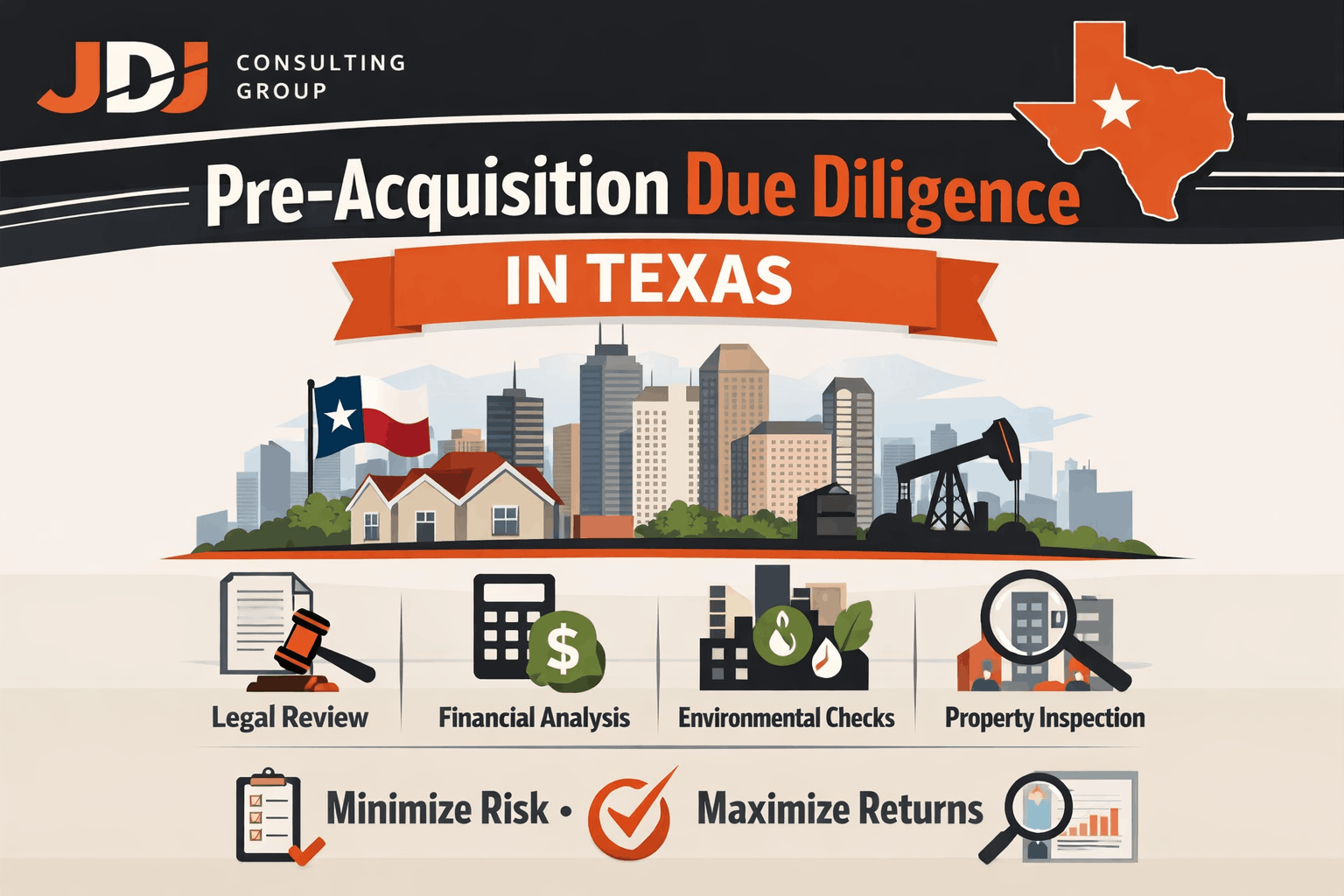
Why Due Diligence is Critical in Texas (Buyer Beware State)
Texas follows a buyer beware approach in many real estate transactions. This means the responsibility to discover problems often falls on the buyer, not the seller.
If you miss something during due diligence:
You may inherit legal liabilities
You may face unexpected costs
You may lose the ability to exit the deal
For example, if a property has environmental contamination and you fail to identify it early, you could become responsible for cleanup after purchase. This is why due diligence in Texas is not optional. It is a protective step that helps you avoid long-term exposure.
When Due Diligence Happens in the Deal Timeline
Due diligence takes place after the initial agreement but before closing.
Here is a simplified timeline:
| Stage | What Happens | Purpose |
|---|---|---|
| Initial Interest | Property identified | Early screening |
| Letter of Intent (LOI) | Basic terms agreed | Align expectations |
| Purchase Agreement (PSA) | Contract signed | Legal structure set |
| Due Diligence Period | Full investigation | Verify all details |
| Closing | Ownership transfer | Final execution |
The due diligence period typically lasts between 30 and 90 days, depending on the deal size and complexity. During this window, you have the right to review documents, inspect the property, and confirm all assumptions. If something does not check out, you may be able to renegotiate or walk away.
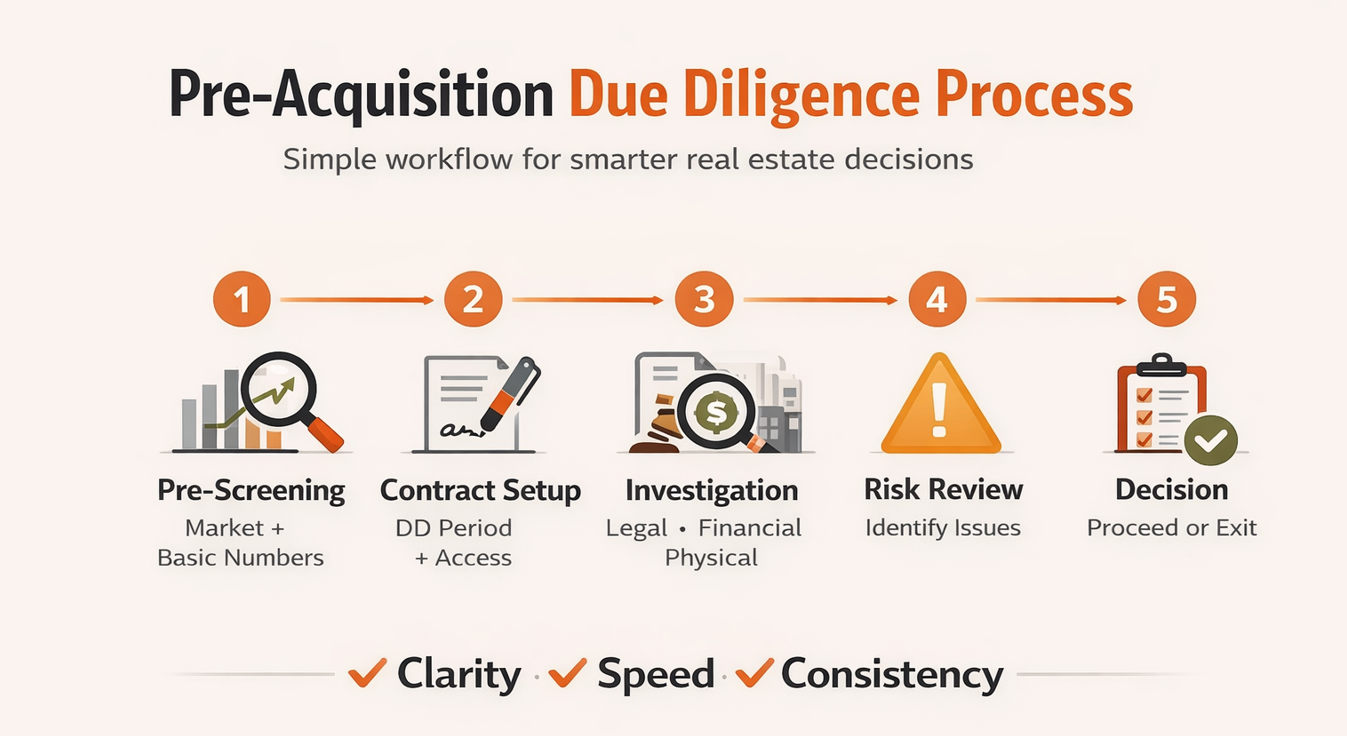
The Pre-Acquisition Due Diligence Process (High-Level Workflow)
Due diligence is not a single task. It is a structured process with clear stages. Each stage builds on the previous one. Having a defined workflow helps you stay organized and avoid missing critical steps.
Step-by-Step Overview
Most investors follow a sequence like this:
Pre-screening Review basic deal metrics and market conditions
Contract setup Secure a due diligence period and access to documents
Detailed investigation Analyze legal, financial, and physical aspects
Risk evaluation Identify issues and assess their impact
Final decision Proceed, renegotiate, or exit
This structure keeps the process focused and efficient. It also ensures that time is spent where it matters most.
Visual Workflow Table
| Phase | Key Actions | Goal |
|---|---|---|
| Pre-Screening | Market + basic numbers | Quick filter |
| Contract Stage | DD clauses + access | Protect buyer |
| Investigation | Legal, physical, financial | Full clarity |
| Decision | Risk vs return | Move forward or exit |
Each phase has a clear purpose. Skipping any step can create blind spots.
How the Workflow Reduces Risk
A structured workflow helps in three ways:
Clarity: You know what to check and when
Speed: You avoid delays during the due diligence period
Consistency: You apply the same process across deals
Over time, this approach becomes repeatable. Investors who follow a system tend to make more consistent decisions.
Step 1 – Pre-Screening & Deal Feasibility
Before you enter a contract, you need to decide if the deal is worth pursuing. This is where pre-screening comes in.
It is a quick but important step. The goal is to filter out weak opportunities early so you do not waste time on deals that will not work.
Market Analysis (Demand, Rent, Trends)
Start by understanding the market around the property.
Ask simple questions:
Is there demand for this type of property?
Are rents stable or growing?
What are comparable properties doing?
Look at:
Population growth
Employment trends
Nearby developments
If the market fundamentals are weak, even a well-priced property may struggle to perform.
Initial Financial Feasibility
Next, run a quick financial check.
This is not a full model. It is a rough estimate to see if the deal makes sense.
Focus on:
Purchase price vs market value
Estimated rental income
Basic operating costs
Here is a simple example:
| Metric | Estimate |
|---|---|
| Purchase Price | $2,000,000 |
| Annual Rent | $180,000 |
| Expenses | $60,000 |
| Net Income | $120,000 |
From this, you can estimate a rough return and compare it to your target. If the numbers are far off, it is better to stop early.
Property Type & Strategy Fit
Every property should match your investment strategy.
For example:
A value-add investor looks for underperforming assets
A developer looks for land with strong upside
A long-term holder prefers stable income
If the property does not align with your strategy, it may not be worth pursuing, even if it looks attractive.
Why Pre-Screening Matters
Pre-screening saves time and resources.
Instead of analyzing every deal in depth, you focus only on the ones with real potential.
It also helps you:
Move faster in competitive markets
Avoid analysis overload
Stay disciplined in your investment approach
Step 2 – Structuring the Due Diligence Period in Texas
Once a deal passes pre-screening, the next step is to secure your position through the contract. This is where many investors make mistakes. They focus on price but overlook the structure of the due diligence period.
In Texas, the contract defines your rights. If something is missing here, it becomes difficult to fix later.
Key Clauses in the Purchase Agreement
The purchase agreement (PSA) outlines how due diligence will work. Several clauses are especially important:
Due Diligence Period (Option Period) This gives you time to inspect the property and review documents
Access Rights Allows you and your consultants to visit the property
Document Delivery Requirements Requires the seller to provide key records
Termination Rights Defines when and how you can exit the deal
These clauses work together. If one is weak, your ability to investigate the deal is limited.
Typical Structure of a Due Diligence Period
| Element | Description | Why It Matters |
|---|---|---|
| Timeframe | 30–90 days | Allows full review |
| Option Fee | Paid upfront | Secures inspection rights |
| Document Access | Seller provides records | Enables analysis |
| Exit Option | Buyer can terminate | Reduces risk |
In many Texas deals, buyers pay an option fee for the right to terminate during this period. This gives flexibility but also creates pressure to act quickly.
Why This Stage Protects You Legally
Texas contracts are strict. Once the due diligence period ends, your ability to exit the deal becomes limited.
If you discover a problem after this window:
You may lose your earnest money
You may be forced to close
You may need to accept unexpected costs
This is why structuring the contract correctly is just as important as the investigation itself.
Negotiation Strategies for Buyers
Strong investors treat this stage as a risk management step.
Here are common strategies:
Ask for a longer due diligence period for complex deals
Require early delivery of documents from the seller
Include extension options if needed
Negotiate repair credits or price adjustments
These small changes can make a big difference later.
Common Mistakes at This Stage
Agreeing to a short due diligence period
Not requesting full documentation upfront
Overlooking access limitations
Relying on verbal assurances instead of contract terms
A well-structured agreement gives you control. Without it, even a good deal can become risky.
Step 3 – Legal Due Diligence (Texas-Specific)
Legal due diligence focuses on ownership, rights, and restrictions tied to the property. It answers a simple question: Can you legally use this property the way you intend?
In Texas, this step is critical because many risks are not disclosed upfront.

Title & Ownership Verification
The first step is to confirm that the seller has clear ownership.
You review:
Title reports
Ownership history
Liens or encumbrances
If issues exist, they must be resolved before closing.
| Title Issue | Example | Risk |
|---|---|---|
| Liens | Unpaid loans | Financial liability |
| Easements | Utility access | Limited use |
| Ownership disputes | Multiple claims | Legal delays |
Even a small title issue can delay or block a transaction.
Survey & Property Boundaries
A survey confirms the exact boundaries of the property.
This helps identify:
Encroachments
Access points
Shared boundaries
An ALTA survey is commonly used in commercial transactions. It provides a detailed view of the property and highlights potential conflicts.
Without a proper survey, you may not fully understand what you are buying.
Zoning & Land Use Compliance
Zoning determines how a property can be used.
You need to confirm:
Current zoning classification
Allowed uses
Development restrictions
For example, a property zoned for industrial use may not allow residential development. Zoning rules also vary across cities in Texas. What works in one area may not apply in another.
Permits, Certificates & Code Compliance
Next, review all permits and approvals tied to the property.
This includes:
Certificates of occupancy
Building permits
Code compliance records
If violations exist, they may need to be fixed before or after closing.
Unresolved issues can lead to:
Fines
Delays in development
Restrictions on use
Why Legal Due Diligence Matters
Legal issues are often complex and costly to fix. Unlike minor repairs, they can affect the entire project.
This step helps you:
Confirm ownership rights
Avoid legal disputes
Ensure the property fits your intended use
Skipping legal due diligence can create long-term problems that are difficult to resolve.
Step 4 – Financial Due Diligence
Once the legal foundation is clear, the next step is to verify the numbers. Financial due diligence focuses on income, expenses, and overall performance.
The goal is to confirm that the property can deliver the returns you expect.
Income & Expense Review
Start with the basics:
Rent roll
Historical income statements
Operating expenses
You want to verify that reported income is accurate and consistent.
| Item | What to Check | Why It Matters |
|---|---|---|
| Rent Roll | Tenant payments | Confirms income stability |
| Expenses | Maintenance, utilities | Impacts profitability |
| Net Income | Revenue minus costs | Core performance metric |
If numbers are unclear or inconsistent, that is a red flag.
Lease Review (If Applicable)
For income-producing properties, leases are a key part of the analysis.
Review:
Lease terms
Expiration dates
Rent escalation clauses
Strong leases provide stability. Weak leases increase risk. For example, if several leases expire at the same time, vacancy risk increases.
Property Valuation & Market Comparison
Next, compare the property to similar assets in the market.
Look at:
Recent sales
Rental rates
Cap rates
This helps you confirm whether the price is reasonable. If the property is priced above market, you need a strong reason to justify it.
Taxes, Insurance & Utilities
These costs are often underestimated but can affect returns significantly.
Review:
Property tax history
Insurance coverage and premiums
Utility costs
In Texas, property taxes can vary widely by location. A sudden increase can impact cash flow.
Why Financial Due Diligence Matters
Financial analysis turns assumptions into facts.
It helps you:
Validate projected returns
Identify hidden costs
Avoid overpaying
Without this step, you are relying on estimates rather than verified data.
Step 5 – Physical & Structural Due Diligence
After reviewing legal and financial aspects, the next step is to examine the physical condition of the property. This is where you move from documents to the actual site. A property may look fine on paper, but hidden physical issues can quickly change the investment outcome.
Property Condition Assessment (PCA)
A Property Condition Assessment (PCA) is a detailed inspection of the building and its systems.
It typically covers:
Structural components
Exterior and interior condition
Major systems like HVAC and electrical
The goal is to identify both current issues and future repair needs.
Key Areas Reviewed in a PCA
| Component | What is Checked | Risk if Ignored |
|---|---|---|
| Structure | Foundation, walls | Major repair costs |
| Roof | Age, leaks | Water damage |
| HVAC | Performance, age | Replacement expenses |
| Electrical | Safety, capacity | Compliance issues |
| Plumbing | Leaks, pressure | Maintenance costs |
A PCA also includes a capital expenditure (CapEx) estimate, which helps you plan future costs.
Building Systems Inspection
Beyond the general assessment, each system should be reviewed in detail.
Focus on:
Heating and cooling systems
Electrical panels and wiring
Plumbing infrastructure
Older systems may still function but could require replacement soon. This affects both your budget and timeline.
Site Conditions & Infrastructure
The condition of the land itself is just as important as the building.
Review:
Drainage and grading
Road access
Utility connections
Poor site conditions can lead to long-term operational issues or development delays.
Why Physical Due Diligence Matters
Physical inspections help you:
Estimate repair and upgrade costs
Identify safety concerns
Plan future improvements
Without this step, you risk unexpected expenses after closing.
Step 6 – Environmental Due Diligence (Critical in Texas)
Environmental due diligence focuses on identifying contamination and environmental risks tied to the property. In Texas, this step is especially important because environmental liability often transfers to the buyer.

What is Environmental Due Diligence?
It is the process of evaluating whether a property has environmental risks such as:
Soil contamination
Hazardous materials
Water pollution
Even if the issue was caused by a previous owner, the current owner may still be responsible.
Phase I Environmental Site Assessment (ESA)
The first step is a Phase I ESA.
This includes:
Review of historical records
Site inspection
Interviews with owners or occupants
The goal is to identify Recognized Environmental Conditions (RECs).
| Phase | Scope | Outcome |
|---|---|---|
| Phase I ESA | Records + site review | Identify potential risks |
| Phase II ESA | Testing (soil, water) | Confirm contamination |
Phase I does not involve testing. It only flags potential concerns.
When Phase II Testing is Required
If Phase I identifies risks, the next step is Phase II.
This involves:
Soil sampling
Groundwater testing
Laboratory analysis
Phase II confirms whether contamination actually exists.
Common Environmental Risks in Texas
Certain risks are more common in Texas due to its industrial and geographic landscape.
These include:
Underground storage tanks
Former industrial use
Flood-prone areas
Oil and gas contamination
Ignoring these risks can lead to:
Cleanup costs
Legal liability
Project delays
Why Environmental Due Diligence Matters
Environmental issues are often expensive and time-consuming to resolve.
This step helps you:
Avoid liability transfer
Understand site limitations
Protect long-term value
For many investors, this is one of the most critical parts of due diligence.
Step 7 – Operational & Document Review
Beyond physical and environmental checks, you also need to review how the property operates on a day-to-day basis. This step is often overlooked, but it can reveal important insights.
Contracts & Service Agreements
Start by reviewing all active contracts tied to the property.
This may include:
Maintenance agreements
Vendor contracts
Service providers
Some contracts may continue after closing. Others may need to be renegotiated.
Key Contract Review Areas
| Contract Type | What to Look For | Impact |
|---|---|---|
| Maintenance | Cost, duration | Ongoing expenses |
| Vendor Agreements | Terms, flexibility | Operational control |
| Service Contracts | Renewal terms | Cost stability |
Understanding these agreements helps you plan future operations.
Litigation & Legal Issues
Check if the property is involved in any legal disputes.
This includes:
Pending lawsuits
Tenant disputes
Regulatory issues
Unresolved litigation can delay closing or create financial risk.
Tenant & Property Management Review
If the property is income-producing, evaluate how it is managed.
Look at:
Occupancy rates
Tenant turnover
Management efficiency
Poor management can reduce income and increase costs.
Why Operational Review Matters
This step gives you a real-world view of how the property performs.
It helps you:
Identify inefficiencies
Understand ongoing obligations
Plan improvements after acquisition
Step 8 – Risk Analysis & Decision Making
By this stage, you have gathered a large amount of information. The next step is to make sense of it. Risk analysis is where you connect all findings and decide whether the deal still makes sense.
Identifying Red Flags
Start by organizing the issues you discovered during due diligence.
Common red flags include:
Title complications or unresolved liens
Zoning restrictions that limit your intended use
Environmental concerns requiring cleanup
Inconsistent financial records
Major structural repairs
Not all issues are deal breakers. The key is to understand their impact.
Categorizing Risks
A simple way to evaluate findings is to group risks by severity.
| Risk Level | Example | Typical Response |
|---|---|---|
| Low | Minor repairs | Proceed as planned |
| Moderate | Lease gaps, small compliance issues | Renegotiate terms |
| High | Legal disputes, contamination | Consider exiting |
This approach keeps decision-making clear and structured.
Risk Mitigation Strategies
Once risks are identified, the next step is to manage them.
Common strategies include:
Price renegotiation to reflect repair or risk costs
Seller credits at closing
Escrow holdbacks for unresolved issues
Contract amendments to shift responsibility
For example, if inspections reveal roof damage, you may negotiate a lower purchase price or request the seller to complete repairs before closing.
Go / No-Go Decision Framework
At the end of due diligence, you need a clear decision.
Use a simple framework:
| Scenario | Decision |
|---|---|
| Risks are minimal | Move forward |
| Risks are manageable | Renegotiate and proceed |
| Risks are significant | Walk away |
Strong investors rely on data, not emotion. Even if a deal looks attractive, it must meet your criteria.
Why This Step Matters
Risk analysis turns information into action.
It helps you:
Avoid emotional decisions
Stay disciplined
Protect long-term returns
Without this step, even a well-executed due diligence process loses value.
Texas-Specific Due Diligence Considerations
While the overall due diligence process is similar across the U.S., Texas has unique factors that investors must consider. Ignoring these can lead to unexpected challenges.
Texas Property Laws & Buyer Responsibility
Texas places significant responsibility on the buyer.
Key points include:
Limited seller disclosure in some transactions
Strong enforcement of contract terms
Higher reliance on buyer investigations
This means your due diligence process must be thorough and well-documented.
Local Zoning & Municipality Differences
Zoning rules vary widely across Texas cities.
For example:
Large cities may have detailed zoning codes
Smaller municipalities may have fewer restrictions but less clarity
Even within the same city, overlay districts can affect:
Building height
Density
Land use
Always confirm zoning at the local level rather than relying on general assumptions.
Permitting & Development Constraints
If your plan involves development or redevelopment, permitting becomes critical.
Factors to consider:
Approval timelines
Required studies or reports
Infrastructure requirements
Delays in permitting can affect both cost and project timelines.
Property Taxes in Texas
Texas is known for relatively high property taxes compared to some other states.
You should:
Review historical tax data
Estimate post-acquisition reassessment
Factor taxes into your financial model
Unexpected tax increases can reduce projected returns.
Environmental & Geographic Factors
Texas has a diverse landscape, which introduces specific risks:
Flood zones in certain regions
Soil conditions affecting construction
Past industrial use in urban areas
These factors should always be reviewed during environmental due diligence.
Due Diligence Checklist (Texas Real Estate)
A checklist helps ensure that nothing is missed during the process. It also creates consistency across deals. Below is a simplified but practical checklist.
Master Due Diligence Checklist
| Category | Key Items to Review |
|---|---|
| Legal | Title report, survey, zoning, permits |
| Financial | Rent roll, expenses, tax records |
| Physical | PCA, system inspections, site condition |
| Environmental | Phase I ESA, Phase II (if needed) |
| Operational | Contracts, leases, management |
How to Use This Checklist
Start with high-level items during pre-screening
Go deeper during the due diligence period
Track progress to avoid missing steps
Many investors also create digital checklists to manage documents and timelines.
Customizing the Checklist
Not every deal is the same. Your checklist should reflect:
Property type (land, multifamily, retail)
Investment strategy (development, value-add, hold)
Deal complexity
For example:
A development deal may require more zoning and permitting review
A stabilized asset may require deeper lease analysis
Why a Checklist Matters
A checklist keeps the process organized and repeatable.
It helps you:
Reduce oversight
Improve efficiency
Maintain consistency across investments
Common Mistakes to Avoid in Texas Due Diligence
Even with a clear process, mistakes can happen. Most of them come from rushing or skipping steps. Being aware of these issues can help you avoid costly outcomes.

Skipping Environmental Checks
Some investors treat environmental reviews as optional. This is risky, especially in Texas.
If contamination exists and you fail to identify it:
Cleanup costs can be significant
Legal liability may transfer to you
Financing may become difficult
Environmental reviews should always be part of your process, even for smaller deals.
Rushing the Due Diligence Period
Time pressure is common, but rushing often leads to missed details. When the timeline is too tight:
Reports may be incomplete
Consultants may not finish inspections
Decisions may be based on partial information
It is better to negotiate more time than to move forward with uncertainty.
Ignoring Zoning Restrictions
Zoning issues are often overlooked in early stages. A property may appear suitable, but zoning can limit:
Use type
Density
Future development
If zoning does not align with your plan, the deal may not work.
Overestimating Financial Performance
Projections are easy to overstate, especially in competitive markets.
Common issues include:
Assuming higher rents than market levels
Underestimating operating costs
Ignoring vacancy risk
Always base projections on verified data, not assumptions.
Relying Too Much on Seller Information
Seller-provided data is useful, but it should not be your only source.
You should always:
Verify financials independently
Cross-check documents
Conduct your own inspections
Independent verification is a core part of due diligence.
Tools & Professionals Involved in Due Diligence
Due diligence is a team effort. No single person can cover every aspect. Working with the right professionals improves both accuracy and efficiency.
Key Professionals
Here are the experts typically involved:
Real Estate Attorney Reviews contracts, title, and legal risks
Environmental Consultant Conducts Phase I and Phase II assessments
Civil Engineer Evaluates site conditions and infrastructure
Property Inspector / PCA Consultant Reviews building condition and systems
Broker or Advisor Provides market insights and deal support
Each professional focuses on a specific area. Together, they provide a complete picture.
How These Roles Fit Together
| Role | Focus Area | Contribution |
|---|---|---|
| Attorney | Legal | Protects ownership rights |
| Consultant | Environmental | Identifies contamination risks |
| Engineer | Technical | Assesses site feasibility |
| Inspector | Physical | Evaluates building condition |
| Broker | Market | Supports pricing and strategy |
A coordinated team helps avoid gaps in the process.
Tools That Support Due Diligence
In addition to people, tools can improve efficiency.
Common tools include:
Financial modeling software
Document management systems
Project tracking platforms
These tools help organize information and keep the process on track.
Why the Right Team Matters
Due diligence involves multiple moving parts. Mistakes often happen when communication breaks down.
A strong team helps you:
Identify risks early
Stay within timelines
Make informed decisions
How JDJ Consulting Supports Due Diligence in Texas
A structured process is important, but execution is what drives results. This is where experienced support can make a difference. JDJ Consulting focuses on helping investors evaluate deals with clarity and confidence.

Feasibility Studies & Market Analysis
JDJ Consulting helps you understand whether a deal makes sense from the start.
This includes:
Market demand analysis
Comparable property review
Financial feasibility
Early insights help you filter deals before committing time and resources.
Zoning & Entitlement Strategy
Zoning and permitting can be complex, especially in Texas.
Support in this area includes:
Zoning verification
Land use analysis
Entitlement strategy
This ensures the property aligns with your intended use.
Risk Identification & Mitigation
JDJ Consulting also supports risk analysis by:
Reviewing due diligence findings
Highlighting potential issues
Suggesting mitigation strategies
This helps investors make decisions based on clear data rather than assumptions.
Why This Support Matters
Working with experienced consultants helps you:
Reduce uncertainty
Improve decision quality
Move faster with confidence
For many investors, this becomes a key part of their acquisition process.
Final Thoughts: Turning Due Diligence into a Competitive Advantage
Due diligence is more than a requirement. It is a tool that can improve your investment outcomes.
Investors who follow a structured process tend to:
Identify better opportunities
Avoid costly mistakes
Make consistent decisions
Over time, this creates a clear advantage.
Why Smart Investors Focus on Process
A repeatable process helps remove guesswork. Instead of reacting to each deal differently, you follow a proven approach. This leads to:
Faster evaluations
Better risk control
More predictable results
Building a Repeatable System
To build a strong due diligence system:
Use checklists for consistency
Work with trusted professionals
Document your process for future deals
Small improvements over time can lead to better outcomes across your portfolio.
Still unsure about a deal? Let’s talk it through before you commit.
Real estate decisions in Texas move fast. But one overlooked detail can cost you months of time and a lot of money. If you’re evaluating a property and want a second set of eyes, we’re here to help.
At JDJ Consulting, we work with investors and developers to break down deals, identify risks early, and bring clarity to the entire due diligence process. Whether you’re in the early screening stage or deep into inspections, a quick conversation can save you from costly surprises.
Here’s how you can get started:
Call us directly: (818) 793-5058
Email your deal details: sales@jdj-consulting.com
Or fill out our pre-consultation form here: https://jdj-consulting.com/contact-us/
If you prefer, you can also schedule a time that works for you, and we’ll walk through your deal step by step. No pressure. Just a clear, honest discussion to help you make the right decision.
Before you move forward with your next acquisition, make sure you have the full picture.
FAQs – Pre-Acquisition Due Diligence in Texas
What is pre-acquisition due diligence in real estate?
Pre-acquisition due diligence is the process of evaluating a property or business before purchase to confirm it aligns with your investment thesis and does not carry hidden risks.
It typically includes:
Review of financial statements and cash flow analysis
Legal review for legal compliance and legal structure
Physical inspections and environmental issues assessment
Analysis of the target company’s operations (for business deals)
This process supports accurate risk assessment and better investment decisions.
How long does the due diligence period usually last?
The due diligence period typically ranges from 30 to 90 days, depending on deal complexity.
During this time, investors:
Conduct financial investigations
Review data rooms and confidential information
Evaluate operational risks and legal and compliance risks
A well-structured timeline ensures thorough risk identification before closing.
What is included in a due diligence checklist?
A complete due diligence audit covers multiple areas of evaluation.
Key components include:
Legal: Titles, contracts, licenses and permits, and legal liabilities
Financial: Financial statements, tax returns, and projections
Operational: Customer relationships, workflows, and systems
Environmental: Assessments by an environmental consultant
This structured approach ensures full regulatory compliance and reduces uncertainty.
What are common red flags in due diligence?
Red flags are issues that may affect the deal’s fair value or long-term viability.
Common examples:
Unclear legal standing or ownership issues
Hidden legal liabilities
Weak market position or declining performance
Environmental or regulatory concerns
Identifying these early helps avoid costly mistakes and supports better risk assessment.
Why is due diligence important for investors?
Due diligence helps validate assumptions and protect your investment.
It allows investors to:
Confirm financial performance through financial statements
Identify operational risks and inefficiencies
Ensure legal compliance and regulatory compliance
Evaluate overall market position
This process reduces uncertainty and improves decision-making.
What role do financial statements play in due diligence?
Financial statements are a core part of the due diligence process.
They help:
Verify income, expenses, and profitability
Support cash flow analysis
Validate projections and business projections
Accurate financials are essential for determining the deal’s fair value.
What legal aspects are reviewed during due diligence?
Legal review focuses on ensuring the deal is compliant and risk-free.
This includes:
Reviewing contracts and agreements
Checking legal structure and ownership
Identifying legal liabilities
Ensuring compliance with regulatory bodies
This step helps prevent future disputes and ensures proper legal standing.
How are operational risks evaluated?
Evaluating operational risks involves reviewing how the business or property operates daily.
This includes:
Assessing the target company’s operations
Reviewing customer relationships
Evaluating systems like ERP software and workflows
Operational insights help identify inefficiencies and improvement opportunities.
What environmental checks are included in due diligence?
Environmental review focuses on identifying potential environmental issues.
This may include:
Site inspections and environmental reports
Work by an environmental consultant
Assessing compliance with environmental regulations
These checks help avoid costly remediation and ensure regulatory compliance.
What is the role of data rooms in due diligence?
Data rooms are secure platforms used to store and share documents during pre-transaction diligence.
They typically contain:
Financial statements and reports
Legal documents and contracts
Operational and technical data
Organized data rooms improve efficiency and streamline the due diligence audit process.
Can due diligence impact deal pricing?
Yes, findings during due diligence often impact pricing.
Buyers may:
Renegotiate based on risks or findings
Adjust valuation based on fair value analysis
Reassess the overall investment thesis
This ensures the deal reflects actual conditions and risks.
What happens after due diligence is completed?
After pre-acquisition due diligence, the focus shifts to closing and integration.
Next steps include:
Finalizing agreements like the Share Purchase Agreement
Planning post-acquisition operations
Preparing for Post-Merger Integration and execution
Strong post-acquisition planning ensures a smooth transition after closing.
What is the biggest mistake during due diligence?
One of the biggest mistakes is rushing or skipping key steps in the due diligence process.
This can lead to:
Missed risk identification
Incomplete analysis
Poor investment decisions
A structured and thorough approach is essential for success.
Who is involved in the due diligence process?
A full due diligence team includes multiple professionals.
Common participants:
Legal advisors for legal compliance
Financial analysts for financial investigations
Engineers and inspectors
Environmental consultants
Each expert helps ensure a complete and accurate risk assessment.
How does due diligence improve investment decisions?
Due diligence provides clarity before committing to a deal.
It helps investors:
Validate assumptions with real data
Identify operational risks early
Ensure full regulatory compliance
Strengthen the overall investment thesis
This leads to more informed, confident decisions.