
In the U.S., even temporary shops must follow local rules. Cities regulate pop-ups to ensure safety, proper zoning, and tax compliance. So, whether you’re planning a weekend event, a mall kiosk, or a short-term retail store, you’ll likely need multiple permits to operate legally.
The challenge is that requirements vary by city, business type, and setup. What works in one location may not apply in another. This often leads to confusion, delays, or unexpected costs.
In this guide, we’ll break everything down in simple terms. You’ll learn what permits you need, how much they cost, how long they take, and how to avoid common mistakes. By the end, you’ll have a clear plan to launch your pop-up shop the right way—without delays or surprises.
Table of Contents
What Is a Pop-Up Shop and Why Permits Matter
A pop-up shop is a short-term retail setup. It can last a day, a week, or a few months. Brands use pop-ups to test products, build buzz, or sell in high-traffic areas without signing a long lease.
You’ll find pop-up shops in many forms:
Empty retail spaces
Shopping malls and kiosks
Outdoor markets and festivals
Mobile trucks or containers
Although these setups are temporary, the legal requirements are not. Cities and states still treat them as real businesses. That means permits, licenses, and compliance rules apply from day one.
Why permits are required
Local governments regulate pop-up shops for several reasons. First, they ensure public safety. For example, fire departments check occupancy limits and emergency exits. Health departments inspect food vendors to prevent contamination.
Second, permits help enforce zoning laws. Not every area allows retail activity. A residential neighborhood, for instance, may restrict commercial use.
Third, permits support tax compliance. If you sell goods, you are expected to collect and report sales tax.
Without proper permits, you may face:
Fines or penalties
Immediate shutdown orders
Legal liability if something goes wrong
Even landlords often require proof of permits before allowing a pop-up to operate in their space.
Common types of pop-up setups
Different setups come with different permit needs. Here’s a simple breakdown:
| Pop-Up Type | Description | Typical Permit Needs |
|---|---|---|
| Retail storefront | Temporary shop in vacant store | Business license, sales tax permit |
| Mall kiosk | Small retail booth in mall | Mall approval, local license |
| Street vendor | Outdoor booth or stand | Vendor permit, zoning approval |
| Event pop-up | Festival or market booth | Event vendor permit |
| Mobile pop-up | Truck or trailer retail | Mobile vendor license |
As you can see, the format of your pop-up directly affects the permits required. So, before you plan your setup, it’s important to understand the legal side.
Why permits matter for your business
Permits are not just paperwork. They protect your business in real ways.
For example:
They build trust with customers and partners
They reduce the risk of unexpected shutdowns
They help you operate smoothly during inspections
In many cities, enforcement has become stricter. Pop-up shops that skip permits are often reported or flagged quickly, especially in busy commercial zones. In short, permits are part of doing business—not an optional step.
Do You Need a Permit for a Pop-Up Shop in the USA?
In most cases, yes—you need at least one permit to run a pop-up shop in the United States. The exact requirements depend on your location, your products, and how long you plan to operate. Still, one rule applies everywhere: if you are selling goods or services to the public, some level of licensing is required.

General legal requirement
At a minimum, most pop-up shops need:
A business license
A sales tax (seller’s) permit
Local approval for the location
These requirements exist even for short-term setups. The duration of your pop-up does not remove your legal obligations.
For example:
A weekend pop-up still needs a sales tax permit
A one-week retail shop still needs zoning approval
Cities treat temporary businesses seriously because they still impact public safety and tax systems.
When you might not need a permit
There are a few limited exceptions, though they are rare.
You may not need a full permit if:
You are selling occasionally at a private garage sale
You are using a third-party marketplace that handles taxes
The event organizer has already secured permits that cover vendors
However, even in these cases, rules vary widely. Some cities still require individual vendor registration, even at organized events. So, it’s always safer to confirm with local authorities before assuming you’re exempt.
Real-world examples across the U.S.
Permit rules differ from city to city. Here’s how some major locations handle pop-up shops:
| Location | Key Requirement | Notes |
|---|---|---|
| California | Temporary seller’s permit | Required for short-term sales |
| Chicago | Pop-up retail license | Specific license for temporary shops |
| New York City | Temporary permits + inspections | Strict fire and health compliance |
| Texas cities | Local business licenses | Rules vary by city |
| Florida | Event-based permits | Often tied to duration |
These differences highlight an important point: there is no single national permit. Everything depends on local and state regulations.
What affects your permit needs
Several factors determine what permits you’ll need:
Type of product (clothing vs. food vs. alcohol)
Location (private property vs. public space)
Duration (one-day event vs. 3-month shop)
Setup (fixed store vs. mobile unit)
For example, a clothing pop-up in a mall is simpler to permit than a food pop-up on a public street. Food setups usually require health inspections and additional approvals.
The risk of skipping permits
Some businesses try to “test” a pop-up without permits. This is risky and often backfires.
Common consequences include:
Immediate closure during inspections
Fines that exceed permit costs
Loss of future permit eligibility
In competitive cities, enforcement teams regularly check pop-up shops. So, skipping permits rarely goes unnoticed.
Types of Pop-Up Shop Permits and Licenses in the USA
Pop-up shops usually require more than one permit. The exact mix depends on your business type and location. Below are the most common permits you may need.
Temporary business license
This is the foundation of your setup. A temporary business license allows you to operate legally within a city for a limited time.
It typically includes:
Business registration details
Location approval
Duration of operation
Some cities issue special short-term licenses just for pop-ups.
Seller’s permit (sales tax permit)
If you sell physical products, you must collect sales tax. A seller’s permit allows you to do that legally.
Key points:
Issued by the state
Often free or low-cost
Required even for short-term sales
Without this permit, you cannot legally charge or report sales tax.
Transient vendor or itinerant merchant license
This license applies if you move from place to place. It is common for:
Traveling vendors
Market sellers
Multi-location pop-ups
It ensures that mobile businesses still follow local rules.
Zoning and land use permits
Zoning laws control where businesses can operate. Even if a space looks suitable, it may not be approved for retail use.
You may need:
Zoning clearance
Temporary use permit
This is especially important if you are using:
Warehouses
Outdoor spaces
Residential areas
Special event or vendor permit
If your pop-up is part of an event, you’ll likely need a vendor permit. In many cases, the event organizer handles part of the process.
However, you may still need:
Individual vendor registration
Proof of insurance
Building and safety permits
If you modify a space, additional permits may apply.
Examples include:
Installing lighting or electrical systems
Building temporary walls or displays
Setting up large signage
These permits ensure the structure is safe for public use.
Fire department permit
Fire safety is a major concern, especially for indoor pop-ups.
You may need approval if you have:
High occupancy
Electrical equipment
Cooking appliances
Fire inspections often check exits, alarms, and spacing.
Health department permit (for food pop-ups)
Food-related pop-ups face stricter rules.
You will likely need:
Food handling permit
Health inspection
Temporary food service license
These requirements protect public health and ensure safe food practices.
Alcohol permit (if applicable)
If you plan to sell alcohol, you need a special license. These are highly regulated and often take longer to approve.
Temporary alcohol permits may be available for:
Events
Tastings
Short-term retail setups
Summary of key permits
Here’s a quick overview of the most common permits:
| Permit Type | Who Needs It | Purpose |
|---|---|---|
| Business license | All pop-ups | Legal operation |
| Seller’s permit | Product sellers | Sales tax collection |
| Vendor license | Mobile sellers | Multi-location compliance |
| Zoning permit | Location-based setups | Land use approval |
| Event permit | Festival vendors | Event participation |
| Health permit | Food vendors | Food safety |
| Fire permit | Indoor/high-risk setups | Safety compliance |
These permits may seem overwhelming at first. However, once you break them down by business type and location, the process becomes much clearer.
Pop-Up Permit Requirements by Business Type
Not all pop-up shops follow the same rules. In fact, your permit requirements depend heavily on what you sell and how you operate. A clothing brand in a mall faces fewer regulations than a food vendor on a public street.
So, before applying for permits, it helps to understand your category. This makes the process faster and reduces the chance of rejection.

Retail pop-up shops
Retail pop-ups are the most common and usually the easiest to permit. These include:
Clothing brands
Accessories and jewelry sellers
Beauty and skincare products
Home goods and gifts
For these setups, the requirements are relatively simple.
You typically need:
A local business license
A seller’s permit for sales tax
Zoning approval for your location
If you’re operating inside a mall or private retail space, the property owner may already meet some requirements. However, you are still responsible for your own business license and tax registration.
Important note: Even indoor retail pop-ups can be shut down if zoning or licensing is not in place. Always confirm with the city before opening.
Food and beverage pop-ups
Food pop-ups come with stricter rules. This is because public health is involved. Whether you sell packaged snacks or hot meals, inspections are often required.
Common examples include:
Coffee stands
Food stalls at markets
Dessert pop-ups
Beverage tasting booths
You will likely need:
Health department permit
Food safety certification
Temporary food establishment license
Fire permit (if cooking equipment is used)
Health inspections may happen before and during your operation. In some cities, you must also show proof of a commercial kitchen.
Why this matters: Food violations can lead to immediate closure. So, it’s important to meet all requirements before launching.
Mobile pop-up shops (trucks, trailers, containers)
Mobile pop-ups are flexible, but they face additional regulation. Since they move between locations, cities require tighter control.
Examples include:
Retail trucks
Converted shipping containers
Mobile boutiques
Trailer-based shops
Typical requirements include:
Mobile vendor license
Parking or location permits
Local business registration
Zoning compliance for each stop
Some cities limit where mobile vendors can operate. For instance, you may not be allowed near schools, intersections, or residential zones.
Also, if your mobile unit includes food or electricity, additional permits may apply.
Event-based pop-up shops
These pop-ups operate within organized events like:
Street fairs
Farmers markets
Seasonal festivals
Trade shows
In many cases, the event organizer secures a general permit. However, vendors still have responsibilities.
You may need:
Individual vendor registration
Seller’s permit
Proof of insurance
Health permit (for food vendors)
Some events require you to submit documents weeks in advance. Missing deadlines can result in losing your spot.
Quick comparison of permit needs by business type
| Business Type | Permit Complexity | Key Requirements |
|---|---|---|
| Retail pop-up | Low | Business license, seller’s permit |
| Food pop-up | High | Health permit, inspections, fire approval |
| Mobile pop-up | Medium–High | Mobile license, location approvals |
| Event pop-up | Medium | Vendor registration, event permits |
Choosing the right setup for easier approvals
If your goal is speed, retail pop-ups in approved commercial spaces are the easiest to launch. On the other hand, food and mobile setups require more planning and time.
So, think about:
Your timeline
Your budget
Your ability to handle inspections
Making the right choice early can save weeks of delays later.
Step-by-Step Process to Get Pop-Up Shop Permits in the USA
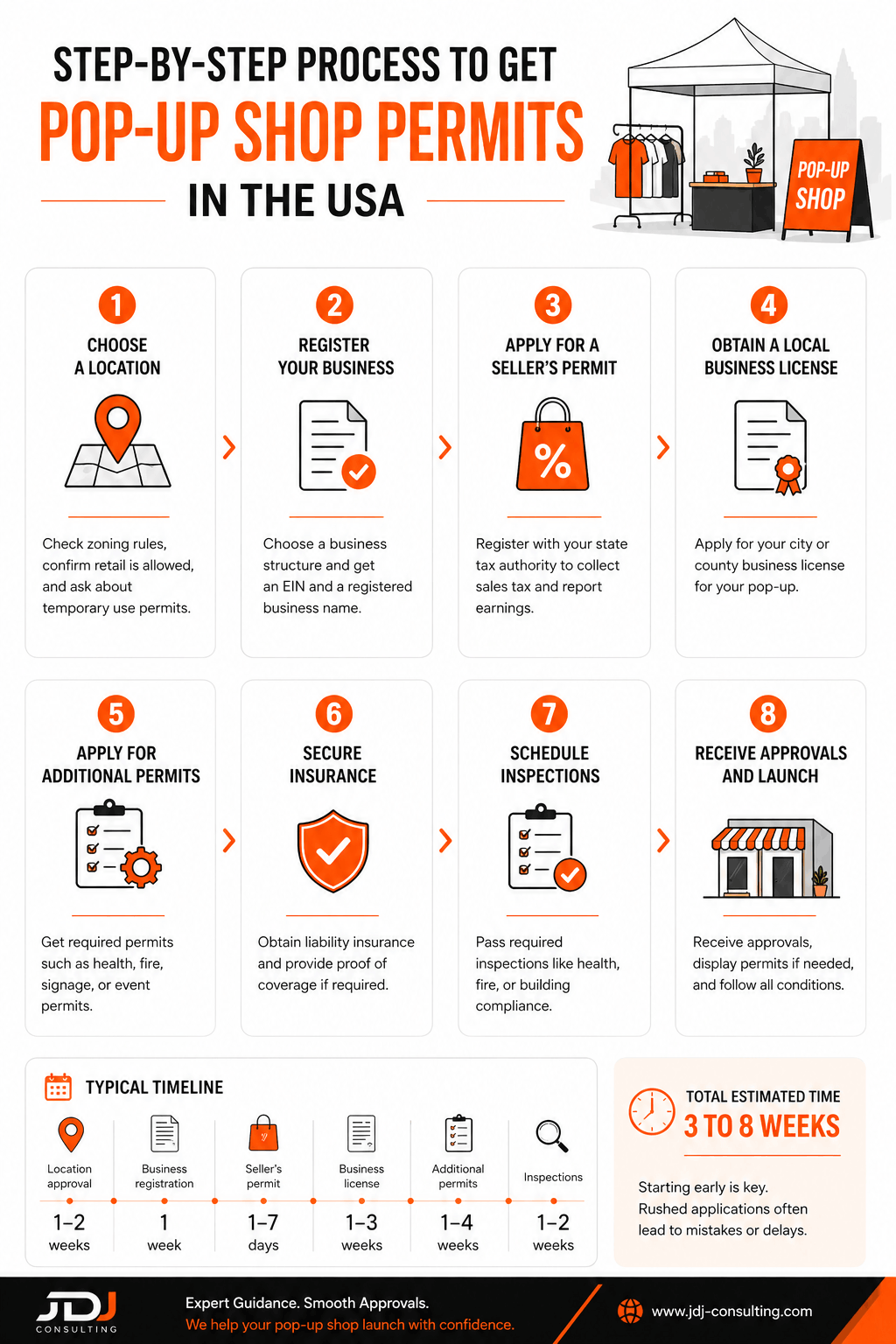
Getting permits may seem complicated, but the process follows a clear sequence. If you complete each step in order, you can avoid most common issues. Let’s break it down.
Step 1 – Choose a location
Start with your location. This decision affects everything else.
Before signing a lease or booking a space:
Check zoning rules
Confirm retail is allowed
Ask about temporary use permits
You can contact the city’s planning department for this. Many cities also provide zoning maps online.
Tip: Never assume a space is approved just because another business operated there before.
Step 2 – Register your business
Next, you need a legal business structure.
Common options include:
Sole proprietorship
LLC (limited liability company)
Corporation
Most small pop-ups choose an LLC because it offers liability protection with simple setup.
You’ll also need:
A registered business name
Step 3 – Apply for a seller’s permit
If you plan to sell goods, this step is mandatory.
You’ll register with your state’s tax authority to:
Collect sales tax
Report earnings
In many states, this process is online and quick.
Step 4 – Obtain a local business license
Now, apply for your city or county business license.
You’ll typically submit:
Business details
Location address
Duration of your pop-up
Some cities offer temporary licenses specifically for pop-ups, while others use standard business licenses.
Step 5 – Apply for additional permits
At this stage, you’ll apply for any extra permits based on your setup.
This may include:
Health permits (for food)
Fire permits (for indoor or equipment-heavy setups)
Signage permits
Event or vendor permits
Each permit may have its own application and approval process.
Step 6 – Secure insurance
Insurance is often required before final approval.
Common types include:
General liability insurance
Product liability insurance
Event insurance
Landlords and event organizers usually ask for proof of coverage.
Step 7 – Schedule inspections
Some permits require inspections before you open.
These may include:
Health inspections
Fire safety checks
Building compliance reviews
If you fail an inspection, you may need to fix issues and reschedule.
Step 8 – Receive approvals and launch
Once everything is approved, you’re ready to open.
Make sure to:
Display permits if required
Keep copies on-site
Follow all operating conditions
Typical timeline for the full process
| Step | Estimated Time |
|---|---|
| Location approval | 1–2 weeks |
| Business registration | 1 week |
| Seller’s permit | 1–7 days |
| Business license | 1–3 weeks |
| Additional permits | 1–4 weeks |
| Inspections | 1–2 weeks |
Total estimated time: 3 to 8 weeks
Starting early is key. Rushed applications often lead to mistakes or delays.
Pop-Up Shop Permit Costs in the USA
Permit costs vary widely across the country. However, most pop-up shops fall within a predictable range. Understanding these costs early helps you budget properly and avoid surprises.
Average cost breakdown
Here’s a general estimate of common permit fees:
| Permit Type | Estimated Cost |
|---|---|
| Business license | $50 – $400 |
| Seller’s permit | Free – $100 |
| Event/vendor permit | $25 – $300 |
| Health permit | $100 – $1,000 |
| Fire permit | $50 – $200 |
These are average ranges. Large cities tend to charge more than smaller towns.
What affects permit costs
Several factors influence how much you’ll pay:
Location: Major cities usually have higher fees
Duration: Longer pop-ups may cost more
Business type: Food and alcohol permits are more expensive
Inspection requirements: More inspections can increase costs
For example, a simple retail pop-up may cost under $200 in permits. In contrast, a food pop-up with inspections can exceed $1,000.
Hidden costs to watch for
Permit fees are not the only expense. You should also consider:
Application processing fees
Late filing penalties
Insurance costs
Equipment upgrades to meet code
These extra costs can add up quickly if you’re not prepared.
Cost-saving tips
To manage your budget more effectively:
Apply early to avoid rush fees
Choose compliant locations to reduce permit needs
Bundle permits where possible (some cities offer combined licenses)
Work with permit consultants to avoid costly mistakes
Final thought on costs
Permits may feel like an extra expense, but they are part of running a legal business. In most cases, the cost of permits is far lower than the cost of fines or shutdowns. Planning ahead ensures you stay within budget and open on time.
Pop-Up Permit Timelines: How Long It Takes
One of the most common questions is simple: how long will permits take? The answer depends on your location and business type. Still, most pop-up shops follow a similar timeline. If you plan ahead, the process is manageable. If you wait too long, delays can push your opening date back.
Typical approval times
Here’s a general timeline for the most common permits:
| Step | Estimated Time |
|---|---|
| Location approval | 1–2 weeks |
| Business registration | 1 week |
| Seller’s permit | 1–7 days |
| Business license | 1–3 weeks |
| Additional permits | 1–4 weeks |
| Inspections | 1–2 weeks |
In total, most pop-up shops take 3 to 8 weeks to fully approve. Retail setups usually move faster. Food and mobile setups often take longer due to inspections.
What can slow down your approval?
Delays are common, but they are often avoidable. Most issues come from missing details or poor planning.
Here are the main causes:
Incomplete applications
Incorrect business information
Zoning conflicts
Missing documents (insurance, IDs, layouts)
Failed inspections
For example, if your location is not approved for retail use, your entire application may be paused or denied. That’s why checking zoning early is so important.
Fast-track vs standard processing
Some cities offer expedited processing. This can reduce waiting time, but it usually comes with higher fees.
Standard processing:
Lower cost
Longer timeline
Best for planned pop-ups
Expedited processing:
Higher cost
Faster approvals
Useful for tight deadlines
However, not all permits can be rushed. Health and fire approvals often require scheduled inspections, which follow fixed timelines.
When to start your permit process
A safe rule is to begin 30 to 60 days before your launch date.
If your pop-up includes food, alcohol, or a custom build-out, you should start even earlier.
Here’s a simple planning guide:
| Pop-Up Type | Recommended Start Time |
|---|---|
| Retail (simple) | 30 days before |
| Event-based | 30–45 days before |
| Mobile pop-up | 45–60 days before |
| Food pop-up | 60+ days before |
Starting early gives you time to fix issues without stress.
Tips to speed up approvals
You can reduce delays by staying organized and proactive.
Prepare all documents in advance
Double-check applications before submitting
Confirm zoning before signing a lease
Schedule inspections early
Stay in contact with local departments
Small steps like these can save weeks.
Final thought on timelines
Permits take time, but they follow a clear process. If you plan ahead and avoid common mistakes, you can stay on schedule and open without last-minute problems.
Zoning Laws and Location Restrictions for Pop-Ups
Zoning is one of the most important—and most overlooked—parts of opening a pop-up shop. Even if you have all your permits ready, the wrong location can stop your business before it starts.
What zoning means
Zoning laws control how land can be used. Cities divide areas into zones such as:
Residential
Commercial
Industrial
Mixed-use
Each zone has its own rules. These rules determine whether you can run a retail business in that area.
Why zoning matters for pop-ups
Pop-up shops are temporary, but zoning laws still apply. You cannot set up a retail shop in a restricted area, even for a short time.
For example:
A warehouse may not allow direct retail sales
A residential street may restrict commercial activity
Public sidewalks may require special approval
If you ignore zoning, your permit application may be denied—or worse, your shop could be shut down after opening.
Common zoning restrictions
Here are some typical rules you may encounter:
Retail is only allowed in commercial zones
Outdoor sales may need special permits
Signage size and placement may be limited
Noise and operating hours may be restricted
Some cities also limit how long a temporary business can operate in certain zones.
Temporary use permits
If your location is not zoned for retail, you may still have an option. Many cities offer temporary use permits.
These allow short-term business activity in non-retail spaces.
They are often used for:
Pop-ups in warehouses
Seasonal markets
Special promotional events
However, approval is not guaranteed. You may need to provide:
Site plans
Safety measures
Proof of insurance
Zoning checklist before choosing a location
Before committing to a space, confirm the following:
Is retail allowed in this zone?
Are temporary businesses permitted?
Do I need a temporary use permit?
Are there restrictions on signage or hours?
Are inspections required?
Answering these questions early can prevent major delays.
Private property vs public space
Your permit process also depends on where you operate.
Private property (malls, stores):
Easier approval process
The landlord may guide the requirements
Fewer public restrictions
Public space (streets, parks):
Stricter rules
Requires city permits
Limited availability
Public locations often involve more paperwork and longer timelines.
Final thought on zoning
Zoning is the foundation of your pop-up shop. If your location is not approved, nothing else matters. So, take time to verify zoning before moving forward. It’s one of the simplest ways to avoid costly mistakes.
Insurance Requirements for Pop-Up Shops
Insurance is not always required by law, but in practice, it is almost always necessary. Most landlords, event organizers, and cities will ask for proof of coverage before approving your pop-up.
Why insurance is important
Running a pop-up shop involves risk. Even a short-term setup can lead to accidents or claims.
For example:
A customer slips and gets injured
A product causes harm
Property is damaged during your event
Without insurance, you could be responsible for all costs.
Common types of insurance
Most pop-up shops need at least one type of coverage. Many require more.
| Insurance Type | What It Covers |
|---|---|
| General liability | Injuries, property damage |
| Product liability | Issues caused by products sold |
| Event insurance | Short-term event-related risks |
| Property insurance | Damage to your equipment |
General liability insurance
This is the most common requirement. It covers:
Customer injuries
Damage to rented spaces
Legal costs
Many landlords require a minimum coverage amount, often $1 million.
Product liability insurance
If you sell physical goods, especially skincare or food, this coverage is important.
It protects you if a product:
Causes injury
Triggers an allergic reaction
Fails to meet safety standards
Event insurance
If your pop-up is part of a festival or market, event insurance may be required.
This type of policy covers:
Short-term risks
Setup and breakdown periods
Event-specific liabilities
When insurance is mandatory
You will likely need insurance if:
You rent a commercial space
You participate in public events
You sell food or physical products
You use equipment or installations
Even when not required, having insurance is a smart decision.
Cost of insurance
Insurance costs vary based on risk level.
Typical ranges:
General liability: $100 – $300 for short-term coverage
Event insurance: $50 – $200 per event
Product liability: varies by product type
Compared to potential risks, these costs are relatively low.
Final thought on insurance
Insurance is a safety net. It protects your business, your customers, and your finances. For most pop-up shops, it is not just recommended—it’s expected.
State & City Differences in Pop-Up Permit Rules
Pop-up shop permits are not the same across the United States. Each state—and often each city—sets its own rules. This is why a setup that works in one location may not be approved in another.
Understanding these differences early can save time and prevent costly mistakes.
Why rules vary by location
Local governments control:
Business licensing
Zoning laws
Health and safety standards
Event regulations
As a result, permit requirements can change even between neighboring cities. For example, one city may allow street vendors freely, while another may restrict them entirely.
Key differences across major states
Let’s look at how some major states handle pop-up shops.
California
Requires a seller’s permit for all sales
Temporary permits apply for short-term setups
Strong enforcement of tax compliance
Location-specific registration often required
New York
Strict fire and safety rules, especially in NYC
Food vendors must pass health inspections
Temporary retail permits vary by borough
Event permits often require early application
Texas
Rules vary widely by city
Zoning enforcement is strict in urban areas
Some cities require separate vendor permits
Mobile pop-ups face additional restrictions
Florida
Pop-up permits often tied to event duration
Easier approval for short-term setups
Coastal cities may have additional rules
Health permits required for food vendors
Illinois (Chicago)
Requires a specific pop-up retail license
Clear guidelines for temporary shops
Strong inspection system
City-level variations
Even within the same state, cities may differ.
For example:
Los Angeles vs. San Diego (different zoning processes)
Miami vs. Orlando (different event permit rules)
Dallas vs. Austin (different mobile vendor regulations)
This means you must always check local city requirements, not just state laws.
What this means for your business
If you plan to operate in multiple locations, you may need:
Separate permits for each city
Different applications for each event
Updated compliance for each location
There is rarely a “one-size-fits-all” permit.
Quick comparison of regulatory strictness
| Location Type | Permit Difficulty | Notes |
|---|---|---|
| Large cities | High | More rules, longer timelines |
| Mid-size cities | Medium | Balanced requirements |
| Small towns | Low | Faster approvals, fewer restrictions |
Final thought on location differences
Always research the exact city where your pop-up will operate. Even small differences in rules can affect your timeline and costs.
Common Mistakes to Avoid When Applying for Pop-Up Permits
Many pop-up shops face delays or shutdowns due to simple mistakes. The good news is that most of these issues are avoidable.
Ignoring zoning laws
This is the most common mistake.
Business owners often:
Assume a space is approved
Skip zoning checks
Sign leases too early
If your location is not zoned for retail, your permit may be denied.
Applying too late
Timing is critical. Many permits take weeks to process.
Late applications can lead to:
Missed launch dates
Rush fees
Denied approvals
Starting early gives you room to fix problems.
Missing required permits
Some businesses apply for only one permit and overlook others.
For example:
Getting a business license but skipping a health permit
Registering for sales tax but ignoring zoning approval
Each requirement matters. Missing even one can stop your operation.
Incomplete or incorrect applications
Small errors can cause big delays.
Common issues include:
Wrong business details
Missing documents
Incorrect location information
Double-check everything before submitting.
Not budgeting for all costs
Permit fees are only part of the expense.
Many businesses forget to include:
Insurance costs
Inspection fees
Equipment upgrades
This can strain your budget and delay your launch.
Skipping insurance
Some owners try to save money by avoiding insurance. This is risky and often not allowed.
Without insurance:
You may lose access to venues
You risk legal liability
Your permit may not be approved
Overlooking inspections
Inspections are not optional in many cases.
Failing an inspection can lead to:
Delayed opening
Additional costs
Re-inspection scheduling
Prepare your setup in advance to pass the first time.
Final thought on mistakes
Most permit issues come from rushing or skipping steps. Taking a careful, organized approach can prevent these problems entirely.
Checklist for Pop-Up Shop Permit Approval
A clear checklist helps you stay on track and avoid missing steps. Use this as a final review before launching your pop-up.
Pre-launch permit checklist
Make sure you have completed the following:
Business registered (LLC or other structure)
Seller’s permit obtained
Location approved under zoning laws
Business license issued
Additional permits secured (health, fire, event, etc.)
Insurance policy active
Inspections completed and approved
Document checklist
Keep these documents ready:
| Document | Purpose |
|---|---|
| Business registration | Legal identity |
| Seller’s permit | Tax compliance |
| Lease or location agreement | Proof of space |
| Insurance certificate | Liability coverage |
| Permit approvals | Legal operation proof |
On-site readiness checklist
Before opening your pop-up:
Display required permits (if applicable)
Keep copies of documents on-site
Train staff on safety and compliance
Ensure setup matches approved plans
Final pre-opening review
Ask yourself:
Is my location fully approved?
Are all permits active and valid?
Have I passed all inspections?
Do I meet safety and insurance requirements?
If the answer is yes to all, you are ready to open.
How JDJ Consulting Can Help with Pop-Up Shop Permits
Getting permits can take time and effort. For many business owners, the process feels overwhelming, especially when dealing with multiple agencies.
This is where expert support can make a difference.
Permit expediting services
Professional consultants can:
Speed up approvals
Handle paperwork
Communicate with city departments
This reduces delays and helps you stay on schedule.
Zoning and compliance support
Choosing the wrong location is one of the biggest risks. Consulting services help by:
Reviewing zoning rules
Confirming site feasibility
Identifying potential issues early
This prevents costly mistakes before they happen.
End-to-end permit management
Instead of handling everything yourself, you can rely on a team to manage the process.
This includes:
Application preparation
Submission and follow-ups
Inspection coordination
With expert support, you can focus on your business while the paperwork is handled for you.
Final thoughts on professional help
For simple pop-ups, you may manage permits on your own. However, for complex setups—especially food or multi-location operations—professional guidance can save time and reduce stress.
Final Thoughts: Planning Your Pop-Up Shop the Right Way
Pop-up shops are a powerful way to test ideas, reach new customers, and grow your brand. However, success depends on more than just a good concept.
Permits, zoning, and compliance play a key role.
To recap:
Most pop-ups require multiple permits
Rules vary by city and business type
Planning early helps avoid delays
Insurance and inspections are often required
Taking the time to follow the process ensures a smooth launch. It also protects your business from fines, shutdowns, and legal risks. With the right preparation, your pop-up shop can open on time and operate with confidence.
Ready to Launch Your Pop-Up Shop?
Permits and approvals can slow things down—but you don’t have to handle them alone. JDJ Consulting helps you get everything approved faster and without the stress.
Have questions? Reach out—we’ll guide you step by step.