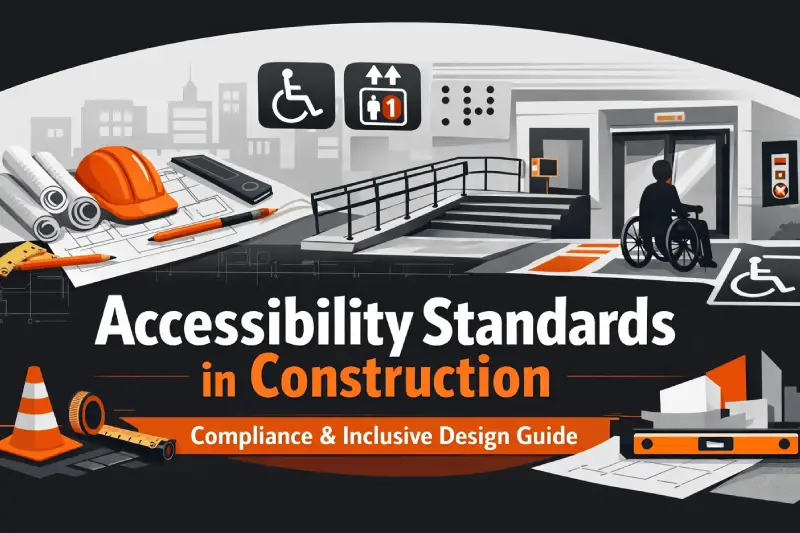
Accessibility standards in construction are rules that ensure buildings can be used by everyone, including people with disabilities. These standards apply to how spaces are designed, built, and maintained. They cover everything from entrances and hallways to restrooms and parking areas.
In simple terms, accessibility means removing barriers. A person using a wheelchair should be able to enter a building without help. Someone with limited vision should be able to read signs and move safely. These are not optional features—they are required in many cases under U.S. law.
For construction professionals, accessibility is not just a design concern. It is a compliance issue. Failing to meet standards can lead to delays, fines, or even legal action. Because of this, accessibility must be part of the project from the very beginning.
Simple Definition of Accessibility in the Built Environment
The built environment includes all physical spaces where people live, work, and interact. Accessibility in this context means making sure those spaces are usable by people with different physical and cognitive abilities.
This includes:
Step-free access at entrances
Wide doorways and hallways
Proper lighting and signage
Accessible restrooms and workspaces
These features may seem basic, but they require careful planning. Even small design choices—like the height of a door handle—can affect usability.
Why Accessibility Matters in Modern Construction
Accessibility is becoming more important in today’s construction industry. There are a few clear reasons for this.
- First, legal requirements are stricter than ever. Laws like the ADA require businesses and public facilities to meet specific standards. Ignoring these rules can result in lawsuits or forced renovations.
- Second, the population is aging. More people need spaces that are easier to use. Buildings that meet accessibility standards are better prepared for long-term use.
- Third, accessible design improves overall usability. Features like wider paths and better lighting benefit everyone, not just people with disabilities.
Here is a quick look at how accessibility impacts construction projects:
| Factor | Impact on Construction |
|---|---|
| Legal compliance | Avoids penalties and project delays |
| User experience | Improves usability for all occupants |
| Property value | Increases market appeal |
| Future readiness | Supports aging population needs |
Accessibility vs. Universal Design: What’s the Difference?
Both accessibility and universal design are often used together, but they are not the same.
Accessibility focuses on meeting minimum legal standards. It ensures that people with disabilities can use a space. Universal design goes further. It aims to create spaces that work for everyone, without the need for adaptation.
Here’s a simple comparison:
| Feature | Accessibility | Universal Design |
|---|---|---|
| Purpose | Meet legal requirements | Improve usability for all |
| Approach | Reactive (compliance-based) | Proactive (design-focused) |
| Example | Adding a ramp | Designing a no-step entrance from the start |
For most construction projects, accessibility is required. Universal design, however, is a choice that can add long-term value.
Table of Contents
Key Accessibility Laws and Codes in the United States
Understanding accessibility standards starts with knowing the laws behind them. In the U.S., several regulations work together to define what is required in construction. These laws apply to different types of buildings and situations, but they all aim to ensure equal access.
For contractors, developers, and consultants, staying informed about these codes is critical. Each project must meet both federal and local requirements.

Americans with Disabilities Act (ADA) Overview
The Americans with Disabilities Act (ADA) is the main law governing accessibility in the United States. It was passed in 1990 as a civil rights law. Its goal is to prevent discrimination against individuals with disabilities.
The ADA applies to:
Public buildings
Commercial facilities
Government properties
It is divided into different sections, called titles. Two of the most important for construction are:
Title II – Covers state and local government facilities
Title III – Covers private businesses open to the public
These sections require that buildings be accessible to all users. This includes entrances, services, and overall usability.
ADA Standards for Accessible Design (2010 Update)
The ADA includes detailed technical standards that must be followed during construction. These are known as the ADA Standards for Accessible Design.
The 2010 update is currently the main reference used in projects. It sets clear requirements for:
Door widths and clearances
Ramp slopes and handrails
Restroom layouts
Parking space dimensions
These standards are not flexible. If a building does not meet them, it may fail inspection or require changes.
International Building Code (IBC) Accessibility Provisions
The International Building Code (IBC) is widely adopted across the United States. While it focuses on overall building safety, it also includes accessibility requirements.
Chapter 11 of the IBC addresses accessibility. It often works alongside ADA standards. In many cases, both must be followed at the same time.
One key difference is enforcement. The IBC is enforced by local authorities, while the ADA is a federal law. This means a project must satisfy both to avoid issues.
ANSI A117.1 Standards Explained
ANSI A117.1 is a technical standard that provides detailed measurements for accessibility. It is often referenced by the IBC.
This standard covers:
Reach ranges
Turning spaces
Fixture heights
While the ADA sets overall rules, ANSI provides the exact dimensions needed to meet them.
Fair Housing Act (FHA) Accessibility Requirements
The Fair Housing Act applies mainly to residential buildings. It focuses on making housing accessible, especially in multi-family developments.
Key requirements include:
Accessible building entrances
Usable kitchens and bathrooms
Reinforced walls for grab bars
Unlike the ADA, which applies to public spaces, the FHA targets residential usability.
OSHA’s Role in Accessibility and Safety
The Occupational Safety and Health Administration (OSHA) focuses on workplace safety. While it is not strictly an accessibility law, it overlaps in several areas.
OSHA requires:
Safe exits and evacuation routes
Proper signage
Accessible workplace facilities
This ensures that all workers, including those with disabilities, can move safely within a building.
Who Must Comply with Accessibility Standards?
Accessibility standards do not apply to every building in the same way. The requirements depend on the type of property, how it is used, and whether it is new or existing. Understanding who must comply helps avoid confusion during planning and construction.
Public vs. Private Sector Responsibilities
Both public and private sectors have responsibilities under accessibility laws, but the rules differ slightly. Public entities, such as government buildings, must follow strict accessibility requirements. These include schools, courthouses, and public transportation facilities.
Private businesses must also comply if they serve the public. This includes:
Retail stores
Restaurants
Offices
Hotels
Even small businesses are not exempt. If a space is open to the public, accessibility must be considered.
Types of Buildings Covered
Accessibility standards apply to a wide range of building types. Some of the most common include:
Commercial buildings
Healthcare facilities
Educational institutions
Transportation hubs
Each type may have additional requirements based on how it is used. For example, hospitals must meet stricter standards than standard office buildings.
New Construction vs. Existing Buildings
The level of compliance depends on whether a building is new or already exists. New construction must fully meet current accessibility standards. There is no flexibility here. All features must comply from the start.
Existing buildings have slightly different rules. They are required to remove barriers when it is “readily achievable.” This means changes should be made when they are practical and not too costly.
Here’s a comparison to make it clearer:
| Requirement Type | New Construction | Existing Buildings |
|---|---|---|
| Compliance level | Full compliance required | Partial, based on feasibility |
| Flexibility | Very limited | More flexible |
| Cost considerations | Built into project | Based on affordability |
| Enforcement risk | High | Moderate |
In many cases, renovations trigger stricter requirements. If a major upgrade is planned, the building may need to meet modern standards.
Core Accessibility Requirements in Construction
Once you understand the laws, the next step is knowing what actually needs to be built. Accessibility standards are very specific. They focus on how people move through a space and how easily they can use it.
These requirements apply to both exterior and interior elements. When planned early, they are straightforward. When ignored, they can lead to costly redesigns.
Accessible Routes and Pathways
Accessible routes are the backbone of any compliant building. These are continuous, unobstructed paths that connect all key areas.
They include:
Sidewalks and exterior paths
Building entrances
Hallways and corridors
Routes between rooms and facilities
These paths must be wide enough for wheelchairs and free of barriers. Sudden level changes, steps, or narrow passages can create serious issues.
In most cases, accessible routes must:
Be at least 36 inches wide
Have smooth, stable surfaces
Avoid steep slopes unless designed as ramps
Consistency matters here. A single obstruction can make the entire route non-compliant.
Entrances and Doorways
Entrances are one of the most visible parts of accessibility. At least one main entrance must be accessible, but in many cases, more are required.
Doors must meet specific size and usability standards. This includes:
Minimum clear width of 32 inches
Easy-to-use handles (lever-style preferred)
Low opening force
Revolving doors or heavy manual doors can create barriers. If they are used, an accessible alternative must be provided nearby.
Ramps and Elevation Changes
Changes in elevation are common in construction. Accessibility standards require these changes to be addressed properly. Ramps are the most common solution. However, they must follow strict guidelines.
Here are the key ramp requirements:
| Feature | Requirement |
|---|---|
| Slope | Maximum 1:12 ratio |
| Width | Minimum 36 inches |
| Landings | Required at top and bottom |
| Handrails | Required for longer ramps |
A ramp that is too steep or too narrow is not just inconvenient—it is unsafe. This is one of the most common compliance issues in construction projects.
Elevators and Vertical Accessibility
In multi-story buildings, vertical access is critical. Elevators are usually required when a building has more than one level. There are a few exceptions, but most commercial and public buildings must provide elevator access.
Elevators must include:
Accessible control panels
Braille markings
Audible floor indicators
In some smaller buildings, platform lifts may be allowed. However, these are limited in use and must still meet strict standards.
Parking and Exterior Accessibility
Accessibility starts before a person even enters the building. Parking areas must include designated accessible spaces.
These spaces must be:
Located close to the entrance
Properly marked with signage
Connected to an accessible route
In addition, access aisles must be wide enough to allow wheelchair movement.
Here’s a quick breakdown:
| Element | Requirement |
|---|---|
| Accessible parking spaces | Based on total parking count |
| Access aisle width | Minimum 5 feet |
| Van-accessible spaces | Larger aisle required |
| Surface | Stable and slip-resistant |
Poorly designed parking areas can make an otherwise compliant building difficult to use.
ADA Requirements for Interior Building Elements
Interior spaces must be just as accessible as the exterior. Once inside, users should be able to move freely and use all essential facilities. These requirements focus on usability, safety, and comfort.
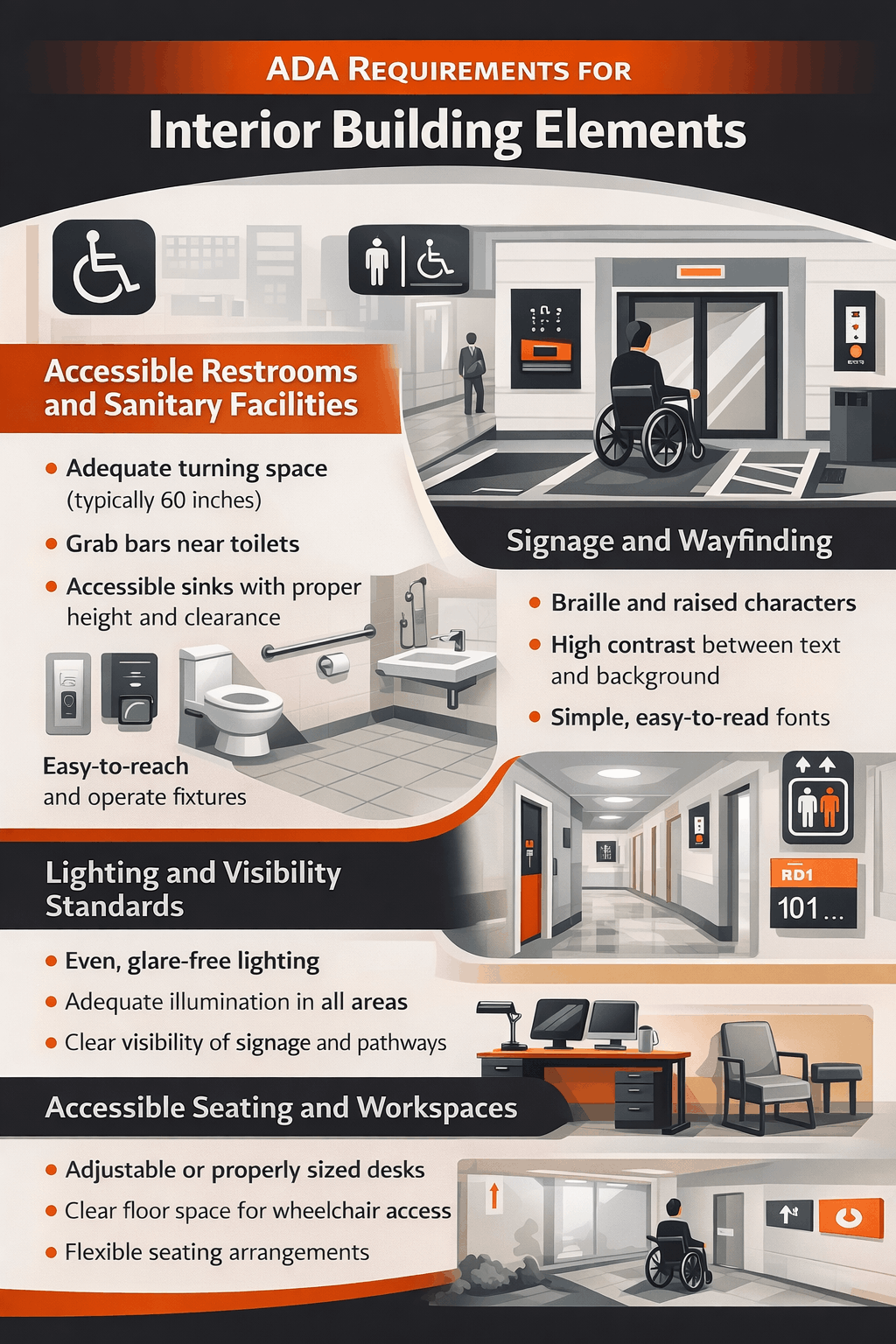
Accessible Restrooms and Sanitary Facilities
Restrooms are one of the most regulated areas under accessibility standards. Small design errors here can lead to major compliance issues.
Accessible restrooms must include:
Adequate turning space (typically 60 inches)
Grab bars near toilets
Accessible sinks with proper height and clearance
Fixtures must be easy to reach and operate. This includes faucets, soap dispensers, and hand dryers. A common issue is poor layout planning. Even if all fixtures are included, incorrect spacing can make the restroom unusable.
Signage and Wayfinding
Signage helps users move through a building independently. For accessibility, signs must be clear, readable, and consistent.
Key requirements include:
Braille and raised characters
High contrast between text and background
Simple, easy-to-read fonts
Signs should be placed at consistent heights and locations. This helps users rely on them without confusion. Wayfinding is especially important in large buildings like hospitals, offices, and schools.
Lighting and Visibility Standards
Lighting plays a major role in accessibility. Poor lighting can create hazards and make navigation difficult.
Accessible buildings should provide:
Even, glare-free lighting
Adequate illumination in all areas
Clear visibility of signage and pathways
Natural light can help, but it must be controlled to avoid shadows and glare.
Accessible Seating and Workspaces
Workspaces and seating areas must be designed to accommodate different users. This applies to offices, waiting areas, and public seating.
Accessible features include:
Adjustable or properly sized desks
Clear floor space for wheelchair access
Flexible seating arrangements
In commercial spaces, at least some seating must be accessible. This ensures equal access without requiring special requests.
Accessibility in Site Design and Outdoor Spaces
Accessibility does not stop at the building entrance. Outdoor areas must also be designed with usability in mind. This includes sidewalks, landscaping, and shared spaces.
Sidewalks, Curb Ramps, and Crossings
Sidewalks must provide a continuous, accessible path. They should connect parking areas, entrances, and nearby streets.
Curb ramps are required where sidewalks meet roadways. These ramps must:
Have smooth transitions
Include detectable warning surfaces
Be properly aligned with crossings
Poorly placed curb ramps can create confusion and safety risks.
Landscaping and Outdoor Accessibility
Landscaping should enhance a space, not block access. Trees, plants, and decorative elements must be placed carefully.
Key considerations include:
Keeping pathways clear
Avoiding low-hanging branches
Maintaining stable walking surfaces
Regular maintenance is also important. Overgrown plants or damaged paths can quickly become barriers.
Recreational Areas and Public Spaces
Parks, plazas, and outdoor seating areas must also be accessible. These spaces are often overlooked, but they are covered under accessibility standards.
Accessible features may include:
Pathways to seating areas
Wheelchair-accessible picnic tables
Inclusive playground equipment
These elements ensure that outdoor spaces can be enjoyed by everyone.
Accessibility Requirements for Different Building Types
Not all buildings follow the exact same accessibility rules. The requirements depend on how the space is used. A hospital, for example, has very different needs compared to a retail store. Still, the goal remains the same—ensure that every user can access and use the space without barriers.
Commercial Buildings
Commercial buildings include offices, retail stores, restaurants, and hotels. These spaces are open to the public, so they must follow strict accessibility standards.
Key requirements include:
Accessible entrances and exits
Clear pathways throughout the space
Accessible service counters and seating areas
In retail and office settings, accessibility also affects layout. Aisles must be wide enough, and key services must be reachable. Restaurants must provide accessible seating and routes to restrooms. Hotels must offer accessible rooms with compliant features.
Residential Buildings
Residential accessibility is mainly governed by the Fair Housing Act. It applies to multi-family housing such as apartments and condominiums.
Unlike commercial buildings, not every unit must be fully accessible. However, certain features are required:
Accessible building entrances
Usable common areas
Reinforced bathroom walls for grab bars
Accessible routes within units
These features allow residents to adapt spaces based on their needs. Single-family homes are usually not required to meet these standards unless they are part of a federally funded project.
Healthcare Facilities
Healthcare buildings have some of the strictest accessibility requirements. These facilities must support patients with a wide range of physical and medical needs.
Accessibility in healthcare includes:
Wider corridors for patient transport
Accessible exam rooms and equipment
Clear signage and wayfinding
Patient safety is a major factor. Every design decision must support ease of movement and reduce risk.
Educational Institutions
Schools, colleges, and universities must also meet accessibility standards. This applies to classrooms, dormitories, and shared spaces.
Requirements include:
Accessible classrooms and seating
Ramps and elevators between floors
Accessible restrooms and common areas
In addition, learning environments must support students with different needs. This includes proper lighting, acoustics, and layout.
Common Accessibility Design Mistakes to Avoid
Even experienced teams can overlook accessibility details. Small mistakes can lead to major compliance issues later. Knowing the common problems helps prevent delays and extra costs.
Incorrect Ramp Slopes or Dimensions
One of the most frequent issues is improper ramp design. A ramp that is too steep may technically exist, but it is not usable.
Common problems include:
Slopes steeper than 1:12
Missing handrails
Lack of proper landings
These errors often require full reconstruction, which adds time and cost to the project.
Inaccessible Restroom Layouts
Restrooms are another area where mistakes happen often. The issue is usually not missing features, but poor spacing.
Examples include:
Not enough turning space
Fixtures placed too close together
Improper grab bar placement
Even if all required elements are present, the layout must allow proper movement.
Poor Signage and Wayfinding
Signage is sometimes treated as a minor detail, but it plays a key role in accessibility.
Common issues include:
Missing Braille
Low contrast between text and background
Inconsistent placement
Without clear signage, users may struggle to navigate the building independently.
Blocking Accessible Routes
Accessible routes must remain clear at all times. However, they are often blocked by:
Furniture placement
Temporary equipment
Storage items
This is especially common after construction is complete. Maintenance teams must also be aware of accessibility requirements.
Here’s a quick summary of common mistakes:
| Mistake | Impact |
|---|---|
| Steep ramps | Unsafe and non-compliant |
| Poor restroom layout | Limited usability |
| Missing signage | Difficult navigation |
| Blocked pathways | Restricted access |
Avoiding these issues early can save significant time and money.
Accessibility Compliance Process in Construction Projects
Accessibility is not a one-time task. It is a process that runs through the entire project—from planning to final inspection. A structured approach helps ensure nothing is missed.
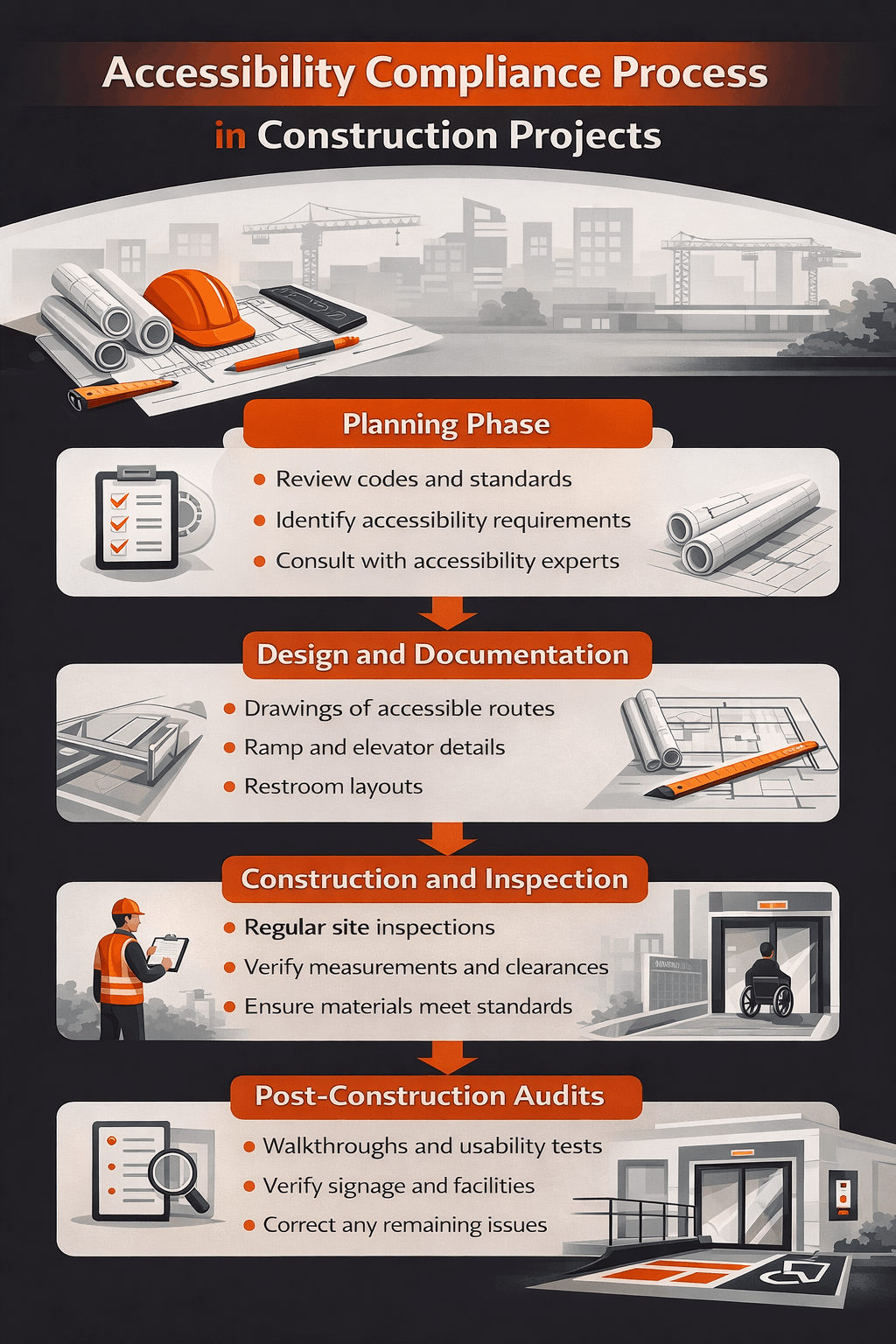
Planning Phase Considerations
Accessibility should be included at the very beginning of a project. Waiting until later stages often leads to redesigns.
During planning:
Review applicable codes and standards
Identify accessibility requirements based on building type
Consult with accessibility experts if needed
Early planning helps integrate accessibility into the overall design, rather than adding it later.
Design and Documentation
Once planning is complete, accessibility must be reflected in design documents.
Architectural drawings should clearly show:
Accessible routes
Ramp and elevator details
Restroom layouts
Accurate documentation is critical. It ensures that contractors understand what needs to be built.
Construction and Inspection
During construction, teams must follow the approved plans closely. Small deviations can create compliance issues.
Key steps include:
Regular site inspections
Verifying measurements and clearances
Ensuring materials meet standards
Inspectors may check accessibility at different stages of the project. Failing an inspection can delay progress.
Post-Construction Audits
After construction is complete, a final review is often required. This ensures that the building meets all accessibility standards.
Post-construction audits may include:
Physical walkthroughs
Testing usability of features
Verifying signage and accessibility elements
If issues are found, they must be corrected before the building is fully operational.
Cost of Accessibility Compliance
Accessibility is often seen as an added cost. In reality, it is a planned investment. When included early, it fits naturally into the project budget. When ignored, it becomes expensive to fix later. Understanding the cost side helps project owners make better decisions.
Initial Design Costs vs. Retrofitting Costs
Designing for accessibility from the start is always more cost-effective. It allows teams to integrate features without major changes.
Retrofitting, on the other hand, often requires:
Structural modifications
Layout changes
Rework of completed areas
These changes can disrupt timelines and increase labor costs.
Here’s a simple comparison:
| Cost Factor | Early Design Inclusion | Retrofitting Later |
|---|---|---|
| Design effort | Planned and efficient | Requires redesign |
| Construction cost | Controlled | Higher due to rework |
| Project timeline | Stable | Delays likely |
| Compliance risk | Lower | Higher |
This is why accessibility should be treated as a core design requirement, not an afterthought.
Budgeting for Accessibility Features
Accessibility features vary depending on the type of building. Some are low-cost, while others require more investment.
Common budget items include:
Ramps and handrails
Elevators or lifts
Accessible restrooms
Signage and wayfinding systems
These costs are predictable when planned early. In most cases, they represent a small percentage of the total construction budget.
ROI of Accessible Construction
Accessibility also provides long-term value. It is not just about meeting legal requirements.
Benefits include:
Higher property value
Broader tenant or customer base
Reduced risk of legal action
Buildings that are easy to use tend to attract more users. This improves occupancy and overall return on investment.
Benefits of Accessibility in Construction
Beyond compliance, accessibility improves the overall quality of a building. It creates spaces that are easier to use, safer, and more adaptable.
Legal Protection and Risk Reduction
One of the most immediate benefits is reduced legal risk. Accessibility laws are enforced strictly, especially in commercial settings.
By meeting standards:
You avoid fines and penalties
You reduce the chance of lawsuits
You minimize costly corrections
This alone makes accessibility a necessary part of any project.
Increased Property Value
Accessible buildings are more attractive to buyers, tenants, and investors. They serve a wider audience and meet modern expectations. Features like step-free access and clear layouts make properties more appealing. Over time, this can increase both rental income and resale value.
Better User Experience
Accessibility improves how people interact with a space. It removes friction and makes movement easier.
Examples include:
Wider pathways that reduce congestion
Clear signage that improves navigation
Better lighting that enhances visibility
These features benefit everyone, not just individuals with disabilities.
Future-Proofing for Aging Population
The demand for accessible spaces is growing. As the population ages, more people require environments that support mobility and independence.
Buildings that meet accessibility standards today are better prepared for future needs. This reduces the need for major upgrades later.
Accessibility and Technology in Modern Construction
Technology is changing how accessibility is approached in construction. It allows for better planning, smarter systems, and improved usability.
Smart Building Features for Accessibility
Modern buildings often include automated systems that improve access.
Examples include:
Automatic doors
Voice-controlled lighting and controls
Sensor-based systems
These features reduce the need for physical effort and make spaces easier to use.
Assistive Technologies Integration
Assistive technologies can be integrated directly into building design. These tools support users with different needs.
Common examples:
Hearing loop systems in meeting spaces
Digital displays with clear, readable information
Mobile-friendly navigation tools
These technologies enhance accessibility beyond basic compliance.
BIM and Accessibility Planning
Building Information Modeling (BIM) is widely used in construction planning. It also plays a role in accessibility.
With BIM, teams can:
Simulate movement through a space
Identify potential barriers early
Adjust designs before construction begins
This reduces errors and improves overall project efficiency.
ADA Compliance Checklist for Contractors and Developers
A checklist helps ensure that accessibility is addressed at every stage of the project. It also makes it easier to track progress and avoid missed details.
Pre-Construction Checklist
Before construction begins, teams should confirm:
Applicable accessibility codes and standards
Site conditions and access points
Design plans include all required features
Early checks prevent major issues later.
During Construction Checklist
While construction is underway:
Verify measurements and clearances
Ensure accessible routes remain open
Install features according to design
Regular checks help maintain compliance throughout the build.
Final Inspection Checklist
Before project completion:
Test usability of ramps, doors, and restrooms
Confirm signage placement and readability
Review all accessibility elements
A final review ensures the building is ready for use.
Here’s a quick reference checklist:
| Stage | Key Focus |
|---|---|
| Pre-construction | Code review and planning |
| Construction | Accurate implementation |
| Final inspection | Usability and compliance |
Accessibility Standards vs Building Codes: Key Differences
Both accessibility standards and building codes are often used together, but they serve different purposes. Accessibility standards focus on usability. Building codes focus on safety and structural integrity.
Here’s a clear comparison:
| Aspect | Accessibility Standards (ADA) | Building Codes (IBC) |
|---|---|---|
| Purpose | Equal access for users | Structural and fire safety |
| Scope | Usability of spaces | Construction requirements |
| Enforcement | Federal law | Local/state authorities |
Both must be followed. Meeting one does not guarantee compliance with the other.
Future Trends in Accessibility Standards
Accessibility is evolving. The focus is shifting from minimum compliance to better overall design.
Inclusive and Universal Design Growth
More projects are adopting universal design principles. This approach creates spaces that work for everyone, without special adaptations. It goes beyond compliance and focuses on usability from the start.
Smart Cities and Accessibility
Urban development is becoming more connected. Smart city planning includes accessibility as a key component.
This includes:
Integrated transportation systems
Accessible public infrastructure
Digital navigation tools
Stricter Regulations and Enforcement
Regulations are becoming more detailed, and enforcement is increasing. This means:
More inspections
Higher expectations for compliance
Greater accountability for project teams
Staying updated with standards is more important than ever.
How to Ensure Your Construction Project Meets Accessibility Standards
Meeting accessibility standards requires a proactive approach. It involves the right team, proper planning, and ongoing attention to detail.
Work with Accessibility Consultants
Accessibility consultants bring specialized knowledge. They help identify risks and ensure compliance throughout the project. Their input can prevent costly mistakes.
Stay Updated with Codes and Regulations
Accessibility standards change over time. Teams must stay informed about updates at both federal and local levels. Regular training and code reviews can help.
Partner with Experienced Construction Firms
Experienced contractors understand accessibility requirements. They are more likely to deliver compliant projects without delays. Working with the right team improves both efficiency and results.
Final Thoughts: Building for Everyone
Accessibility is not just about meeting legal requirements. It is about creating spaces that people can use with ease and dignity.
Accessibility as a Responsibility, Not Just Compliance
Construction professionals have a responsibility to build spaces that serve all users. Accessibility should be part of every project, not treated as an extra step.
Creating Inclusive Spaces That Last
Accessible design adds long-term value. It improves usability, supports diverse needs, and prepares buildings for the future. In the end, good construction is not just about structure—it is about people.
Quick ADA Requirements Snapshot
To simplify things, it helps to keep a quick reference of common accessibility requirements. These are widely used benchmarks in construction projects across the U.S.
While full compliance requires detailed review of codes, this table gives a practical overview for day-to-day use.
| Element | Standard Requirement |
|---|---|
| Door clear width | Minimum 32 inches |
| Ramp slope | Maximum 1:12 |
| Hallway width | Minimum 36 inches |
| Wheelchair turning radius | 60 inches |
| Accessible parking aisle | Minimum 5 feet |
| Mounting height (controls) | 15–48 inches from floor |
These values come up often during design reviews and site inspections. Keeping them in mind helps reduce common errors.
Key Takeaways for Contractors and Developers
Accessibility can seem complex at first, but the core ideas are straightforward. When applied early, they become part of the normal construction process.
Here are the most important points to remember:
Accessibility is a legal requirement in many construction projects
Planning early reduces costs and avoids redesigns
Small design details can have a big impact on usability
Compliance improves property value and user experience
Regular inspections help maintain standards throughout the project
These takeaways apply to projects of all sizes, from small commercial spaces to large developments.
Practical Tips to Improve Accessibility on Your Next Project
Even with clear standards, execution is what matters most. These practical tips can help teams stay on track during real projects.
Focus on Layout First
Start with accessible routes and spacing. If movement works well, the rest becomes easier to manage.
Avoid Last-Minute Adjustments
Trying to “fix” accessibility at the end often leads to poor results. Plan it from the beginning instead.
Coordinate Across Teams
Architects, engineers, and contractors must stay aligned. Miscommunication can lead to compliance issues.
Test Real Usability
Walk through the space as a user would. This helps identify problems that drawings may not show.
Internal Linking Opportunities for Your Website
To strengthen SEO and keep users engaged, this blog can connect naturally with your existing services and content.
You can link to:
Construction consulting services
Code compliance and inspection support
Building permit guidance and approvals
For example, when discussing compliance or inspections, you can reference your consulting services. This keeps the content helpful while guiding readers toward your expertise.
Conclusion: Accessibility Is Smart Construction
Accessibility is no longer optional. It is a core part of modern construction and design.
When done right, it does more than meet regulations. It improves how people experience a space. It reduces risks, increases value, and prepares buildings for the future.
For contractors, developers, and consultants, the approach is simple: Plan early. Follow the standards. Focus on usability. In the end, accessible construction is not just about compliance—it is about building spaces that work for everyone.
Need Help with Accessibility Compliance for Your Project?
If you’re planning a new build or working through a renovation, accessibility requirements can quickly become overwhelming. Codes, measurements, inspections—it’s a lot to manage, especially when timelines and budgets are tight.
That’s where we come in.
At JDJ Consulting, we work closely with contractors, developers, and property owners to make sure accessibility is handled the right way—from the very beginning. No guesswork. No last-minute fixes. Just clear guidance and practical support.
If you’re unsure about compliance or just want a second set of eyes on your project, let’s talk.
Fill out our pre-consultation form or schedule a quick meeting with our team here: https://jdj-consulting.com/book-consultation/
Prefer to speak directly?
- Call us at (818) 793-5058
- Email: sales@jdj-consulting.com
We’ll walk through your project, answer your questions, and help you move forward with confidence.
FAQs About Accessibility Standards in Construction
What are accessibility standards in construction?
Accessibility standards are guidelines that ensure buildings can be used by people with disabilities. These rules apply to design, construction, and maintenance.
They typically include:
Accessible entrances and routes
Proper restroom layouts
Clear signage and lighting
In the U.S., these standards are mainly defined by the ADA, along with codes like IBC and ANSI.
Is ADA compliance mandatory for all construction projects?
ADA compliance is required for most public and commercial buildings. Private businesses that serve the public must also follow these rules.
However, requirements vary:
New construction must fully comply
Existing buildings must remove barriers when feasible
Not all residential properties fall under ADA, but they may be covered by other laws like the Fair Housing Act.
What is the difference between ADA and IBC accessibility requirements?
ADA and IBC both address accessibility, but they serve different purposes.
ADA focuses on civil rights and usability
IBC focuses on building safety and structural standards
In most projects:
ADA ensures equal access
IBC ensures safe construction
Both must be followed together to avoid compliance issues.
What is the minimum width required for an accessible doorway?
The ADA requires a minimum clear width of 32 inches for doorways.
This ensures:
Wheelchair access
Ease of movement
Other considerations include:
Lever-style handles
Low opening force
Even small deviations can lead to non-compliance during inspections.
What is the standard slope for ADA-compliant ramps?
The standard ramp slope is a maximum of 1:12. This means for every inch of height, there must be at least 12 inches of length.
Additional requirements include:
Handrails for longer ramps
Level landings at the top and bottom
Steeper ramps may be unsafe and are one of the most common violations.
Do existing buildings need to meet accessibility standards?
Yes, but the requirements are more flexible compared to new construction.
Existing buildings must:
Remove barriers when it is “readily achievable”
Improve accessibility over time
Examples include:
Adding ramps
Adjusting door hardware
Major renovations may trigger full compliance requirements.
How many accessible parking spaces are required?
The number of accessible parking spaces depends on the total parking capacity.
General guidelines include:
A minimum number based on lot size
At least one van-accessible space in most cases
Spaces must also include:
Proper signage
Access aisles
Incorrect parking layouts are a common compliance issue.
What are common accessibility mistakes in construction?
Several common issues can lead to compliance problems.
These include:
Incorrect ramp slopes
Poor restroom layouts
Missing or unclear signage
Blocked accessible routes
Most of these errors happen due to lack of planning or coordination. Regular inspections can help prevent them.
What is the required turning space for wheelchairs?
The ADA typically requires a turning radius of 60 inches.
This allows:
Full wheelchair rotation
Safe movement in restrooms and tight spaces
Designers must ensure:
Clear floor space
No obstructions
This requirement is often overlooked in small rooms.
Are elevators required in all multi-story buildings?
Elevators are required in most multi-story public and commercial buildings.
However, there are exceptions:
Small buildings with limited floor area
Certain low-occupancy structures
When required, elevators must include:
Accessible controls
Audible and visual signals
Always verify local code requirements for specific projects.
What is the role of ANSI A117.1 in accessibility?
ANSI A117.1 provides technical details for accessibility design.
It includes:
Exact measurements
Reach ranges
Fixture placement
While ADA sets overall requirements, ANSI helps define how to meet them. It is often referenced by building codes like the IBC.
How does accessibility impact construction costs?
Accessibility can affect costs, but the impact is usually manageable.
When planned early:
Costs remain controlled
Integration is easier
When added later:
Costs increase due to rework
Project delays may occur
Overall, early planning helps avoid unnecessary expenses.
What is the Fair Housing Act’s role in accessibility?
The Fair Housing Act focuses on residential buildings, especially multi-family housing.
It requires:
Accessible common areas
Adaptable unit features
Examples include:
Reinforced bathroom walls
Accessible entrances
It differs from ADA, which mainly applies to public and commercial spaces.
How can contractors ensure accessibility compliance?
Contractors can follow a structured approach to maintain compliance.
Key steps include:
Reviewing codes during planning
Following detailed design drawings
Conducting regular site checks
Working with accessibility consultants can also help reduce errors and ensure proper implementation.
Why is accessibility important in modern construction?
Accessibility improves both compliance and usability.
It helps:
Meet legal requirements
Enhance user experience
Increase property value
It also prepares buildings for future needs, especially as the population ages. In simple terms, accessible design benefits everyone who uses the space.