When planning a new building or development, two terms often cause confusion: building codes and zoning codes. They sound similar. However, they serve very different purposes.
One focuses on how a structure is built. The other focuses on where and what you are allowed to build.
If you are a property owner, developer, architect, or investor, understanding this difference is critical. It affects project timelines, design decisions, costs, and legal compliance.
In this guide, we’ll break it down in simple terms. No legal jargon. No complicated language. Just clear explanations you can use in real projects.
Table of Contents
ToggleWhat Is a Building Code?
A building code is a set of rules that governs how buildings must be constructed. These rules are designed to protect public safety. They ensure structures are strong, safe, and functional.
In simple terms, building codes answer this question:
“Is this building safe to construct and occupy?”
They apply to residential homes, commercial buildings, industrial facilities, and renovations.
Most jurisdictions adopt versions of national or international model codes. Local governments may adjust them to reflect climate, geography, and regional risk factors.
Definition and Core Purpose
Building codes establish minimum standards for construction.
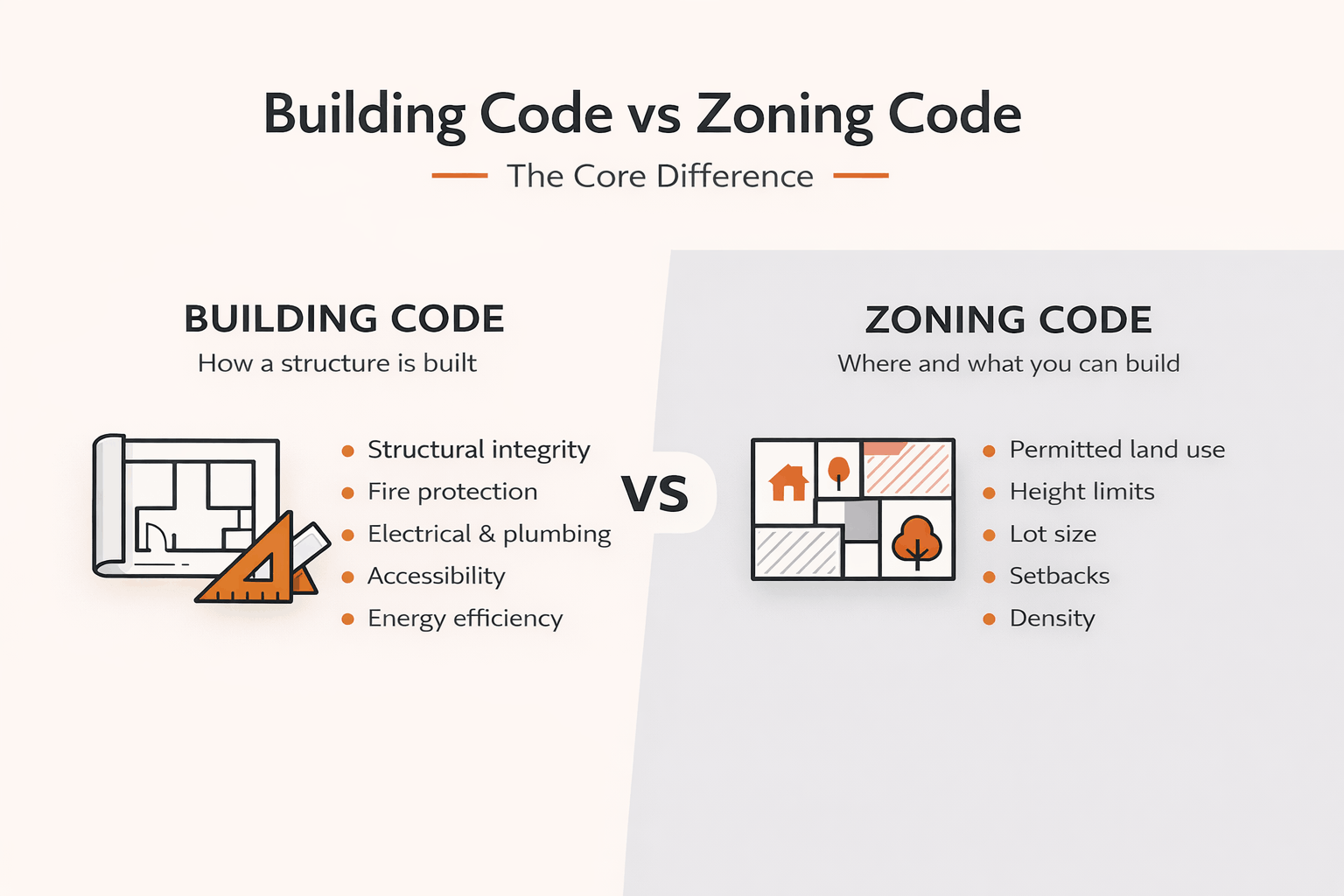
They regulate technical aspects such as:
Structural integrity
Fire protection systems
Electrical safety
Plumbing systems
Mechanical systems (HVAC)
Accessibility requirements
Energy efficiency
The purpose is straightforward:
Protect human life
Reduce risk of collapse or failure
Limit fire hazards
Promote safe exits during emergencies
Ensure buildings function properly
For example, structural rules determine how much weight a floor must support. Fire safety rules dictate the number of exits required. Electrical standards prevent shock hazards.
Without building codes, construction quality would vary widely. That creates safety risks and legal exposure.
Who Enforces Building Codes?
Building codes are enforced by local building departments.
Before construction begins, developers must submit plans. These plans are reviewed for code compliance.
After approval, inspectors visit the site during construction. They check:
Foundation work
Framing
Electrical installation
Plumbing systems
Fire safety measures
If something does not meet the code, corrections are required before work continues. At the end of the process, the project must pass final inspection to receive a certificate of occupancy. That certificate confirms the building is safe for use.
Common Examples of Building Code Requirements
Here are a few practical examples:
Minimum ceiling heights in residential units
Fire-rated walls between commercial spaces
Proper stair dimensions and handrails
Seismic reinforcement in earthquake-prone areas
Wind load resistance in hurricane zones
Each of these requirements protects occupants and reduces long-term liability.
To make it clearer, here’s a quick breakdown:
| Area of Regulation | What Building Code Controls |
|---|---|
| Structural Design | Load limits, foundation depth, framing standards |
| Fire Safety | Sprinklers, alarms, fire-rated walls, exit access |
| Electrical | Wiring methods, grounding, panel installation |
| Plumbing | Pipe materials, drainage systems, water pressure |
| Accessibility | Ramps, door widths, restroom requirements |
As you can see, building codes deal with the technical performance of a structure. They do not determine whether you can build a warehouse next to a home. That is where zoning comes in.
What Is a Zoning Code?
While building codes focus on safety, zoning codes focus on land use.
They answer a different question:
“What type of building is allowed on this piece of land?”
Zoning laws divide cities and counties into districts. Each district has rules about how land may be used. These rules shape how communities grow. They also protect property values and neighborhood character.
Definition and Core Purpose
A zoning code regulates:
Permitted land uses
Building height limits
Lot size requirements
Setbacks from property lines
Density limits
Parking requirements
For example, a residential zone may allow single-family homes but prohibit heavy industrial activity. A commercial zone may allow offices and retail stores but restrict residential construction.
The purpose of zoning is to:
Separate incompatible land uses
Prevent overcrowding
Manage traffic impact
Preserve community character
Control growth patterns
In short, zoning is about planning and organization.
Types of Zoning Districts
Most jurisdictions divide land into categories such as:
Residential (single-family, multi-family)
Commercial
Industrial
Mixed-use
Agricultural
Each district includes specific standards. For instance, a residential zone might require:
Minimum lot size
Maximum building height
Minimum front yard setback
A commercial district may allow taller buildings but require more parking spaces.
Here is a simplified comparison:
| Zoning Category | Typical Permitted Uses |
|---|---|
| Residential | Single-family homes, duplexes |
| Commercial | Retail stores, offices, restaurants |
| Industrial | Warehouses, manufacturing facilities |
| Mixed-Use | Combination of residential and commercial |
| Agricultural | Farming, rural structures |
Zoning regulations are usually reviewed before a building permit is issued. If your project does not meet zoning rules, you may need:
A variance
A special use permit
A rezoning approval
These processes often involve public hearings.
Who Enforces Zoning Codes?
Zoning codes are enforced by planning departments or zoning boards.
They review:
Site plans
Land use proposals
Development applications
If a project violates zoning regulations, approval will be denied. Even if your building design fully complies with safety standards, you cannot proceed without zoning compliance. That distinction is critical.
Key Differences Between Building Codes and Zoning Codes
At first glance, these regulations may seem similar. Both involve permits. Both require government approval. However, they regulate very different aspects of development.
Building codes focus on construction standards. Zoning codes focus on land use and placement. Understanding the difference helps avoid costly delays.
Side-by-Side Comparison
Below is a clear breakdown:
| Feature | Building Code | Zoning Code |
|---|---|---|
| Primary Focus | Construction safety and standards | Land use and development control |
| Governs | How a building is built | Where and what can be built |
| Enforced By | Building department inspectors | Planning or zoning department |
| Applies To | Structural, electrical, plumbing systems | Lot size, height, setbacks, density |
| Timing | During plan review and construction | Before building permit approval |
The sequence matters.
Typically:
Zoning approval comes first.
Building code review follows.
Construction begins after permits are issued.
Inspections occur throughout construction.
If zoning prohibits your intended use, you cannot move forward. If zoning allows the use but the structure fails safety standards, you still cannot move forward. Both sets of regulations must align.
Why the Difference Matters
Consider this example. You purchase land in a residential district. You design a small office building that fully complies with structural and fire codes. However, the zoning district only permits single-family homes.
Even though the building is safe, it cannot be built on that site. Now consider the opposite situation.
The zoning district allows commercial construction. But your building plans lack proper fire exits. Zoning approves the use. Still, building officials reject the plans.
In both cases, failure to understand the distinction leads to delays and redesign costs. That is why early due diligence is essential.
How Building Codes and Zoning Codes Work Together in Real Projects
By now, the difference is clear. Zoning controls where and what you can build. Building codes control how you build it.
However, in real projects, these two systems do not operate separately. They overlap throughout the approval process. If one fails, the entire project can stall.
Understanding how they work together helps reduce risk and avoid costly redesigns.
The Typical Approval Process Step by Step
Most development projects follow a similar sequence. While details vary by jurisdiction, the structure is consistent.
Here is a simplified timeline:
Preliminary due diligence
Zoning review
Site plan approval
Building permit submission
Construction inspections
Final approval and occupancy
Let’s break that down.
1. Preliminary Due Diligence
Before design begins, developers typically verify:
Zoning designation
Permitted uses
Height limits
Setbacks
Density allowances
Parking requirements
This early review prevents wasted design costs. If zoning does not allow the intended use, the team must decide whether to:
Request a variance
Seek rezoning
Modify the project
Select a different site
Skipping this step can lead to major delays later.
2. Zoning Review Comes First
Zoning approval usually happens before detailed construction review.
Planning departments evaluate:
Land use compliance
Lot coverage
Building height
Traffic impact
Landscaping requirements
Environmental considerations
If the project fits within zoning rules, it moves forward. If not, public hearings may be required. That adds time and uncertainty.
3. Building Code Review Follows
Once zoning compliance is confirmed, building departments review technical drawings.
They check:
Structural calculations
Fire protection plans
Electrical layouts
Plumbing systems
Accessibility compliance
Energy code requirements
At this stage, safety and performance standards are evaluated. If revisions are needed, plans must be updated before permits are issued.
How Departments Coordinate
In many municipalities, zoning and building departments communicate regularly.
For example:
Planning may flag height issues.
Building officials may identify fire separation requirements.
Engineering departments may review stormwater management.
Complex projects often require multiple approvals at once. This coordination reduces conflicts but does not eliminate them. Clear communication between consultants, architects, and municipal staff is critical.
Why Timing Matters
A common mistake is assuming zoning approval guarantees a smooth path to construction. That is not always the case.
Consider this scenario:
Zoning allows a four-story building.
However, building code requires additional fire protection systems at that height.
The cost increases significantly.
Although zoning permits the structure, safety regulations may affect feasibility. Early code analysis prevents surprises.
Common Conflicts and Compliance Challenges
Even experienced developers encounter issues when zoning and building codes intersect. Some problems arise from misunderstanding. Others stem from evolving regulations.
Here are common challenges.
1. Height Limits vs. Fire Code Requirements
Zoning may allow a certain building height. However, building codes often impose stricter fire safety rules for taller structures, such as:
Sprinkler systems
Fire-rated stairwells
Smoke control systems
The additional cost can impact project viability.
2. Density vs. Structural Capacity
Zoning may allow high-density residential units. Yet structural requirements, parking demands, and accessibility standards can limit design efficiency. Balancing these requirements requires careful planning.
3. Setbacks and Design Constraints
Zoning setbacks control how far a building must sit from property lines. Meanwhile, building codes regulate:
Window placement
Fire separation distances
Emergency egress
Sometimes these requirements conflict. Design adjustments become necessary.
4. Renovation Projects and Older Buildings
Renovations create unique issues. Zoning may permit continued use of an existing building. However, building codes may require upgrades when:
Occupancy type changes
Square footage increases
Structural systems are modified
Older buildings often require modernization to meet current standards.
5. Variances and Special Approvals
When zoning rules create hardship, developers may request a variance.
However:
Approval is not guaranteed.
Public opposition may arise.
Conditions may be attached.
Even if zoning flexibility is granted, building code compliance remains mandatory. The two systems are independent.
Practical Strategies to Avoid Delays
Because compliance affects cost and timeline, early planning is essential. Below are practical strategies used in professional development projects.
Conduct Early Zoning Analysis
Before purchasing land:
Confirm zoning classification
Review permitted uses
Check overlay districts
Verify development standards
This reduces acquisition risk.
Engage Code Consultants Early
Building code consultants can:
Review conceptual designs
Identify high-cost requirements
Suggest alternatives
Clarify occupancy classifications
This prevents redesign later.
Coordinate With Local Authorities
Pre-application meetings are valuable.
They allow you to:
Confirm interpretation of regulations
Identify potential issues
Understand submission requirements
Clear expectations reduce friction.
Align Design With Both Codes Simultaneously
Design teams should not treat zoning and building codes as separate tasks.
Instead:
Evaluate them together
Model compliance early
Adjust layouts proactively
This integrated approach saves time.
Why This Matters for Developers and Property Owners
Regulatory misunderstandings increase risk.
They can cause:
Project delays
Budget overruns
Redesign costs
Legal disputes
On the other hand, early compliance planning improves:
Predictability
Cost control
Community approval
Long-term property value
In today’s development environment, due diligence is not optional. It is essential.
Real-World Examples and Financial Impact of Code Compliance
Understanding theory is helpful. However, real projects reveal how building codes and zoning codes affect time, cost, and feasibility. Small oversights can create large financial consequences. On the other hand, early planning improves control and predictability. Let’s look at practical examples.
Example 1: Zoning Restricts the Intended Use
A developer purchases land assuming a mixed-use project is allowed. After closing, they discover the property is zoned strictly residential.
Now the options are limited:
Apply for rezoning
Request a special use permit
Redesign the project
Sell the property
Each option adds time and cost. Public hearings may delay the project by months. In some cases, rezoning requests are denied. The issue had nothing to do with construction safety. It was purely a zoning restriction.
Example 2: Building Code Increases Construction Cost
In another case, zoning allows a four-story apartment building. The design fits within height limits and setbacks. However, once the building code review begins, additional requirements apply:
Full sprinkler system
Two enclosed stairwells
Fire-rated corridors
Enhanced structural framing
These features increase construction cost significantly. The project remains legally permitted. Still, profit margins shrink. This is why both regulatory systems must be reviewed early.
Example 3: Renovation Triggers Code Upgrades
An investor plans to convert an old warehouse into office space. Zoning allows commercial use. No issue there. However, the change in occupancy classification triggers new building code requirements:
Accessibility upgrades
Restroom modifications
Fire alarm system installation
Structural reinforcement
The renovation budget increases by 25%. The building was legally allowed. Yet safety regulations required modernization.
Financial Impacts of Non-Compliance
Failure to understand these regulations can affect more than timelines.
It can impact:
Construction financing
Insurance approvals
Investor confidence
Long-term property value
Here is a simplified breakdown of potential risks:
| Type of Issue | Possible Financial Impact |
|---|---|
| Zoning violation | Project denial or redesign costs |
| Missed setback requirement | Demolition or reconstruction |
| Fire code non-compliance | Permit delays and reinspection fees |
| Occupancy misclassification | Increased system upgrades |
| Height miscalculation | Structural redesign |
These issues are avoidable with proper review. Regulatory compliance is not just a legal step. It is a financial strategy.
The Role of Professional Consulting in Code Compliance
Many developers assume architects handle all regulatory issues. While architects play a major role, complex projects often require specialized guidance. Professional consulting services add value in several ways.
1. Early Feasibility Analysis
Consultants can:
Review zoning classifications
Identify overlay districts
Analyze development potential
Flag height or density constraints
This supports smarter land acquisition decisions.
2. Risk Assessment Before Design Finalization
Building code consultants evaluate:
Occupancy type
Construction type
Fire separation needs
Egress requirements
This prevents redesign after permit submission.
3. Coordination Between Stakeholders
Large projects involve:
Architects
Engineers
Contractors
Planning officials
Fire marshals
Professional advisors help align interpretations and reduce conflicts.
4. Avoiding Delays During Permitting
Permit delays increase holding costs.
For example:
Loan interest continues
Contractors wait on schedule
Material prices may fluctuate
Early compliance review reduces these risks.
Best Practices for Managing Zoning and Building Code Requirements
Successful development teams treat regulatory compliance as part of strategic planning. Here are proven practices.
Start With Land Use Confirmation
Before design investment:
Confirm zoning classification
Review permitted uses
Check development standards
Verify parking requirements
Do not rely on assumptions.
Analyze Building Code Requirements at Concept Stage
Even early sketches should consider:
Occupancy classification
Fire protection thresholds
Structural load implications
Accessibility standards
Waiting until final drawings increases redesign costs.
Schedule Pre-Application Meetings
Meeting with planning and building officials early can:
Clarify interpretations
Identify potential issues
Build cooperative relationships
This step often saves weeks later.
Budget for Compliance Costs
Regulatory compliance adds cost. That is normal.
However, budgeting for:
Fire systems
Accessibility upgrades
Structural enhancements
prevents financial shock mid-project.
Conclusion: It’s Not Just Paperwork — It’s Smart Planning
At first, building codes and zoning codes can feel like layers of red tape. Forms, reviews, inspections, meetings. It may seem like a slow process standing between you and construction. But in reality, these rules exist for good reasons.
Zoning protects communities. It keeps neighborhoods organized and separates homes from heavy industry. It manages growth so infrastructure can keep up. Building codes protect people. They reduce fire risk. They improve structural strength and make sure exits are safe and help buildings perform the way they should. When you step back, both systems serve the same goal: long-term safety and stability.
For developers and property owners, the key is simple. Do not treat zoning and building codes as afterthoughts. Review them early. Ask questions early. Budget for them early. A few conversations at the beginning of a project can prevent months of delay later.
Smart planning is not just about design and cost. It is about understanding the rules that shape your project from day one. When zoning compliance and building safety standards are addressed together, projects move more smoothly. Investors feel more confident. And communities benefit from well-planned development.
In the end, this is not just about permits. It is about building responsibly — and building with clarity.
Need Help With Zoning or Building Code Compliance?
Understanding the rules is one thing. Applying them correctly to your project is another. If you’re planning a development, renovation, or property purchase, early guidance can save time, money, and stress.
At JDJ Consulting, we help property owners and developers review zoning requirements, assess building code impacts, and move through approvals with fewer surprises. We focus on clear advice and practical solutions so your project stays on track.
Call us: (818) 793-5058
Email: sales@jdj-consulting.com
You can also:
Explore our Services: https://jdj-consulting.com/services/
Early planning makes a difference. Let’s make sure your project starts on solid ground.
FAQs: Building Code vs. Zoning Code
What is the main difference between building codes and zoning codes?
Building codes regulate how a structure is built, focusing on safety and construction standards. Zoning codes regulate how land is used, determining what type of building is allowed in a specific area.
In simple terms:
Zoning decides if you can build something.
Building codes decide how it must be built.
Both approvals are required before construction can move forward.
Do I need both zoning approval and a building permit?
Yes, in most cases you need both.
Zoning approval confirms your project fits the permitted land use, setbacks, height limits, and density rules. A building permit confirms your design meets structural, fire, electrical, plumbing, and safety standards.
Without zoning approval, you cannot proceed. Without a building permit, you cannot legally construct.
Which comes first: zoning approval or building permit?
Typically, zoning review happens first.
Planning departments confirm that the project is allowed on the property. Once zoning compliance is verified, building officials review construction drawings for safety and technical compliance.
Some jurisdictions allow parallel reviews, but zoning compliance is usually required before a permit is issued.
What happens if my project does not comply with zoning laws?
If your project violates zoning rules, you may:
Apply for a variance
Request rezoning
Modify your design
Select a different site
Approval is not guaranteed. Public hearings may be required, and delays can occur. It is best to verify zoning before purchasing property or investing in design work.
Can building codes be waived or modified?
Building codes protect public safety, so they are rarely waived.
In limited cases, alternative methods may be approved if they meet the same safety standards. However, you cannot bypass structural integrity, fire safety, or accessibility requirements.
Compliance is mandatory for occupancy approval.
What is a zoning variance?
A zoning variance is special permission to deviate from specific zoning requirements.
For example:
Reducing setback distance
Exceeding height limits
Adjusting lot coverage
Variances usually require public review and proof of hardship. Even with a variance, building code compliance is still required.
How do building codes affect renovation projects?
Renovations can trigger updated code requirements, especially if:
The occupancy type changes
Square footage increases
Structural elements are modified
You may need to upgrade fire systems, accessibility features, or structural components. Older buildings often require modernization when major alterations occur.
What are common zoning restrictions?
Zoning codes often regulate:
Permitted land use
Building height
Lot size
Density limits
Parking requirements
Setbacks from property lines
These restrictions shape how communities grow and ensure compatibility between neighboring properties.
What are common building code requirements?
Building codes typically address:
Structural load calculations
Fire-rated walls and exits
Electrical wiring standards
Plumbing systems
Accessibility compliance
Energy efficiency standards
These rules ensure buildings are safe and functional for occupants.
Can zoning laws prevent me from building on my land?
Yes.
Even if you own the property, zoning laws may limit how it can be used. For example, industrial facilities cannot typically be built in residential districts.
Ownership does not override land use regulations.
How long does zoning approval take?
Approval timelines vary by jurisdiction. Simple projects that meet zoning standards may be reviewed quickly. Projects requiring variances or public hearings can take several months. Early consultation with planning officials helps reduce delays.
How long does it take to get a building permit?
Permit timelines depend on project complexity. Small residential projects may be approved within weeks. Larger commercial developments may require multiple review cycles. Submitting complete, code-compliant drawings helps speed up approval.
What is a certificate of occupancy?
A certificate of occupancy is issued after final inspection.
It confirms the building:
Meets building code requirements
Passed inspections
Is safe for occupancy
Without it, the building cannot legally be used.
Can zoning and building codes conflict?
They usually address different issues, but conflicts can occur in design.
For example, zoning may allow a certain height, but building code may require additional fire protection systems at that height. Coordination during design helps resolve these issues early.
Who enforces zoning laws?
Zoning laws are enforced by local planning departments or zoning boards.
They review:
Site plans
Land use applications
Development proposals
They ensure projects align with community development standards.
Who enforces building codes?
Building departments enforce building codes. Inspectors review construction drawings and conduct site inspections during different phases of construction. They ensure structural, electrical, plumbing, and fire safety standards are met before occupancy.
What is the difference between land use and construction standards?
Land use regulations (zoning) determine what activities are allowed on a property. Construction standards (building codes) determine how structures must be built to ensure safety. Both systems operate independently but must align for project approval.
Do building codes vary by state or city?
Yes.
Most jurisdictions adopt model codes, but local governments can amend them. Requirements may vary based on:
Climate conditions
Seismic risk
Wind exposure
Local policy decisions
Always verify the local code version in effect.
How can early compliance planning reduce project costs?
Early review helps identify:
Height restrictions
Fire system requirements
Structural upgrades
Parking obligations
Addressing these factors during conceptual design prevents expensive redesign and construction delays later.
Why is professional consulting helpful for zoning and building compliance?
Professional consultants help clarify complex regulations.
They can:
Review zoning classifications
Analyze feasibility
Identify code triggers
Coordinate with local agencies
Early expert guidance reduces uncertainty and keeps projects moving efficiently.
References
International Code Council (ICC) – Overview of building codes and standards. https://www.iccsafe.org
U.S. Department of Housing and Urban Development (HUD) – Guide to building and zoning regulations. https://www.hud.gov
Lawshun – What Are Zoning Laws and Building Codes? https://lawshun.com/article/what-are-zoning-laws-and-building-codes
National Fire Protection Association (NFPA) – Building safety codes. https://www.nfpa.org
Encyclopedia of Building and Zoning Codes (Wikipedia) – Overview of code differences. https://en.wikipedia.org/wiki/Building_code