Construction Cost Per Square Foot in Texas: The 2026 Guide
Building a project in Texas begins with one big question: How much will it cost per square foot? Whether you are planning a home, office, retail space, or industrial building, this simple metric helps you estimate your budget early.
In this article, we explain what “cost per square foot” really means. We also show current cost ranges and real examples for Texas. The goal is to make the data easy to use and understandable.
Let’s begin.
What “Cost Per Square Foot” Means in Construction
When builders say cost per square foot, they refer to the amount it costs to build one square foot of a structure. This includes labor, materials, systems like electrical and HVAC, and basic site work. The number varies a lot by project type and quality.
You can think of it like this:
The bigger the building, the more total cost you will have.
The per‑square‑foot number gives a starting point for budgeting. Estimator Texas
So, this metric lets owners compare different building scenarios or plans and make better decisions without guessing.
What Costs Are Usually Included?
In most cost estimates, the following are included:
Labor — workers installing every part of the build
Systems — electrical, plumbing, HVAC
Site work — clearing, grading, excavation
What Costs Are Often Not Included?
Some expenses are not part of the basic per‑square‑foot estimate. These are called soft costs and might include:
Land purchase
Architectural design fees
Engineering or permitting fees
Utility connection charges
Financing costs
These costs can add 10–25% or more to the project budget. JAA Contractors
🏗️ Construction Cost Calculator
Estimate your total project cost based on square footage and building type.
Current Construction Cost Ranges in Texas (2025–2026)
Construction costs in Texas vary depending on project type, finishes, and location. The tables below summarize typical ranges you can expect for different uses.
Residential and Commercial Cost Breakdown
Here’s a simple table showing cost ranges per square foot in Texas. These numbers are realistic estimates for 2025–2026 and reflect current market conditions:
Project Type
Low ($/SF)
High ($/SF)
Notes
Basic Home Construction
$130
$185
Standard build without luxury features
Mid‑Grade Residential
$180
$260
Upgraded finishes or larger homes
Custom / Luxury Homes
$300
$600+
High‑end materials and design
Commercial Retail
$220
$400
Depends on layout and finishes
Industrial / Warehouse
$110
$200
Simple industrial spaces
Hospitality / Hotels
$350
$700+
Hotels vary greatly by amenities
Medical / Healthcare Facilities
$310
$600+
Specialized systems and codes
Multifamily / Apartment Buildings
$175
$350
Mid‑size multifamily properties
(Data based on current Texas construction estimates)Estimator Texas
This table gives a quick comparison of common project types. Costs rise when projects include more complex systems, finishes, and regulatory requirements.
What Affects Cost Per Square Foot in Texas
Several key factors push the number higher or lower. Understanding them helps you estimate more accurately.
1. Project Complexity and Use
The type of building matters a lot. A basic warehouse with simple systems costs much less per square foot than a medical clinic loaded with special mechanical systems. Commercial projects like hospitals or schools can cost two to three times more than standard residential builds. Arrant Construction
2. Location Within Texas
Texas is big, and costs vary widely by region. For example:
Austin tends to be more expensive due to high demand and sustainability trends.
Dallas–Fort Worth is competitive with many contractors, which can help balance costs.
Houston sees higher prices in some sectors because of local building codes and hurricane design needs.
San Antonio and secondary markets often offer more affordable options. Maxx Builders
Higher population areas and booming markets often mean more demand for labor. More demand usually increases wages and cost per square foot.
Example Table: Regional Cost Differences in Texas
Region
Typical Range ($/SF)
General Trends
Austin
$210 – $360
High demand, sustainability focus
Dallas–Fort Worth
$190 – $340
Competitive market, balanced costs
Houston
$185 – $330
Coastal codes, strong build demand
San Antonio & Secondary
$175 – $300
Lower labor pressure, cost‑efficient
(Regional estimates sourced from recent Texas construction data)Maxx Builders
This helps highlight how location in Texas can influence budgets even for the same building type.
Cost Trends Over Time in Texas
Construction costs in Texas have changed significantly over the past 3–5 years. Understanding these trends helps owners, developers, and investors plan more accurately.
Key Drivers of Cost Changes
Labor Rate Increases
Skilled labor has become more expensive, especially in high-growth cities like Austin and Dallas.
Shortages in electricians, plumbers, and HVAC specialists have pushed hourly rates higher, directly affecting per-square-foot costs.
Material Price Fluctuations
Prices of lumber, steel, concrete, and other materials have been volatile.
For example, lumber and steel prices surged sharply in 2022–2023, increasing the cost of residential and commercial builds alike.
Inflation
General inflation has also contributed to higher overall construction costs.
Even with stable material availability, rising wages and energy costs affect budgets.
Market Demand
Texas has seen booming construction in tech hubs and urban areas. High demand can drive costs higher as contractors prioritize projects and material supply is limited.
In short: Costs per square foot are trending upward, especially for projects in high-demand areas or projects with specialized requirements.
📝 Quick Tips for Texas Construction
Include both hard costs (materials, labor) and soft costs (permits, design, utilities) in your budget.
Smaller projects often cost more per square foot due to fixed costs.
Plan contingencies of 5–10% for unexpected changes or delays.
Use local materials when possible to reduce shipping costs and delays.
Compare multiple contractor bids and check experience in your building type.
It’s not just what you build, but how big it is that affects costs. Interestingly, smaller buildings often cost more per square foot than larger ones. Here’s why:
Fixed Costs Are Spread Over Fewer Square Feet
Certain costs—like site preparation, permits, and basic mechanical systems—don’t scale down easily.
For a small 1,500 sq ft home, these fixed costs represent a larger portion of the total per-square-foot cost.
Economies of Scale for Larger Buildings
Larger buildings allow materials and labor to be used more efficiently.
Bulk purchasing, repetitive construction tasks, and shared systems reduce per-square-foot costs.
Design Complexity Can Amplify Costs
High ceilings, custom layouts, or specialty features in smaller homes can make costs per sq ft even higher.
Example Table: Cost per Square Foot by Building Size
Project Size
Estimated Cost per Sq Ft
Notes
Small Home (1,500 sq ft)
$210
Fixed costs spread over fewer sq ft
Medium Home (2,500 sq ft)
$200
Slightly lower per sq ft
Large Home (4,000 sq ft)
$190
Economies of scale reduce per sq ft cost
This table helps show why smaller projects can feel disproportionately expensive and why planning for scale is important.
Tip for Owners: When comparing projects, always consider size alongside quality and complexity. Two homes with the same design but different sizes can have very different cost-per-square-foot metrics.
How to Calculate Your Project Cost
Estimating your construction cost per square foot is not complicated, but accuracy matters. Here’s a simple approach:
1. Use a Basic Formula
Estimated Cost = Square Footage × Cost per Square Foot
For example, a 2,000 sq ft mid-grade home in Dallas might cost:
2,000 × $220 = $440,000
This gives a starting point for budgeting.
2. Include Soft Costs
Architectural design
Engineering fees
Permitting
Utility connections
Soft costs can add 10–25% to your total.
3. Break Down Hard Costs
Cost Component
Percentage of Total
Materials
40–50%
Labor
30–35%
Systems (HVAC, Electrical, Plumbing)
10–15%
Site Work & Foundation
5–10%
This helps you see where your money goes and identify areas to save.
4. Example Scenarios
Residential Home (2,500 sq ft)
Mid-grade finishes: 2,500 × $220 = $550,000
Soft costs (~15%): $82,500
Total Estimated Cost: $632,500
Small Commercial Retail Space (5,000 sq ft)
Basic build: 5,000 × $250 = $1,250,000
Soft costs (~15%): $187,500
Total Estimated Cost: $1,437,500
These calculations give a realistic starting point and help avoid surprises later. Planning early, tracking costs, and understanding these drivers is the key to successful construction budgeting.
Construction Costs per Square Foot in Texas (2025–2026)
Residential Construction (Homes)
Building Type
Typical Cost per Sq Ft
Notes
Basic Home Construction
$130 – $185
Standard build quality
Mid‑Grade Residential
$180 – $260
Better finishes
Custom / Luxury Homes
$300 – $600+
High end materials & design
Residential summary: Lower‑end homes in Texas can be built around $130–$185 per sq ft, while upscale custom homes reach $300–$600+ per sq ft depending on quality and features. Estimator Texas
Commercial Construction (Office, Retail, Hospitality, Medical)
Building Type
Cost Range ($/SF)
Why It Varies
Office / Corporate
$190 – $330
Tenant fit‑outs, elevators
Retail / Restaurant
$230 – $370
Kitchens, finishes
Medical / Healthcare
$280 – $440
Code compliance, MEP systems
Multifamily / Apartments
$230 – $350
Shared systems & amenities
Hospitality / Hotels
$310 – $450+
FF&E, fire safety
Commercial summary: Most commercial builds fall between $190 and $450+ per sq ft. Industrial projects tend to be more cost‑effective, while medical and hotel builds sit on the higher end. Maxx Builders
Industrial & Warehouse Construction
Industrial Type
Cost Range ($/SF)
Typical Use
Industrial / Warehouse (General)
$160 – $250
Storage, light industrial
Light Industrial / Flex Space
$130 – $180
Mixed use
Distribution / Logistics Center
$140 – $210
Dock and material handling
Cold Storage / Specialty Industrial
$220 – $400+
Refrigerated & insulated
Industrial summary: Industrial builds often cost between $130 and $250 per sq ft. Facilities with refrigeration or heavy equipment requirements can exceed this range. Maxx Builders
Quick Reference Table – Texas Construction Cost Ranges (2025–2026)
Category
Range ($ per Sq Ft)
Basic Residential
$130 – $185
Mid‑Grade Residential
$180 – $260
Custom / Luxury Homes
$300 – $600+
Office Buildings
$190 – $330
Retail / Restaurants
$230 – $370
Medical / Healthcare
$280 – $440
Multifamily / Apartments
$230 – $350
Hotels / Hospitality
$310 – $450+
Industrial / Warehouse
$130 – $250+
This summary gives you a clear snapshot of typical Texas construction costs by building type for 2025–2026. Estimator Texas
Common Mistakes in Estimating Square Foot Costs
Many owners underestimate the true cost of construction because they focus only on the per-square-foot number. Here are some common mistakes to watch out for:
1. Ignoring Regional Differences
Costs vary by city or county.
A $200/sq ft estimate in San Antonio may be $250/sq ft in Austin.
Always check local averages before budgeting.
2. Forgetting Soft Costs
Architectural design, engineering, permits, and utility connections are often overlooked.
Soft costs can add 10–25% to your total budget.
3. Assuming All Square Feet Are Equal
Not all space costs the same.
Kitchens, bathrooms, labs, and commercial spaces often cost more per square foot than storage or basic areas.
4. Not Accounting for Market Fluctuations
Labor shortages and material price spikes happen frequently.
Always include a contingency of 5–10% for unexpected changes.
5. Skipping Contingency Planning
Every project has surprises: soil issues, design changes, or delays.
Lack of contingency funds can quickly derail a budget.
Tips to Save on Construction Costs in Texas
While construction costs are rising, smart planning can reduce your expenses without sacrificing quality.
1. Plan Early and Clearly
Create detailed designs before starting.
Avoid last-minute changes; they increase labor and material costs.
2. Choose the Right Contractor
Compare multiple bids.
Look for contractors with experience in your project type.
A contractor who understands local codes can save both time and money.
3. Consider Material Choices
Durable but cost-effective materials may save money over time.
Locally sourced materials can reduce shipping costs and delays.
4. Use Value Engineering
Evaluate each system and finish for cost vs. performance.
Minor changes in finishes can save thousands without lowering quality.
5. Schedule Strategically
Avoid high-demand seasons when labor costs spike.
Coordinating multiple trades efficiently reduces downtime and costs.
6. Keep Track of Changes
Every change order affects the final cost.
Maintain a change log and update your budget regularly.
These steps can make a significant difference in managing your Texas construction budget while keeping quality high.
Tools and Resources for Estimating Costs
Estimating construction costs accurately is essential before starting any project. Fortunately, there are tools and resources to simplify the process and give you a realistic budget.
1. Online Cost Calculators
Online calculators are great for preliminary estimates.
You can quickly enter building size, type, and location to get a rough per-square-foot cost.
Use Excel to track your hard and soft costs separately.
Allows you to adjust line items such as labor, materials, permits, and contingencies.
Helps you see which areas of your project are driving costs and identify opportunities to save.
3. Combining Hard and Soft Costs
For realistic budgeting, always include:
Hard Costs – direct construction expenses like labor, materials, systems, and site work.
Soft Costs – indirect costs like permits, architectural design, engineering fees, and utility connections.
Tip: A common approach is to calculate hard costs first, then add 10–25% for soft costs depending on the project’s complexity. This ensures your estimate is closer to the actual total build cost.
Case Studies / Real Project Examples
Real-world examples help illustrate how per-square-foot costs vary in practice and why contingency planning is essential.
Example Residential Project – Mid-Grade Home
Location: Austin, Texas
Size: 3,000 sq ft
Estimated Cost per Sq Ft: $230
Total Estimated Build: $690,000
Actual Cost: $715,000
Key Takeaways:
Design changes during construction increased the cost by $25,000.
Highlights the importance of budgeting for contingencies and unexpected changes.
Example Commercial Project – Retail Space
Location: Dallas, Texas
Size: 10,000 sq ft
Estimated Cost per Sq Ft: $280
Total Estimated Build: $2,800,000
Actual Cost: $2,925,000
Key Takeaways:
Material delays added $125,000 to the total project.
Shows how commercial projects are vulnerable to supply chain issues.
Reinforces the need to monitor project timelines and costs regularly.
Why These Examples Matter:
Even with careful planning, real costs often differ from estimates.
Including contingencies, tracking costs, and using reliable estimation tools can prevent surprises.
Helps owners make smarter decisions and keep projects on budget.
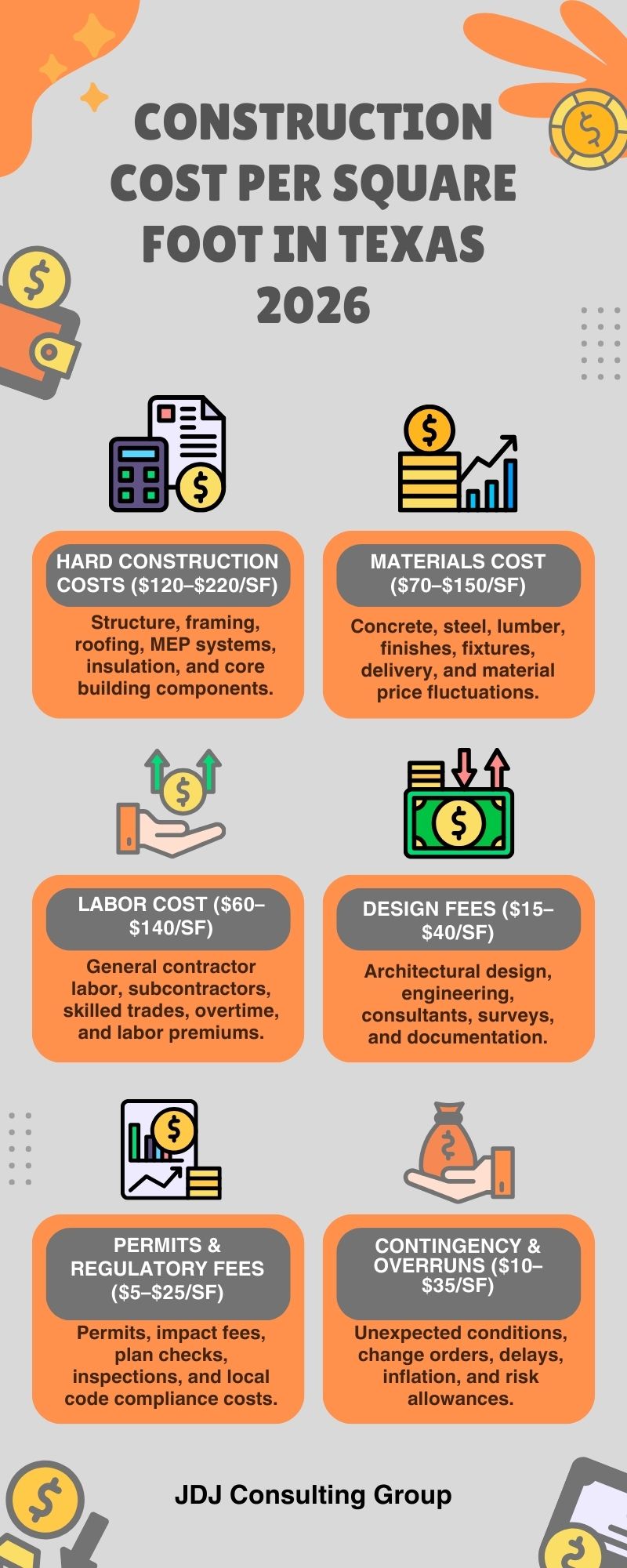
Average construction cost per square foot explained with real numbers, showing where building budgets are typically spent.
Conclusion
Figuring out construction costs per square foot in Texas doesn’t have to be confusing. Costs can vary a lot depending on what you’re building, where, and how big it is.
By understanding both hard costs (materials, labor, systems) and soft costs (permits, design, fees), planning for contingencies, and looking at real examples, you can make a smarter budget. Smaller projects often cost more per square foot, while larger projects can save money with scale.
Knowing these details upfront can save you time, money, and stress during your build.
Ready to Plan Your Project?
Building in Texas can feel overwhelming, but JDJ Consulting is here to help. We can:
Give you a clear estimate for your project
Help plan your budget with both hard and soft costs
Provide guidance on permits, codes, and contractors
Call us at (818) 793-5058 or contact us online to get started. With the right planning, your project can stay on budget and on track.
🏗️ Construction Cost per Square Foot in Texas (2025–2026)
Visual summary of typical cost ranges for different building types in Texas. These estimates include labor, materials, and basic site work.
🏠 Residential (Mid-Grade) - $180–$260/sq ft
🏡 Custom / Luxury Home - $300–$600+/sq ft
🏢 Commercial / Office - $190–$330/sq ft
🛍️ Retail / Restaurant - $230–$370/sq ft
🏭 Industrial / Warehouse - $130–$250/sq ft
🏥 Medical / Healthcare - $280–$440/sq ft
🏨 Hotels / Hospitality - $310–$450+/sq ft
Data source: JDJ Consulting estimates and Texas construction market analysis 2025–2026.
FAQs About Construction Cost Per Square Foot in Texas
What is construction cost per square foot?
Construction cost per square foot is the average amount it costs to build one square foot of a structure. It includes:
Labor
Materials
Mechanical systems (HVAC, plumbing, electrical)
Site work (grading, excavation)
This metric helps owners and developers estimate budgets and compare different building options before finalizing plans.
Does construction cost per square foot include land?
No. Land purchase is considered a soft cost and is separate from construction costs. Construction cost per square foot only covers the building itself, including labor, materials, systems, and site work. Soft costs like land, permits, and architectural design are usually calculated separately.
What factors affect construction costs in Texas?
Several factors influence costs per square foot:
Location – urban areas like Austin have higher labor and material costs.
Project type – industrial buildings are cheaper than medical or luxury homes.
Building size – smaller projects often cost more per square foot.
Material and labor prices – fluctuations impact overall cost.
Codes and permits – regulatory requirements can add expenses.
How does building size affect cost per square foot?
Smaller buildings often have higher per-square-foot costs because fixed costs (permits, design, site work) are spread across fewer square feet. Larger buildings benefit from economies of scale, reducing per-square-foot costs while maintaining quality and functionality.
What are hard costs in construction?
Hard costs are the direct expenses of construction, including:
Materials like concrete, lumber, steel
Labor for installation
Electrical, plumbing, and HVAC systems
Site preparation and foundation work
These costs form the bulk of the total project budget and are essential for per-square-foot estimates.
What are soft costs in construction?
Soft costs are indirect expenses not part of the physical build, such as:
Land purchase
Architectural and engineering fees
Permits and inspections
Utility connections and financing
Soft costs typically add 10–25% to the total project budget and should be considered when planning.
Why do commercial buildings cost more per square foot than residential?
Commercial buildings often require:
Specialized mechanical systems
Compliance with stricter codes
Higher-quality finishes for tenants or clients
These factors, combined with design complexity, make office, retail, medical, and hospitality projects more expensive per square foot than standard residential builds.
How much does a mid-grade home cost per square foot in Texas?
A mid-grade residential home in Texas generally costs $180–$260 per square foot, depending on location and finishes. Costs increase if you include upgrades like higher-end flooring, custom cabinetry, or energy-efficient systems.
How much does a luxury home cost per square foot in Texas?
Luxury and custom homes can range from $300–$600+ per square foot. Prices depend on:
Materials quality
Architectural complexity
High-end systems (smart home, HVAC, plumbing)
Landscaping and site preparation
Luxury builds often require more professional labor, increasing costs.
How much does a commercial office cost per square foot in Texas?
Typical office buildings cost $190–$330 per square foot. Factors influencing cost include tenant fit-outs, elevators, advanced electrical or mechanical systems, and finish quality. Larger office spaces may reduce cost per square foot slightly due to scale.
How much does industrial construction cost per square foot in Texas?
Industrial buildings and warehouses cost $130–$250 per square foot on average. Simple storage spaces are at the lower end, while refrigerated, specialized, or heavy-equipment facilities are at the higher end.
Why do labor costs affect construction costs?
Skilled labor is in high demand in Texas, especially in Austin and Dallas. Labor shortages or specialized trades (plumbers, electricians, HVAC) can drive up hourly rates and increase the overall per-square-foot cost.
Do material prices impact per-square-foot estimates?
Yes. Fluctuations in lumber, steel, concrete, and other materials significantly affect costs. Supply chain delays or rising prices increase both total construction costs and cost per square foot.
How do permits and codes affect cost estimates?
Construction projects must comply with local building codes, zoning laws, and safety standards. Permits, inspections, and special compliance requirements (like flood zone or hurricane-resistant builds) can add to overall costs, sometimes significantly increasing per-square-foot expenses.
What is a contingency in construction budgeting?
A contingency is a reserve of 5–10% (or more) added to a construction budget to cover unexpected changes, delays, or price increases. It ensures that small surprises don’t derail the project or exceed the planned budget.
How can I reduce construction costs per square foot?
Ways to save include:
Planning designs early and avoiding last-minute changes
Choosing durable but cost-effective materials
Using local materials to reduce shipping costs
Selecting experienced contractors familiar with Texas building codes
Evaluating finishes and systems using value engineering
How do regional differences affect costs in Texas?
Costs vary by city and region. For example:
Austin – $210–$360/sq ft, higher due to demand and sustainability focus
San Antonio/secondary markets – $175–$300/sq ft, generally more affordable
Are all square feet priced equally in a building?
No. Kitchens, bathrooms, laboratories, and specialized commercial spaces often cost more per square foot than storage or basic living areas. High ceilings, custom layouts, or premium finishes also increase local per-square-foot costs.
What are typical soft cost percentages for Texas projects?
Soft costs usually add 10–25% of total project costs. Simple residential projects may be closer to 10%, while commercial, medical, or luxury builds often exceed 20% due to design, permits, and utility connections.
Why is it important to calculate total project cost, not just per square foot?
Focusing only on per-square-foot costs can underestimate the true expense. Total project cost includes soft costs, contingencies, and variations due to location, size, and complexity. Accurate budgeting ensures projects stay on track financially and avoid surprises.
What is the average price per square foot to build a house in California?
The average cost to build a home in California ranges from $250 to $600+ per square foot, depending on the location, materials, and home type. Coastal cities like San Francisco and Los Angeles are on the higher end due to labor demand and land costs, while inland regions like Sacramento or Central Valley tend to be more affordable. Luxury or custom homes can exceed $700 per square foot.
What are the typical construction cost per square foot differences between commercial and residential projects?
Commercial construction usually costs 20–50% more per square foot than residential due to stricter building codes, specialized systems, and larger-scale infrastructure. For example:
Residential: $200–$500 per sq ft (single-family or custom homes)
Commercial: $300–$700 per sq ft (offices, retail, healthcare)
Factors include HVAC complexity, fire safety, accessibility requirements, and zoning regulations.
How can I reduce construction cost per square foot without compromising quality?
Reducing costs is possible by focusing on efficiency and smart planning:
Simplify design: Fewer corners and uniform layouts reduce labor and material waste.
Choose cost-effective materials: Engineered wood, recycled steel, or modular components maintain quality at lower cost.
Plan early: Avoid last-minute design changes, which can spike per-square-foot costs.
Bulk purchasing: Buying materials in volume can lower unit costs.
Hire experienced local contractors: Knowledge of regional regulations reduces delays and extra costs.
Why does construction cost per square foot vary by location?
Costs vary due to:
Labor rates: High-demand urban areas pay more for skilled trades.
Material availability: Remote areas may have higher shipping costs.
Local codes and permitting: Coastal or seismic zones require stricter standards.
Market demand: Booming regions increase contractor rates and competition.
What factors influence the construction cost per square foot?
Key influencers include:
Project type and complexity (luxury homes, commercial buildings, or medical facilities).
Size of the project (smaller homes often cost more per sq ft due to fixed costs).
Material and labor costs (price fluctuations directly affect budgets).
Location and regional regulations (zoning, environmental codes, and labor market).
Design choices (high ceilings, custom finishes, and advanced systems increase costs).
What is the average construction cost per square foot for residential buildings?
In the U.S., typical residential construction costs range from $150 to $500 per square foot, depending on the type:
Basic homes: $150–$250 per sq ft
Mid-grade homes: $250–$400 per sq ft
Custom/luxury homes: $400–$700+ per sq ft
Location, size, and design features are major cost drivers.
When a builder or architect gives a per square foot cost to build a custom home, what does that cost include or not include?
Included:
Labor and materials
Mechanical systems (HVAC, plumbing, electrical)
Basic site work (grading, excavation)
Not included (soft costs):
Land purchase
Architectural or engineering fees
Permits and utility connections
Financing or insurance costs
Soft costs can add 10–25% or more to the overall budget.
What is a ballpark for current home construction costs per square foot?
As of 2026, a reasonable estimate for a standard home in most U.S. regions:
Low-end: $150–$200 per sq ft
Mid-range: $250–$400 per sq ft
High-end / luxury: $400–$700+ per sq ft
These numbers vary by region, size, and complexity of the project.