Cost Savings and ROI of Site Selection Consulting in Texas
Site selection is not just about finding land. It directly affects your financial performance. A well-chosen location can reduce both upfront and long-term costs.
At JDJ Consulting, we focus on decisions that improve return on investment. Every recommendation is tied to cost, efficiency, and future growth.
How Site Selection Reduces Capital Costs
The right site can lower initial expenses. This includes land cost, construction needs, and infrastructure upgrades.
We help reduce capital costs by:
Identifying cost-effective regions
Avoiding sites with hidden issues
Securing financial incentives
Reducing site preparation work
Even small savings at this stage can have a large impact on the overall project budget.
Operational Cost Optimization
Operating costs continue long after construction is complete. Location plays a major role in these expenses.
We analyze:
Labor costs across regions
Transportation and logistics expenses
Utility pricing and reliability
Local tax structures
Choosing the right site helps control these costs over time.
Risk Reduction and Cost Avoidance
Some costs are not obvious at first. Zoning conflicts, environmental issues, or poor infrastructure can delay projects and increase expenses.
We reduce risk by:
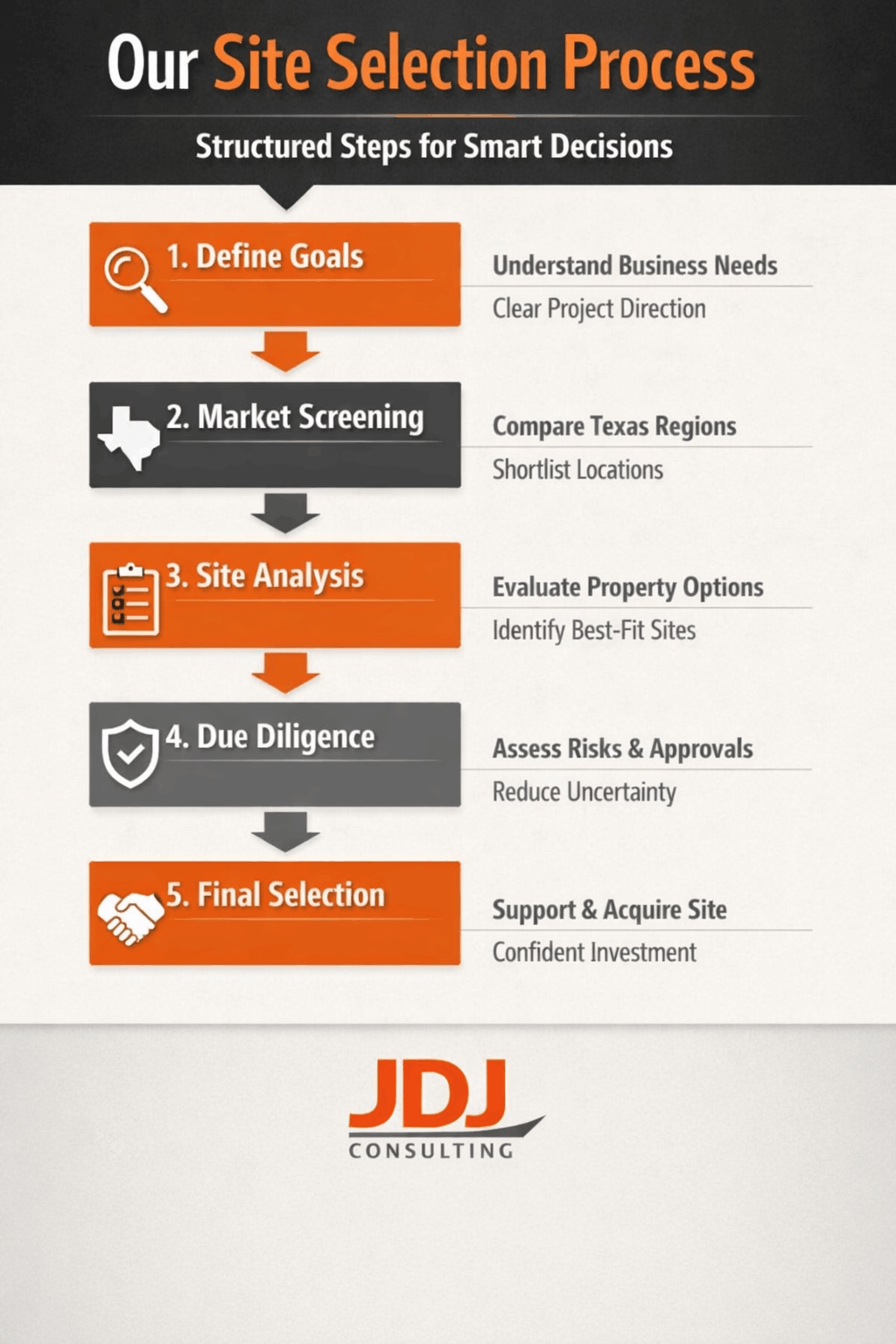
Conducting detailed due diligence
Reviewing zoning and permitting early
Identifying environmental concerns
Ensuring site readiness
Avoiding one major issue can save months of delays and significant capital.
Long-Term Value and ROI
A good site supports growth. It allows expansion, attracts talent, and keeps operations efficient.
Key long-term benefits include:
In simple terms, the right location pays off over time.
Site Selection Consulting vs In-House Decision Making
Many companies consider handling site selection internally. While this may seem cost-effective, it often leads to missed opportunities.
A structured comparison helps clarify the difference.
Consultant vs In-House Approach
| Factor | Site Selection Consultant | In-House Team |
|---|
| Market Data | Access to detailed, current data | Limited or outdated data |
| Objectivity | Unbiased recommendations | Internal bias possible |
| Incentives | Strong negotiation support | Often overlooked |
| Risk Management | Structured due diligence | Gaps in analysis |
| Speed | Streamlined process | Slower decision-making |
Advantages of Hiring a Consultant
Working with a consultant brings clarity and structure. It also improves decision quality.
Key benefits include:
Access to specialized expertise
Better data and insights
Strong negotiation support
Reduced risk of costly mistakes
This is especially important in a complex market like Texas.
Challenges of Handling Site Selection Internally
Internal teams often face limitations. They may not have access to full market data or local insights.
Common challenges include:
These issues can lead to higher costs and delays.
When It Makes Sense to Hire a Consultant
Not every project requires external support. However, for most developments, consulting adds clear value.
You should consider hiring a consultant when:
The project involves significant investment
Multiple locations are being evaluated
Zoning or permitting is complex
Incentives play a major role
In these cases, expert guidance can improve outcomes.
How to Choose the Right Site Selection Consultant in Texas
Choosing the right consultant is just as important as choosing the right site. The quality of guidance directly affects the final decision.
A structured approach helps you find the right partner.
Key Criteria for Selecting a Consultant
| Criteria | What to Look For | Why It Matters |
|---|
| Local Experience | Knowledge of Texas markets | Better regional insights |
| Service Scope | End-to-end capabilities | Fewer gaps in process |
| Industry Expertise | Experience in your sector | More relevant advice |
| Track Record | Proven project success | Confidence in results |
| Communication | Clear and consistent updates | Smooth collaboration |
Experience in Texas Markets
Texas is not a single market. Each region has its own rules, costs, and opportunities.
A strong consultant understands:
This helps avoid delays and confusion.
Industry-Specific Knowledge
Different industries have different requirements. A consultant with relevant experience can provide better recommendations.
For example:
Industrial projects need strong logistics access
Tech projects require skilled labor and infrastructure
Commercial developments depend on market demand
Matching expertise with your project type improves results.
Data and Analytical Capabilities
Good decisions depend on good data. A reliable consultant uses detailed analysis, not assumptions.
Look for:
This ensures decisions are based on facts.
Transparent Process and Communication
Clear communication keeps projects on track. You should always understand the status of your project.
A good consultant provides:
Regular updates
Clear recommendations
Honest feedback
This builds trust and improves collaboration.
Why Choose JDJ Consulting for Site Selection in Texas
Choosing a consultant is about trust and results. At JDJ Consulting, we focus on clear advice, practical solutions, and long-term value. Our approach is simple. We help clients make informed decisions without adding complexity.
We work closely with developers, investors, and businesses across Texas. Each project is handled with a structured process and local expertise.
What Sets JDJ Consulting Apart
| Strength | What It Means for You | Result |
|---|
| Local Market Knowledge | Deep understanding of Texas regions | Better site decisions |
| Zoning & Entitlements Expertise | Clear guidance through approvals | Faster project timelines |
| End-to-End Support | From strategy to final selection | Seamless execution |
| Data-Driven Approach | Decisions based on real insights | Reduced risk |
| Client-Focused Process | Tailored recommendations | Stronger outcomes |
Expertise in Zoning and Entitlements
Zoning is often the biggest hurdle in site selection. Many projects face delays because this step is not handled early.
We guide clients through:
This keeps projects moving without unnecessary setbacks.
Strong Knowledge of Texas Markets
Texas is diverse. What works in Dallas may not work in Houston or Austin. Our team understands these differences.
We provide insights on:
Regional cost variations
Growth trends
Market demand
This ensures your project is placed in the right location.
End-to-End Consulting Approach
We do not stop at site recommendations. Our team supports the full process, from early planning to final selection.
This includes:
You get one team managing the full process.
Focused on Practical Results
Our goal is not to overcomplicate decisions. We provide clear options and explain the trade-offs.
This helps you:
Make faster decisions
Avoid unnecessary risks
Stay within budget
Trends Shaping Site Selection in Texas
Site selection is changing. New factors are influencing how businesses choose locations. Understanding these trends helps you stay ahead.
Growth of Secondary Markets
Major cities are still strong, but smaller markets are gaining attention. These areas often offer lower costs and new opportunities.
Examples include:
This shift creates more options for developers.
Increased Focus on Infrastructure
Reliable infrastructure is now a top priority. Power, water, and connectivity must support long-term operations.
Projects now require:
Strong utility capacity
Reliable energy supply
Scalable infrastructure
This is especially important for industrial and tech projects.
Workforce Shifts and Talent Movement
Population growth in Texas continues to shape site selection. People are moving to areas with better job opportunities and lower costs.
This affects:
Labor availability
Wage levels
Housing demand
Choosing the right region helps attract and retain talent.
Rising Competition for Prime Sites
As demand grows, high-quality sites are becoming harder to secure. Delays in decision-making can lead to missed opportunities.
This makes early planning critical.
Final Thoughts on Site Selection Consulting in Texas
Site selection is one of the most important decisions in any development project. It affects cost, operations, and long-term success.
Texas offers strong opportunities, but the market is complex. Each region has its own advantages and challenges.
A structured approach makes a clear difference. With the right data, process, and guidance, you can choose a site that supports both current needs and future growth.
JDJ Consulting helps simplify this process. We provide clear insights, reduce risk, and support every step from planning to final decision.
If you are planning a project in Texas, the right site is not just an option. It is a strategic advantage.
Let’s Talk About Your Project
If you’re exploring sites in Texas or unsure where to start, we’re here to help. You don’t need to have everything figured out. A quick conversation can often bring clarity.
Tell us a bit about your project, and we’ll guide you on the next steps.
FAQs About Site Selection Consulting Texas
What is site selection consulting in Texas?
Site selection consulting helps businesses choose the right location for development projects. In Texas, this includes evaluating cities, land options, and regulatory requirements.
A consultant typically helps with:
Market research and location comparison
Zoning and permitting checks
Cost and incentive analysis
The goal is to select a site that supports long-term success while avoiding risks and unnecessary costs.
Why is site selection important for development projects?
Site selection directly affects both short-term and long-term outcomes. A poor location can increase costs and create delays.
Key impacts include:
A well-chosen site improves efficiency, reduces risk, and supports business growth over time.
How long does the site selection process take in Texas?
The timeline depends on project size and complexity. Smaller projects may take a few weeks, while larger developments can take several months.
Typical phases include:
Proper planning helps avoid delays and keeps the process efficient.
What factors are considered in site selection?
Several factors are analyzed before choosing a site. These vary based on the project type.
Common factors include:
Labor availability and cost
Infrastructure and transportation
Taxes and incentives
Utilities and site readiness
Each factor plays a role in determining long-term success.
What are the benefits of site selection consulting services?
Hiring a consultant brings structure and expertise to the process. This reduces risk and improves decision-making.
Benefits include:
Overall, it helps avoid costly mistakes.
Why is Texas a popular state for site selection?
Texas attracts businesses due to its strong economy and business-friendly environment.
Key advantages include:
No state income tax
Large workforce
Strong infrastructure
Rapid population growth
However, choosing the right region within Texas is still critical.
Which cities in Texas are best for site selection?
The best city depends on your industry and project needs.
Popular options include:
Dallas-Fort Worth for logistics
Austin for technology
Houston for industrial and energy
San Antonio for cost-effective development
Each region offers different strengths.
How do incentives impact site selection in Texas?
Incentives can significantly reduce project costs. These may include tax abatements, grants, or local support programs.
Consultants help by:
This can lead to substantial savings.
What is due diligence in site selection?
Due diligence is a detailed review of a site before final selection. It helps identify risks and confirm feasibility.
This includes:
Zoning verification
Environmental checks
Utility availability
Skipping this step can lead to delays and unexpected costs.
Can site selection consultants help with zoning and permits?
Yes, zoning and permitting are a key part of site selection consulting.
Consultants assist with:
This ensures the site is legally suitable for your project.
How much do site selection consulting services cost?
Costs vary depending on the project scope and complexity. However, the value often outweighs the cost.
Savings can come from:
Better site pricing
Secured incentives
Avoided risks
Most businesses see a strong return on investment.
What industries benefit most from site selection consulting?
Many industries rely on site selection services, especially those with large investments.
These include:
Each industry has unique requirements that must be considered.
What risks are involved in choosing the wrong site?
Choosing the wrong site can create serious challenges for a project.
Common risks include:
Proper analysis helps avoid these issues.
How do consultants compare different sites?
Consultants use data and analysis to compare locations. This ensures decisions are based on facts.
They evaluate:
Cost differences
Workforce availability
Infrastructure quality
Market demand
This structured approach improves accuracy.
What role does infrastructure play in site selection?
Infrastructure affects how efficiently a business can operate. Poor access can increase costs and delays.
Important elements include:
Road and highway access
Airports and ports
Utility connections
Strong infrastructure supports smooth operations.
Can site selection consulting help reduce operational costs?
Yes, location plays a major role in ongoing expenses. A well-chosen site can lower costs over time.
Savings may come from:
This improves long-term profitability.
What is the difference between site selection and real estate brokerage?
Site selection focuses on strategy, while brokerage focuses on transactions.
Site selection includes:
Market analysis
Feasibility studies
Risk assessment
Brokerage mainly deals with buying or leasing property.
How early should site selection start in a project?
Site selection should begin as early as possible. Early planning leads to better decisions.
Starting early helps:
Identify better options
Secure incentives
Avoid delays
It also allows more time for proper analysis.
Do small businesses need site selection consulting?
Yes, even smaller projects can benefit from expert guidance.
Consulting helps small businesses:
Avoid costly mistakes
Choose the right market
Plan for growth
It ensures resources are used efficiently.
How do I choose the right site selection consultant in Texas?
Choosing the right consultant is key to project success. Look for experience and a clear process.
Important factors include:
A good consultant provides both insight and practical solutions.