Permitting often feels like paperwork. Forms. Reviews. Waiting.

However, inefficient permitting is much more than an administrative step. It directly affects your project timeline, your budget, and your client relationships.

In construction and development, time equals money. When permits are delayed or mishandled, costs increase quietly. At first, the impact seems small. A few extra weeks. Likewise, a few revisions and some missing documents.

But over time, these delays stack up. Projects stall. Crews sit idle. Equipment rentals extend. Loan interest grows. Clients grow frustrated.

For growing markets like Miami and other fast-moving cities, permitting inefficiencies can slow down entire developments. That affects not just one builder, but investors, contractors, and even future buyers.

In this article, we will break down:

  • What permitting really involves

  • What inefficient permitting looks like

  • The hidden financial and operational costs

  • Why it happens

  • And how to reduce risk before delays start

Let’s start with the basics.

What Is Permitting? A Quick, Simple Overview

Before we talk about hidden costs, we need to understand what permitting actually means in real-world projects. At its core, permitting is official approval from local authorities. It allows you to begin construction legally and safely.

It may seem routine. But it is one of the most critical phases of any project.

Breaking Down Permits — What They Are and Why We Need Them

A permit is formal approval issued by a city or county. It confirms that your plans meet local building codes, zoning laws, and safety rules.

Different projects require different permits. Some of the most common include:

  • Building permits

  • Electrical permits

  • Plumbing permits

  • Mechanical permits

  • Zoning approvals

  • Environmental clearances

Each permit exists for a reason.

Local governments use them to:

  • Protect public safety

  • Ensure structural integrity

  • Maintain zoning standards

  • Reduce environmental impact

  • Prevent unsafe construction

Without permits, a project can face stop-work orders, fines, or legal action. In some cases, completed work must be removed. That alone shows why permitting is not optional. It is foundational.

How the Permitting Process Typically Works

Although every jurisdiction differs, the general process follows similar steps.

Here is a simplified view:

  1. Project design is completed

  2. Plans are submitted to the city or county

  3. Review departments evaluate compliance

  4. Comments or revisions are issued

  5. Plans are resubmitted if needed

  6. Final approval is granted

  7. Inspections occur during construction

At first glance, this seems straightforward. However, real-world permitting rarely moves this smoothly.

There are often multiple review departments involved. These may include:

Each department can issue comments. Each comment can trigger revisions. And each revision adds time. Below is a simple comparison of how the process looks in theory versus reality.

Stage Ideal Timeline Common Real-World Scenario
Plan Submission Day 1 Day 1
Initial Review 2–3 weeks 4–8 weeks
Revision Cycle 1 round 2–4 rounds
Final Approval Within 30 days 60–180+ days
Construction Start Month 2 Month 4–9

The difference is significant. And this gap is where hidden costs begin.

The Many Faces of Permitting Inefficiency

Inefficiency does not always look dramatic. Sometimes it is subtle. A missing form, small plan detail overlooked. An unclear zoning interpretation. But small issues can create large delays.
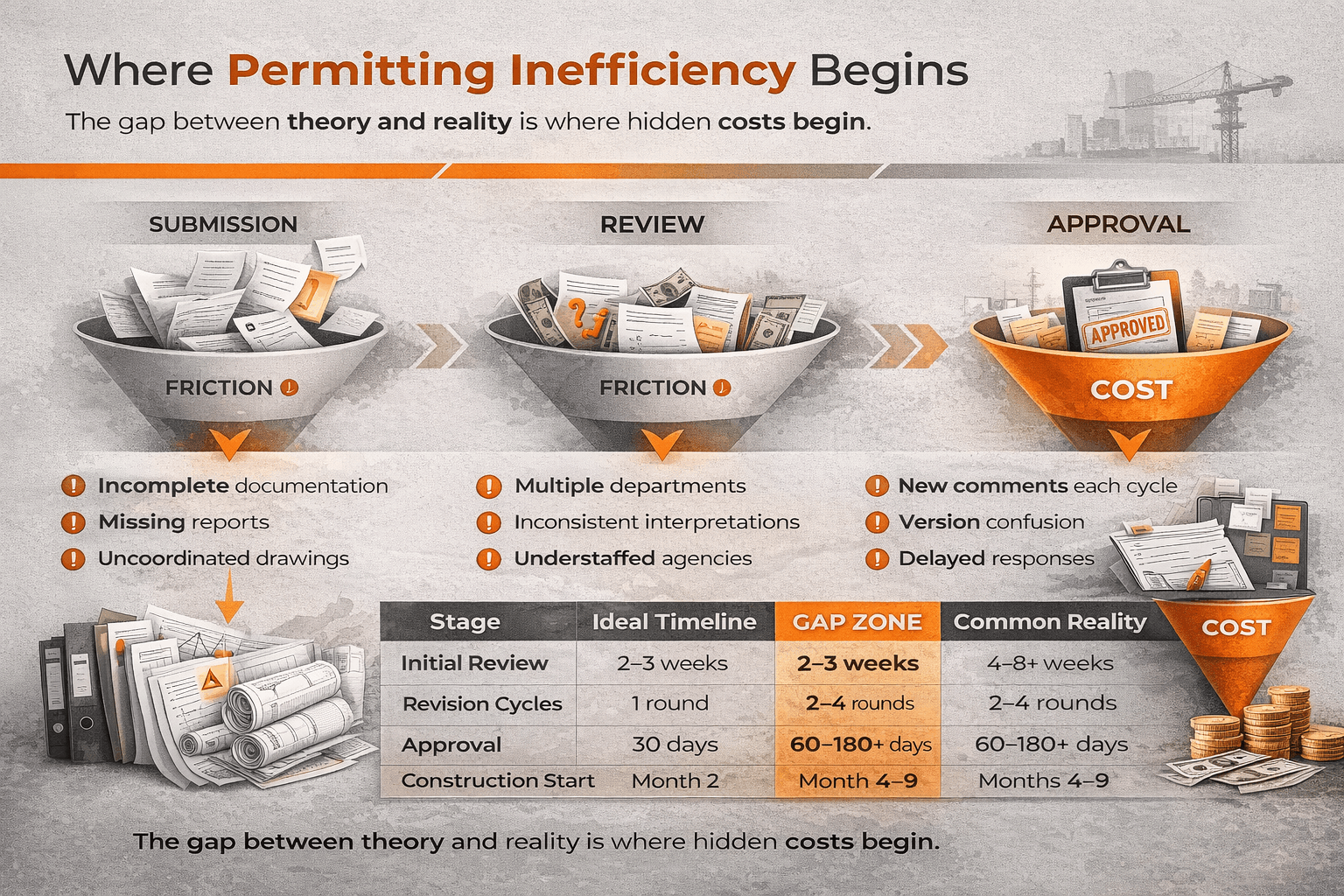
Horizontal infographic titled “Where Permitting Inefficiencies Cost You the Most” highlighting cost categories like labor idle time, extended financing, compliance corrections, and inspection delays.
Inefficient permitting doesn’t just slow projects—it compounds costs across labor, financing, compliance, and inspections, shrinking margins before construction even begins.

What Does “Inefficient Permitting” Look Like?

Inefficient permitting can appear in several ways. First, there may be a lack of transparency. Applicants submit plans but receive little visibility into status updates. Second, communication can be unclear. Comments may be vague or inconsistent across departments. Third, outdated systems slow everything down. Some jurisdictions still rely on:

  • Paper submissions

  • Manual routing between departments

  • Email-based approvals

  • Physical stamps and signatures

These methods increase the chance of error. They also increase review time.

Another common issue is repeated revision cycles. A project may receive comments, respond to them, and then receive new comments that could have been addressed earlier.

This back-and-forth adds weeks or even months.

Why Inefficiency Happens

Permitting delays are rarely caused by one factor. Instead, they stem from a mix of structural and operational issues.

Here are common causes:

  • Complex and changing building codes

  • Different interpretations between reviewers

  • Understaffed permitting offices

  • Rapid population growth in high-demand cities

  • Poor coordination between architects and consultants

  • Incomplete or inaccurate plan submissions

Fast-growing areas often struggle the most. Development increases, but staffing levels do not always keep pace. This creates backlogs.

In addition, many project teams underestimate permitting complexity. They treat it as a final step instead of an early priority. That mistake is costly.

Early Warning Signs of a Problem

It helps to recognize red flags early.

Watch for these signals:

  • Multiple correction letters with new comments each round

  • Long response times with no updates

  • Requests for documents already submitted

  • Conflicting feedback from departments

  • Unclear next steps

If these signs appear, delays are likely growing behind the scenes.

Unseen Consequences — The Hidden Financial Costs

Now we move to the most important question. What does inefficient permitting actually cost? The answer is more than most project owners expect.

Direct Monetary Impacts

Some costs are obvious. When permits are delayed, labor schedules shift. Crews may be reassigned. Equipment may sit unused.

These direct costs include:

  • Extended equipment rentals

  • Idle labor expenses

  • Additional consultant fees

  • Resubmission and redesign costs

  • Extended project management time

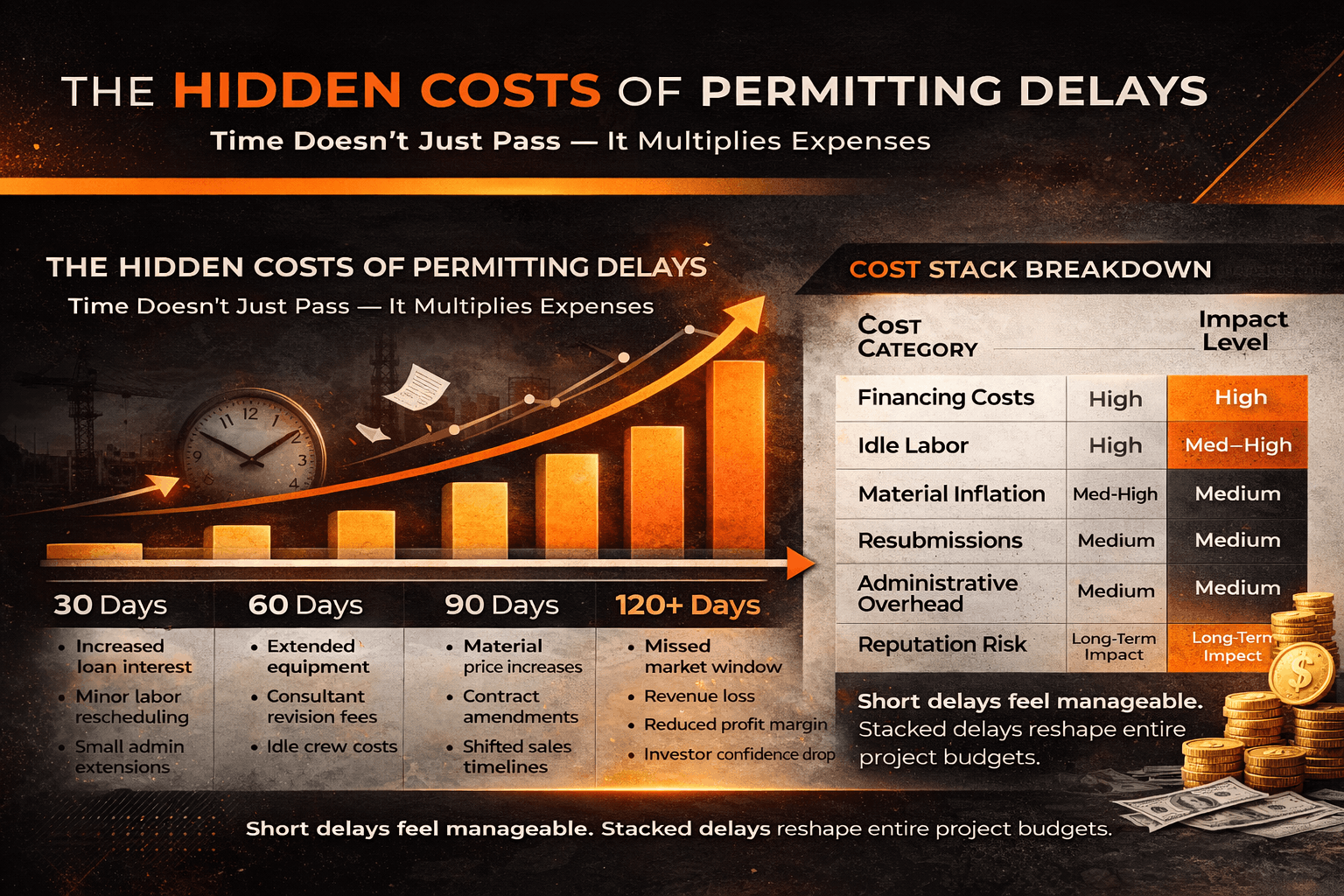
Financing costs also increase. Construction loans accrue interest daily. The longer the delay, the higher the carrying cost. Even a 60-day delay can significantly affect total project cost.

Indirect and Long-Term Financial Impacts

Other costs are less visible but equally serious.

For example:

  • Delayed sales or leasing revenue

  • Missed market timing

  • Increased material prices due to inflation

  • Reduced investor confidence

  • Strained contractor relationships

If a project misses peak selling season, revenue projections shift. If material costs rise during delays, budgets stretch. Over time, these indirect costs may exceed direct permitting expenses.

Below is a breakdown of common hidden costs and how they accumulate.

Hidden Cost Category Example Impact Long-Term Effect
Financing Costs Loan interest during delay Reduced profit margin
Labor Rescheduling Crew downtime Higher labor rates
Material Inflation Price increases during wait Budget overruns
Lost Revenue Delayed occupancy Cash flow strain
Reputation Impact Client frustration Fewer referrals

Each category compounds the others. A short delay may seem manageable. But several short delays together create major financial pressure.

The Compounding Effect of Time

Time multiplies cost.

For example:

  • A 30-day delay increases loan interest.

  • A 60-day delay may trigger contract extensions.

  • A 90-day delay could push the project into a new pricing cycle.

At that point, what started as a permitting issue becomes a full project risk. This is why efficient permitting is not just a regulatory step. It is a financial strategy.
Beyond Dollars — Non-Financial Costs of Inefficient Permitting

Money is measurable. Delays show up in budgets. However, not all damage appears on a spreadsheet.

Inefficient permitting also affects reputation, morale, planning confidence, and long-term growth. These impacts may not appear immediately. Still, they shape how clients and partners view your business.

Let’s look at what happens beyond the financial side.

Horizontal infographic titled “The Hidden Costs of Permitting Delays” showing financial losses from slow approvals including holding costs, labor downtime, redesign fees, and revenue delays.
Even small permitting delays can silently drain thousands in carrying costs, redesign fees, and lost revenue—turning minor inefficiencies into major financial setbacks.

Client Frustration and Damage to Reputation

Clients care about timelines. When a project is delayed due to permitting issues, most clients do not blame the city. They blame the project team.

Even if the delay was outside your control, communication gaps can weaken trust.

Here is what often happens:

  • Expected completion dates shift

  • Sales or leasing targets move

  • Investors question projections

  • Buyers grow impatient

Over time, this affects referrals. In construction and development, reputation spreads quickly. One delayed project can affect future opportunities. Clear expectations help. However, repeated delays create doubt.

Operational Bottlenecks and Internal Stress

Permitting delays also strain internal teams. Project managers must adjust schedules. Contractors reschedule crews. Consultants update drawings again and again. This creates friction. Team members may feel:

  • Frustrated by unclear comments

  • Pressured to respond quickly

  • Stressed by timeline uncertainty

When schedules shift repeatedly, productivity drops. Work becomes reactive instead of planned. That slows momentum across multiple projects.

Compliance Risks and Legal Exposure

Some teams try to move forward while waiting for final approvals. This is risky.

Starting work without proper permits can result in:

  • Stop-work orders

  • Fines

  • Required demolition

  • Inspection failures

  • Legal disputes

Even minor non-compliance can trigger delays that exceed the original wait time. It is better to build the right system than to rush and correct mistakes later.

Market Timing and Competitive Disadvantage

In fast-growing cities, timing matters. If one developer secures approvals quickly while another waits months, the first project reaches the market sooner.

That means:

  • Earlier sales

  • Stronger pricing

  • First-mover advantage

Meanwhile, delayed projects may face higher competition and tighter margins. Over time, slow permitting can weaken a company’s competitive position.

Typical Causes of Delay — A Closer Look

Now that we understand the impact, let’s examine the root causes. Permitting delays rarely happen by accident. Most delays come from predictable patterns. When you understand those patterns, you can plan better.

Manual Workflows and Paper-Based Systems

Many jurisdictions still rely on manual review processes.

That often includes:

  • PDF uploads without tracking

  • Email comment exchanges

  • Paper routing between departments

  • Physical signatures

Manual systems create several issues:

  • Documents get misplaced

  • Version control becomes confusing

  • Review timelines are unclear

  • Follow-ups depend on individual staff

Even digital systems can be inefficient if they lack coordination between departments. When one reviewer finishes but another has not started, applications sit idle.

Incomplete or Inaccurate Submissions

One of the most common causes of delay is incomplete documentation.

Missing details may include:

  • Structural calculations

  • Energy compliance reports

  • Site surveys

  • Updated zoning information

  • Engineering stamps

Each missing document restarts the review clock. Many teams underestimate how detailed submissions must be. A small oversight can cost weeks.

Below is a comparison of strong submissions versus risky submissions.

Submission Type Characteristics Likely Outcome
Complete and Coordinated All drawings aligned, required reports attached, clear labeling Faster review, fewer correction cycles
Partially Complete Missing reports, inconsistent sheets, unclear notes Multiple correction letters
Rushed Submission Minimal detail, assumptions made Major delays, redesign required

Preparation reduces review rounds. And fewer review rounds mean lower cost.

Poor Coordination Between Stakeholders

Permitting involves many parties.

These often include:

  • Architects

  • Engineers

  • Owners

  • Contractors

  • Expeditors

  • City reviewers

If communication is not structured, confusion grows.

For example:

  • An architect revises drawings without informing engineers

  • A contractor assumes approval is granted

  • An owner changes scope mid-review

Each change creates new review requirements. Strong coordination prevents these surprises.

Understaffed or Overloaded Agencies

Fast-growing areas experience higher application volume. However, staffing levels often lag behind demand.

This leads to:

  • Longer review queues

  • Slower responses

  • Limited reviewer availability

  • Backlogged inspections

While you cannot control staffing levels, you can control how organized your submission is. Clear, complete, and well-prepared applications often move more smoothly.

Strategic Solutions — Turning Permitting Into a Strength

Permitting does not have to be a constant risk. With the right approach, it can become a predictable and manageable phase of your project. Here are practical strategies that reduce delay.

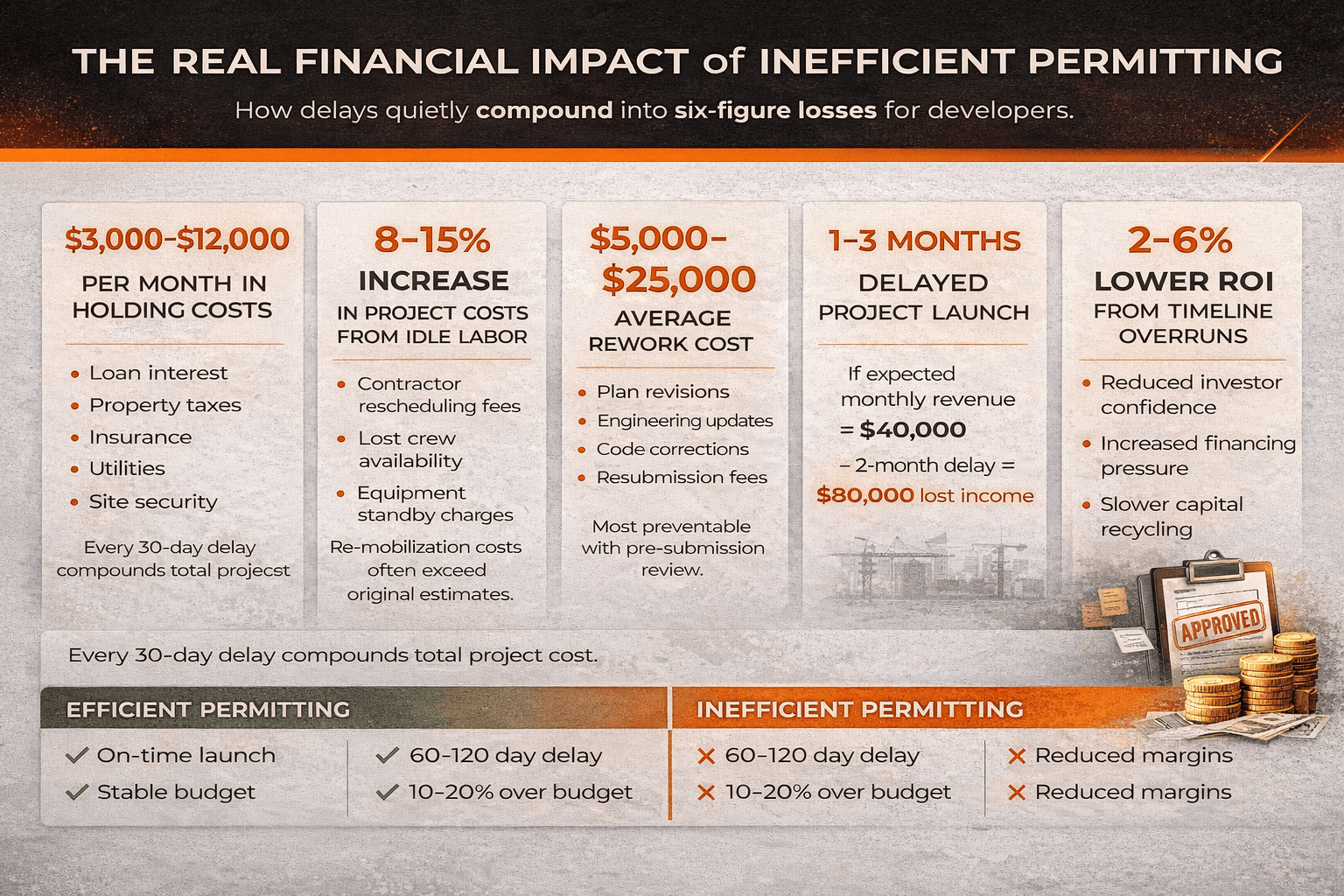
Horizontal infographic showing financial consequences of permitting delays, including holding costs, idle labor, rework expenses, delayed launches, reduced ROI, and a comparison of efficient versus inefficient permitting outcomes.
Permitting delays quietly escalate costs, idle labor, rework, and lost revenue, while efficient permitting protects budgets, timelines, and ROI—turning administrative steps into strategic advantages.

Start Permitting Early in the Design Phase

Too often, permitting is treated as the final step before construction. Instead, it should begin during early design.

This means:

  • Reviewing zoning requirements before final layouts

  • Confirming setback rules early

  • Identifying special approvals in advance

  • Creating a permitting timeline alongside the construction schedule

Early research prevents last-minute redesign.

Build a Structured Internal Checklist

A strong internal checklist reduces errors.

Your checklist should include:

  • Required permit types

  • Supporting documents

  • Consultant responsibilities

  • Submission deadlines

  • Review response timelines

When everyone understands their role, delays shrink.

Improve Communication and Documentation

Clear communication prevents confusion.

Best practices include:

  • Centralized document storage

  • Version tracking

  • Regular internal coordination meetings

  • Clear documentation of reviewer comments

Responding to correction letters in an organized way speeds approval.

Consider Professional Permitting Support

For complex projects, experienced permitting consultants can add value.

They understand:

  • Local building departments

  • Review expectations

  • Common correction patterns

  • Documentation standards

Their involvement can reduce revision cycles and shorten timelines.

Use Technology Where Available

Many cities now offer online tracking systems. Use them actively. Monitor status updates. Follow up when necessary. Keep records of communication. Transparency reduces uncertainty.

Moving Forward

Permitting is not just paperwork. It is a key driver of project success. Inefficient permitting increases cost, strains teams, and weakens market position. However, with early planning, strong coordination, and organized submissions, delays become manageable.

Success Stories — When Permitting Is Managed the Right Way

Permitting does not always cause delays. In fact, when handled properly, it can become one of the most predictable phases of a project. The difference usually comes down to preparation and coordination.

Let’s look at what successful projects do differently.

Case Example: Proactive Planning Reduced Delays

Consider a mid-sized commercial renovation project in a high-growth area. Instead of waiting until design completion, the team began permit research during early concept planning.

They:

  • Reviewed zoning regulations before finalizing layouts

  • Confirmed required inspections early

  • Held coordination meetings between architect and engineer

  • Created a clear submission checklist

As a result, the first submission included all required documents. The city issued only minor comments. Approval came within the initial review window. Construction began on schedule. The key takeaway is simple. Early preparation reduces revision cycles.

What High-Performing Teams Do Consistently

Projects that move smoothly often follow similar patterns.

They:

  • Treat permitting as a core phase, not an afterthought

  • Assign clear responsibility to one lead coordinator

  • Maintain consistent communication with reviewers

  • Submit organized and complete plan sets

  • Track deadlines carefully

They also build realistic timelines. Instead of assuming best-case approval, they plan for standard review durations. This reduces surprise and protects client expectations.

Below is a comparison of reactive versus proactive permitting management.

Approach Characteristics Likely Outcome
Reactive Submit late, fix issues after comments, unclear ownership Multiple delays, budget strain
Proactive Early research, coordinated documents, assigned permit lead Faster approvals, stable timeline
Strategic Built-in buffer time, regular city follow-ups, detailed tracking Predictable scheduling, stronger client trust

Small improvements create large gains.

Practical Checklist — Reduce Permitting Risk on Your Next Project

Now let’s make this actionable. Below is a simplified checklist you can apply before your next submission.

Before Design Completion

  • Confirm zoning compliance

  • Identify all required permit types

  • Review city submittal guidelines

  • Check for special approvals or variances

Before Submission

  • Ensure all drawings are aligned

  • Verify consultant stamps and signatures

  • Attach required reports and calculations

  • Label documents clearly

  • Double-check version numbers

During Review

  • Track review deadlines

  • Respond to comments in an organized format

  • Address every comment directly

  • Avoid partial responses

  • Follow up professionally if timelines extend

Before Construction Starts

  • Confirm final approval documentation

  • Verify inspection schedule requirements

  • Share approved drawings with the full project team

Consistency matters.

When teams use a repeatable system, outcomes improve over time.

Frequently Asked Questions About Permitting Delays

Clear answers help project owners set realistic expectations.

How long does permit approval usually take?

Timelines vary by city and project type. Small residential permits may take a few weeks. Larger commercial projects can take several months, especially if multiple departments review the plans. The key factor is submission quality.

Can hiring a permit expeditor reduce delays?

In many cases, yes. An experienced expeditor understands local processes and common review concerns. They can help prevent avoidable correction cycles.

However, even the best consultant cannot fix incomplete design documents. Preparation still matters most.

What is the biggest cause of permitting delays?

Incomplete or inconsistent submissions. Many delays occur because required documents are missing or drawings conflict with each other. Coordination between consultants reduces this risk.

Is digital permitting always faster?

Not always. Online systems improve tracking and communication. However, efficiency still depends on reviewer workload and submission quality.

Technology helps, but preparation remains critical.

Final Thoughts — Why Efficient Permitting Protects Your Bottom Line

Permitting may not be the most visible phase of a project. Yet it shapes everything that follows.

When inefficient, it increases:

  • Financing costs

  • Labor expenses

  • Material inflation risk

  • Client frustration

  • Market timing pressure

When managed well, it creates:

  • Predictable schedules

  • Stable budgets

  • Stronger client relationships

  • Competitive advantage

The difference is planning.

Projects succeed when permitting is treated as a strategic process, not just a requirement. In fast-moving markets, organized permitting can separate strong developers from struggling ones.

If your team wants to reduce delays and improve project predictability, start by improving preparation, communication, and documentation. Small improvements today can prevent major costs tomorrow.

Ready to Reduce Permitting Delays and Protect Your Budget?

Permitting should not slow down your project.

When handled early and strategically, it supports smoother approvals, stronger timelines, and better cost control.

At JDJ Consulting, we help developers, contractors, and property owners manage the permitting process with clarity and structure. From early zoning research to submission coordination and review tracking, our team focuses on reducing delays before they grow into costly setbacks.

If you want your next project to move forward with fewer surprises, we’re ready to help.

Contact JDJ Consulting today to discuss your project and learn how we can support your permitting and construction management needs. 

Let’s keep your timeline on track and your investment protected.

References

  1. Civil Lead explains how permit delays create idle time, scheduling problems, and added project risk.

  2. CPS Permit Management outlines the hidden costs of permit delays, including equipment rental extensions and lost revenue.

  3. Mercury Permits discusses how complex zoning rules and changing regulations slow down approvals.

  4. EB3 Construction reviews common causes of construction delays and how they increase labor and material costs.

  5. PermitFlow highlights how inefficient permitting raises administrative costs and affects project timelines.

This will close in 0 seconds