Electric vehicles are becoming common across the United States. Many drivers now expect charging stations in places where they shop, work, or stay overnight. Because of this shift, more commercial property owners are planning EV charging installations.
However, installing EV chargers is not as simple as placing equipment in a parking lot. Most commercial projects require permits, electrical planning, inspections, and coordination with local utilities. Cities and counties enforce these rules to make sure charging stations are safe and compliant with electrical codes.
For property owners, the permitting process can feel confusing at first. Requirements vary by city. Some projects need electrical permits, while others also require zoning approval, building permits, and accessibility compliance.
The good news is that the process becomes much easier when you understand the steps ahead of time. With proper planning, most commercial EV charging permits move through approval smoothly.
In this guide, we explain how commercial property owners can get EV charging station permits. We will cover requirements, planning steps, costs, and common challenges.
Table of Contents
Why EV Charging Stations Are Becoming Essential for Commercial Properties
Electric vehicles are growing fast. More companies are adding EVs to their fleets, and many drivers now prefer electric cars for daily commuting. Because of this shift, businesses are starting to see EV charging as an important feature.
For commercial properties, EV chargers are no longer just a sustainability upgrade. They are becoming a business advantage.
When drivers look for places to shop or work, they often search for locations with charging stations. Providing charging access can increase foot traffic, tenant satisfaction, and property value.
Growth of Electric Vehicles and Charging Demand
EV adoption continues to increase every year. Government incentives, lower fuel costs, and improved vehicle technology are driving this growth.
As more drivers switch to electric cars, charging infrastructure must grow with it. Public charging networks are expanding, but workplace and commercial charging is still limited in many areas.
This creates an opportunity for businesses.
When commercial properties install charging stations, they help fill a gap in the charging network. At the same time, they attract customers who want convenient places to charge.
Common locations where EV charging demand is growing include:
Office buildings
Retail shopping centers
Hotels and resorts
Multifamily housing communities
Parking garages
Medical centers
Universities and campuses
These properties often have large parking areas and long visitor dwell times, which make them ideal for charging stations.
Benefits of Installing EV Chargers for Businesses
Installing EV chargers can provide several long-term benefits for commercial property owners.
- Customer attraction
Many EV drivers actively search for businesses that offer charging stations. When drivers stop to charge, they often spend time and money nearby.
- Higher tenant satisfaction
Office buildings and apartment communities see strong demand for EV charging from tenants and residents.
- Competitive advantage
Properties with charging stations often stand out compared to nearby buildings without them.
- Sustainability goals
Many companies now track environmental impact. EV infrastructure supports corporate sustainability initiatives.
- Future-ready infrastructure
EV adoption is expected to grow rapidly in the coming decade. Installing charging stations now prepares properties for that demand.
Here is a quick overview of how different property types use EV charging.
| Commercial Property Type | Typical Charging Use |
|---|---|
| Office buildings | Employee charging during work hours |
| Retail centers | Customer charging while shopping |
| Hotels | Overnight charging for guests |
| Multifamily housing | Resident charging |
| Parking garages | Public charging stations |
As EV adoption grows, charging infrastructure will likely become a standard feature in many commercial properties.
What Is an EV Charging Station Permit?
Before installing EV chargers, most commercial projects require permits from the local authority. These permits ensure that the installation follows electrical safety rules and building regulations.
An EV charging permit is official approval that allows a property owner to install charging equipment on the site. The permit confirms that the project meets local building codes, electrical standards, and zoning requirements.
Cities require these permits for several reasons. Charging stations draw significant electrical power, and improper installation can create safety risks. Permits help inspectors verify that the equipment, wiring, and infrastructure meet code requirements.
For most commercial projects, permits are issued by the city building department or electrical inspection office.
Why Permits Are Required for EV Charger Installations
Permits may seem like extra paperwork, but they play an important role in protecting both property owners and the public. Local governments require permits to ensure:
- Electrical safety
Charging stations connect directly to a building’s electrical system. Inspectors verify proper wiring, circuit protection, and grounding.
- Code compliance
EV chargers must follow the National Electrical Code (NEC), especially Article 625, which covers EV charging systems.
- Load management
Some properties need electrical upgrades before adding high-power chargers. Permit reviews help identify these needs early.
- Accessibility compliance
Public charging stations must meet accessibility requirements, including ADA parking standards.
- Fire safety
High-power charging equipment generates heat and requires proper spacing and installation practices. Without permits, a project may face fines, delays, or safety concerns during inspections.
Types of Permits Required for Commercial EV Chargers
Depending on the project size and location, commercial EV charging installations may require multiple permits.
The most common permits include:
| Permit Type | Purpose |
|---|---|
| Electrical permit | Approval for wiring, circuits, and charger installation |
| Building permit | Required if structural work or trenching is involved |
| Zoning permit | Confirms chargers are allowed in the property’s zoning district |
| Utility approval | Ensures the power grid can support the added load |
| Inspection approval | Final verification after installation |
Small projects with only a few Level 2 chargers may require only an electrical permit. However, larger installations often involve several approvals.
Understanding these requirements early can prevent delays during construction.
Understanding Commercial EV Charger Types Before Applying for Permits
Before submitting permit applications, property owners must choose the type of charging equipment they plan to install. Different chargers have different power requirements. These differences can affect electrical infrastructure, installation cost, and permit complexity. Most commercial properties choose between three main charging levels.
Level 1 Chargers
Level 1 chargers use a standard 120-volt outlet. They are the slowest type of charging equipment. Charging times are long. A full charge may take more than 20 hours for many vehicles.
Because of this, Level 1 chargers are rarely used for commercial projects. They are more common in residential settings.
Level 2 Chargers
Level 2 chargers are the most common option for commercial properties. They use a 240-volt electrical connection and charge vehicles much faster than Level 1 equipment. Typical charging time ranges from four to eight hours depending on the vehicle.
Level 2 chargers work well in locations where drivers stay for longer periods, such as:
Offices
Hotels
Apartment communities
Shopping centers
Public parking garages
Because of their moderate power requirements, Level 2 chargers usually require fewer electrical upgrades than fast chargers.
DC Fast Chargers
DC fast chargers provide very rapid charging. Some systems can charge a vehicle to 80 percent in about 20–40 minutes. These chargers require high electrical capacity and often need major infrastructure upgrades.
They are typically installed in locations with high traffic and short parking times, such as:
highway rest stops
large retail centers
commercial charging hubs
However, fast chargers are more expensive to install and may require additional permits and utility coordination.
Here is a comparison of the three charger types.
| Charger Type | Voltage | Typical Charging Speed | Common Locations |
|---|---|---|---|
| Level 1 | 120V | 20+ hours | Residential |
| Level 2 | 240V | 4–8 hours | Offices, hotels, retail |
| DC Fast Charger | 400V+ | 20–40 minutes | High-traffic commercial areas |
Choosing the right charger type early in the planning process helps avoid permitting delays. Electrical load calculations, equipment specifications, and site plans must all match the selected charger type.
Key Requirements Before Applying for an EV Charging Permit
Before submitting a permit application, commercial property owners should complete several planning steps. These steps help ensure the installation meets electrical, safety, and accessibility standards.
Cities often reject permit applications that lack proper documentation or electrical planning. Because of this, preparing the right information early can save time and avoid delays.
Most commercial EV charging projects must review electrical capacity, parking layout, accessibility rules, and local code requirements. When these factors are addressed first, the permit approval process becomes much smoother.
Electrical Capacity Assessment
The first step is understanding the electrical capacity of the property. EV chargers draw a large amount of power, especially when several units operate at the same time. An electrical capacity assessment helps determine whether the existing system can support the chargers or if upgrades are required.
Electrical engineers or licensed electricians usually review several components:
Main electrical panel capacity
Available circuit space
Transformer capacity
Current building electrical load
Distance from power supply to charging area
For example, if a building already operates near its electrical limit, installing several chargers could overload the system. In that case, the property may need panel upgrades or additional transformers.
Below is a simplified example of how charger quantity affects electrical demand.
| Number of Chargers | Typical Charger Type | Estimated Power Demand |
|---|---|---|
| 2 chargers | Level 2 | 14–20 kW |
| 6 chargers | Level 2 | 40–60 kW |
| 10 chargers | Level 2 | 70–100 kW |
| 2 DC Fast Chargers | Fast charging | 100–350 kW |
This is why an electrical review is one of the most important steps before applying for permits. In some cases, smart charging software can help manage power demand by distributing electricity between chargers.
Compliance With Electrical Codes
All EV charging installations must follow national and local electrical codes. In the United States, the main standard is the National Electrical Code (NEC). Article 625 of the NEC specifically covers electric vehicle charging systems.
These rules address several safety requirements, including:
Proper grounding of charging equipment
Overcurrent protection
Disconnect switches
Cable management systems
Circuit sizing
Permit reviewers check electrical plans carefully to confirm these standards are followed. If code requirements are not met, the permit application may be rejected or delayed. Because of this, many commercial projects work with electrical engineers or consultants during the planning stage.
ADA Accessibility Requirements
Commercial EV charging stations must also meet accessibility rules under the Americans with Disabilities Act (ADA). When charging stations are open to the public, a certain number of spaces must be accessible to drivers with disabilities.
ADA compliance often includes:
Accessible parking spaces with proper width
Clear pathways to charging equipment
Appropriate charger height
Accessible payment systems
For example, accessible charging spaces usually require extra width for wheelchair access.
Here is a simplified comparison.
| Parking Type | Typical Width Requirement |
|---|---|
| Standard parking space | 8–9 feet |
| ADA accessible space | 11–12 feet with access aisle |
Local building departments review these details during the permit approval process. Planning accessible spaces early helps prevent design changes later in the project.
Parking Layout and Infrastructure Planning
Another key requirement involves the physical layout of the charging stations. Property owners must decide where chargers will be installed and how they will connect to the electrical system.
Several factors influence the layout:
Distance from electrical panels
Parking lot traffic flow
The cable reaches from the charger to the vehicle
Protection from vehicle impact
Lighting and visibility
Site plans typically show the location of each charger, conduit routes, and parking space markings. In many projects, underground conduit must be installed to carry electrical wiring from the building to the charging stations.
Trenching and conduit installation are often reviewed as part of the building permit process. Proper planning can also help reduce installation costs. For example, chargers placed closer to electrical panels usually require less trenching and wiring.
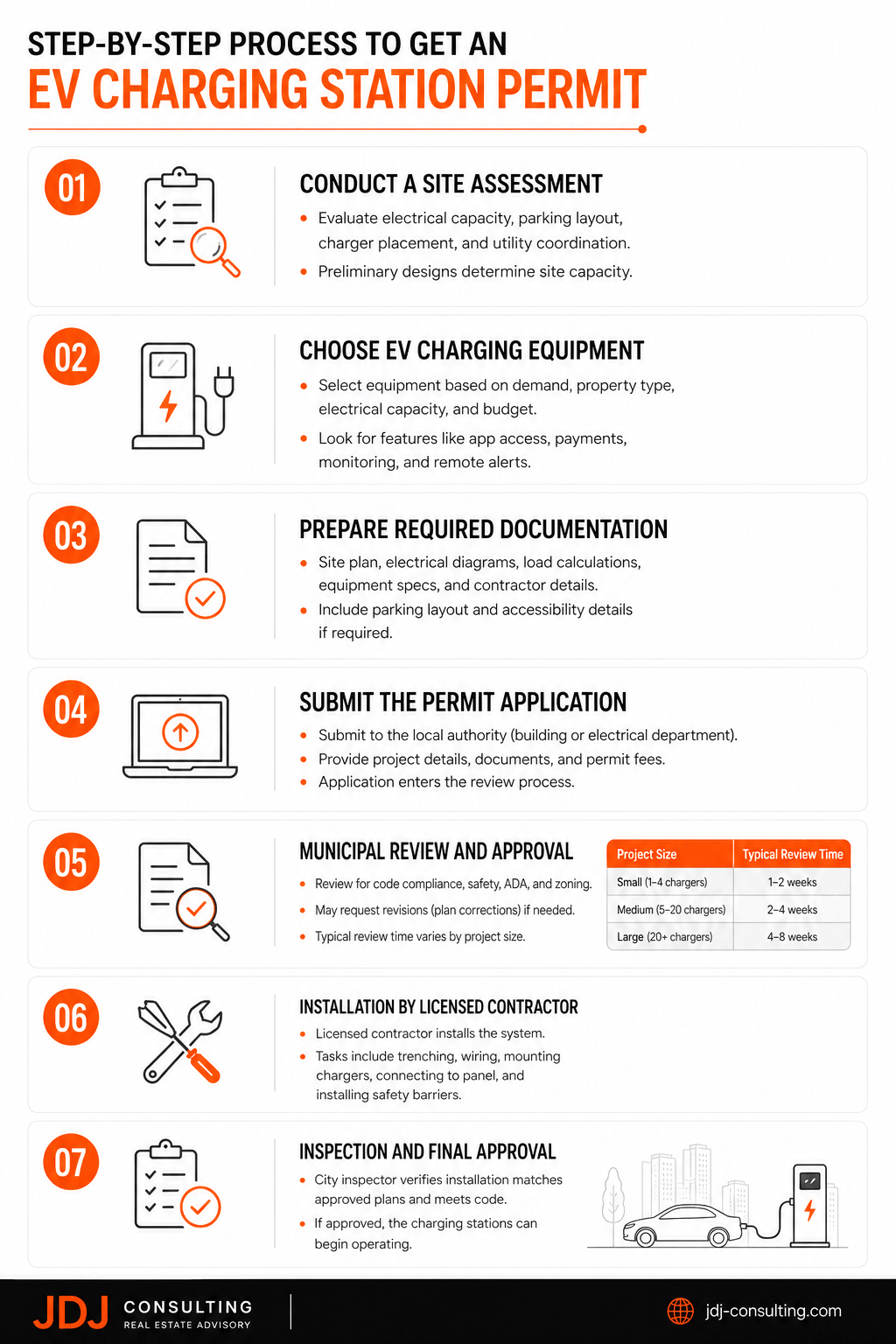
Step-by-Step Process to Get an EV Charging Station Permit
Once planning is complete, property owners can begin the permit process. Although the exact requirements vary by city, most commercial EV charging projects follow a similar approval process. Understanding each step ahead of time can help avoid delays and unexpected costs.
Step 1: Conduct a Site Assessment
A site assessment evaluates whether the property is suitable for EV charging installation.
This assessment typically includes:
Electrical capacity evaluation
Parking lot layout review
Charger placement planning
Distance to electrical supply
Utility coordination
Engineers or consultants often prepare preliminary designs during this stage. These early plans help determine how many chargers the site can support.
Step 2: Choose EV Charging Equipment
After the site assessment, the next step is selecting the charging equipment.
The choice depends on several factors:
expected user demand
property type
available electrical capacity
installation budget
Commercial properties often install networked chargers that allow owners to monitor usage, control pricing, and track energy consumption.
Common charger features include:
mobile app access
payment systems
energy monitoring
remote maintenance alerts
Choosing equipment early helps ensure permit drawings match the actual hardware specifications.
Step 3: Prepare Required Documentation
Permit applications require several technical documents. These documents allow city officials to review the project for safety and code compliance.
Typical documents include:
Site plan showing charger locations
Electrical diagrams
Load calculations
Equipment specifications
Contractor license details
In some cities, the application must also include parking layout drawings and accessibility details. Providing complete documentation at the beginning can significantly reduce review time.
Step 4: Submit the Permit Application
Once the documents are ready, the permit application is submitted to the local authority. This usually involves the city building department or electrical inspection office. Many cities now allow digital permit submissions through online portals.
During submission, applicants may need to provide:
project address
contractor information
equipment specifications
electrical load calculations
permit fees
After submission, the application enters the review process.
Step 5: Municipal Review and Approval
City engineers and inspectors review the permit application to verify compliance with building and electrical codes.
They typically evaluate:
electrical load calculations
site layout and safety measures
ADA accessibility requirements
compliance with local zoning rules
If the application meets all requirements, the permit is approved. However, if issues are found, the city may request revisions. This is known as a plan correction. Responding quickly to these corrections helps keep the project moving forward.
Here is a general overview of review timelines.
| Project Size | Typical Permit Review Time |
|---|---|
| Small installations (1–4 chargers) | 1–2 weeks |
| Medium projects (5–20 chargers) | 2–4 weeks |
| Large commercial projects | 4–8 weeks |
These timelines can vary depending on the city and project complexity.
Step 6: Installation by Licensed Contractor
After the permit is approved, installation can begin. Most cities require EV chargers to be installed by a licensed electrical contractor.
During installation, the contractor completes tasks such as:
trenching and conduit installation
electrical wiring and circuit installation
mounting charging equipment
connecting chargers to the electrical panel
installing safety barriers or bollards
Proper installation ensures the system operates safely and meets code requirements.
Step 7: Inspection and Final Approval
The final step is the inspection process. City inspectors visit the property to confirm the installation matches the approved permit plans.
They review several items:
wiring and circuit protection
equipment grounding
charger placement and mounting
ADA accessibility compliance
If everything meets code requirements, the inspector signs off on the project. At that point, the charging stations can begin operating.
Utility Coordination and Grid Requirements
Many commercial EV charging projects require coordination with the local electric utility. This step is especially important when installing multiple chargers or high-power fast chargers.
Utility companies must confirm that the electrical grid can support the additional power demand. Without proper coordination, projects may face delays or require expensive infrastructure upgrades.
Working With Local Utility Providers
During the planning phase, property owners or consultants typically contact the local utility provider.
The utility reviews several factors:
current transformer capacity
available electrical service at the property
expected charging load
future demand projections
If the existing infrastructure can support the chargers, the project may proceed without major upgrades. However, if the electrical demand is too high, the utility may recommend system improvements.
These improvements might include:
installing larger transformers
upgrading electrical service lines
increasing panel capacity
Early communication with the utility can prevent unexpected costs later in the project.
Electrical Infrastructure Upgrades
Some commercial properties require electrical upgrades before installing EV chargers. These upgrades depend on the size of the charging system.
Common infrastructure upgrades include:
electrical panel expansion
transformer replacement
additional service connections
underground conduit installation
While these upgrades add cost to the project, they also increase the property’s long-term electrical capacity. This can support future expansion as EV demand continues to grow.
Load Management Systems
In some cases, installing additional electrical infrastructure may not be necessary. Instead, property owners can use load management systems to control power usage.
Load management software distributes electricity between chargers so that the building’s electrical capacity is not exceeded. For example, if several vehicles are charging at the same time, the system may reduce power temporarily to maintain safe electrical levels.
Benefits of load management include:
lower installation costs
fewer electrical upgrades
better energy efficiency
easier expansion later
Because of these advantages, many modern commercial charging networks include built-in load management technology.
Zoning and Local Government Regulations for EV Charging Stations
Before installing EV charging stations, commercial property owners must review local zoning rules. Zoning laws determine how land can be used and what types of infrastructure are allowed on a property.
In many cities, EV chargers are considered an accessory use within commercial parking areas. This means they are usually allowed in office buildings, retail centers, hotels, and multifamily properties. However, the exact requirements vary depending on the city and state.
Because of this variation, it is important to review zoning rules early in the planning process.
Local governments may regulate several aspects of EV charging installations. These rules can affect the number of chargers allowed, where they can be placed, and how they must be labeled.
Local Zoning Rules for EV Charging Stations
Zoning regulations often address how EV charging infrastructure fits into existing parking areas. In most commercial zones, EV chargers are permitted as long as they do not reduce the minimum number of required parking spaces.
Cities may also regulate:
Charger placement within parking lots
Traffic flow around charging spaces
Equipment visibility from public streets
Signage requirements
Lighting and safety features
Some municipalities also require charging equipment to be placed near building entrances or accessible parking areas. If the project includes new parking construction, additional zoning approvals may be required. Property owners should always confirm zoning rules with the local planning department before submitting permit applications.
Parking Space Requirements
Many cities have started including EV charging requirements in their building codes. These rules ensure that new developments prepare for future EV demand. Some areas require a percentage of parking spaces to be EV-ready or EV-capable. EV-ready spaces include conduit and electrical capacity for future chargers, even if chargers are not installed immediately.
Below is a simplified example of how some jurisdictions structure EV parking requirements.
| Total Parking Spaces | EV-Ready Spaces Required |
|---|---|
| 10–25 spaces | 2–4 EV-ready spaces |
| 26–50 spaces | 4–8 EV-ready spaces |
| 51–100 spaces | 10–20 EV-ready spaces |
| 100+ spaces | 20% or more EV-ready |
These requirements often apply to:
new commercial construction
major parking lot renovations
large redevelopment projects
Existing buildings may not be required to install chargers immediately, but many cities encourage voluntary installation through incentives.
Local Ordinances Supporting EV Infrastructure
Many governments are encouraging EV charging development through streamlined permitting rules. These policies are designed to make EV infrastructure easier and faster to install.
Examples of common EV-friendly policies include:
expedited permit reviews for EV charger projects
reduced permit fees
simplified application forms
standardized inspection procedures
Some cities have adopted EV-ready building codes, which require electrical infrastructure for future charging stations. This approach helps reduce installation costs later because conduit and wiring pathways are already in place. For property owners planning long-term investments, installing EV-ready infrastructure during renovations can be a smart strategy.
It prepares the property for future charging demand without requiring a full installation today.
Costs Associated With EV Charging Permits and Installation
The cost of installing EV charging stations varies widely depending on the size of the project, the type of chargers used, and the electrical infrastructure required.
While some small projects can be completed for a few thousand dollars, larger commercial installations may require significant electrical upgrades.
Understanding these costs early helps property owners budget properly and avoid surprises during construction.
Permit Fees
Permit costs vary by city, but most commercial EV charging projects require at least one electrical permit. Some projects may also require building permits or zoning approvals.
Permit fees typically cover:
plan review by city engineers
electrical inspections
administrative processing
Below is a general example of typical permit costs.
| Permit Type | Typical Cost Range |
|---|---|
| Electrical permit | $100 – $1,000 |
| Building permit | $200 – $2,000 |
| Planning or zoning review | $100 – $500 |
| Inspection fees | $50 – $300 |
Larger projects with multiple chargers may have higher permit costs because of additional plan reviews. However, permit costs are usually a small portion of the total installation budget.
Installation Costs
Installation costs depend heavily on the charger type and the complexity of the site. Level 2 chargers are usually the most affordable option for commercial properties. DC fast chargers are significantly more expensive due to their high power requirements.
Here is a simplified comparison of installation costs.
| Charger Type | Typical Installation Cost per Charger |
|---|---|
| Level 2 Charger | $3,000 – $10,000 |
| DC Fast Charger | $30,000 – $100,000+ |
Several factors influence installation costs.
These include:
distance from electrical panels
trenching requirements
electrical capacity upgrades
parking lot modifications
charger hardware cost
Projects that require long underground conduit runs or electrical service upgrades tend to cost more. Planning charger placement close to existing electrical infrastructure can reduce installation expenses.
Infrastructure Upgrade Costs
Some properties require electrical upgrades before chargers can be installed. These upgrades can significantly affect the total project cost.
Common upgrades include:
electrical panel replacement
transformer installation
new utility service connections
additional electrical meters
For example, installing DC fast chargers often requires major electrical infrastructure improvements. These upgrades may involve coordination with the local utility provider. While these costs may seem high, they can increase the long-term value of the property and support future expansion.
Many property owners install additional conduit or electrical capacity during the first project so that new chargers can be added later at lower cost.
Incentives and Funding for Commercial EV Charging Stations
To encourage EV infrastructure growth, many government agencies and utility companies offer financial incentives. These incentives can significantly reduce the cost of installing commercial charging stations.
Some programs cover equipment costs, while others provide tax credits or rebates for infrastructure upgrades. Because incentive programs change frequently, property owners should research available options before starting installation.
Federal Incentives
One of the most important incentives in the United States is the Alternative Fuel Infrastructure Tax Credit. This federal program allows businesses to claim a tax credit for a portion of EV charging installation costs.
The credit can apply to:
charging equipment
installation labor
electrical infrastructure
In many cases, businesses may claim up to 30% of installation costs, depending on eligibility requirements. Federal programs may also prioritize projects in rural areas or communities with limited charging access.
State and Utility Rebates
Many states offer additional rebates for EV charging infrastructure. Utility companies may also provide financial incentives because EV charging increases electricity demand.
Common incentive types include:
equipment rebates
installation grants
reduced electricity rates for EV charging
infrastructure upgrade support
These programs often require pre-approval before installation begins. Because of this, property owners should review eligibility requirements early in the planning stage.
How Businesses Can Apply for EV Charging Incentives
Applying for incentives usually follows a simple process. Most programs require property owners to submit project details before installation begins.
The general process includes:
Research available federal, state, and utility programs
Confirm eligibility requirements
Submit application and project documentation
Install approved charging equipment
Submit proof of installation to receive funding
Many incentive programs also require chargers to meet certain technical standards. For example, some programs require networked chargers that allow usage tracking and energy monitoring.
Working with experienced consultants can help businesses identify the best incentive opportunities and complete applications correctly.
Common Challenges in EV Charger Permitting
Even though EV charging projects are becoming more common, many commercial property owners still face challenges during the permitting process. These challenges often arise from electrical limitations, zoning restrictions, or incomplete documentation.
Understanding these issues early can help property owners avoid delays and move projects forward more smoothly.
Electrical Capacity Limitations
One of the most common challenges involves electrical capacity. EV chargers require significant power, especially when multiple vehicles charge at the same time.
Many older commercial buildings were not designed for this level of electrical demand. As a result, the existing electrical system may not support the new load.
When this happens, the property may require upgrades such as:
electrical panel expansion
transformer upgrades
new service connections
load management systems
These upgrades can increase project costs and extend the project timeline.
However, proper electrical planning during the early stages can help identify these issues before the permit application is submitted.
Zoning and Parking Restrictions
Another challenge involves local zoning rules and parking regulations. Some cities limit how parking spaces can be modified or reserved.
For example, certain properties must maintain a minimum number of standard parking spaces. Installing EV chargers may reduce the available parking count, which can create compliance issues.
Local governments may also regulate:
placement of charging equipment
signage requirements
accessibility standards
traffic flow in parking lots
Because these rules vary by city, it is important to confirm zoning compliance before designing the charging layout.
Permit Review Delays
Permit reviews sometimes take longer than expected. This can happen for several reasons.
Common causes include:
incomplete application documents
incorrect electrical load calculations
missing site plans
revisions requested by city engineers
When permit reviewers request corrections, the application must be updated and resubmitted. This process can extend approval timelines.
Working with experienced consultants or engineers can help ensure that the permit package is complete from the beginning. This reduces the chances of delays during review.
EV Fleet Charging Setup and Cost in Tampa, Florida (2026 Guide)
Best Practices for Commercial EV Charger Projects
Installing EV charging stations is a long-term investment. Because of this, careful planning can help property owners reduce costs and prepare for future expansion.
Several best practices can improve the success of commercial EV charging projects.
Plan for Future Expansion
EV adoption continues to grow each year. Properties that install only a few chargers today may need additional stations in the future. For this reason, many experts recommend preparing infrastructure for expansion during the first installation.
This may include:
installing extra conduit underground
increasing electrical panel capacity
leaving space for additional chargers
installing scalable charging networks
Planning ahead can reduce future construction costs and minimize disruptions to parking areas.
Choose Scalable Charging Systems
Modern EV charging systems often include network management software. These systems allow property owners to monitor usage, adjust pricing, and control charging speeds.
Benefits of networked charging systems include:
real-time usage monitoring
energy management
remote maintenance alerts
payment processing options
Networked chargers also make it easier to add additional stations later. This flexibility can help businesses respond to growing EV demand.
Work With Experienced Consultants
Permitting and installing EV charging infrastructure involves several technical steps. Electrical planning, code compliance, and permit documentation must all meet local requirements. Because of this complexity, many businesses work with consultants who specialize in EV charging projects.
Experienced consultants can assist with:
site feasibility studies
electrical load calculations
permit application preparation
coordination with local authorities
inspection support
Professional guidance often helps projects move through permitting more efficiently.
How JDJ Consulting Group Helps Businesses Get EV Charging Permits
Installing EV charging stations requires more than equipment installation. Businesses must also manage permits, approvals, electrical planning, and inspections. This is where professional consulting services become valuable.
JDJ Consulting Group helps commercial property owners streamline the EV charging permit process and move projects forward with confidence.
EV Charging Permit Consulting
Permit applications often require detailed documentation and compliance with local building codes. JDJ Consulting Group helps businesses prepare accurate permit submissions by assisting with:
permit application preparation
electrical compliance documentation
coordination with city departments
permit tracking and follow-up
This support helps reduce delays and keeps projects on schedule.
Commercial Electrical Planning
EV charging installations must integrate safely with existing electrical systems. JDJ Consulting Group supports electrical planning through services such as:
site feasibility studies
load analysis and capacity planning
infrastructure planning for charging stations
coordination with electrical contractors
Proper planning helps ensure the installation meets both safety requirements and operational needs.
End-to-End Project Support
From early planning to final inspection, EV charging projects involve several steps. JDJ Consulting Group provides support throughout the entire process.
Services may include:
initial site assessment
project planning and documentation
permit application management
coordination with contractors
final inspection preparation
This comprehensive approach helps commercial property owners install EV charging infrastructure efficiently while meeting all regulatory requirements.
Final Thoughts: Getting EV Charging Permits the Right Way
EV charging infrastructure is quickly becoming an important feature for commercial properties. As electric vehicle adoption grows, businesses that offer charging access can attract more customers, tenants, and visitors.
However, installing EV charging stations requires careful planning. Property owners must consider electrical capacity, zoning regulations, accessibility standards, and permit approvals. Understanding these requirements early can prevent delays and reduce project costs.
By following the proper permitting process, businesses can install charging stations safely and in compliance with local regulations. Working with experienced professionals can also simplify the process and ensure the project moves forward smoothly.
For commercial property owners planning EV charging installations, the right planning and support can make the entire process much easier.
And with EV demand continuing to grow, investing in charging infrastructure today can help properties stay competitive for years to come.
Need Help With an EV Charging Permit?
Planning to install EV charging stations at your commercial property?
JDJ Consulting Group helps businesses handle EV charging permits, electrical planning, and approvals so projects move forward smoothly.
Learn more at https://jdj-consulting.com/book-consultation/
- Phone number (818) 793-5058
- Email: sales@jdj-consulting.com
FAQs About EV Charging Station Permits
What permits are required for installing EV charging stations on commercial properties?
Most commercial EV charging projects require at least an electrical permit. Depending on the location and project size, additional permits may also be required.
Common permits include:
Electrical permit for wiring and circuit installation
Building permit if trenching or structural work is needed
Zoning approval to confirm chargers are allowed on the property
Utility coordination approval for large power upgrades
Local building departments review these permits to ensure installations meet electrical codes and safety standards.
How long does it take to get an EV charging station permit?
Permit approval timelines vary depending on the city and the complexity of the project. Small installations with only a few chargers are often approved quickly, while larger projects may require additional reviews.
Typical timelines include:
Small projects: about 1–2 weeks
Medium projects: 2–4 weeks
Large commercial installations: 4–8 weeks
Submitting complete drawings and electrical plans usually helps speed up the review process.
Do commercial EV charging stations require electrical upgrades?
Some properties can install EV chargers using their existing electrical system, but many buildings require upgrades. The need for upgrades depends on the building’s current electrical capacity and the number of chargers planned.
Possible upgrades may include:
Electrical panel expansion
Transformer upgrades
New electrical service connections
Load management systems
An electrical capacity assessment is usually completed before applying for permits.
What type of EV chargers are best for commercial properties?
Most commercial properties install Level 2 charging stations because they provide a good balance between charging speed and installation cost.
Common options include:
Level 2 chargers – ideal for offices, hotels, and retail centers
DC fast chargers – designed for high-traffic locations
Networked chargers – allow payment processing and usage tracking
The right charger depends on how long drivers typically stay at the property.
How much does it cost to install EV charging stations for a business?
Installation costs vary depending on charger type, electrical infrastructure, and site conditions. Level 2 chargers are generally the most affordable option for businesses.
Typical cost ranges include:
Level 2 chargers: about $3,000–$10,000 per unit
DC fast chargers: $30,000–$100,000 or more
Additional costs may include trenching, electrical upgrades, permit fees, and parking lot modifications.
Are there incentives for installing EV charging stations at commercial properties?
Yes, many governments and utility companies offer incentives to support EV infrastructure. These programs help businesses reduce installation costs.
Common incentives include:
Federal tax credits for EV charging equipment
State rebates for infrastructure installation
Utility company grants or rate discounts
Many programs require businesses to apply before installation begins.
Do EV charging stations need ADA-compliant parking spaces?
Yes, public EV charging stations often need to meet accessibility requirements under the Americans with Disabilities Act (ADA).
Typical ADA requirements include:
Accessible parking spaces near chargers
Adequate space for wheelchair access
Reachable charging connectors and controls
Clear paths between parking spaces and equipment
Local building departments review accessibility details during the permit process.
Can existing commercial buildings add EV charging stations?
Yes, most existing commercial properties can add EV charging stations to their parking areas. However, the project must meet local electrical and zoning requirements.
Property owners typically need to:
Conduct an electrical capacity review
Prepare site and electrical plans
Apply for the required permits
Complete inspections after installation
Older buildings may require electrical upgrades before chargers can be installed.
What documents are required when applying for an EV charging permit?
Permit applications usually require technical documents that describe the charging installation and electrical system.
Typical documents include:
Site plans showing charger locations
Electrical load calculations
Equipment specifications
Contractor license information
Parking layout drawings
Providing accurate documentation helps city reviewers approve permits faster.
Can consultants help businesses get EV charging permits faster?
Yes, experienced consultants can help businesses streamline the permitting process. They understand local regulations and can prepare the required documentation correctly.
Consultants often assist with:
Site feasibility assessments
Electrical planning and load analysis
Permit application preparation
Coordination with city departments
Working with professionals can reduce delays and make EV charging projects easier to complete.