
Getting permits in Texas is now mostly done online. Cities like Austin, Dallas, and Houston use e permitting portals to handle applications, reviews, and approvals. On paper, this makes the process faster. In reality, it often feels complicated.
Each city has its own system. Requirements change from one location to another. A small mistake—like missing documents or choosing the wrong permit type—can delay your project by weeks.
For developers and architects, this stage is critical. Permitting affects your timeline, budget, and ability to move forward. It is not just about submitting forms. It is about getting approvals without unnecessary back-and-forth.
This guide explains how Texas e permitting portals work, where delays usually happen, and how to keep your project moving. If you are planning a development in Austin or anywhere in Texas, understanding this process early can save time and cost.
Table of Contents
What Is a Texas e Permitting Portal (And Why It Matters for Your Project)
A Texas e permitting portal is an online system used by cities, counties, and state agencies to review and approve permits. Instead of visiting offices or submitting paper forms, you upload plans, pay fees, and track approvals online.
At first glance, this sounds simple. However, in real projects, it is one of the most critical parts of development. Every delay inside the portal affects your construction schedule, financing, and overall cost.
For developers and architects, the portal is not just a tool. It is where decisions happen.
A typical project depends on:
Correct permit selection
Complete document submission
Timely responses to review comments
Coordination with multiple departments
If one step goes wrong, the entire timeline shifts.
The Real Role of e Permits in Development Projects
E permitting is not a standalone process. It sits in the middle of your full development pipeline. Before submission, you deal with zoning, land use, and entitlement approvals. After submission, you go through plan reviews, corrections, and inspections.
So, the portal connects three key phases:
Pre-development planning
Technical review and approvals
Construction and inspection
This is why even small mistakes inside the system can cause major delays.
For example, if zoning does not match your plans, your application may be rejected early. If drawings are incomplete, you will receive comments and need to resubmit. Each cycle can add weeks.
Why Most Developers Struggle With Texas e Permitting Systems
Most developers expect a single, simple system. Texas does not work that way.
Instead, you deal with:
Different portals for each city
Different submission formats
Different review timelines
Because of this, even experienced teams face challenges.
Common issues include:
Uploading incorrect document types
Missing required approvals before submission
Miscommunication between departments
Delayed responses to review comments
These problems do not just slow things down. They increase costs and create uncertainty.
This is where structured support becomes valuable. When the process is handled correctly from the start, approvals move faster and with fewer revisions.

How Texas e-Permitting Actually Works (From Land Use to Final Permit)
To understand how to move faster, it helps to see the full process. E-permitting is only one part of a larger system. Each phase builds on the previous one. When developers skip steps or rush early decisions, delays show up later in the portal.
Phase 1 – Land Use & Entitlement Approvals
Every project starts with land use. Before submitting anything online, you must confirm what is allowed on the property.
This includes:
Zoning classification
Height and density limits
Parking requirements
Use restrictions
If your project does not match zoning, you may need approvals such as:
Zone changes
Variances
Plan amendments
These approvals take time. However, they prevent bigger issues later. Without this step, many applications are rejected during plan review. That means redesign, resubmission, and delays.
Phase 2 – Submitting Through e Permitting Portals
Once your plans align with zoning, you move to submission.
This step usually includes:
Creating an online account
Selecting the correct permit type
Uploading drawings and reports
Paying initial fees
Each city has its own system. For example, Austin, Houston, and Dallas all use different platforms. Because of this, submission requirements vary. One city may require specific file formats, while another may require additional forms. If anything is missing, your application may not move forward.
Phase 3 – Plan Check & Revisions
After submission, your project enters the review phase. This is where multiple departments review your plans.
Common departments include:
Planning
Building
Fire
Utilities
Each department may provide comments. These comments must be addressed clearly.
Typical issues include:
Design clarifications
Missing technical details
You then resubmit updated plans. This process may repeat several times. The number of review cycles has a direct impact on your timeline.
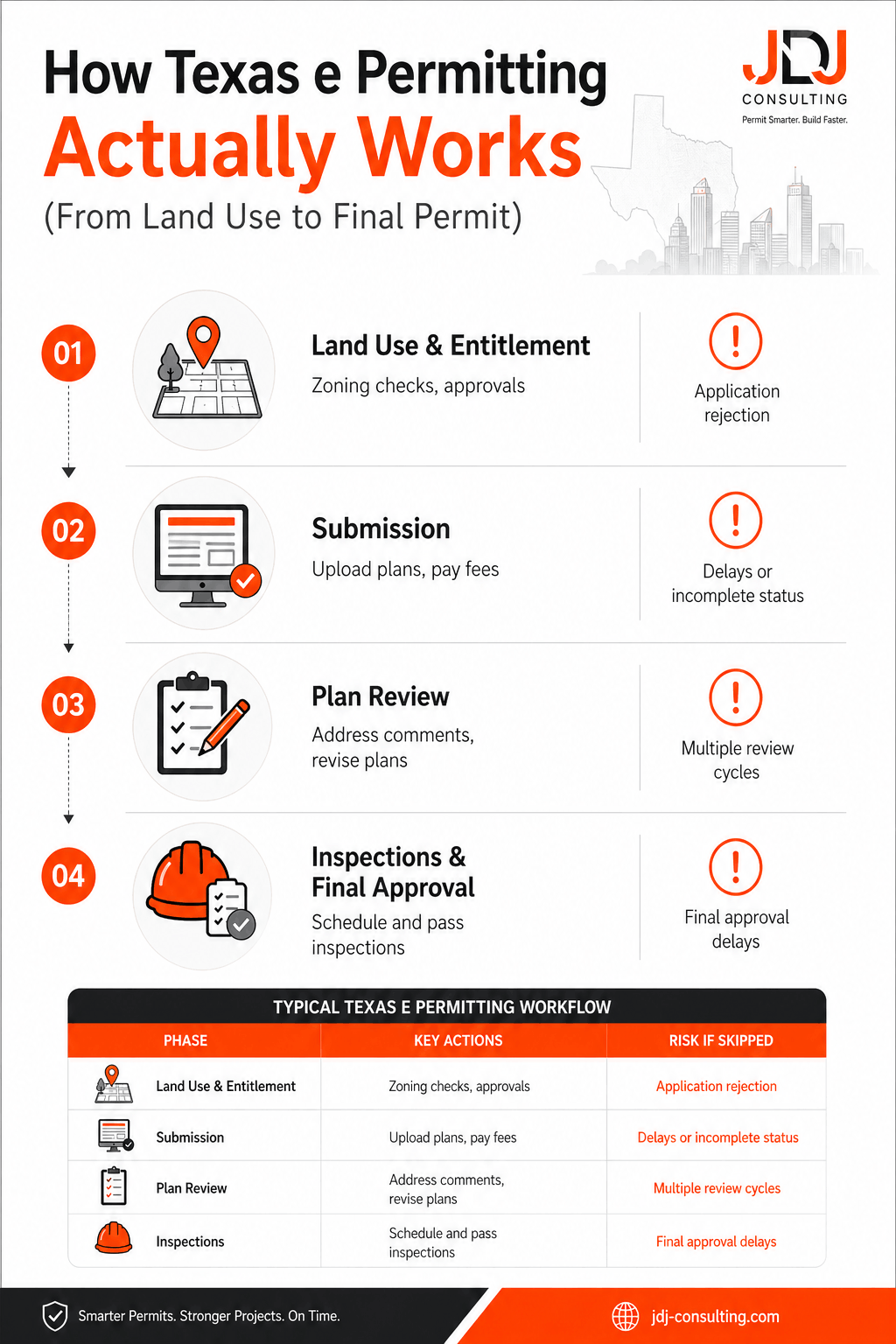
Phase 4 – Inspections & Final Approval
Once plans are approved, construction can begin. However, approvals do not end there.
You will need inspections at different stages, such as:
Foundation
Framing
Electrical and mechanical systems
Final inspection
These inspections are often scheduled through the same portal. After passing all inspections, the city issues final approval. This may include a certificate of occupancy.
Table: Typical Texas e Permitting Workflow
| Phase | Key Actions | Risk if Skipped |
|---|---|---|
| Land Use & Entitlement | Zoning checks, approvals | Application rejection |
| Submission | Upload plans, pay fees | Delays or incomplete status |
| Plan Review | Address comments, revise plans | Multiple review cycles |
| Inspections | Schedule and pass inspections | Final approval delays |
Texas e Permitting Portals Are Not One System (Here’s What That Means for You)
One of the biggest misconceptions is that Texas has a single permitting system. In reality, every city and county operates its own portal. This creates complexity, especially for developers working across multiple locations.
Each system has:
Different interfaces
Different submission steps
Different timelines
As a result, experience in one city does not always transfer to another.
Austin e Permitting Portal
Austin uses its own Development Services system. It handles building permits, site plans, and inspections.
Common challenges include:
Strict submission requirements
Detailed plan reviews
Multiple department coordination
Projects in Austin often require careful preparation before submission. Missing details can quickly lead to review comments.
Houston and Dallas Systems
Houston and Dallas also use separate systems. While the overall process is similar, the details differ.
For example:
File naming requirements may vary
Review timelines may differ
Required documents may not be the same
Because of this, teams must adjust their approach for each city.
Why This Fragmentation Causes Delays
Working across multiple portals increases the chance of mistakes.
Developers often face:
Relearning systems for each project
Misunderstanding local requirements
Submitting incomplete applications
These issues lead to:
More review cycles
Longer approval times
Increased project costs
Table: Key Differences Between Texas City Portals
| Feature | Austin | Houston | Dallas |
|---|---|---|---|
| System Type | City-specific portal | Centralized system | DallasNow platform |
| Review Complexity | High | Moderate | High |
| Document Requirements | Detailed | Moderate | Detailed |
| Timeline Predictability | Moderate | Moderate | Variable |
In practice, success with Texas e permitting comes down to preparation and coordination. When each phase is handled properly, the process becomes more predictable.
Step-by-Step: How to Use a Texas e Permitting Portal Without Delays
Using a Texas e permitting portal is not difficult on its own. The challenge comes from timing, accuracy, and coordination. Small mistakes early in the process often lead to long delays later.
A clear step-by-step approach helps reduce those risks.
Step 1 – Verify Zoning and Feasibility First
Before opening any portal, confirm what is allowed on the site. This step is often rushed. However, it is one of the most important parts of the process.
You should review:
Zoning designation
Allowed land uses
Parking and setback rules
If your project does not align with zoning, you may need approvals before submitting permits.
Skipping this step often leads to:
Immediate rejection
Major redesigns
Weeks or months of delay
A feasibility review helps you avoid these issues. It also helps you decide if the project makes financial sense before investing further.
Step 2 – Prepare Complete Application Packages
Once zoning is confirmed, the next step is preparing your documents. Incomplete submissions are one of the most common reasons for delays. Many applications are returned before review even begins.
A complete package usually includes:
Site plans
Architectural drawings
Structural and engineering plans
Energy compliance reports
Ownership or authorization documents
Each city may have additional requirements. So, it is important to follow local checklists closely. Clear and well-organized documents help reviewers move faster. On the other hand, missing or unclear details lead to comments and resubmissions.
Step 3 – Submit Through the Correct Portal
Texas does not have a single system. Each city uses its own portal.
Before submitting, confirm:
The correct jurisdiction
The correct permit type
The correct submission category
Submitting to the wrong system or selecting the wrong permit type can delay your project before review even starts.
It is also important to:
Use the correct file formats
Follow naming conventions
Upload all required documents
Even small technical errors can slow down processing.
Step 4 – Manage Plan Check Comments
After submission, your plans go through review. This is where many projects lose time. Reviewers will send comments. These comments must be addressed clearly and completely.
Common issues include:
Code compliance corrections
Missing details
Design conflicts
To avoid delays:
Respond to all comments at once
Provide clear revisions
Include response letters when required
Partial responses often lead to additional review cycles. Each cycle can add weeks to your timeline.
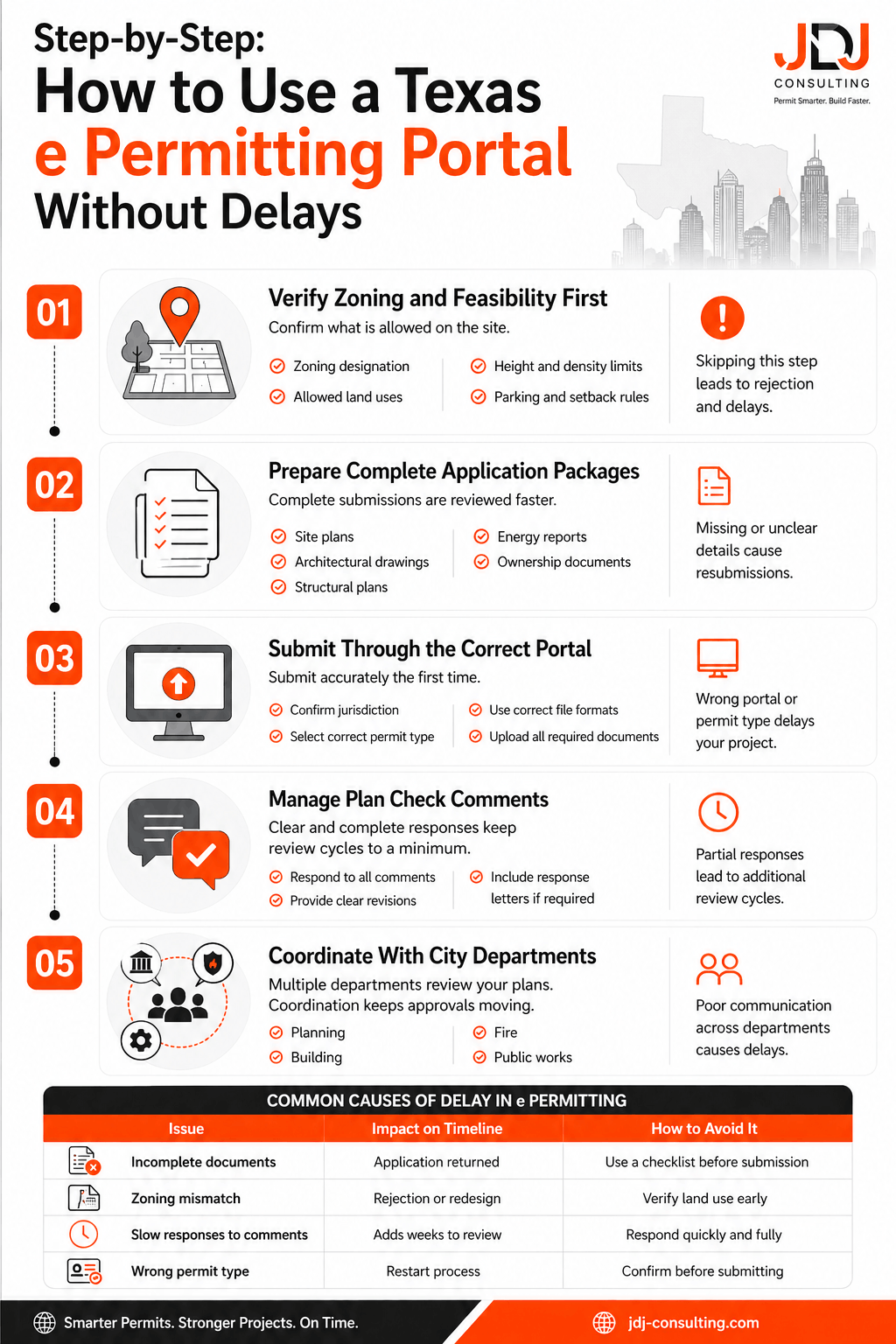
Step 5 – Coordinate With City Departments
Most projects involve multiple departments. Each one reviews a different part of your plans.
These may include:
Planning
Building
Fire
Public works
Delays often happen when communication is not aligned across departments.
Coordinating responses and keeping communication clear helps move approvals forward faster.
Table: Common Causes of Delay in e Permitting
| Issue | Impact on Timeline | How to Avoid It |
|---|---|---|
| Incomplete documents | Application returned | Use a checklist before submission |
| Zoning mismatch | Rejection or redesign | Verify land use early |
| Slow responses to comments | Adds weeks to review | Respond quickly and fully |
| Wrong permit type | Restart process | Confirm before submitting |
Common Mistakes Developers Make With Texas e Permitting
Even experienced developers face delays. In most cases, the issues come from a few common mistakes. Understanding these early can save time and cost.
Submitting Incomplete Plans
Incomplete plans are one of the biggest reasons for delays.
When documents are missing or unclear:
Applications may be rejected
Review may not begin
Additional requests are issued
This slows down the entire process.
Clear and complete plans help reviewers approve faster and reduce back-and-forth.
Ignoring Zoning Restrictions
Zoning is often misunderstood or overlooked.
If your project does not match zoning rules:
You may need redesign
You may need additional approvals
Your timeline will extend
This is especially common in mixed-use or commercial projects.
Early zoning review helps prevent these issues.
Delaying Responses to City Comments
After review, timing becomes critical.
Slow responses to comments can:
Push your project to the back of the review queue
Add weeks between review cycles
Delay approvals significantly
Quick and complete responses help keep momentum.
Trying to Handle Everything Internally
Some teams try to manage the entire permitting process on their own. While this may work for simple projects, it often creates problems in more complex cases.
Challenges include:
Limited knowledge of local systems
Lack of direct communication with departments
Difficulty managing multiple review cycles
The hidden cost is time. Delays can affect construction schedules, financing, and overall project success.
How JDJ Consulting Speeds Up Texas Permitting Projects
Permitting is not just about submission. It is about managing the entire process from start to finish. This is where structured support makes a difference.
End-to-End Permit Expediting
Permit expediting focuses on keeping your project moving.
This includes:
Preparing and submitting applications
Coordinating with city departments
Tracking progress and follow-ups
Managing review comments
Instead of waiting for updates, your project is actively managed. This helps reduce delays and keeps timelines more predictable.
Land Use & Entitlement Strategy
Strong projects start before submission.
Land use and entitlement strategy ensures:
Your project aligns with zoning
Required approvals are identified early
Risks are reduced before design begins
This step helps avoid costly redesigns later in the process.
Due Diligence Before You Invest
Before committing to a project, it is important to understand potential risks.
Due diligence reviews:
Property records
Zoning restrictions
Existing permits and conditions
This helps you make informed decisions and avoid unexpected issues.
Agency Coordination That Moves Projects Forward
Permitting involves multiple agencies. Clear communication is key.
Coordinated outreach helps:
Align expectations
Resolve issues early
Keep approvals moving
When communication is managed properly, projects move forward with fewer delays. In Texas, e permitting systems are only part of the process. What matters more is how the process is managed from start to finish.
Real-World Scenario: How e Permitting Impacts Project Timelines
To understand the impact of e permitting, it helps to look at how timelines change based on process management. Two projects can start at the same time, use the same city portal, and still finish weeks apart. The difference usually comes down to preparation and coordination.
Without Structured Support
In many cases, teams handle permitting internally without a clear process.
This often leads to:
Submitting incomplete plans
Missing zoning issues early
Slow responses to review comments
Poor coordination between departments
As a result:
Review cycles increase
Timelines become unpredictable
Costs begin to rise
For example, a commercial project may go through three to four review cycles instead of one or two. Each cycle can take several weeks.
With a Managed Approach
When the process is handled with planning and coordination, the timeline improves.
A structured approach focuses on:
Verifying zoning before submission
Preparing complete and accurate documents
Responding quickly to all comments
Coordinating with departments early
This reduces:
The number of review cycles
Back-and-forth communication
Unexpected delays
The result is a smoother process with fewer surprises.
Table: Timeline Comparison (Typical Scenario)
| Stage | Unmanaged Process | Managed Process |
|---|---|---|
| Initial Submission | Delayed due to missing info | Submitted correctly first time |
| Plan Review | 3–4 cycles | 1–2 cycles |
| Comment Response | Slow and partial | Fast and complete |
| Final Approval | Uncertain timeline | More predictable timeline |
Costs and Timelines for Texas e Permitting
Permitting costs and timelines vary by city and project type. However, the structure is similar across most Texas jurisdictions. Understanding these costs early helps with budgeting and planning.
Typical Permit Costs
Permit costs usually include several components.
These may include:
Application fees
Plan review fees
Inspection fees
Impact or development fees
Costs depend on:
Project size
Building type
Location
For example, a small residential permit may cost much less than a large commercial development with multiple reviews.
Realistic Timelines
Timelines vary widely, but most projects follow a general pattern. A simple project may move quickly. A complex project may take longer due to multiple reviews and approvals.
Typical factors that affect timelines include:
Completeness of submission
Number of review cycles
City workload
Project complexity
Table: General Timeline Estimates
| Project Type | Estimated Timeline | Key Factors |
|---|---|---|
| Small Residential | 2–6 weeks | Simple plans, fewer reviews |
| Medium Commercial | 1–3 months | Multiple departments involved |
| Large Development | 3–6+ months | Entitlements, complex reviews |
Tips to Get Your Texas Permit Approved Faster
While every project is different, certain steps consistently help reduce delays. These are practical actions that improve approval timelines.
Verify zoning before design begins
Submit complete and accurate plans
Follow city-specific requirements carefully
Respond to review comments quickly
Keep communication clear across departments
Each of these steps reduces friction in the process. Even small improvements can save weeks.

When You Should Hire a Permit Expeditor in Texas
Not every project requires outside help. However, certain situations benefit from additional support.
Complex Commercial Projects
Larger projects involve:
Multiple departments
Detailed reviews
Higher risk of delays
In these cases, managing the process becomes more demanding.
Tight Deadlines
If your project has strict timelines, delays can create serious issues.
This may affect:
Construction schedules
Financing timelines
Tenant commitments
A faster and more predictable process becomes important.
Multi-Agency Approvals
Some projects require coordination across different agencies.
This increases:
Communication complexity
Review requirements
Approval steps
Clear coordination helps keep everything aligned.
Out-of-State Developers
Developers working in Texas for the first time often face a learning curve. Each city has different systems and requirements. Without local experience, delays are more likely.
Get Your Texas Permits Approved Faster
Delays in permitting can affect your entire project. A structured approach helps reduce risks and keep timelines on track.
JDJ Consulting supports developers with:
Land use and entitlement strategy
Permit expediting
Due diligence
Agency coordination
If you are planning a project in Texas, working with the right team can make the process smoother and more predictable.
Let’s Get Your Permits Moving
If you want to avoid delays or speed up approvals, a quick conversation can help. We’ll review your project, spot risks early, and guide you through the process so things move smoothly.
Schedule a call or fill out the pre-consultation form: https://jdj-consulting.com/book-consultation/
Phone: (818) 793-5058
Email: sales@jdj-consulting.com
A few minutes now can save you weeks later.
FAQs About Texas e Permitting Portals (Developer-Focused)
What is a Texas e permitting portal?
A Texas e permitting portal is an online system used by cities and agencies to manage permit applications from start to finish. Instead of paper forms, everything is submitted and reviewed digitally.
It usually lets you:
Upload plans and documents
Pay fees securely
Track status and comments
While this improves convenience, the process still requires accuracy. If documents are incomplete or incorrect, the system will not move your application forward.
Is there a single e permitting portal for all of Texas?
No, Texas uses a decentralized system. Each city and county operates its own permitting portal.
For example:
Austin has its own development system
Dallas uses DallasNow
Houston uses a separate platform
This means you must submit through the correct portal based on location. Using the wrong system or misunderstanding local requirements can delay your project before review even begins.
How do I apply for a building permit online in Texas?
Applying online follows a structured process, but each step must be done carefully.
You typically need to:
Create an account in the city portal
Select the correct permit type
Upload plans and required documents
Pay application fees
After submission, your application enters review. If anything is missing or unclear, you will receive comments and need to revise your plans, which can extend timelines.
What documents are required for Texas e permitting?
Document requirements depend on the project, but most applications require detailed plans.
Common documents include:
Site plans showing layout and boundaries
Architectural drawings with design details
Structural or engineering plans
Proof of ownership or authorization
Some cities may also require energy reports or additional studies. Submitting complete and clear documents helps reduce review cycles and speeds up approvals.
How long does it take to get a permit in Texas?
Permit timelines vary based on project complexity and city workload.
In general:
Small residential permits may take a few weeks
Commercial projects can take several months
Large developments may take longer due to multiple approvals
The biggest factor is how many review cycles your project goes through. Fewer revisions usually mean faster approvals.
Why do permit approvals get delayed in Texas?
Most delays come from avoidable issues during submission and review.
Common causes include:
Missing or incomplete documents
Zoning conflicts
Slow responses to reviewer comments
Miscommunication between departments
Each issue can trigger additional review cycles. Addressing these early helps keep your project on schedule and reduces unnecessary back-and-forth.
Can I track my permit application online?
Yes, most e permitting portals provide real-time tracking tools.
You can usually:
Check your application status
View reviewer comments
See pending actions or requirements
This transparency helps you stay updated. However, you still need to monitor the portal regularly and respond quickly to avoid delays in the review process.
Do I need a contractor to apply for permits in Texas?
It depends on the type of project.
For smaller residential work:
Homeowners can often apply themselves
For larger or commercial projects:
Licensed contractors are usually required
Additional approvals may be needed
Even when not required, working with experienced professionals can help ensure your application meets all local requirements.
What is permit expediting and how does it help?
Permit expediting is a service that manages the permitting process on your behalf.
It typically involves:
Preparing and submitting applications
Communicating with city departments
Responding to review comments
This helps reduce delays and keeps your project moving. It is especially useful for complex projects where coordination and timing are critical.
What happens after I submit my permit application?
After submission, your application goes through a review process involving multiple departments.
This usually includes:
Technical review of plans
Comments or correction requests
Resubmission of updated documents
Once all departments approve, you can proceed to inspections. Final approval is only issued after all requirements are met.
What are plan check comments in Texas permitting?
Plan check comments are feedback provided by city reviewers during the approval process.
They often highlight:
Code compliance issues
Missing or unclear details
Required design changes
You must address every comment before approval. Clear and complete responses help reduce additional review cycles and keep your project moving forward.
Can I resubmit my application if it gets rejected?
Yes, most systems allow you to revise and resubmit your application.
If rejected:
Review all comments carefully
Update your plans to address each issue
Upload revised documents through the portal
Incomplete revisions can lead to further delays, so it is important to respond thoroughly to avoid repeated review cycles.
What is zoning and why is it important before applying?
Zoning defines what can be built on a property and how it can be used.
It regulates:
Land use type
Building height and density
Setbacks and parking
If your project does not match zoning rules, your permit may be denied. Verifying zoning early helps prevent redesigns and delays later in the process.
Are inspections required after permit approval?
Yes, most construction projects require inspections at different stages.
Typical inspections include:
Foundation and structural work
Electrical and mechanical systems
Final inspection before occupancy
These inspections ensure the work meets safety and code standards. You must pass all required inspections before receiving final approval.
What fees are involved in Texas e permitting?
Permit costs vary depending on project size and type.
Common fees include:
Application and processing fees
Plan review fees
Inspection fees
Some projects may also include impact fees. Understanding these costs early helps you plan your budget and avoid surprises during the process.
Can delays affect my construction timeline?
Yes, permitting delays can directly impact your construction schedule.
Delays may:
Push back project start dates
Increase holding and financing costs
Disrupt contractor timelines
Because of this, managing the permitting process efficiently is essential to keeping your project on track.
How can I speed up my permit approval in Texas?
Improving approval speed requires careful preparation and quick responses.
Key steps include:
Submitting complete and accurate documents
Verifying zoning before applying
Responding quickly to all comments
Following city-specific requirements
These actions reduce review cycles and help your application move through the system more efficiently.
Do different Texas cities have different permitting rules?
Yes, each city has its own rules, systems, and processes.
This means:
Requirements can vary by location
Timelines may differ
Submission formats may change
Understanding local requirements is important, especially if you are working across multiple cities.
When should I hire a permit consultant?
Hiring a consultant is helpful in situations where the process becomes complex.
You may need support if:
Your project involves multiple approvals
You have strict timelines
You are unfamiliar with local systems
Consultants help manage the process, reduce delays, and improve overall efficiency.
Is Texas e permitting better than traditional permitting?
E permitting improves access and convenience compared to paper-based systems.
It allows you to:
Submit applications online
Track progress in real time
Reduce paperwork
However, the review process still requires careful planning and coordination. Digital systems make submission easier, but they do not eliminate the need for accurate and complete applications.