
Table of Contents
Pre-Construction Risk Assessment: What Developers Should Verify Before Investing
A development opportunity can look promising until zoning restrictions, infrastructure limitations, permitting requirements, or unexpected site conditions change the project’s financial outlook. For developers and property investors, identifying these risks before committing significant capital can make a meaningful difference in how a project moves forward.
A pre-construction risk assessment helps evaluate whether a proposed development is practical, what obstacles could affect its execution, and which issues require further investigation before design and construction begin.
Rather than focusing only on estimated construction costs, this process examines the regulatory, physical, financial, and administrative factors that influence a project’s feasibility.
For projects in California, Texas, and Florida, understanding local development requirements early can help property owners make better-informed decisions about land acquisition, project scope, and approval strategy.
What Is a Pre-Construction Risk Assessment?
A pre-construction risk assessment is an early review of the conditions that could affect a proposed construction or real estate development project.
It evaluates the property’s development potential alongside the requirements, constraints, and uncertainties that may influence project cost, schedule, and approvals.
Depending on the site and proposed use, the assessment may include:
Zoning and land-use restrictions
Permitted building height, density, setbacks, and floor area
Parking and access requirements
Existing site conditions and utility availability
Environmental or geotechnical considerations
Entitlement and permitting requirements
Preliminary project costs and financial assumptions
Potential approval delays and coordination challenges
The goal is not to eliminate every possible risk. It is to identify material uncertainties early enough for the development team to investigate them and determine an appropriate response.
1. Confirm What the Property Can Legally Support
Before investing in architectural design, verify whether the intended development aligns with the property’s applicable zoning and land-use regulations.
A parcel’s size alone does not determine how much can be built. Height limits, setbacks, floor area ratio, density restrictions, parking rules, overlays, and other requirements may significantly affect the usable development area.
For example, a property that appears suitable for a multifamily building may have restrictions that reduce the number of feasible units or require additional approvals.
Developers should review the applicable zoning designation, permitted uses, dimensional standards, and potential entitlement requirements. Where a project depends on a density bonus, variance, conditional use permit, or other discretionary approval, the associated eligibility requirements and uncertainties should also be evaluated.
JDJ Consulting provides pre-construction analysis services to help assess site potential, zoning constraints, and development pathways before a project advances.
2. Identify Site Conditions That Could Affect Development
A property’s physical characteristics can influence design decisions, construction methods, and overall project costs.
Early site review should consider topography, grading, drainage, access, existing structures, utility connections, and visible site constraints. Depending on the property’s history and location, additional environmental, geotechnical, or specialized investigations may be necessary.
Consider a parcel with a significant slope or limited access. Even if the proposed building is permitted under zoning regulations, grading requirements, retaining structures, drainage improvements, or construction access limitations could affect the project’s budget.
A preliminary review helps identify which questions can be addressed through available records and which require qualified technical professionals.
It is important to distinguish between an initial screening and a completed technical investigation. A preliminary assessment can flag potential concerns, but it does not replace required surveys, soil testing, environmental assessments, or engineering studies.
3. Map the Approval Process Before Finalizing the Schedule
Permitting risk is not limited to whether a project qualifies for approval. The sequence of required reviews, the completeness of submissions, and coordination among agencies can also affect the development schedule.
Depending on the jurisdiction and project scope, approvals may involve planning departments, building departments, fire authorities, utility providers, public works agencies, or other reviewing entities.
Before establishing major project milestones, determine:
Which approvals and permits may be required
Whether land-use entitlements must be secured before building permits
Which technical studies or supporting documents are necessary
Whether separate agency reviews can proceed concurrently
What potential plan-check corrections could affect the schedule
A clear approval strategy helps the project team understand dependencies before committing to design deadlines or construction start dates.
For additional guidance, read JDJ Consulting’s article on permit sequencing strategy.
4. Test the Project Budget Against Realistic Conditions
A preliminary budget should reflect more than the anticipated cost of constructing the building.
Depending on the project, total development costs may include design and engineering, surveys, environmental studies, permit and entitlement fees, utility upgrades, site preparation, financing, insurance, and contingency allowances.
Developers should identify which costs are based on confirmed information and which remain preliminary assumptions.
For instance, a project budget may assume that existing utilities can support the proposed building. If further investigation reveals that upgrades are necessary, the development’s total cost and timeline may change.
A useful early-stage cost review should therefore document:
Known project costs and outstanding estimates
Potential site improvement expenses
Fees and studies associated with approvals
Unresolved design and engineering requirements
Contingency allowances for identified uncertainties
Financial assumptions that require further validation
This approach creates a more transparent basis for evaluating whether the project remains financially viable.
5. Evaluate Development Incentives Without Assuming Approval
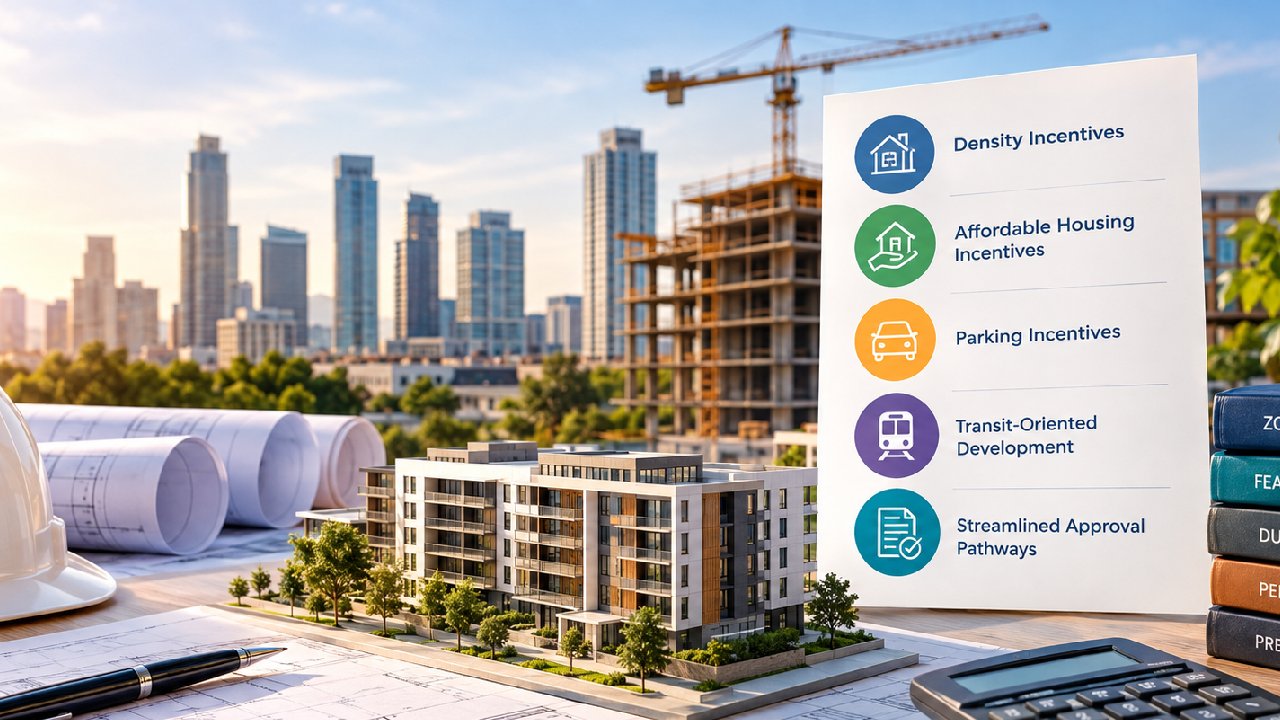
Incentive programs may improve project feasibility by offering eligible developments benefits such as tax relief, financing assistance, additional development capacity, or reduced parking requirements. The specific benefits depend on the program, location, project type, and applicable rules.
However, an incentive should not automatically be treated as guaranteed project value.
Developers should verify eligibility criteria, application deadlines, affordability or use restrictions, documentation requirements, and the relationship between the incentive and other applicable regulations.
If the project relies on an incentive to meet its financial objectives, the development team should evaluate the project both with and without the anticipated benefit whenever practical.
Review JDJ Consulting’s 2026 real estate development incentive program guide for additional context on identifying potential development incentives.
6. Prioritize Risks by Their Potential Impact
Not every uncertainty deserves the same level of attention. A minor documentation issue and a fundamental zoning restriction should not receive equal priority.
A practical risk register can help organize the issues identified during pre-construction review.
For each issue, document its potential impact, likelihood, current status, responsible party, and recommended next step.
For example:
| Potential risk | Possible impact | Recommended next step |
|---|---|---|
| Unconfirmed permitted density | Reduced development capacity | Verify zoning and applicable regulations |
| Unknown soil conditions | Additional investigation or foundation costs | Consult a qualified geotechnical professional |
| Unclear permit requirements | Delays and additional submissions | Confirm the approval pathway with relevant agencies |
| Unverified utility capacity | Additional infrastructure expenses | Contact applicable utility providers |
| Unconfirmed incentive eligibility | Changes to project economics | Review program requirements and obtain confirmation |
This process helps developers determine which questions must be resolved before acquisition, which can be addressed during design, and which require ongoing monitoring.
7. Make a Documented Go/No-Go Decision
The final purpose of a pre-construction risk assessment is to support a practical development decision.
After reviewing the property’s constraints, approval requirements, preliminary costs, and unresolved questions, the project team can determine whether to proceed, revise the proposed scope, conduct additional due diligence, or reconsider the opportunity.
A project may be suitable to advance when its principal constraints are understood, critical assumptions have been tested, and the remaining risks have a reasonable investigation or mitigation plan.
Other projects may require additional work before a commitment is justified. For example, a developer might need a more detailed zoning opinion, a survey, a geotechnical study, an environmental assessment, or updated cost estimates before making a final investment decision.
Documenting the decision and its supporting assumptions gives owners, investors, consultants, and other stakeholders a shared understanding of the project’s current status.
How JDJ Consulting Supports Pre-Construction Planning
JDJ Consulting helps developers and property owners evaluate development constraints, understand land-use requirements, and plan the steps needed to move projects toward approval.
Depending on the project’s needs, pre-construction support may include zoning and land-use review, development feasibility analysis, entitlement strategy, permitting coordination, and guidance on potential approval requirements.
These services can help project teams identify issues that warrant further investigation before substantial resources are committed to design or construction.
Explore JDJ Consulting’s pre-construction analysis services to learn more about evaluating site potential and planning the next steps for a proposed development.
Frequently Asked Questions
What is included in a pre-construction risk assessment?
A pre-construction risk assessment may include zoning and land-use review, preliminary site evaluation, permitting requirements, utility considerations, environmental or geotechnical concerns, initial cost assumptions, and potential schedule risks. The exact scope depends on the project and the information available.
When should developers conduct a pre-construction risk assessment?
Ideally, developers should begin reviewing major risks before acquiring a property or committing substantial funds to design. The assessment can continue as additional information becomes available and the project moves toward entitlement and permitting.
How does zoning affect development feasibility?
Zoning regulations determine which uses and development characteristics may be allowed on a property. Requirements involving density, height, setbacks, parking, and other site standards can influence the size, configuration, and approval pathway of a proposed project.
Can a pre-construction assessment guarantee permit approval?
No. An assessment can help identify applicable requirements, potential obstacles, and likely approval steps, but it cannot guarantee that a jurisdiction will approve a project. Final outcomes depend on applicable regulations, complete submissions, agency review, and project-specific circumstances.
How does early risk assessment help control development costs?
Early review can identify potential cost drivers before they lead to major design revisions or construction changes. By clarifying assumptions, identifying required studies, and flagging possible approval issues, developers can make more informed decisions about budgets and project scope.
What is the difference between a feasibility study and a risk assessment?
A feasibility study evaluates whether a proposed development is practical and potentially viable. A risk assessment focuses more specifically on uncertainties and constraints that could affect the project. These processes often overlap and can be combined during early development planning.
Plan Before You Commit
Successful development begins with a clear understanding of what a property can support, what approvals may be required, and which uncertainties could affect project economics.
A structured pre-construction risk assessment gives developers a stronger basis for evaluating opportunities, prioritizing investigations, and determining the next steps before design and construction advance.
If you are evaluating a potential development, contact JDJ Consulting to discuss your property’s zoning, feasibility, and permitting considerations.