Table of Contents
Real estate development incentives can create opportunities to improve a project’s financial outlook, expand its development potential, or support a specific public policy objective. However, finding a program is only the first step. Property owners and developers must also determine whether their projects qualify, understand the application process, and confirm that they can meet the program’s conditions.
Development incentive compliance involves understanding and satisfying the eligibility criteria, documentation standards, deadlines, and continuing obligations attached to a particular incentive. Depending on the program, these requirements may affect project design, financing, construction schedules, leasing, operations, and future property transfers.
For investors, the goal is not simply to identify an attractive benefit. It is to determine whether the project can realistically obtain that benefit and fulfill its requirements throughout the applicable period.
Before acquiring a property, finalizing plans, or committing funds, developers should conduct a structured review of incentive requirements alongside zoning, permitting, and financial feasibility.
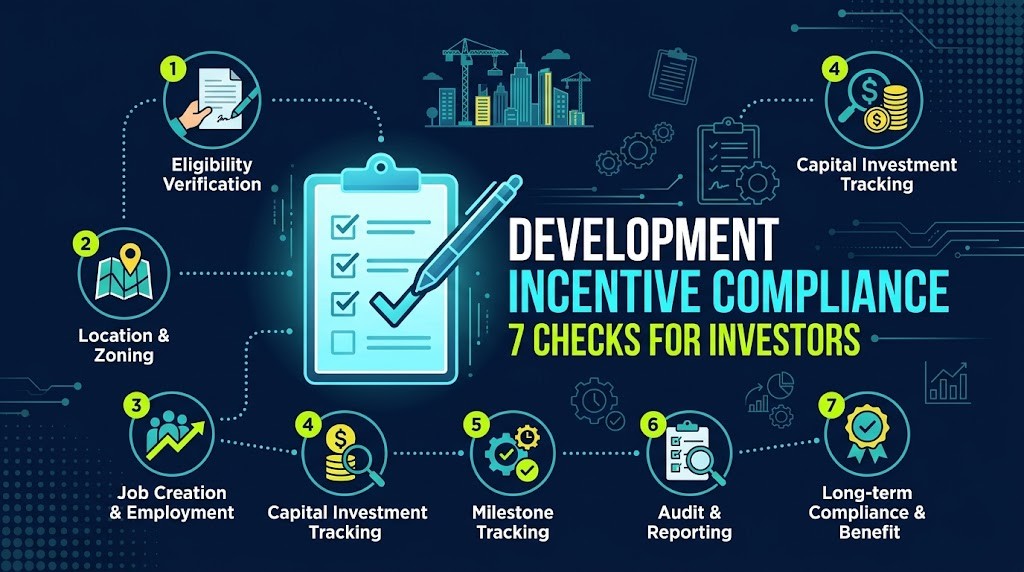
1. Confirm That the Property and Project Are Eligible
The existence of an incentive program does not mean every property or development can participate. Eligibility may depend on the property’s location, zoning designation, proposed use, project size, applicant type, investment amount, or other program-specific criteria.
For example, an incentive intended to encourage affordable housing may require qualifying income-restricted units. A business expansion program may focus on eligible business activities, investment thresholds, or job creation. A density bonus may depend on affordability commitments or compliance with specific land-use regulations.
Before relying on a potential incentive, verify:
The property is located within the program’s eligible geographic area.
The proposed development type is permitted under the program.
The applicant satisfies ownership or business eligibility requirements.
The project meets applicable size, investment, or affordability thresholds.
Any additional zoning, environmental, or land-use conditions can be satisfied.
Request written clarification from the administering agency when a program requirement is unclear. Keep a record of the source, date, and interpretation of each important eligibility condition.
2. Understand the Difference Between Applying and Receiving Approval
An application does not guarantee an incentive. Some programs operate through defined eligibility rules, while others require competitive review, discretionary approval, funding allocation, or negotiations with a public agency.
Developers should identify the actual approval process before incorporating a proposed benefit into their financial projections.
Questions to investigate include:
Is the program currently accepting applications?
Is funding available, and is it limited?
Does the project require preliminary approval before construction?
Are there public hearings or additional agency reviews?
Does the agency issue a formal award, reservation, or approval?
What conditions must be met before benefits can be claimed?
These distinctions matter because an incentive that is theoretically available may not be secured in time to support a planned acquisition or construction schedule.
When building a financial model, evaluate the project under both an incentive scenario and a scenario in which the incentive is delayed, reduced, or unavailable.
3. Review Application Deadlines and Project Milestones
Timing is one of the most important aspects of incentive planning. Certain programs require an application before construction, equipment purchases, property improvements, or other qualifying activities begin. Others may impose deadlines tied to permits, financing commitments, project completion, or annual funding cycles.
Missing a required milestone could make a project ineligible or delay access to an anticipated benefit.
Create an incentive schedule that identifies:
Initial eligibility review.
Pre-application meetings, if required.
Application submission deadlines.
Supporting document requirements.
Agency review and approval milestones.
Construction or implementation deadlines.
Reporting, inspection, and renewal dates.
Coordinate this schedule with design development, financing, entitlement approvals, and permit submissions.
For complex projects, consider assigning one team member responsibility for tracking incentive-related obligations. That person should coordinate with the development manager, architect, consultants, lender, and other relevant parties.
For additional planning guidance, review JDJ Consulting’s permit expediting services.
4. Calculate the Net Benefit, Not Just the Advertised Incentive
A program may advertise a tax benefit, fee reduction, grant, additional development capacity, or other advantage. However, the headline benefit does not necessarily reflect the project’s actual financial outcome.
The complete analysis should consider both the potential value and the costs of participating.
Financial consideration | What to evaluate |
|---|---|
Direct benefit | Estimated value of the incentive under the applicable rules |
Application costs | Consultant fees, technical studies, and administrative expenses |
Additional project costs | Design changes, infrastructure, or qualifying improvements |
Compliance costs | Reporting, inspections, audits, and ongoing administration |
Development restrictions | Affordability, use, occupancy, or operating conditions |
Timing | When the benefit can actually be received or realized |
Risk | What happens if approval is delayed, denied, or modified |
For example, a hypothetical project might qualify for a $200,000 incentive but incur $35,000 in additional application, documentation, and compliance costs. The potential net benefit before other project-specific expenses would be $165,000, assuming the full incentive is approved and realized.
This simplified calculation is not a forecast or a guarantee. Actual tax treatment, funding conditions, financing costs, and eligibility rules may change the result.
The important point is to model the net benefit using documented assumptions rather than treating the advertised incentive as guaranteed savings.
5. Identify Long-Term Compliance Obligations
Some incentives involve requirements that continue after the initial approval or payment. A developer may need to maintain a particular use, satisfy affordability restrictions, submit annual reports, preserve records, or meet other performance standards.
These obligations can affect the project’s long-term management and investment strategy.
Before applying, determine:
How long the requirements remain in effect.
Whether restrictions apply to future owners or operators.
What records must be retained.
Whether inspections or periodic reporting are required.
What happens if the project no longer meets the program conditions.
Whether repayment, penalties, or loss of benefits may result from noncompliance.
These considerations are particularly important for investors planning to refinance, sell, reposition, or change the use of a property.
Document ongoing obligations in the project’s compliance plan and communicate them to the parties responsible for property management and future transactions.
6. Coordinate Incentives With Zoning and Development Approvals
An incentive does not automatically override zoning regulations, building codes, environmental requirements, or other applicable laws. Some programs provide specific regulatory flexibility, but that flexibility must be confirmed under the governing rules and approved for the particular project.
A development concept may appear financially attractive while still facing limitations involving height, density, parking, setbacks, access, utilities, or other site conditions.
Before incorporating an incentive into the design, evaluate the relationship between:
Existing zoning and permitted uses.
Proposed density, height, and floor area.
Any additional entitlements or discretionary approvals.
Affordable housing or other public-benefit commitments.
Building permit and site development requirements.
Utility, transportation, environmental, or infrastructure constraints.
This is where incentive review should connect with a broader feasibility and development consulting assessment.
A coordinated review can help determine whether the incentive is compatible with the project’s intended design and whether additional approvals or changes are necessary.
7. Build a Documentation and Compliance Checklist
Incomplete documentation can delay review or create problems when a project is audited or monitored. Establish a central file before submitting an application, then maintain it throughout the project.
A practical checklist includes:
Not every program requires every item. Use the administering agency’s current checklist as the controlling reference.
For projects involving multiple agencies, establish a clear process for tracking submissions, comments, approvals, and outstanding conditions.
Common Mistakes to Avoid
Even a promising incentive can create complications when developers misunderstand its requirements.
Assuming eligibility without checking the rules. General descriptions are not substitutes for reviewing the criteria that apply to the specific property and applicant.
Starting work too early. If advance approval is required, beginning construction or making purchases prematurely may affect eligibility.
Counting unapproved incentives as committed funding. Financial projections should distinguish confirmed awards from potential benefits.
Ignoring long-term obligations. Requirements may continue after construction or the initial payment.
Overlooking conflicts with project approvals. Incentive conditions may affect design, use, affordability, or development schedules.
Failing to assign responsibility. Without clear ownership of deadlines and records, teams may miss important submissions or reporting requirements.
A disciplined process helps developers assess the opportunity while keeping project risks visible.
How JDJ Consulting Can Help
Evaluating an incentive requires more than finding a program. Property owners and developers need to understand how the opportunity fits the property’s zoning, proposed use, approval pathway, project schedule, and financial objectives.
JDJ Consulting supports development planning through services that include feasibility analysis, due diligence, land-use and entitlement strategy, permit expediting, and agency coordination.
Depending on the project’s scope, this support can help identify development constraints, organize relevant requirements, coordinate with agencies, and evaluate the approvals needed to move the project forward.
Explore JDJ Consulting’s services or learn about agency liaison and stakeholder outreach for projects requiring coordination with planning departments and other public agencies.
Planning an acquisition or development project? Book a consultation with JDJ Consulting to discuss your project’s requirements and determine what should be reviewed before major commitments are made.
Frequently Asked Questions
What is development incentive compliance?
Development incentive compliance means meeting the eligibility criteria, application requirements, deadlines, reporting obligations, and other conditions associated with a development incentive. Requirements vary by program and jurisdiction.
How do I know if my property qualifies for an incentive?
Review the official program guidelines, geographic boundaries, eligible property and project types, applicant requirements, and any applicable zoning or affordability conditions. Confirm uncertain requirements with the agency administering the program.
Should I apply for an incentive before starting construction?
That depends on the program. Some require an application or approval before construction, purchases, or other qualifying activities begin. Verify the applicable rules before starting work or incurring expenses that you expect to qualify.
Can a development project qualify for more than one incentive?
Possibly. Some programs allow incentives to be combined, while others limit overlapping benefits or prohibit certain combinations. Review the rules for each program, including restrictions on duplicate funding or the same eligible expenses.
What happens if a project fails to meet incentive requirements?
Consequences depend on the program and the terms of approval. They may include loss of future benefits, repayment obligations, penalties, or other corrective measures. Review the governing documents and seek qualified professional advice when necessary.
Should incentive benefits be included in a project’s feasibility analysis?
Yes, but potential and approved benefits should be distinguished. Evaluate the project with and without the anticipated incentive and account for application costs, compliance expenses, timing, and approval risk.
Can JDJ Consulting guarantee incentive approval?
No. Approval is determined by the agency or organization administering the program. JDJ Consulting can assist with development feasibility, land-use considerations, permitting, and agency coordination, but eligibility and approval depend on the applicable rules and decision-maker.
Final Thoughts
Development incentives can create valuable opportunities, but the benefits must be evaluated alongside eligibility requirements, application timing, financial assumptions, and long-term obligations.
A structured compliance review helps developers identify potential issues before they affect an acquisition, project design, financing strategy, or construction schedule.
Before relying on an incentive, confirm the official requirements, document the assumptions behind the projected benefit, and coordinate the opportunity with the project’s broader feasibility and approval strategy.
JDJ Consulting helps property owners and developers navigate feasibility, land-use, entitlement, permitting, and agency coordination across California, Texas, and Florida.