
Texas has quickly become one of the top locations for data center development in the United States. Large technology companies, cloud providers, and enterprise firms are expanding their infrastructure across the state. Cities like Dallas, Austin, and San Antonio continue to see new projects because they offer land availability, strong energy access, and business-friendly policies.
At the same time, demand is rising fast. Artificial intelligence, cloud computing, and digital services require more storage and processing capacity. As a result, developers are moving quickly to secure sites and begin construction.
However, one factor often determines whether a project moves forward smoothly or gets delayed—permitting.
Permitting is not just a step in the process. It is the framework that controls how, when, and where a data center can be built. Without a clear strategy, even well-funded projects can face delays.
Why Permitting Matters More for Data Centers
Data centers are not typical commercial buildings. They require:
- Large amounts of electrical power
- Advanced cooling systems
- Backup generation infrastructure
- High-speed fiber connectivity
Because of this, they face stricter review compared to standard real estate projects.
Local authorities must evaluate:
- Land use compatibility
- Environmental impact
- Utility demand
- Infrastructure strain
This adds layers to the approval process.
Texas Offers Opportunity — With Complexity
Texas provides strong advantages for developers:
- Competitive energy markets
- Large tracts of developable land
- Economic incentives for data centers
Yet, each city has its own zoning rules, approval timelines, and permitting procedures. In addition, power access is governed by regional systems, which can create delays if not planned early.
This means success depends on planning ahead and coordinating approvals early.
Where Consulting Firms Add Value
This is where firms like JDJ Consulting Group fit into the process.
A structured approach helps developers:
- Identify viable sites before purchase
- Reduce permitting risks
- Coordinate with agencies efficiently
- Avoid costly redesigns
In large-scale infrastructure projects like data centers, small delays can lead to major cost increases. A clear permitting strategy helps prevent that.
Table of Contents
What Is Data Center Permitting? (Simple Explanation)
Data center permitting refers to the full set of approvals required before construction can begin and operations can start. These approvals come from local, state, and sometimes federal agencies.
Unlike a simple building permit, data center permitting involves multiple layers that often run at the same time.

Definition of Data Center Permitting
At its core, permitting includes:
- Zoning and land use approvals
- Site plan approval
- Utility and power approvals
- Environmental permits
- Building permits
Each approval focuses on a different aspect of the project. Together, they ensure that the development meets safety, environmental, and infrastructure standards.
Why It Is More Complex Than Traditional Development
Data centers require far more coordination than typical office or retail projects.
Here are the key differences:
| Factor | Typical Commercial Project | Data Center Project |
|---|---|---|
| Power demand | Moderate | Extremely high |
| Cooling systems | Basic HVAC | Advanced cooling infrastructure |
| Utility coordination | Limited | Extensive |
| Environmental review | Minimal | Often required |
| Approval timeline | Shorter | Longer |
The biggest difference is power dependency. A data center cannot function without reliable, high-capacity electricity. Because of this, utility approvals often become the critical path in the timeline.
Key Agencies Involved in Texas
In Texas, several entities play a role in permitting.
Local Authorities
- Planning and zoning departments
- City councils or planning commissions
- Building departments
Utility Providers
- Electric utilities and transmission operators
- Coordination with the ERCOT grid
Environmental Agencies
- Air quality regulators
- Water resource authorities
Each agency reviews a specific part of the project. Delays in one area can affect the entire timeline.
How the Process Works in Practice
In most cases, permitting does not follow a strict linear path. Instead, multiple approvals happen at the same time.
For example:
- Zoning may begin while site design is still in progress
- Utility coordination starts before final building plans
- Environmental reviews may run alongside engineering
This overlapping structure can speed up timelines—but only if managed properly. Without coordination, it can create confusion and delays.
Step-by-Step Data Center Permitting Process in Texas
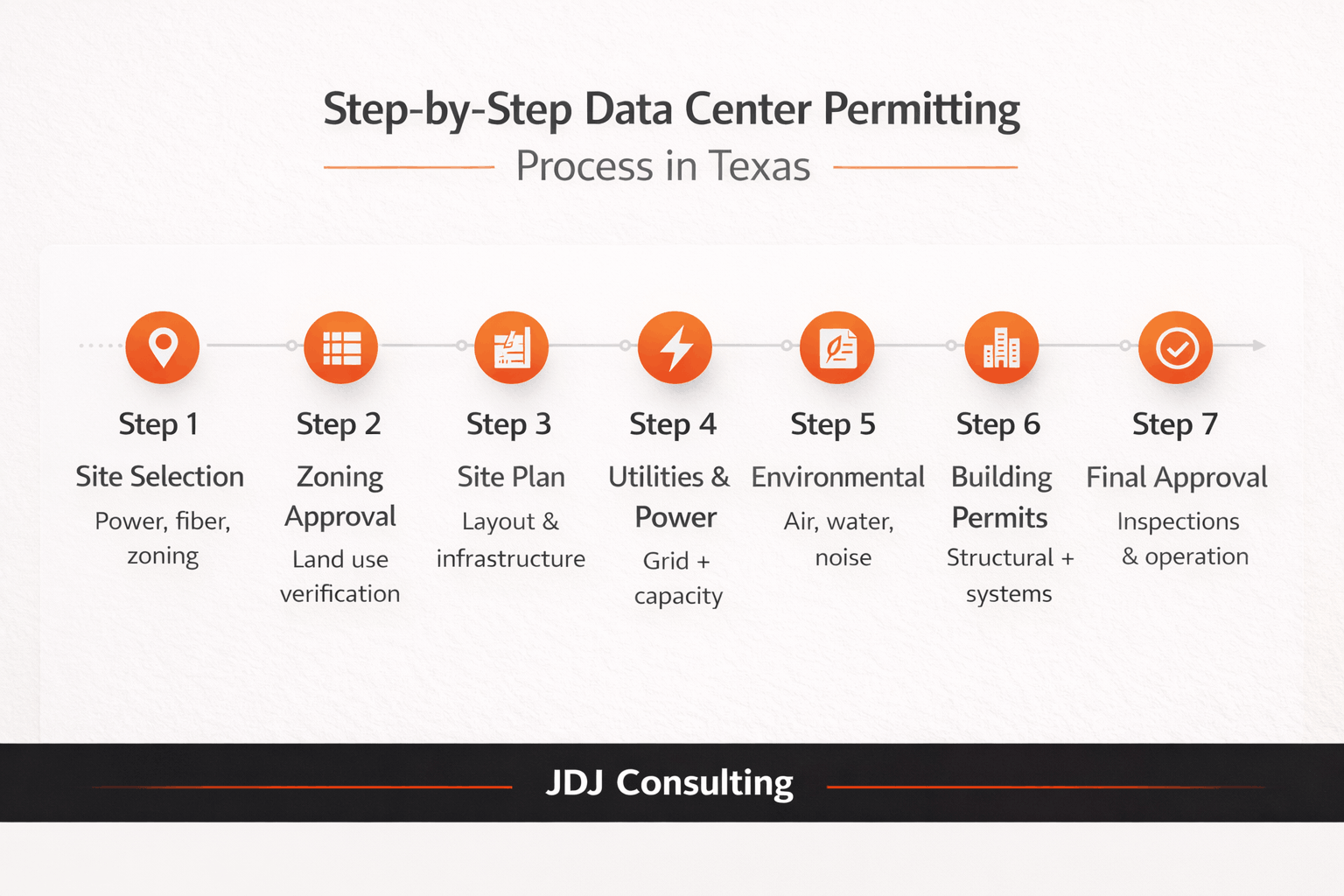
A clear process helps reduce uncertainty. While each project is different, most data center developments in Texas follow a similar sequence. Breaking the process into steps makes it easier to manage.
Step 1: Site Selection and Feasibility Analysis
Every project starts with choosing the right site. This decision affects all future approvals.
Developers evaluate several factors early on:
- Power availability and capacity
- Fiber connectivity
- Zoning compatibility
- Environmental constraints
- Access to transportation and infrastructure
Among these, power is the most critical. Even if land is available, limited grid capacity can delay a project by months or years.
Key Site Selection Criteria
| Criteria | Impact on Project |
|---|---|
| Power capacity | Determines if the project is feasible |
| Fiber access | Ensures connectivity requirements |
| Zoning alignment | Reduces risk of denial |
| Water availability | Supports cooling systems |
| Environmental conditions | Affects permitting complexity |
A strong feasibility study helps avoid problems later in the process.
Step 2: Zoning and Land Use Approvals
Once a site is selected, the next step is confirming that the proposed use is allowed. In Texas, zoning rules vary by city. Some areas allow data centers by right, while others require special approvals.
Common zoning steps include:
- Verifying zoning classification
- Applying for rezoning if needed
- Requesting a Special Use Permit (SUP)
- Attending public hearings
Public hearings can influence timelines. Community concerns about noise, energy use, or environmental impact may lead to additional review.
Step 3: Site Plan Approval
After zoning is addressed, developers submit a site plan.
This plan shows how the property will be developed, including:
- Building layout
- Access roads and circulation
- Utility connections
- Drainage and grading
City staff reviews the plan to ensure it meets local development standards. Revisions are common at this stage. Clear communication with reviewers can help reduce back-and-forth delays.
Step 4: Utility and Power Approvals
This is often the most time-sensitive step. Data centers require large amounts of electricity, which means developers must coordinate with utility providers early.
This process may include:
- Grid capacity analysis
- Interconnection studies
- Substation planning
- Transmission upgrades
Delays in power approvals can impact the entire schedule. In some cases, infrastructure upgrades are required before service can begin.
Step 5: Environmental Permitting
Environmental reviews depend on the project size and location.
Common requirements include:
- Air permits for backup generators
- Water usage approvals
- Stormwater management plans
- Noise studies
Common Environmental Reviews
- Air emissions modeling
- Water consumption analysis
- Noise impact assessments
- Land disturbance permits
These studies help ensure compliance with regulations and reduce long-term risk.
Step 6: Building Permits and Construction Approvals
Once earlier approvals are secured, developers apply for building permits.
These permits cover:
- Structural systems
- Electrical infrastructure
- Mechanical and cooling systems
- Fire safety requirements
Because data centers include complex systems, plan reviews can take longer than standard projects.
Step 7: Final Inspections and Operational Approval
Before operations begin, the project must pass final inspections.
This includes:
- Building inspections
- Fire safety checks
- Utility connections
- Certificate of occupancy
Only after these approvals can the data center begin operations.
Why a Structured Process Matters
Each step connects to the next. Delays in early stages often affect later approvals.
A well-planned approach helps:
- Reduce timeline risks
- Control costs
- Improve coordination
For data center projects, timing is critical. A structured permitting strategy keeps the project moving forward without unnecessary setbacks.
Texas-Specific Regulations Affecting Data Centers
Texas offers strong advantages for data center development, but it also comes with unique regulatory factors. These rules directly affect timelines, costs, and feasibility. Understanding them early can prevent delays later.
ERCOT and Power Grid Requirements
Most of Texas operates under the Electric Reliability Council of Texas, commonly known as ERCOT. This system manages the flow of electricity across the state.
For data center developers, ERCOT plays a major role because it oversees grid reliability and large-load connections.
Data centers often fall into the category of large-load customers, especially when demand exceeds 75 megawatts. This classification brings additional review requirements.
Key considerations include:
- Grid capacity in the selected area
- Queue timelines for interconnection
- Reliability studies before approval
In high-demand regions like Dallas-Fort Worth, power availability has become a limiting factor. Developers must confirm capacity early, even before land acquisition.
Senate Bill 6 (SB6) and Its Impact
Recent legislation, such as Texas Senate Bill 6, has introduced new rules for large energy users, including data centers. This law focuses on protecting grid reliability while managing growing demand.
Under SB6, developers may need to:
- Share costs for infrastructure upgrades
- Meet stricter interconnection requirements
- Demonstrate long-term energy commitments
This changes how projects are planned. In the past, some infrastructure costs were absorbed by utilities. Now, developers may carry a larger portion of those costs. As a result, early financial planning becomes more important.
Local Government Authority in Texas
Even though state-level systems like ERCOT manage power, local governments still control land use and permitting.
Cities handle:
- Zoning approvals
- Site plan reviews
- Building permits
However, Texas generally limits how much cities can restrict development if a project meets all requirements.
This creates a balanced environment:
- Developers have opportunities
- Cities still enforce compliance
Still, each city has different processes. For example:
- Dallas may require more detailed site reviews
- Austin may focus more on environmental impact
- Smaller cities may have faster approval timelines
Because of this variation, understanding local rules is just as important as state regulations.
Zoning Challenges for Data Centers in Texas
Zoning is often one of the first major hurdles in data center development. Even in business-friendly states like Texas, zoning rules can create delays if not addressed early.
Why Data Centers Don’t Fit Traditional Zoning
Data centers are unique. They do not fit neatly into standard zoning categories.
They combine features of:
- Industrial facilities (power usage, infrastructure)
- Commercial buildings (office and operational space)
Because of this, some cities treat them as a special use rather than a standard permitted use.
This can trigger:
- Additional approvals
- Public hearings
- Longer timelines
Common Zoning Classifications in Texas
Most data centers fall under one of the following categories:
- Industrial zoning districts
- Light industrial zones
- Special-use or conditional-use permits
In many cases, developers must apply for a Special Use Permit (SUP). This allows the city to review the project in more detail before approval.
Setbacks, Height, and Design Requirements
Zoning is not just about land use. It also controls how the project is designed.
Common requirements include:
- Setbacks from property lines
- Building height limits
- Landscaping and screening
- Buffer zones near residential areas
These rules help reduce the impact on surrounding communities.
For example:
- Noise from generators may require additional setbacks
- Visual screening may be required near neighborhoods
Ignoring these factors early can lead to redesigns later.
Zoning Risks Developers Should Watch
Zoning issues can delay projects if not identified early.
Common risks include:
- Land not zoned for data center use
- Community opposition during public hearings
- Unexpected design requirements
- Conflicts with nearby land uses
A simple zoning check during due diligence can prevent these issues.
Key Permits Required for Data Center Projects
Data center development requires multiple permits at different levels. There is no single approval that covers everything. Instead, developers must secure several permits across local, state, and federal agencies.

Local Permits
Local permits form the foundation of the approval process. These are handled by city or county authorities.
Typical local permits include:
- Site plan approval
- Zoning or land use approval
- Building permits
- Fire safety permits
These approvals ensure that the project meets local development standards.
State-Level Permits in Texas
At the state level, permits focus more on environmental and infrastructure impacts.
Common state permits include:
- Air permits for backup generators
- Water usage permits
- Stormwater discharge permits
The Texas Commission on Environmental Quality oversees many of these approvals. State permits often require technical studies, which can take time to complete.
Federal Permits (When Applicable)
Not all projects require federal permits. However, they may apply in certain situations.
Examples include:
- Projects affecting wetlands or waterways
- Large energy infrastructure connections
- Environmental compliance under federal laws
When federal permits are required, timelines can extend significantly.
Summary of Permit Types
| Permit Level | Examples | Purpose |
|---|---|---|
| Local | Site plan, zoning, building permits | Ensure compliance with city rules |
| State | Air, water, environmental permits | Protect natural resources |
| Federal | Environmental and infrastructure approvals | Address national regulations |
Why Multiple Permits Create Complexity
Each permit has:
- Its own timeline
- Separate review process
- Different documentation requirements
Because of this, coordination becomes critical.
For example:
- A delay in environmental approval can hold up building permits
- Utility approvals may depend on site plan completion
Managing these dependencies is key to keeping projects on schedule.
How Developers Can Stay on Track
To reduce delays, developers often:
- Start applications early
- Run approvals in parallel when possible
- Coordinate closely with agencies
- Use phased permitting strategies
This approach helps maintain momentum across all stages.
Common Challenges in Data Center Permitting
Even in a strong market like Texas, data center projects face several challenges during permitting. These issues can slow progress, increase costs, and sometimes force redesigns. Understanding these challenges early helps developers plan better and avoid surprises.
Power Availability and Grid Constraints
Power is the most critical factor in any data center project. Without sufficient capacity, the project cannot move forward. In many parts of Texas, demand is growing faster than supply. This creates pressure on the grid, especially in major markets.
Common power-related challenges include:
- Limited capacity in high-demand areas
- Long interconnection timelines
- Required infrastructure upgrades
- Delays in utility approvals
In some cases, developers must wait months or even years for power availability. This makes early coordination with utilities essential.
Environmental Concerns
Data centers must meet environmental standards, especially due to their scale and energy use.
Key concerns include:
- Air emissions from backup generators
- Water usage for cooling systems
- Noise from equipment and operations
These factors often require detailed studies and approvals.
Typical environmental hurdles:
- Air permitting delays
- Water availability restrictions
- Additional mitigation requirements
If these issues are identified late, they can lead to costly changes.
Community Opposition
Public perception can affect the approval process, especially during zoning and land use hearings.
Nearby residents may raise concerns about:
- Noise levels
- Increased traffic
- Environmental impact
- Visual appearance
Even if a project meets all regulations, community feedback can influence timelines.
Ways community concerns affect projects:
- Extended public hearings
- Additional conditions imposed by cities
- Requests for design changes
Early communication with stakeholders can help reduce resistance.
Regulatory Uncertainty
Regulations continue to evolve as data center demand grows.
Changes in laws, policies, or utility rules can affect:
- Project costs
- Approval timelines
- Infrastructure requirements
For example, new energy policies may introduce stricter requirements for large-load users. Because of this, developers must stay informed and flexible.
Summary of Key Challenges
| Challenge | Impact on Project |
|---|---|
| Power constraints | Delays in project start |
| Environmental reviews | Extended permitting timelines |
| Community opposition | Public hearing delays |
| Regulatory changes | Increased costs and uncertainty |
How to Speed Up Data Center Permitting (Expert Strategies)
While permitting can be complex, there are proven ways to reduce delays and keep projects moving. A structured approach makes a significant difference.
Use Phased Permitting
Phased permitting allows developers to break the project into smaller parts and move forward without waiting for full approval.
For example:
- Start grading while building plans are under review
- Begin utility work before final construction approval
This approach helps maintain progress.
Benefits of phased permitting:
- Shorter overall timelines
- Better coordination between teams
- Reduced downtime between approvals
Start Utility Coordination Early
Power is often the biggest bottleneck. Waiting too long to engage utilities can delay the entire project.
Developers should:
- Request capacity studies early
- Begin interconnection discussions before site purchase
- Plan for potential upgrades
Early action helps avoid unexpected delays.
Conduct Early Due Diligence
Due diligence should go beyond basic checks. It should identify risks before major decisions are made.
Key areas to review:
- Zoning compatibility
- Infrastructure availability
- Environmental constraints
- Permitting timelines
A strong due diligence process reduces uncertainty later.
Work with Local Authorities Early
Engaging with city staff early can improve outcomes.
Pre-application meetings allow developers to:
- Understand local requirements
- Identify potential issues
- Build relationships with reviewers
This often leads to smoother approvals.
Coordinate Approvals in Parallel
Instead of waiting for one approval to finish before starting another, many processes can run at the same time.
Examples include:
- Environmental studies during site design
- Utility coordination alongside zoning approvals
This approach saves time when managed correctly.
Use Experienced Consultants
Large projects benefit from experienced teams who understand the process.
Consultants help:
- Manage timelines
- Coordinate with agencies
- Identify risks early
This reduces errors and improves efficiency.
Role of Due Diligence in Data Center Development
Due diligence is one of the most important stages in data center development. It sets the foundation for everything that follows. A well-executed due diligence process helps avoid delays, reduce costs, and improve decision-making.
Pre-Acquisition Risk Assessment
Before purchasing land, developers must evaluate whether the site can support a data center.
This includes:
- Zoning review
- Power availability
- Access to fiber networks
- Site constraints
Skipping this step can lead to major issues later.
Environmental Due Diligence
Environmental factors can affect both permitting and long-term operations.
Developers assess:
- Air quality requirements
- Water availability
- Land conditions
These factors influence both cost and timeline.
Financial and Timeline Risk
Permitting delays can impact project budgets.
Key risks include:
- Extended approval timelines
- Unexpected infrastructure costs
- Redesign expenses
Early analysis helps developers plan more accurately.
Due Diligence Checklist
| Category | Key Questions |
|---|---|
| Zoning | Is the site approved for data center use? |
| Power | Is sufficient capacity available? |
| Environment | Are permits required? |
| Infrastructure | Are utilities accessible? |
| Timeline | How long will approvals take? |
Why Due Diligence Matters More for Data Centers
Compared to traditional real estate, data centers involve more variables.
They depend heavily on:
- Infrastructure
- Energy supply
- Regulatory approvals
Because of this, small oversights can lead to large delays.
Connecting Due Diligence to Permitting Success
Strong due diligence supports:
- Faster approvals
- Fewer revisions
- Better coordination
It also helps developers make informed decisions before committing resources.
Cost Factors in Data Center Permitting
Permitting is not just about approvals. It also has a direct impact on project costs. For data centers, these costs can be significant due to the scale and complexity involved. Understanding where expenses come from helps developers plan better and avoid budget overruns.

Permitting and Application Fees
Every approval comes with its own cost. These fees vary by city, project size, and scope.
Typical local costs include:
- Zoning application fees
- Site plan review fees
- Building permit fees
- Inspection fees
While these costs may seem manageable on their own, they add up quickly across multiple approvals.
Infrastructure and Utility Costs
This is often the largest cost category for data center projects. Because of high power demand, developers may need to fund:
- Substation construction
- Transmission line upgrades
- Grid interconnection fees
In some cases, costs are shared with utility providers. However, recent policy changes mean developers often carry a larger portion of the expense.
Environmental Compliance Costs
Environmental requirements also add to the budget.
These may include:
- Air quality studies
- Water usage analysis
- Noise impact assessments
- Mitigation measures
Each study requires time, technical expertise, and documentation.
Soft Costs and Delays
Permitting delays can lead to indirect costs, often called soft costs.
These include:
- Extended project timelines
- Increased financing costs
- Consultant and legal fees
- Redesign expenses
Even small delays can affect overall project returns.
Summary of Cost Drivers
| Cost Category | Typical Impact |
|---|---|
| Permit fees | Moderate but cumulative |
| Utility infrastructure | High |
| Environmental compliance | Moderate to high |
| Delays and soft costs | Potentially very high |
How to Control Permitting Costs
Developers can reduce costs by:
- Planning early
- Identifying risks upfront
- Coordinating approvals efficiently
- Avoiding redesigns
A structured approach helps keep budgets under control.
Texas Incentives for Data Center Development
Texas offers several incentives that make it attractive for data center investment. These incentives can offset some of the costs associated with permitting and infrastructure.
Sales Tax Exemptions
One of the most significant benefits is the sales tax exemption for qualifying data centers. To qualify, projects typically must meet certain criteria, such as:
- Minimum capital investment
- Minimum square footage
- Job creation requirements
This exemption can apply to:
- Equipment purchases
- Infrastructure components
- Operational systems
For large facilities, the savings can be substantial.
Local Economic Incentives
Many cities and counties in Texas offer additional incentives to attract development.
These may include:
- Property tax abatements
- Economic development grants
- Infrastructure support
Local incentives vary widely, so developers should evaluate options during site selection.
Why Incentives Matter
Incentives can:
- Improve project feasibility
- Offset infrastructure costs
- Attract long-term investment
However, they often come with requirements. Developers must meet performance criteria to maintain eligibility.
Future Trends in Data Center Permitting
The data center industry continues to evolve. As demand increases, permitting processes are also changing. Understanding these trends helps developers stay ahead.
Increasing Regulation
As more data centers are built, regulators are paying closer attention to:
- Energy consumption
- Environmental impact
- Water usage
This may lead to stricter permitting requirements in the future.
AI-Driven Demand
Artificial intelligence is driving the need for larger and more powerful data centers.
This creates:
- Higher energy demand
- More complex infrastructure
- Greater pressure on permitting systems
As a result, projects are becoming larger and more complex.
Faster Permitting Models
To keep up with demand, some regions are exploring faster approval processes.
These may include:
- Pre-zoned industrial areas
- Streamlined permitting systems
- Fast-track approvals for qualified projects
Texas may continue to adopt similar approaches to remain competitive.
How JDJ Consulting Supports Data Center Projects
Data center permitting requires coordination across multiple areas. A structured approach can make a significant difference. JDJ Consulting Group supports developers throughout the process.
Site Selection and Feasibility
Early-stage support includes:
- Evaluating site viability
- Identifying risks
- Assessing infrastructure availability
This helps developers make informed decisions before committing to a property.
Permitting Strategy
A clear strategy improves timelines.
JDJ helps by:
- Structuring phased permitting approaches
- Coordinating approvals
- Reducing delays
This keeps projects moving forward.
Agency Coordination
Managing multiple agencies can be challenging.
Support includes:
- Communication with local authorities
- Coordination with utility providers
- Managing review timelines
This reduces confusion and improves efficiency.
Risk Reduction
Avoiding delays is critical in large-scale projects.
JDJ helps identify:
- Zoning risks
- Environmental challenges
- Infrastructure constraints
Addressing these early prevents costly issues later.
Conclusion: Navigating Data Center Permitting Successfully
Data center permitting in Texas involves multiple steps, agencies, and requirements. While the process can be complex, it becomes manageable with the right approach.
Early planning is essential. Developers who focus on site selection, due diligence, and utility coordination are better positioned for success.
At the same time, understanding local regulations and maintaining clear communication with agencies helps avoid delays.
Texas continues to offer strong opportunities for data center development. With proper strategy and coordination, developers can move projects forward efficiently and reduce risk.
A structured permitting approach is not just helpful—it is necessary for delivering projects on time and within budget.
FAQs: Data Center Permitting in Texas
What is data center permitting in Texas?
Data center permitting in Texas is the formal approval process required before you can build and operate a facility. It ensures your project meets local zoning laws, building codes, and safety standards. This process typically involves multiple departments reviewing your plans.
- Covers land use, construction, and infrastructure compliance
- Includes approvals for electrical, mechanical, and structural systems
- Helps ensure long-term operational safety and legality
A well-managed permitting process prevents costly delays and legal complications later.
What permits are required for a data center in Texas?
Data centers require several permits depending on size and location. Each permit addresses a specific aspect of development and operation.
- Zoning and land use approvals
- Building permits for construction
- Electrical and mechanical permits for systems
- Environmental permits, if applicable
The exact combination varies by city, so understanding local requirements early is essential to avoid rework.
Why do data centers need permits in Texas?
Permits are required to ensure that data centers operate safely and align with local regulations. These facilities consume large amounts of power and require careful planning.
- Ensures compliance with fire and electrical safety standards
- Confirms appropriate land use under zoning laws
- Protects environmental and community interests
Without proper permits, projects risk fines, shutdowns, or forced redesigns.
How long does data center permitting take in Texas?
The timeline depends on project complexity and jurisdiction. Smaller facilities may move quickly, while large-scale developments take longer due to multiple reviews.
- Small projects may take 2–4 months
- Larger data centers often require 6–12+ months
- Delays can occur due to zoning changes or environmental studies
Starting early and submitting complete documents can help reduce approval time.
What is zoning approval for data centers?
Zoning approval determines whether your chosen land can legally support a data center. It is one of the first and most critical steps.
- Verifies land use compatibility
- May require rezoning or special approvals
- Sometimes involves public hearings
If zoning is not aligned, your project may need adjustments or relocation, which can increase costs.
Do data centers require environmental permits in Texas?
Some data centers require environmental permits, especially larger ones with significant infrastructure. These permits focus on minimizing environmental impact.
- Air permits for backup generators
- Stormwater and drainage approvals
- Environmental assessments for large sites
Not all projects need extensive reviews, but it depends on scale and location-specific factors.
What are the biggest challenges in data center permitting?
Permitting can be complex due to multiple agencies and strict regulations. Each department has its own requirements and timelines.
- Coordinating between city departments and utilities
- Meeting high-power and infrastructure demands
- Addressing zoning or community concerns
Experienced guidance can help simplify these challenges and keep the project on track.
Can I build a data center on any land in Texas?
No, not all land is suitable for data center development. Zoning laws determine where these facilities can be built.
- Industrial zones are typically preferred
- Residential areas are usually restricted
- Some sites require rezoning or special permits
Choosing the right site early can save significant time and avoid regulatory issues.
What role do local authorities play in permitting?
Local authorities are responsible for reviewing and approving most aspects of data center projects. They ensure compliance with city regulations.
- Planning departments review zoning and land use
- Building departments issue construction permits
- Fire departments review safety systems
Each authority must approve its portion before construction can proceed.
How much does data center permitting cost in Texas?
Permitting costs vary widely depending on project size and complexity. Larger facilities typically require more reviews and inspections.
- Application and processing fees
- Inspection and review costs
- Consultant or legal support fees
Budgeting for permitting early helps prevent unexpected financial strain during development.
What documents are needed for data center permits?
A strong application includes detailed technical and planning documents. These help reviewers understand your project clearly.
- Site plans and architectural drawings
- Electrical and mechanical system designs
- Environmental reports, if required
Incomplete or unclear documents can lead to delays, so accuracy is critical.
Do data centers require special electrical permits?
Yes, data centers have significant power requirements, making electrical permits a key part of the process.
- Detailed load calculations are required
- Backup systems like generators must be approved
- Coordination with utility providers is necessary
These permits ensure that the electrical infrastructure is safe, reliable, and capable of handling demand.
What is a conditional use permit for data centers?
A conditional use permit allows a data center to be built in areas where it is not automatically permitted. It provides flexibility in zoning.
- Requires additional review and justification
- May involve public hearings or approvals
- Often includes specific operating conditions
This is common in mixed-use zones where strict zoning rules apply.
Can permitting delays impact project timelines?
Yes, delays in permitting can significantly affect your project schedule and budget. Even small issues can cause major setbacks.
- Delays can increase construction and labor costs
- Financing and contracts may be affected
- Project launch timelines can shift
Proper planning and early coordination help minimize these risks.
Do I need a consultant for data center permitting?
Hiring a consultant is not mandatory, but it can be highly beneficial for complex projects.
- Helps navigate regulations and requirements
- Reduces errors in applications
- Speeds up the approval process
Consultants bring experience that can streamline the process and improve outcomes.
What inspections are required during construction?
Inspections are conducted throughout construction to ensure compliance with approved plans and safety standards.
- Structural inspections for building integrity
- Electrical inspections for system safety
- Fire safety inspections for compliance
Passing inspections is necessary before moving to the next phase or final approval.
How does utility coordination affect permitting?
Utility coordination is critical because data centers require large amounts of power and infrastructure.
- Confirms power availability for the site
- May require upgrades to existing systems
- Impacts project timeline and costs
Early coordination with utility providers helps avoid unexpected delays.
Are there state-level permits for data centers in Texas?
While most permits are handled locally, some projects may require state-level approvals.
- Environmental permits from state agencies
- Compliance with statewide construction standards
- Energy-related regulations for large facilities
The need for state permits depends on the scale and impact of the project.
What happens if a data center is built without permits?
Building without proper permits can lead to serious legal and financial consequences.
- Fines and penalties from authorities
- Stop-work orders during construction
- Possible removal of non-compliant structures
Following the correct process protects your investment and ensures long-term operation.
How can I speed up the permitting process?
There are several ways to make permitting more efficient and reduce delays.
- Schedule a pre-application meeting with local authorities
- Submit complete and accurate documentation
- Work with experienced professionals
A proactive approach helps streamline approvals and keeps your project moving forward.