
Table of Contents
Austin is considering one of its most important zoning updates in years. At first glance, it sounds technical. More housing on single-family lots. New rules for small businesses in residential areas. Looser restrictions on mixed-use development. But if you look closer, this is not just a policy update. It is a shift in how the city defines neighborhoods.
Homes may no longer be just homes. Streets may no longer be strictly residential. And single-family zoning may no longer mean what it used to. For developers, investors, and land-use consultants, this is not just news. It is a signal that the development landscape in Austin is changing again.
What Is the Austin Zoning Reform Proposal?
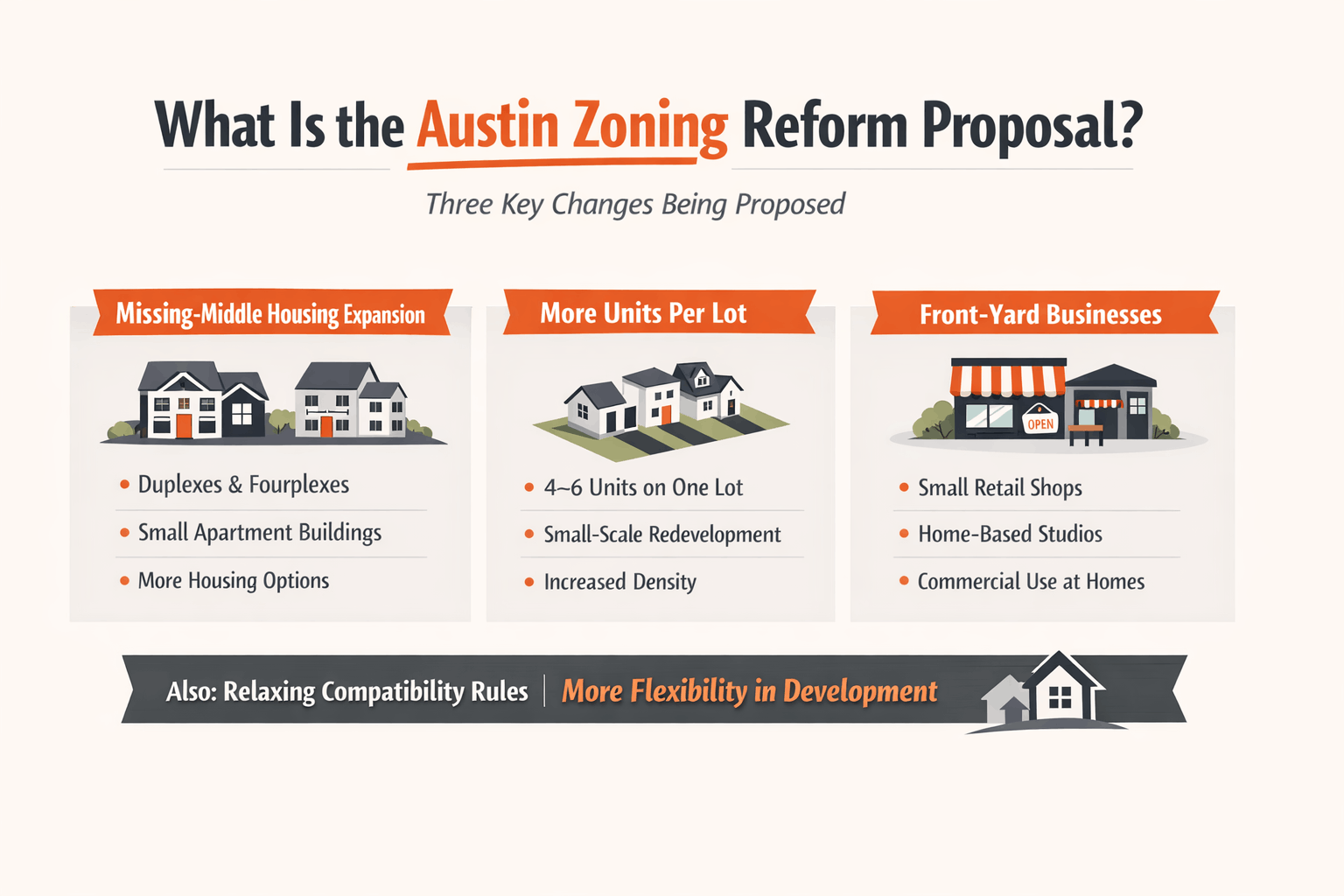
The current proposal being discussed by Austin policymakers focuses on three main changes:
1. Missing-middle housing expansion
This would allow:
Duplexes
Triplexes
Fourplexes
Small apartment buildings
These housing types would be permitted in areas that were previously limited to single-family homes.
2. More units per residential lot
The city is considering allowing:
4 to 6 housing units on a single-family lot
Small-scale redevelopment without full rezoning battles
Increased density in existing neighborhoods
3. Front-yard businesses
This is one of the most debated ideas. It would allow homeowners to:
Run small retail shops
Operate studios or service businesses
Use part of their residential property for commercial activity
At the same time, the city is exploring relaxing compatibility rules that limit how new buildings must “match” surrounding homes.
Why This Matters for Austin Real Estate Development
On paper, these changes are about affordability and housing supply. But in practice, they change something deeper: land value. Zoning rules decide what you can build. And what you can build decides what land is worth.
So when zoning expands, everything changes:
Property values shift
Development feasibility increases
Investor strategies change
Neighborhood transformation accelerates
This is why zoning reform is not just a planning issue. It is a financial one.
From Single-Family Homes to Flexible Density
For decades, much of Austin’s residential land has been locked into single-family zoning. That means one house per lot, with strict limits on additional units. The proposed reform changes that model.
What could change
If approved, a single lot could potentially support:
Multiple housing units
Small apartment-style buildings
Duplex or triplex conversions
Incremental redevelopment over time
Why this is important
This shift creates what planners often call “missing-middle housing potential.” It fills the gap between single-family homes and large apartment complexes.
From a development perspective, this means:
Higher yield per parcel
More redevelopment opportunities in established neighborhoods
Stronger demand for feasibility studies before land purchase
In simple terms, land becomes more productive.
Missing-Middle Housing in Austin: Filling the Gap
Missing-middle housing has become a major focus in urban planning across the United States.
It includes housing types that are:
Smaller than apartment buildings
Larger than single-family homes
Designed to fit into existing neighborhoods
Why cities support it
The main arguments are:
It increases housing supply without large high-rises
It supports walkable neighborhood design
It allows gradual, organic density growth
Why developers pay attention
For developers, missing-middle housing is attractive because:
Construction costs can be lower than those of large-scale projects
Approval processes may be simpler than those for high-density developments
Smaller projects reduce financial risk
However, it also introduces complexity in zoning interpretation, parking requirements, and neighborhood compatibility.
Front-Yard Businesses: A New Type of Mixed-Use Living
One of the most interesting parts of the proposal is the idea of allowing small businesses in residential front yards.
This could include:
Small cafés or bakeries
Home studios or creative spaces
Service-based micro-businesses
Neighborhood retail uses
Why is this idea controversial
Supporters see this as a way to:
Support local entrepreneurship
Reduce commercial rent pressure
Create walkable neighborhoods
Encourage mixed-use living
But there are practical concerns:
Increased traffic in residential streets
Parking shortages
Noise and privacy issues
Insurance and liability challenges
Enforcement complexity
This is where zoning theory meets real-world neighborhood dynamics.
Relaxing Compatibility Rules: More Flexibility, Less Predictability
Compatibility standards are rules that control how new buildings fit into existing neighborhoods. They often regulate height, setbacks, and design transitions. Austin is considering loosening these rules.
What could this lead to
Taller buildings near single-family homes
More design variation across neighborhoods
Increased redevelopment opportunities
Faster approval for certain projects
The tradeoff
While this increases flexibility, it also reduces predictability. For developers, that means:
More uncertainty during design phase
Higher need for early-stage feasibility analysis
Greater reliance on zoning interpretation experts
The Real Impact on Developers and Investors
If these zoning reforms pass, Austin’s development landscape will shift quickly.
New opportunities
Small infill housing projects become more viable
Single-family redevelopment increases
Mixed-use residential properties become more common
Underutilized land gains new development potential
New challenges
Community opposition may increase in some neighborhoods
Permitting systems may struggle to adapt
Financing models for small-scale projects become more important
Regulatory interpretation becomes more complex
In short, opportunity expands, but so does uncertainty.
Why Feasibility Studies Become More Important
In a changing zoning environment, guessing is risky.
Developers will need to answer questions like:
What can legally be built on this lot today—and tomorrow?
How likely is approval under new zoning rules?
What is the highest and best use under multiple scenarios?
How long will entitlements realistically take?
This is where early-stage consulting becomes essential.
Firms specializing in zoning analysis and entitlement strategy, such as JDJ Consulting Group, help bridge the gap between policy change and real development decisions.
Lessons From Other U.S. Cities
Austin is not the first city to explore these ideas.
Cities that expanded housing flexibility
Some cities have seen:
Increased housing supply
More diverse housing types
Better use of underdeveloped land
Common challenges
However, many also experienced:
Slow or inconsistent permitting systems
Neighborhood resistance to change
Infrastructure pressure in growing areas
Confusion during transition periods
The lesson is simple: zoning reform works best when implementation systems are strong.
What This Means for Austin’s Future Growth
Austin is moving toward a more flexible urban model. The direction is clear:
Less strict separation between residential and commercial uses
More density inside existing neighborhoods
More small-scale development opportunities
More mixed-use living environments
This does not mean every neighborhood will change overnight. But it does mean the rules are becoming more flexible. And flexibility changes everything in real estate.
Final Thoughts: A Market in Transition
Austin’s zoning reform debate is not just about housing policy. It is about how cities evolve. Some people see opportunity. Others see disruption. Both views are valid. But from a development and consulting perspective, one thing is clear:
The zoning environment is becoming more dynamic, more complex, and more opportunity-driven. In markets like this, success depends on timing, interpretation, and strategy. And those who understand zoning shifts early will always have the advantage.
Want Clarity on an Austin Project?
If you’re looking at a site or thinking about a development in Austin, these zoning changes could seriously affect what’s possible—and what’s profitable.
Instead of guessing, talk it through with us.
At JDJ Consulting Group, we help you understand feasibility, zoning potential, and real development options in plain language.
FAQs: How Austin’s Zoning Shift Changes Development Feasibility
What is the main goal of the Austin zoning reform proposal?
The goal is simple: allow more housing and make neighborhoods more flexible.
Add more housing options in existing areas
Improve affordability by increasing supply
Support mixed-use, walkable communities
Instead of strict single-family zoning, Austin is moving toward a more flexible system where land can be used more efficiently.
What is missing-middle housing?
Missing-middle housing sits between single homes and large apartments.
Duplexes, triplexes, and fourplexes
Small apartment-style buildings
Designed to fit into neighborhoods
It helps cities grow without building high-rises everywhere. It also creates more affordable housing choices for different types of residents.
How do zoning changes affect property value?
Zoning decides what you can build—and that impacts value.
More units = higher land value
More flexibility = more investor interest
Better use of land
When zoning expands, land becomes more productive. That often leads to higher demand and stronger development potential.
What are front-yard businesses?
Front-yard businesses allow small commercial activity in residential areas.
Cafés, studios, or small shops
Home-based service businesses
Creative or retail uses
They support local business growth. But they can also raise concerns about traffic, parking, and noise in quiet neighborhoods.
How many units can be built on one lot?
The proposal allows more units on a single lot.
Around 4 to 6 units per lot
No need for full rezoning in some cases
Supports small-scale development
This change makes it easier to increase housing without large projects. It also improves land efficiency.
What are compatibility rules?
Compatibility rules control how new buildings fit into neighborhoods.
Limit height and size
Control spacing and design
Protect neighborhood character
Relaxing these rules gives developers more flexibility. But it can also make outcomes less predictable.
How will developers be affected?
Developers will see both benefits and challenges.
More redevelopment opportunities
Higher returns per property
More small-scale projects
But they may also face community pushback and more complex approvals. Careful planning becomes more important than ever.
Why are feasibility studies important now?
Zoning changes make development less predictable.
Helps understand what can be built
Reduces financial risk
Improves decision-making
Without proper analysis, developers may misjudge a project’s potential. Feasibility studies provide clarity before investing.
What does this mean for Austin’s future?
Austin is shifting toward a more flexible city model.
More density in existing neighborhoods
More mixed-use living
More housing choices
Change will happen gradually. But over time, neighborhoods will become more dynamic, diverse, and development-friendly.