
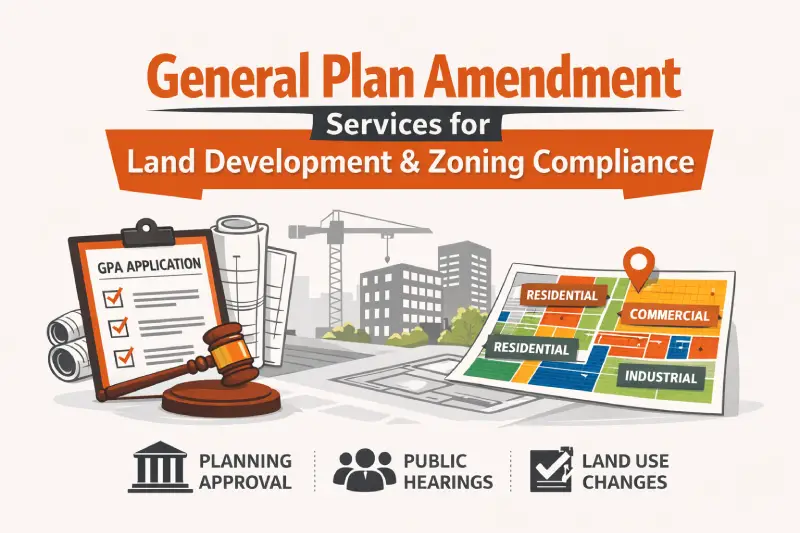
A General Plan Amendment (GPA) is often the first major step when a development project does not align with a city’s long-term land use vision. Whether you are planning a mixed-use project, increasing density, or converting land use, a GPA allows you to legally adjust how a property can be used.
For developers, property owners, and investors, this process can feel complex. It involves multiple reviews, public hearings, and strict compliance requirements. That is where professional guidance becomes important.
At its core, a General Plan Amendment is about aligning your project with future growth policies. Cities rely on general plans to guide housing, transportation, infrastructure, and economic development. If your project falls outside those guidelines, a GPA becomes necessary.
This guide explains what a General Plan Amendment is, when you need one, and the different types involved. It is written in a simple, practical way to help you understand both the process and the value of working with a consulting firm.
Table of Contents
What Is a General Plan Amendment (GPA)?
A General Plan Amendment is a formal request to change a city or county’s long-term planning document. This document, called the general plan, acts as a blueprint for how land will be used over time.
Cities use general plans to manage growth. They outline where housing, commercial centers, industrial zones, and public services should be located. When a proposed project does not match this blueprint, an amendment is required.
Definition and Purpose of a General Plan
A general plan is a policy-level document that guides development decisions. It does not regulate individual parcels directly. Instead, it sets the direction for future zoning and land use decisions.
Most general plans include the following elements:
- Land use
- Housing
- Transportation
- Safety
- Environmental conservation
- Infrastructure planning
These elements work together to ensure balanced growth. For example, a city may plan for higher-density housing near transit corridors while preserving low-density residential areas elsewhere.
The purpose of a General Plan Amendment is to adjust this long-term vision when conditions change. Economic trends, population growth, and development opportunities often require updates to keep the plan relevant.
What Does a General Plan Amendment Change?
A GPA can modify different aspects of the general plan. The most common changes involve land use designations, but amendments can also affect policies and development intensity.
Here are the typical changes a GPA allows:
| Change Type | Description | Example |
|---|---|---|
| Land Use Designation | Changes how land is categorized | Residential → Commercial |
| Density/Intensity | Adjusts how much can be built | Low-density → High-density housing |
| Policy Updates | Revises planning policies | Adding mixed-use development policies |
| Land Use Map Changes | Updates planning maps | Expanding urban development zones |
These changes directly impact what can be built on a property. For example, increasing density may allow multi-family housing instead of single-family homes.
Why General Plan Amendments Are Required
A General Plan Amendment is required when a project conflicts with the existing plan. Cities must ensure that all zoning and development approvals remain consistent with their general plan.
Common reasons for needing a GPA include:
- A developer wants to change land use (e.g., residential to commercial)
- A project proposes higher density than currently allowed
- A property is being redeveloped for a new purpose
- Market demand shifts, requiring updated land use strategies
In many cases, a project cannot move forward without this step. Even if zoning changes are approved, they must align with the general plan. If they do not, the amendment must come first.
General Plan vs Zoning (Important Distinction)
Understanding the difference between a general plan and zoning is critical. These terms are often confused, but they serve different roles in land development.
Here is a simple comparison:
| Factor | General Plan | Zoning |
|---|---|---|
| Purpose | Long-term vision | Day-to-day regulation |
| Scope | Citywide | Parcel-specific |
| Flexibility | Broad and policy-based | Detailed and rule-based |
| Authority | Guides decisions | Enforces rules |
The general plan sets the direction. Zoning follows that direction and applies specific rules such as building height, setbacks, and permitted uses.
If your project does not align with the general plan, rezoning alone will not solve the issue. A General Plan Amendment must come first to ensure consistency.
When Do You Need General Plan Amendment Services?
Not every development project requires a General Plan Amendment. However, when your proposal does not align with the city’s long-term plan, this process becomes necessary. Understanding when to pursue a GPA early can save time, reduce risk, and prevent costly delays.

Common Development Scenarios
Several types of projects typically require a General Plan Amendment. These are often larger or more complex developments that go beyond existing land use designations.
Common scenarios include:
- Converting residential land into commercial or mixed-use space
- Developing multi-family housing in low-density areas
- Expanding industrial or logistics facilities
- Redeveloping outdated or underutilized properties
- Creating large-scale mixed-use communities
For example, if a property is designated for single-family housing but a developer wants to build apartments, a GPA is usually required to increase density.
Signs Your Project Requires a GPA
It is not always obvious when a General Plan Amendment is needed. However, there are clear indicators that signal this requirement.
Look for these signs:
- The proposed use does not match the current land use designation
- The city flags inconsistency during early review
- Zoning approval is denied due to general plan conflict
- The project significantly increases traffic or infrastructure demand
Early feasibility analysis is important here. A consultant can review your project and confirm whether a GPA is required before you invest further resources.
Do You Need a GPA and Rezoning Together?
In many cases, a General Plan Amendment and rezoning go hand in hand. These are separate processes, but they are closely linked.
Here is how they work together:
- GPA updates the city’s long-term vision
- Rezoning updates the rules for the specific property
Most cities require the GPA to be approved first. Once the general plan is updated, zoning changes can follow to implement the new land use.
| Scenario | GPA Required | Rezoning Required |
|---|---|---|
| Land use change | Yes | Yes |
| Density increase | Yes | Yes |
| Minor zoning adjustment | No | Yes |
| Policy update only | Yes | Sometimes |
Handling both processes together requires careful coordination. This is where professional consulting services add value by aligning timelines and documentation.
Types of General Plan Amendments
Not all General Plan Amendments are the same. The type of amendment depends on the scale of the project, the nature of the change, and who is initiating it. Understanding these categories helps set expectations for timelines, costs, and approval complexity.
Major vs Minor Amendments
Cities often classify GPAs as either major or minor. This distinction affects how the application is reviewed and approved.
Major Amendments
- Involve large land areas
- Create significant policy or land use changes
- Often require extensive environmental review
- Typically reviewed less frequently (sometimes annually)
Minor Amendments
- Affect smaller parcels
- Involve limited changes
- Faster review process
- Lower overall complexity
| Amendment Type | Scope | Review Complexity | Timeline |
|---|---|---|---|
| Major GPA | Large-scale changes | High | 6–12+ months |
| Minor GPA | Small adjustments | Moderate | 3–6 months |
Major amendments usually face more scrutiny due to their broader impact on the community.
Map Amendments vs Text Amendments
General Plan Amendments can also be categorized based on what they change within the document.
Map Amendments
- Modify land use maps
- Change how a property is designated
- Most common type of GPA
Text Amendments
- Update policies, goals, or standards
- May affect multiple properties or citywide rules
For example:
- A map amendment might change land from “low-density residential” to “mixed-use”
- A text amendment might introduce new policies encouraging transit-oriented development
Both types may be required for larger projects.
Private vs City-Initiated Amendments
Another important distinction is who initiates the amendment.
Private-Initiated Amendments
- Submitted by developers or property owners
- Focused on specific projects
- Require application fees and supporting documents
City-Initiated Amendments
- Proposed by local government
- Often part of broader planning updates
- May involve multiple properties or districts
| Initiator | Purpose | Example |
|---|---|---|
| Private Developer | Project-specific change | Mixed-use development proposal |
| City Government | Policy or area-wide update | Downtown redevelopment plan |
Private amendments are more common in development projects, while city-initiated changes often reflect long-term planning strategies.
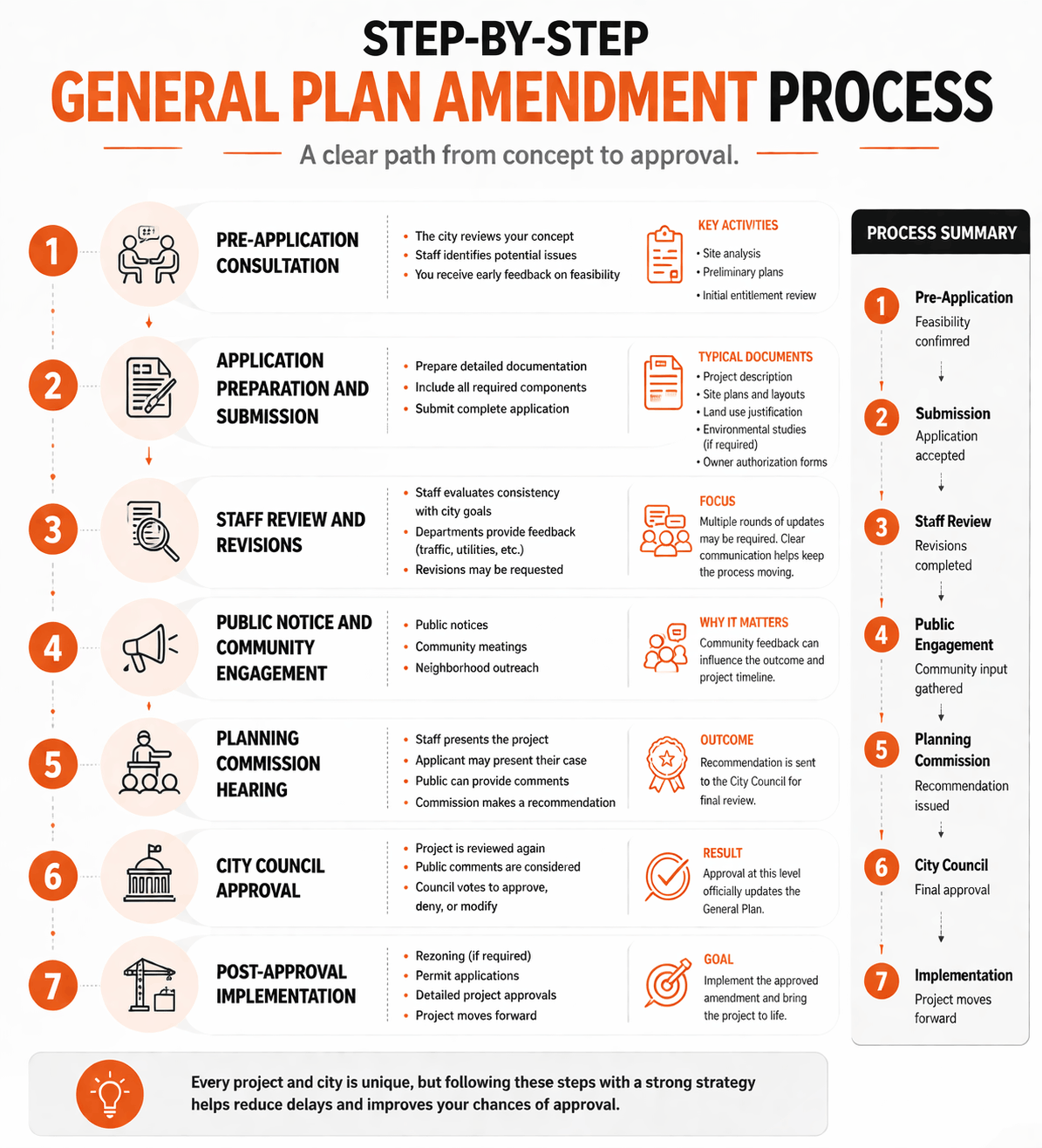
Step-by-Step General Plan Amendment Process
The General Plan Amendment process follows a structured path. While details vary by city, most jurisdictions follow a similar sequence. Understanding each step helps you plan ahead and avoid delays.
1. Pre-Application Consultation
This is the starting point. Before submitting a formal application, you meet with the planning department to discuss your project.
During this stage:
- The city reviews your concept
- Staff identifies potential issues
- You receive early feedback on feasibility
This step is important because it helps you confirm whether a GPA is required. It also highlights risks such as community concerns or environmental constraints.
A strong pre-application strategy often includes:
- Site analysis
- Preliminary plans
- Initial entitlement review
2. Application Preparation and Submission
Once feasibility is confirmed, the next step is preparing the application. This stage requires detailed documentation.
Typical application components include:
- Project description
- Site plans and layouts
- Land use justification
- Environmental studies (if required)
- Owner authorization forms
Here is a simplified breakdown:
| Document Type | Purpose |
|---|---|
| Project Narrative | Explains the proposal and intent |
| Site Plans | Shows layout and design |
| Land Use Analysis | Justifies the amendment |
| Environmental Reports | Evaluates impacts |
| Application Forms | Official submission paperwork |
Accuracy matters here. Missing or incomplete information can delay the review process.
3. Staff Review and Revisions
After submission, city planning staff reviews the application. This is often an iterative process.
During review:
- Staff evaluates consistency with city goals
- Departments provide feedback (traffic, utilities, etc.)
- Revisions may be requested
It is common to go through multiple rounds of updates. Clear communication with city staff can help move things forward efficiently.
4. Public Notice and Community Engagement
Public involvement is a key part of the GPA process. Cities must notify nearby property owners and give the community a chance to respond.
This may include:
- Public notices
- Community meetings
- Neighborhood outreach
Community feedback can influence the outcome. Projects with strong local support tend to move faster, while opposition can lead to delays or revisions.
5. Planning Commission Hearing
Once staff review is complete, the project moves to the Planning Commission.
At this stage:
- Staff presents the project
- The applicant may present their case
- The public can provide comments
The Planning Commission then makes a recommendation. This recommendation is forwarded to the City Council for final review.
6. City Council Approval
The City Council is the final decision-making authority.
During this stage:
- The project is reviewed again
- Public comments are considered
- The council votes to approve, deny, or modify the amendment
Approval at this level officially updates the General Plan.
7. Post-Approval Implementation
Once approved, the amendment must be implemented.
This usually includes:
- Rezoning (if required)
- Permit applications
- Detailed project approvals
| Stage | Key Outcome |
|---|---|
| Pre-Application | Feasibility confirmed |
| Submission | Application accepted |
| Staff Review | Revisions completed |
| Public Engagement | Community input gathered |
| Planning Commission | Recommendation issued |
| City Council | Final approval |
| Implementation | Project moves forward |
Key Approval Criteria for General Plan Amendments
Approval is not automatic. Cities evaluate each application based on specific criteria. Meeting these standards is essential for success.
Consistency with City Vision
The most important factor is alignment with the city’s long-term goals.
Your project should support:
- Planned growth patterns
- Economic development goals
- Housing and infrastructure strategies
If a proposal conflicts with these priorities, approval becomes difficult.
Impact on Infrastructure and Services
Cities assess whether existing infrastructure can support the project.
This includes:
- Traffic and road capacity
- Water and sewer systems
- Schools and public services
Projects that overload infrastructure may require mitigation measures.
Environmental Considerations
Environmental review is often required, especially for larger projects.
This may involve:
- Environmental impact studies
- Air quality analysis
- Noise and traffic assessments
Environmental concerns can significantly affect timelines and costs.
Community Impact and Public Interest
Public opinion plays a major role. Cities consider how the project affects surrounding neighborhoods.
Key factors include:
- Compatibility with nearby uses
- Visual and design impact
- Community benefits
Projects that provide clear public value tend to receive stronger support.
Cost-Benefit Evaluation
Cities weigh the overall benefits against potential drawbacks.
| Evaluation Factor | Considerations |
|---|---|
| Economic Impact | Job creation, tax revenue |
| Infrastructure Demand | Cost of upgrades |
| Community Benefit | Housing, amenities |
| Environmental Impact | Mitigation required |
A well-prepared application clearly demonstrates that the benefits outweigh the impacts.
Challenges in the General Plan Amendment Process
Even well-planned projects can face challenges. Being aware of these issues helps you prepare and respond effectively.
Regulatory Complexity
The GPA process involves multiple departments and regulations. Each agency may have its own requirements.
Common challenges include:
- Coordinating between departments
- Meeting technical standards
- Managing documentation
Without proper guidance, this complexity can slow progress.
Public Opposition
Community resistance is one of the most common obstacles.
Concerns may include:
- Increased traffic
- Changes to neighborhood character
- Environmental impact
Addressing these concerns early through outreach and communication is critical.
Long Approval Timelines
General Plan Amendments take time. Even straightforward cases can take several months.
Typical delays occur due to:
- Application revisions
- Scheduling hearings
- Extended environmental review
Environmental Review Delays
Environmental requirements can add another layer of complexity.
| Issue | Impact |
|---|---|
| Additional Studies | Increases cost and time |
| Regulatory Compliance | Requires expert coordination |
| Public Review | Adds more scrutiny |
Projects that trigger extensive environmental review often experience longer timelines.
Our General Plan Amendment Services
A General Plan Amendment is not just a form submission. It requires strategy, coordination, and clear communication with multiple stakeholders. Our services are designed to guide your project from early feasibility to final approval.
We focus on reducing risk, improving approval chances, and keeping your project on schedule.
Land Use Feasibility Analysis
Every successful project starts with a clear understanding of what is possible. We evaluate your site and proposal before any formal submission.
Our feasibility analysis includes:
- Review of current land use designation
- Identification of conflicts with the general plan
- Assessment of approval likelihood
- Strategy recommendations
This early step helps you avoid costly mistakes. It also provides a roadmap for moving forward.
Application Preparation and Management
Preparing a strong application is critical. Cities expect detailed and accurate documentation.
We handle:
- Project narratives
- Land use justifications
- Application forms and submittals
- Coordination of technical reports
Our goal is to present your project in a way that aligns with city priorities. A well-prepared application reduces review cycles and delays.
Stakeholder and Community Coordination
Community input can shape the outcome of your project. We help manage this process in a structured way.
Our approach includes:
- Organizing community meetings
- Addressing concerns early
- Preparing communication materials
- Supporting public presentations
Clear communication builds trust and reduces opposition.
Government Liaison and Representation
Working with city staff and decision-makers requires experience. We act as your representative throughout the process.
This includes:
- Coordinating with planning departments
- Responding to staff comments
- Presenting at hearings
- Managing approvals
Having a knowledgeable representative helps keep the process on track.
Environmental and Technical Coordination
Many projects require specialized studies. We coordinate with experts to ensure compliance.
We manage:
- Environmental consultants
- Traffic and infrastructure studies
- Technical reports and documentation
This coordination ensures all requirements are met without unnecessary delays.
End-to-End Project Management
From concept to approval, we manage every stage of the GPA process.
| Service Stage | What We Handle |
|---|---|
| Pre-Planning | Feasibility and strategy |
| Application | Documentation and submission |
| Review | Revisions and coordination |
| Hearings | Representation and support |
| Approval | Final steps and implementation |
This full-service approach allows you to focus on your project while we handle the process.
Benefits of Hiring a General Plan Amendment Consultant
Many developers underestimate the complexity of a General Plan Amendment. Working with a consultant provides both strategic and practical advantages.

Faster Approvals
Experienced consultants understand the process and expectations. This helps reduce delays caused by incomplete applications or missed requirements.
Benefits include:
- Fewer revision cycles
- Better coordination with city staff
- Efficient handling of documentation
Reduced Risk
Land use approvals carry financial and regulatory risks. A consultant helps identify and manage these risks early.
Key advantages:
- Early issue detection
- Strategic planning
- Compliance with regulations
This reduces the chance of denial or major setbacks.
Better Project Outcomes
A well-planned GPA does more than secure approval. It improves the overall quality and viability of your project.
Consultants help:
- Align projects with city goals
- Improve design and land use strategy
- Enhance long-term value
Expertise in Local Regulations
Each city has its own rules and procedures. Understanding these details is essential.
| Benefit | Impact |
|---|---|
| Local Knowledge | Better alignment with city policies |
| Process Expertise | Smoother approvals |
| Established Relationships | Improved communication |
This expertise can make a significant difference in both timeline and outcome.
General Plan Amendment Costs and Timeline
Costs and timelines vary depending on the size and complexity of the project. Understanding these factors helps you plan your investment.
Typical Cost Breakdown
A General Plan Amendment involves several cost components. These can vary widely based on location and project scope.
| Cost Component | Estimated Range |
|---|---|
| Application Fees | $1,000 – $10,000+ |
| Environmental Studies | $5,000 – $50,000+ |
| Consulting Fees | Varies by project |
| Technical Reports | $2,000 – $20,000 |
| Public Outreach | Variable |
Larger or more complex projects typically require higher investment, especially if environmental review is extensive.
Timeline Expectations
The GPA process takes time. While smaller projects may move faster, most require several months.
| Stage | Estimated Duration |
|---|---|
| Pre-Application | 2–4 weeks |
| Application Preparation | 3–6 weeks |
| Staff Review | 2–4 months |
| Hearings and Approval | 2–4 months |
Overall, timelines typically range from 4 months to over a year.
Factors That Affect Cost and Timeline
Several factors can influence how long the process takes and how much it costs:
- Project size and complexity
- Environmental review requirements
- Level of community support
- City workload and review cycles
Projects with strong preparation and clear alignment with city goals tend to move faster.
General Plan Amendment vs Rezoning: Key Differences
Understanding the difference between a General Plan Amendment and rezoning is essential for any development project. Although they are related, they serve different purposes.
| Factor | General Plan Amendment | Rezoning |
|---|---|---|
| Purpose | Changes long-term land use vision | Changes property-specific rules |
| Scope | Citywide or large area | Individual parcel |
| Complexity | High | Moderate |
| Approval Authority | City Council | Planning Commission or Council |
In most cases:
- A GPA must be approved first
- Rezoning follows to implement the change
This sequence ensures consistency between planning policy and regulation.
Get Expert Help with Your General Plan Amendment
A General Plan Amendment is a critical step in many development projects. It requires careful planning, clear communication, and strong coordination with city agencies. Working with an experienced consultant helps simplify the process and improves your chances of success. Whether you are exploring a new project or ready to move forward, professional support can make a measurable difference.
Let’s Talk About Your Project
If you’re considering a General Plan Amendment, it’s best to start with a simple conversation. Every site and project is different, and getting early clarity can save you months of delays.
Our team at JDJ Consulting is here to help you understand what’s possible, what challenges to expect, and how to move forward with confidence. You don’t need to have everything figured out. Even if you’re just exploring an idea, we can guide you in the right direction.
Here’s how you can get started:
- Fill out our pre-consultation form so we can review your project details
- Schedule a one-on-one meeting with our consultants
- Or reach out directly if you prefer a quick conversation
- Phone: (818) 793-5058
- Email: sales@jdj-consulting.com
You can also use our contact page here: https://jdj-consulting.com/book-consultation/
We’ll take the time to understand your goals, review your site, and give you clear next steps. No pressure, just practical guidance to help you move forward.
FAQs General Plan Amendment Services
What is a General Plan Amendment?
A General Plan Amendment (GPA) is a formal change to a city or county’s long-term land use plan. It allows updates to land use designations, policies, or development intensity.
- Used when a project does not align with the current plan
- Required before certain zoning changes
- Ensures consistency with future growth strategies
It acts as the foundation for how land can be used and developed over time.
When is a General Plan Amendment required?
A GPA is required when your proposed development conflicts with the existing land use designation. Cities must ensure all projects align with their general plan.
- Changing land use (e.g., residential to commercial)
- Increasing density beyond current limits
- Large redevelopment projects
If your project does not match the city’s vision, a GPA is usually the first step.
How long does a General Plan Amendment take?
The timeline varies depending on project complexity and city processes. Most GPAs take several months to complete.
- Simple projects: 3–6 months
- Complex projects: 6–12+ months
- Environmental review can extend timelines
Delays often occur during staff review or public hearings, especially if revisions are required.
How much does a General Plan Amendment cost?
Costs vary widely based on project size, location, and required studies. There is no fixed price.
- Application fees: $1,000 – $10,000+
- Environmental studies: $5,000 – $50,000+
- Consulting fees: project-based
Larger developments typically require more detailed analysis, which increases overall costs.
What is the difference between a General Plan Amendment and rezoning?
A General Plan Amendment changes the long-term vision, while rezoning changes property-specific rules.
- GPA = policy-level change
- Rezoning = regulatory change
- GPA usually comes first
Both are often required for development projects that involve major land use changes.
Can a General Plan Amendment be denied?
Yes, a GPA can be denied if it does not meet city requirements or lacks support. Approval depends on several factors.
- Inconsistency with city goals
- Strong public opposition
- Environmental concerns
A well-prepared application with clear benefits improves approval chances significantly.
Who approves a General Plan Amendment?
The final approval is typically made by the City Council or governing body.
- Planning Commission reviews and recommends
- City Council makes the final decision
- Public input is considered
This multi-step process ensures transparency and alignment with community goals.
Do I need both a General Plan Amendment and rezoning?
In many cases, yes. Both processes serve different purposes but often work together.
- GPA updates land use designation
- Rezoning applies development regulations
If your project changes land use or density, you will likely need both approvals.
What documents are required for a General Plan Amendment?
A GPA application requires detailed documentation to support the request.
- Project description and narrative
- Site plans and maps
- Land use justification
- Environmental reports (if required)
Accurate and complete documents help avoid delays during the review process.
What is the role of public hearings in the GPA process?
Public hearings allow community members to review and comment on proposed changes. They are a required part of the process.
- Held during Planning Commission review
- Final input before City Council decision
- Helps identify concerns early
Community feedback can influence approval outcomes and project modifications.
What factors do cities consider when approving a GPA?
Cities evaluate multiple factors to determine whether a GPA should be approved.
- Consistency with long-term planning goals
- Impact on infrastructure and services
- Environmental considerations
- Community benefits
Projects that align with city priorities and provide clear value are more likely to succeed.
What are the biggest challenges in the GPA process?
The GPA process can be complex and time-consuming. Several challenges may arise.
- Regulatory requirements and documentation
- Public opposition or concerns
- Environmental review delays
Proper planning and expert guidance can help manage these challenges effectively.
Can a property owner apply for a General Plan Amendment?
Yes, property owners or developers can initiate a GPA request. It is not limited to government agencies.
- Requires formal application submission
- Must include supporting documentation
- Subject to city review and approval
Working with a consultant can improve the quality and success of the application.
What is a major vs minor General Plan Amendment?
Cities often classify GPAs based on the scale of change. This affects review timelines and complexity.
- Major GPA: large-scale or policy changes
- Minor GPA: small adjustments to land use
Major amendments typically require more review and take longer to approve.
Why should I hire a consultant for a General Plan Amendment?
A consultant helps manage the process and improves approval chances. Their expertise reduces risk and delays.
- Handles documentation and submissions
- Coordinates with city staff
- Represents you during hearings
This support ensures your project is aligned with regulations and positioned for success.