California’s housing crisis has been escalating for years. Skyrocketing rents, shrinking affordable options, and a backlog of development approvals have made building new housing a complicated and often frustrating process. When Mr. Thompson, a small developer in Los Angeles, came to us, he described the struggle perfectly:
“I thought I had everything lined up,” he said. “Site plans, contractor, financing—I was ready. But the city kept pushing back. They changed rules mid-review, asked for new designs, and my timeline kept slipping. I had no idea what I was supposed to prepare first. It felt like the system was working against me.”
This is exactly what SB 330 was designed to address. Passed in 2019 as the Housing Crisis Act, the law aims to streamline the permitting process, protect existing housing, and give developers and communities a clearer path forward. In this blog, we’ll break down how SB 330 works, its practical implications, and why it is both praised and criticized in the real estate world.
What Is SB 330?
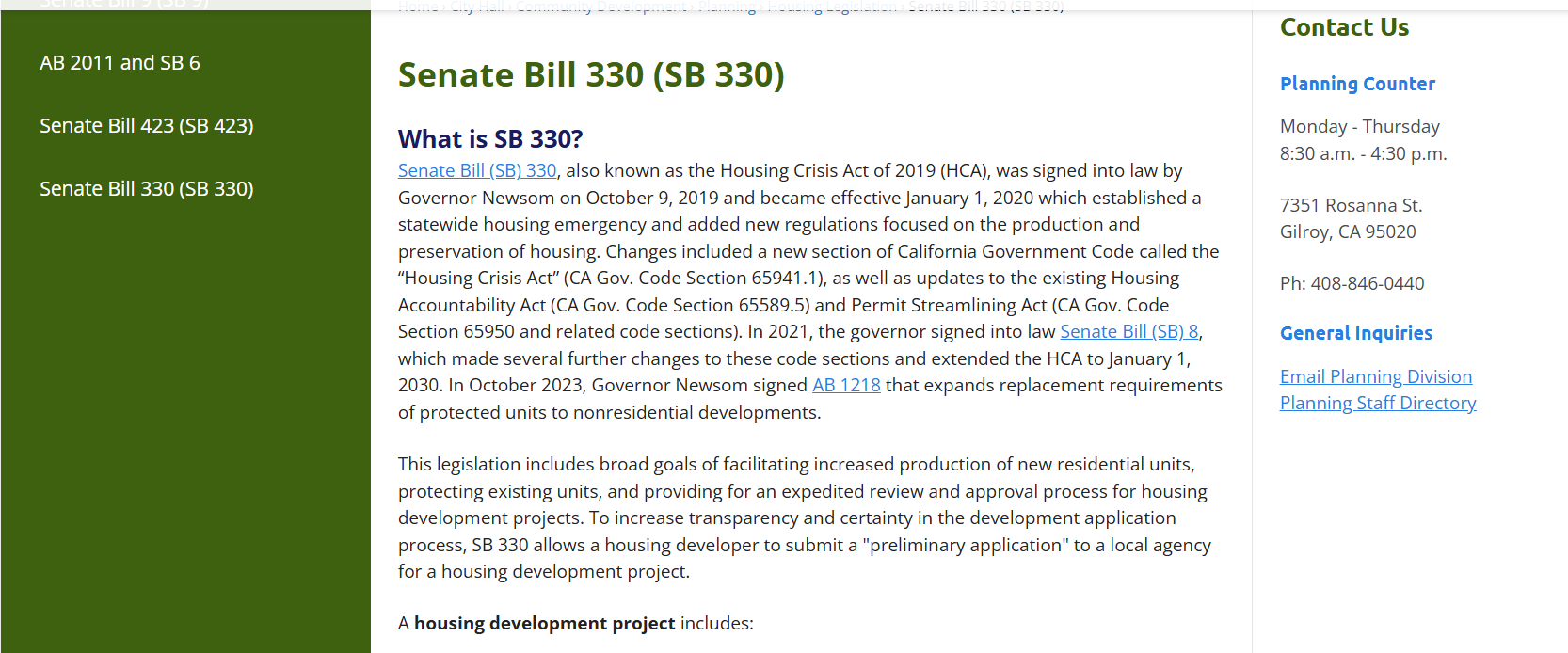
SB 330, officially known as the Housing Crisis Act of 2019, went into effect on January 1, 2020. Its main goal is simple: speed up housing production while protecting existing housing stock.
At its core, SB 330:
Limits local governments’ ability to impose new restrictions once a project is in the approval pipeline.
Protects tenants in existing units by requiring replacement housing if demolitions occur.
Streamlines permitting and review timelines, giving developers more predictability.
Although originally set to expire on January 1, 2025, many provisions have since been extended or made permanent.
Why SB 330 Matters: The Big Picture
The law is not just bureaucracy—it’s a strategic attempt to solve a statewide housing crisis. Here’s why it matters:
1. Streamlined Permitting
Before SB 330, developers often spent months navigating shifting rules and requirements. SB 330 allows for a “preliminary application”, which locks in:
Fees at the time of submission
Zoning and development standards
Design requirements that cannot be changed mid-review
This reduces the risk of sudden rule changes, saving developers time, money, and legal headaches.
2. Protecting Existing Housing
One of the most impactful aspects of SB 330 is “no net loss” protection. If a development demolishes existing housing, it must:
Replace all units lost
Maintain unit size and income category for protected units
Provide tenants relocation assistance and possibly the right to return
This ensures new developments don’t worsen the housing crisis by displacing existing residents.
3. Limiting Local Regulatory Power
Cities can no longer arbitrarily introduce:
New moratoria on housing
Caps on housing permits
Subjective design standards that could block projects
Additionally, the law limits public hearings to five per project, including appeals, preventing endless delays.
4. Faster, More Predictable Review
SB 330 sets tight deadlines for local agencies, including projects requiring environmental review. Developers gain predictability: fees, rules, and timelines are locked in, reducing project uncertainty and financing risk.
How SB 330 Works in Practice
Understanding SB 330’s provisions in theory is one thing; applying it to real projects is another. Here’s how it works on the ground.
Preliminary Application & Vesting
The preliminary application is submitted with basic information:
Site plan
Project description
Basic drawings
By submitting this early and paying required fees, developers vest current rules and fees, meaning local governments cannot apply new restrictions or fees that arise after submission.
Limits on Local Regulatory Actions
SB 330 prevents cities from:
Downzoning: Cannot reduce allowable residential density after application submission
Imposing new moratoria aimed at restricting housing growth
Adding non-objective design standards that were not in effect at the time of the preliminary application
These measures reduce the risk of political or bureaucratic interference mid-project.
Housing Protection
SB 330 requires:
| Requirement | Details |
|---|---|
| No net loss | Must replace demolished units |
| Protected units | Same size/income class as original units |
| Tenant rights | Temporary relocation, return rights, relocation assistance |
This ensures that projects contribute positively to housing stock without displacing existing residents.
Review Timelines
The law enforces stricter timelines:
Local governments must act quickly once the full application is submitted
Environmental review timelines (CEQA) are shortened where applicable
Reduced rounds of corrections speed up overall approval
Who Qualifies for SB 330 Protections?
SB 330 applies to housing development projects, including:
Purely residential projects (2+ units)
Mixed-use projects with at least two-thirds residential square footage
Transitional or supportive housing
Some exceptions exist, including high fire hazard zones or other restricted areas.
Pros and Criticisms of SB 330
Advantages
Predictability: Developers can lock in rules and fees early
Efficiency: Streamlined review and fewer hearings speed up construction
Tenant protection: Replacement and relocation requirements preserve housing
Regulatory restraint: Reduces arbitrary or politically motivated obstacles
Criticisms
Reduced local control: Communities have less say in design and zoning changes
Design quality concerns: Limiting new design standards could affect aesthetics
Displacement risk: Demolitions, even with protections, may temporarily disrupt tenants
Temporary nature: Original expiration caused uncertainty, though many provisions are now extended
Real-World Impacts
Consider a mid-sized developer planning a 50-unit apartment project in Los Angeles:
Without SB 330: They could face six months of rule changes, multiple public hearings, and fee increases mid-review.
With SB 330: Preliminary application locks in fees, design, and zoning. Only five hearings are allowed, and demolition of existing units requires in-kind replacement.
This translates into faster approvals, reduced legal risk, and a more predictable budget.
Why Developers Should Care
SB 330 is not just legislation—it’s a strategic tool:
Lock in zoning and fees early
Reduce uncertainty during permitting
Plan with confidence knowing tenant protections and demolition rules are clear
Use SB 330 to protect investment and avoid lengthy bureaucratic delays
Why Local Governments Should Care
Cities and counties must:
Process applications efficiently
Limit hearings to five per project
Enforce “no net loss” and protected unit requirements
Adapt planning processes to comply with SB 330 timelines
Failure to comply can slow projects and potentially create legal challenges.
Key Takeaways
SB 330 streamlines housing development while protecting tenants.
Developers gain predictability by vesting current rules and fees.
Cities must comply with tighter review timelines and limited hearings.
Replacement requirements prevent net housing loss.
Provisions originally temporary are now extended or permanent.
Understanding SB 330 is critical for developers, investors, and planners navigating California’s housing landscape.
Opinion: Why SB 330 Is a Step Forward
From our perspective at JDJ Consulting, SB 330 represents a needed balance between developer predictability and housing preservation. While critics argue it limits local control, in practice it helps move projects forward, reduces wasted time, and ensures California gains housing stock without displacing residents. In a state where supply has not kept pace with demand, SB 330 is arguably one of the most important housing laws of the decade.

Conclusion
California’s housing crisis demands action. SB 330 provides developers with certainty and speed while protecting tenants and communities. For anyone involved in residential development—from small ADUs to large apartment complexes—understanding SB 330 is essential. With the right strategy, projects can proceed more efficiently, meet community needs, and comply with state law.
At JDJ Consulting, we help developers and property owners plan, prepare, and submit compliant housing projects under SB 330, ensuring smoother approvals and reduced risk.
Contact JDJ Consulting:
Address: 12925 Riverside Dr Suite 302, Sherman Oaks, CA 91423, USA
Phone: (818) 793-5058
Email: sales@jdj-consulting.com
Services & Consultation: Services, Book Consultation