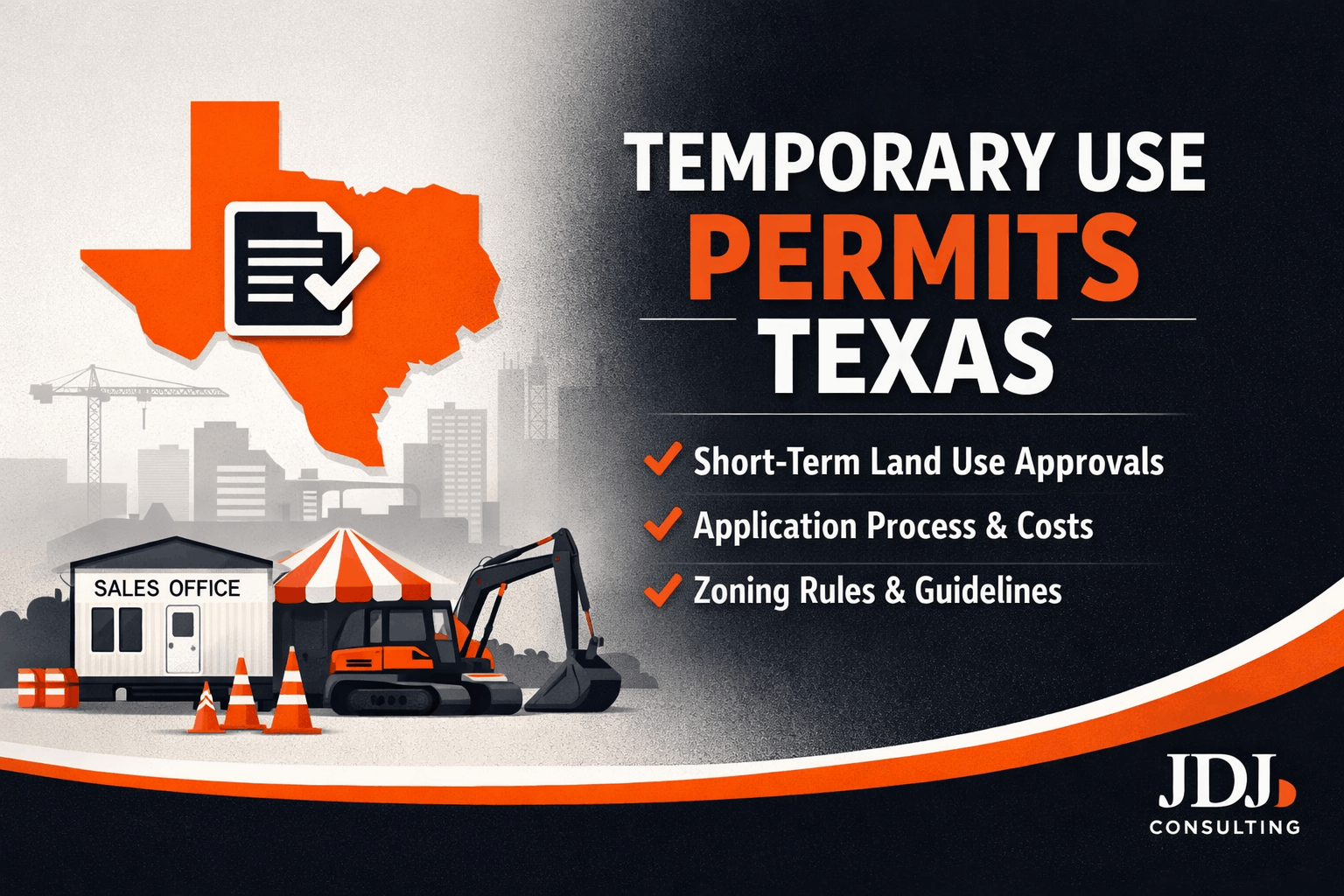
If you plan to use land in Texas for a short time, you may need a Temporary Use Permit before moving forward.
Many developers, landowners, and investors assume that short-term land use does not require approval. However, even temporary activities must comply with local zoning rules in most Texas cities.
For example, you may want to:
Set up a temporary sales office
Install a construction trailer
Use land for equipment storage
Operate a seasonal retail stand
Host a short-term outdoor event
These uses may not meet the existing zoning classification of the property. Still, local planning departments may allow them for a limited time through a Temporary Use Permit.
This permit gives legal approval for short-term land use without changing the zoning of the site.
Temporary Use Permits are often required during:
Pre-development planning
Project marketing phases
Construction staging
Land entitlement review
Applying for this permit early can help prevent delays during project setup.
In this guide, we will explain how Temporary Use Permits in Texas work, including requirements, timelines, costs, zoning rules, and common application mistakes. This will help you prepare for short-term land use while keeping your project aligned with local development regulations.
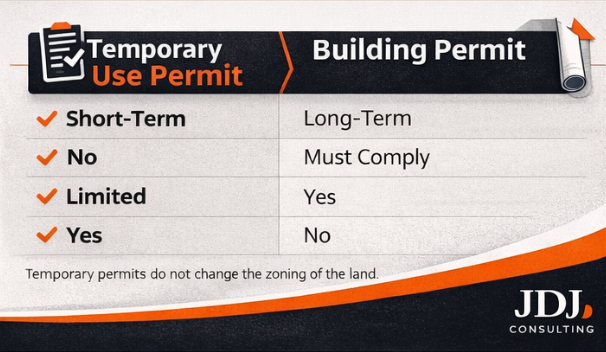
Table of Contents
ToggleWhat Is a Temporary Use Permit in Texas?
If you plan to use land in Texas for a short time, you may need a Temporary Use Permit (TUP). This permit allows you to run an activity on a property that is not usually allowed under the current zoning rules. However, the approval is only for a limited period.
In simple terms, it gives you legal permission to use land in a different way without changing the zoning of the property. For example, you may want to:
Set up a temporary sales office
Run a seasonal retail stand
Use land for equipment storage
Host a short-term commercial event
Install a construction trailer
These activities may not meet the permanent zoning requirements. Still, cities in Texas may allow them for a short time if safety rules are followed. That is where a Temporary Use Permit becomes important.
It helps developers, landowners, and investors move forward with early project activities before full construction or long-term approvals begin.
This is common during:
Pre-development planning
Construction staging
Land entitlement review
Marketing phases of new projects
Many commercial development projects rely on temporary approvals before permanent permits are issued. Instead of applying for rezoning, which may take months, a Temporary Use Permit offers a faster path for short-term land use.
Simple Explanation of Temporary Use Permits (TUP)
A Temporary Use Permit allows a property to be used in a way that is not normally permitted under its zoning classification. However, the use must:
Be limited in time
Meet public safety rules
Avoid disruption to nearby properties
Support local planning goals
The key point is that the land use is not permanent. Once the approved time ends, the temporary structures or activities must be removed from the site.
This may include:
Portable offices
Tents
Equipment yards
Temporary parking
Pop-up retail setups
In most Texas cities, these permits are issued for a few days to several months, depending on the use.
When Do You Need a Temporary Use Permit in Texas?
You may need a Temporary Use Permit if you plan to use land for short-term business or project support. Common situations include:
Seasonal product sales
Mobile food service locations
Construction job site offices
Outdoor business promotions
Festivals or commercial events
Temporary real estate sales trailers
Contractor storage yards
Even temporary parking lots or staging areas may require approval in some jurisdictions. Each Texas city has its own zoning ordinance. So, requirements may vary. Still, most local governments require a permit when the proposed use does not match the approved zoning category.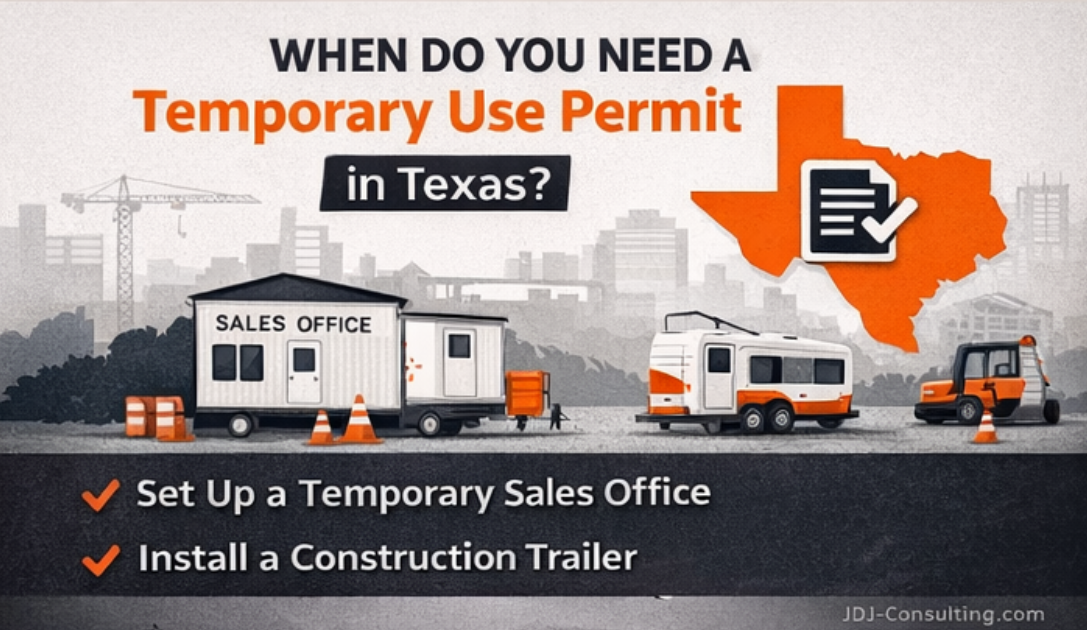
Temporary vs Permanent Land Use Approvals
It is also helpful to understand how a Temporary Use Permit compares with other approvals.
| Permit Type | Duration | Zoning Change Required | Construction Allowed | Renewal Needed |
|---|---|---|---|---|
| Temporary Use Permit | Short-term | No | Limited | Yes |
| Building Permit | Long-term | Must comply | Yes | No |
| Special Event Permit | Event-based | No | Sometimes | Case-specific |
| Zoning Change | Permanent | Yes | Yes | No |
A Temporary Use Permit does not change the zoning of the land. It only allows a short-term exception. That is why many developers apply for this permit during feasibility or entitlement phases.
Types of Temporary Use Permits Allowed in Texas Cities
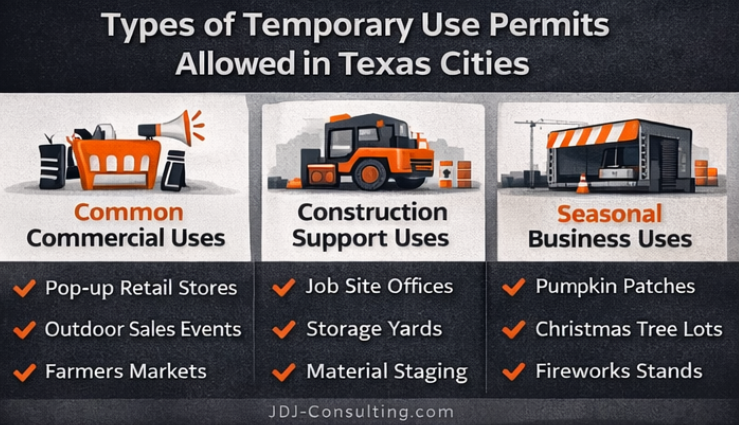
Temporary Use Permits support a wide range of short-term land uses across Texas. These uses often help projects move forward during early development stages. In most cities, temporary approvals are grouped into three main categories:
Commercial uses
Construction support uses
Seasonal or promotional activities
Each category serves a different purpose but follows similar zoning and safety rules.
Common Commercial Temporary Uses
Many businesses need short-term land use approval before opening a permanent location. Some common examples include:
Pop-up retail stores
Outdoor display areas
Temporary parking lots
Sales or leasing trailers
Farmers markets
Mobile vendor setups
Retail developers often apply for temporary permits to test market demand before full site development. This can help reduce investment risk during the planning stage. Temporary permits also support short-term promotions such as:
Grand opening events
Product launch displays
Limited-time outdoor sales
As long as the activity does not create safety concerns, local authorities may approve these uses for a defined time period.
Construction-Related Temporary Permits
Temporary Use Permits are also widely used during construction projects. Before the main building permit is issued, developers may need space for:
Job site offices
Equipment storage
Construction trailers
Material staging areas
Portable sanitation units
Temporary fencing
These structures are not meant to stay after the project is complete. Still, they must meet:
Fire safety standards
Accessibility guidelines
Traffic flow requirements
Local planning departments often review site plans to confirm that emergency access routes remain clear. In some cases, even temporary storage yards must be screened from nearby properties.
Seasonal Business Temporary Permits
Many seasonal businesses operate for only a few weeks each year. However, they still require land use approval in most Texas cities. Examples include:
Christmas tree lots
Pumpkin patches
Fireworks stands
Plant nurseries
Holiday markets
These uses often appear in commercial parking areas or vacant lots. Since they operate for a short time, a Temporary Use Permit allows them to function without rezoning the site. Still, operators must follow:
Signage rules
Traffic access requirements
Waste disposal standards
Permit duration usually depends on the seasonal timeline of the business.
Temporary Use Permit Requirements in Texas
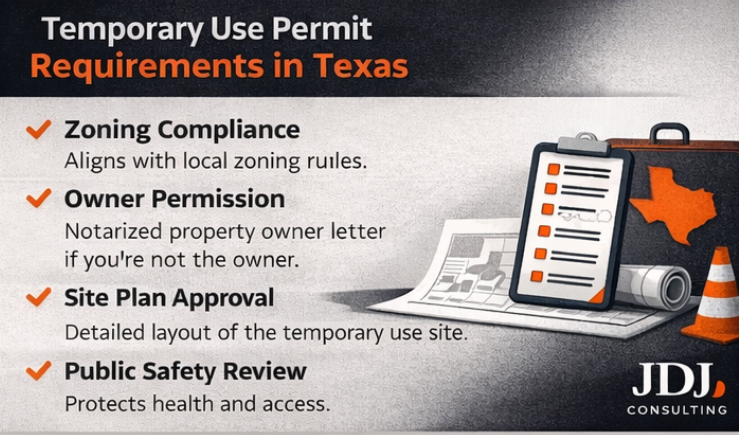
Although requirements vary by city, most Texas jurisdictions follow a similar review process for Temporary Use Permits. Applicants must show that the proposed activity:
Meets zoning intent
Protects public safety
Maintains access and traffic flow
Does not create nuisance conditions
Planning departments usually require several documents before approval.
Zoning Compliance Rules
Temporary use must align with the overall purpose of the zoning district. For example:
Commercial zones may allow temporary retail use
Industrial zones may allow staging yards
Mixed-use zones may allow event setups
However, residential districts may have stricter limits. City planners review each request to confirm that nearby properties will not be affected. Noise levels, lighting, and operating hours are often reviewed during this step.
Property Owner Authorization
If the applicant is not the property owner, written permission is usually required. This letter must confirm that:
The owner approves the temporary activity
The use is limited in time
Site conditions will be restored after removal
Some cities may require this document to be notarized before review begins.
Site Plan Requirements
A site plan is one of the most important parts of the application. It should clearly show:
Location of temporary structures
Parking layout
Vendor placement
Entry and exit points
Fire lanes
ADA access routes
Planning staff use this drawing to check:
Emergency access
Traffic safety
Pedestrian movement
Equipment placement
Incomplete site plans are one of the most common reasons for permit delays.
| Site Plan Element | Required for Approval |
|---|---|
| Structure Layout | Yes |
| Parking Plan | Yes |
| Fire Lane Access | Yes |
| Entry/Exit Routes | Yes |
| Accessibility Pathways | Yes |
| Vendor or Equipment Area | Yes |
Developers often submit temporary use permit applications during early project planning. This helps support:
Land feasibility studies
Pre-construction marketing
Temporary leasing operations
For firms like JDJ Consulting, this step is part of the broader land entitlement and zoning review process.
How to Apply for a Temporary Use Permit in Texas
Applying for a Temporary Use Permit in Texas is usually a local process. This means you must apply through the city or county where the property is located. While the steps may vary by jurisdiction, most planning departments follow a similar approval path.
In general, the process focuses on:
Zoning compatibility
Public safety
Traffic access
Site layout
So, it is important to prepare your documents before submitting the application.
Step-by-Step Application Process
Below is the typical process used by most Texas cities.
Step 1: Confirm Zoning Eligibility
First, check the zoning category of the property. Make sure your proposed temporary use is allowed under local zoning rules. If the use does not meet zoning intent, the permit may be denied.
Step 2: Prepare the Application
Next, complete the Temporary Use Permit application form. Most cities require:
Applicant information
Property details
Type of temporary use
Duration of use
Proposed operating hours
Step 3: Submit a Site Plan
Your application must include a site plan that shows:
Location of temporary structures
Parking layout
Equipment areas
Emergency access routes
Entry and exit points
Missing drawings are a common reason for review delays.
Step 4: Department Review
After submission, several departments may review the application. These may include:
Transportation Division
Environmental Services
Each department checks for safety and compliance issues.
Step 5: Pay Permit Fees
Permit fees vary by city. Some jurisdictions may also charge:
Inspection fees
Temporary signage fees
Health permit fees
Step 6: Receive Approval
If all requirements are met, the city will issue the permit. You may then proceed with the temporary activity for the approved duration. Most cities require applications to be submitted at least 7 to 10 days before the proposed start date. Larger or more complex uses may require extra review time.

Departments That May Review Your Permit
Temporary Use Permits often require approval from multiple departments. Each department focuses on a different aspect of safety or land use.
| Reviewing Department | Purpose of Review |
|---|---|
| Zoning | Land use compliance |
| Fire Department | Emergency access and fire safety |
| Health Department | Food or sanitation concerns |
| Transportation | Traffic flow and access |
| Environmental Services | Waste and environmental impact |
Working with a land planning consultant during this phase can help reduce delays. Firms like JDJ Consulting often assist developers with:
Application preparation
Site layout review
Zoning analysis
Permit documentation
This helps ensure the submission meets city standards before review begins.
Temporary Use Permit Timeline in Texas
The approval timeline for a Temporary Use Permit depends on:
The proposed use
Site conditions
Local zoning rules
Department review requirements
In most Texas cities, simple applications move through the process fairly quickly. Still, delays may occur if documents are incomplete.
Standard Approval Timeline
Below is a general timeline based on common municipal review processes.
| Application Stage | Estimated Time |
|---|---|
| Initial Application Review | 2 – 3 Days |
| Zoning Compliance Check | 3 – 5 Days |
| Department Review | 5 – 10 Days |
| Final Approval | 7 – 15 Days Total |
More complex uses may take up to 30 days if additional review is required.
For example:
Temporary parking lots
Construction staging yards
Large event setups
Mobile vendor markets
These uses may require:
Traffic impact review
Fire safety inspection
Environmental approval
Submitting early can help avoid project delays. This is especially important during pre-construction planning.
Factors That Can Delay Approval
Permit approval may take longer if:
Site plans are incomplete
Traffic access is limited
Fire lanes are blocked
Waste disposal plans are unclear
The temporary use conflicts with nearby property
Applications that involve public right-of-way may also require a separate permit. Because of this, many developers include temporary permit planning during early feasibility studies.
This allows time for:
Zoning review
Site planning
Permit coordination
Temporary Use Permit Fees in Texas
Temporary Use Permit fees vary across Texas cities. There is no statewide fee schedule. Instead, each jurisdiction sets its own rates based on:
Project size
Duration of use
Type of temporary activity
In general, permit costs include both application and inspection fees.
Typical Permit Cost Range
Common fee categories include:
Base application fee
Site inspection fee
Department review fee
Signage permit fee
Health permit fee
Smaller uses, such as seasonal retail stands, may have lower fees. Larger uses, such as construction staging yards, may require additional inspection costs.
Other Potential Costs
Developers should also consider related approvals. These may include:
| Additional Permit | Possible Fee Requirement |
|---|---|
| Health Permit | Required for food sales |
| Fire Inspection | Required for public access |
| Signage Permit | Required for temporary signs |
| Right-of-Way Permit | Required for street use |
Failing to apply for related permits may delay approval. For this reason, developers often review all temporary use requirements during early land entitlement planning.
At JDJ Consulting, this step is often coordinated alongside:
Site development planning
Entitlement support services
Planning ahead can help reduce permit issues before construction begins.
Temporary Use Permit Restrictions in Texas
Temporary Use Permits allow flexibility. However, they also come with limits. Local governments use these permits to manage short-term land use without affecting long-term zoning plans. Because of this, approved uses must follow strict time and location rules. If these limits are not followed, the permit may be revoked.
Duration Limits
Temporary Use Permits are issued for a fixed period. In most Texas cities, the approved time may range from:
One day
Several weeks
Up to six months
The exact duration depends on:
Type of temporary activity
Site conditions
Public safety review
Some seasonal uses, such as holiday retail stands, may be approved for a shorter timeline. Construction-related uses, such as job site offices, may remain in place for the length of the project phase. Still, once the approved period ends:
Temporary structures must be removed
Equipment must be cleared
Site conditions must be restored
If additional time is needed, a renewal request may be required. Cities may also limit how many times a Temporary Use Permit can be renewed within a calendar year.
Location Restrictions
Not every location qualifies for temporary use approval. Planning departments review each request to confirm that the use:
Does not create traffic hazards
Does not block emergency access
Does not disrupt nearby property
In most cases, temporary uses are not allowed within:
Public streets
Sidewalks
Drainage easements
Fire access lanes
Activities that involve public right-of-way may require a separate permit from the transportation department. Other location-based limits may include:
Minimum distance from residential areas
Noise level restrictions
Lighting controls
Operating hour limits
These rules help reduce the impact on nearby businesses and homes.
Temporary Use Permit for Commercial Development Projects
Temporary Use Permits are often used during early development phases. Before full construction begins, developers may need short-term land use approval to support project planning.
This is common during:
Pre-construction setup
Sales and marketing phases
Equipment staging
Use Cases for Developers
Developers may apply for temporary permits to install:
Pre-construction sales centers
Temporary leasing offices
Model home trailers
Equipment storage areas
Contractor staging yards
These uses help move the project forward before permanent permits are issued. For example, a developer may need a temporary office on-site to manage leasing before building construction is complete. Without a Temporary Use Permit, this setup may not meet zoning rules. Temporary approval allows the use to operate legally for a limited time.
Why Developers Need TUP Before Building Permit
A building permit allows permanent construction. However, many early project activities begin before construction starts. Temporary Use Permits help bridge this gap.
They support:
Feasibility analysis
Project marketing
Site preparation
Land entitlement review
During this phase, developers may also coordinate:
Zoning compliance
Utility planning
Traffic access review
Working with a consulting firm such as JDJ Consulting can help manage this process. Their services often include:
Land use feasibility studies
Zoning analysis
Temporary permit coordination
Entitlement documentation
This reduces the risk of delays during early project planning.
Common Mistakes When Applying for Temporary Use Permits in Texas
Many Temporary Use Permit applications are delayed due to simple errors. These issues often occur during document preparation. Avoiding these mistakes can help speed up approval.
Common application problems include:
Missing or incomplete site plans
Applying too close to the start date
Ignoring zoning limitations
Failing to obtain property owner consent
Blocking fire lanes or emergency access
Not applying for required inspections
In some cases, applicants may overlook related permits such as:
Temporary signage approval
Health permits for food vendors
Right-of-way permits
Planning departments review each application for safety and compliance. Incomplete submissions may be returned for correction. Because of this, many developers prepare Temporary Use Permit applications during the early feasibility phase.
This allows time for:
Site planning
Zoning verification
Department review
Consultants like JDJ Consulting often assist with this step as part of the broader land entitlement process. Proper planning helps prevent delays that may affect construction timelines.
How JDJ Consulting Helps with Temporary Use Permit Approvals in Texas
Temporary Use Permit approval is often tied to early project planning. If the permit is delayed, the entire development timeline may be affected. That is why many developers review temporary use requirements during the feasibility phase. This helps confirm whether short-term land use will be allowed before construction begins. At this stage, consulting support becomes valuable.
JDJ Consulting assists landowners, investors, and developers with the planning steps required before submitting permit applications.
Their services may include:
Land use analysis
Temporary use permit documentation
Site planning coordination
Entitlement support
Temporary permits are often needed for:
Sales offices
Leasing trailers
Contractor staging areas
Equipment storage
Each of these uses must comply with local zoning rules. JDJ Consulting reviews proposed temporary uses to confirm that they:
Meet zoning intent
Maintain site safety
Provide emergency access
Avoid conflicts with nearby property
By addressing these issues early, applicants can reduce the risk of permit delays. This process is often coordinated alongside:
Utility planning
Traffic access review
Site layout preparation
Permit planning is a key part of early land development strategy.

FAQs About Temporary Use Permits Texas
What is a Temporary Use Permit in Texas?
A Temporary Use Permit (TUP) allows short-term land use that does not meet the current zoning classification of a property. It gives legal approval for activities such as seasonal sales, temporary offices, or equipment storage without changing the zoning permanently.
These permits are often used for:
Pop-up retail operations
Construction trailers
Outdoor promotional events
Temporary parking areas
Once the approved timeline ends, the temporary structures or uses must be removed from the site.
When is a Temporary Use Permit required in Texas?
You may need a Temporary Use Permit when your planned activity does not match the zoning rules of the property. Even if the use is short-term, approval may still be required by the local planning department.
Common examples include:
Seasonal retail stands
Mobile vendor setups
Temporary leasing offices
Construction staging areas
Each Texas city sets its own requirements, so zoning verification is usually the first step.
How long does a Temporary Use Permit last in Texas?
Permit duration varies by jurisdiction and proposed use. In many Texas cities, temporary permits may be issued for:
One-day events
Several weeks of retail activity
Up to six months for construction-related uses
If more time is needed, applicants may request a renewal. However, some cities limit the number of renewals allowed within a calendar year.
Can a Temporary Use Permit be renewed?
Yes, some Texas jurisdictions allow permit renewals. Still, renewal approval depends on:
Compliance with safety rules
Zoning compatibility
Previous permit history
Applicants must submit a renewal request before the permit expires. Planning departments may review site conditions again before granting an extension.
Do construction trailers require a Temporary Use Permit?
In most cases, yes. Construction trailers or job site offices are not considered permanent structures. Because of this, they may not meet zoning standards without temporary approval. A permit helps ensure:
Emergency access is maintained
Traffic flow is not blocked
Public safety requirements are met
Once construction is complete, these temporary structures must be removed.
What types of businesses need a Temporary Use Permit?
Many short-term or seasonal businesses must apply for temporary approval. These may include:
Fireworks stands
Christmas tree lots
Farmers markets
Mobile food vendors
Outdoor sales events
Since these uses operate for a limited time, a Temporary Use Permit allows them to function legally without rezoning the property.
How much does a Temporary Use Permit cost in Texas?
Permit costs vary by city and type of temporary use. Fees may include:
Application charges
Inspection costs
Department review fees
Additional approvals, such as signage or health permits, may increase the total cost. Applicants should review local fee schedules before submitting their application.
Is zoning approval required for temporary land use?
Yes. Planning departments review zoning compatibility before issuing a Temporary Use Permit. The proposed use must:
Align with zoning intent
Avoid nuisance conditions
Maintain public safety
Temporary approval does not change the zoning classification of the property.
Can mobile vendors operate without a Temporary Use Permit?
In many Texas cities, mobile vendors operating on private property must obtain temporary approval. They may also need:
Health permits
Waste disposal plans
Traffic access review
Operating without required permits may result in fines or code enforcement action.
Are seasonal retail stands required to get a permit?
Yes, seasonal retail operations often require a Temporary Use Permit. These may include:
Holiday markets
Plant nurseries
Pumpkin patches
Permit duration usually matches the seasonal timeline of the business. Applicants must follow local signage and safety rules.
Do Temporary Use Permits apply to temporary parking lots?
Yes. Temporary parking areas may require approval if they are not part of the approved site plan. Planning departments review:
Traffic flow
Entry and exit points
Emergency vehicle access
Separate permits may be needed if public right-of-way is involved.
Can I use a Temporary Use Permit for outdoor storage?
Outdoor storage of equipment or materials may require temporary approval. This is common during:
Construction projects
Site preparation phases
Applicants may need to show:
Screening plans
Fire lane access
Equipment placement
Permit duration depends on the project timeline.
What documents are needed for a Temporary Use Permit application?
Most cities require:
Completed application form
Site plan
Property owner authorization
Description of temporary use
Incomplete submissions may delay approval. Planning departments use these documents to review safety and zoning compliance.
Do Temporary Use Permits allow permanent construction?
No. Temporary Use Permits only allow short-term structures or activities.
Permanent construction requires:
Zoning compliance
Full site development review
Temporary approval must not be used as a substitute for permanent permits.
Can investors apply for Temporary Use Permits?
Yes. Land investors may apply for temporary permits during:
Pre-development planning
Site marketing
Feasibility review
This allows short-term use of land before construction begins.
Are Temporary Use Permits handled at the state level in Texas?
No. Temporary Use Permits are issued by local city or county governments.
Each jurisdiction has its own:
Application process
Fee schedule
Review timeline
Applicants must apply with the local planning department where the property is located.
Can a Temporary Use Permit be denied?
Yes. Applications may be denied if the proposed use:
Conflicts with zoning intent
Creates safety risks
Disrupts nearby property
Planning departments may request revisions before approval.
Do I need a site plan for a Temporary Use Permit?
Yes. A site plan is usually required to show:
Structure placement
Parking layout
Fire lane access
Entry and exit points
Planning staff review this drawing to confirm compliance with safety standards.
Can Temporary Use Permits be used during land development?
Yes. Developers often apply for temporary approval to support:
Leasing offices
Sales centers
Equipment staging
This helps move projects forward before permanent permits are issued.
What happens if I operate without a Temporary Use Permit?
Operating without approval may result in:
Fines
Permit denial
Project delays
Applicants should confirm permit approval before starting any temporary activity on-site.