When people in Central Texas think about building permits, they usually think about Austin. However, many areas in Travis County are outside Austin’s authority. This includes growing communities such as Bee Cave, Lakeway, Pflugerville, Manor, Rollingwood, and large areas of unincorporated land.
If your project is in one of these locations, you will not work with Austin’s Development Services Department. Instead, you will work with Travis County Development Services. The process, requirements, and points of contact are different.
This guide explains what you need to know about Travis County permits in 2026. It covers when permits are required, how the process works, and the issues that often cause delays.
Table of Contents
ToggleWhy Jurisdiction Matters
One of the most common mistakes is assuming Austin’s permit rules apply everywhere in Travis County. That is not always true. Austin’s rules only apply if your property is inside Austin city limits or within Austin’s extraterritorial jurisdiction (ETJ).
Travis County covers more than 1,000 square miles. Within that area are the City of Austin, several incorporated cities, and large sections of unincorporated land. Each area may have a different permitting authority.
Before you begin planning, designing, or budgeting, you need to know which agency has authority over your property. This decision affects every step of the permitting process.
Who Issues Building Permits in Travis County?
For properties in unincorporated Travis County, permits are issued by the Travis County Transportation and Natural Resources (TNR) Development Services Division.
This department reviews and approves:
Building permits
Floodplain development permits
Other land development approvals
Property owners can find permit applications and project information through the Travis County Development Services portal. If your property is inside an incorporated city, that city’s building department has authority over the project. In these cases, Travis County does not issue the permit.
This distinction is important. Cities such as Bee Cave, Cedar Park, and Pflugerville have their own codes, requirements, and review procedures. These rules may be very different from those in Travis County or the City of Austin.
When Do You Need a Travis County Building Permit?
In most cases, Travis County requires a permit for work that affects a building’s structure, fire safety systems, or utility connections. The county follows standards based on the International Building Code (IBC) and the International Residential Code (IRC), along with local requirements.
Projects that usually require a permit include:
New homes, manufactured homes, and modular buildings
Home additions and expansions
Detached garages, carports, and larger accessory structures
Structural changes and major interior renovations
Electrical service upgrades and new circuits completed by licensed contractors
Plumbing additions or rerouting work
HVAC replacements and new mechanical systems
Swimming pools and spas
Building demolition projects
Some projects may not require a permit, including:
Cosmetic upgrades such as painting, flooring, and cabinet replacement
Minor repairs that fall within approved limits
Small accessory structures that meet county size exemptions
Whether a permit is required depends on the details of your project and property. If you are unsure, verify the requirements before starting work. A quick check can save significant time, money, and complications later in the project.
Floodplain Development: An Important Permit Requirement
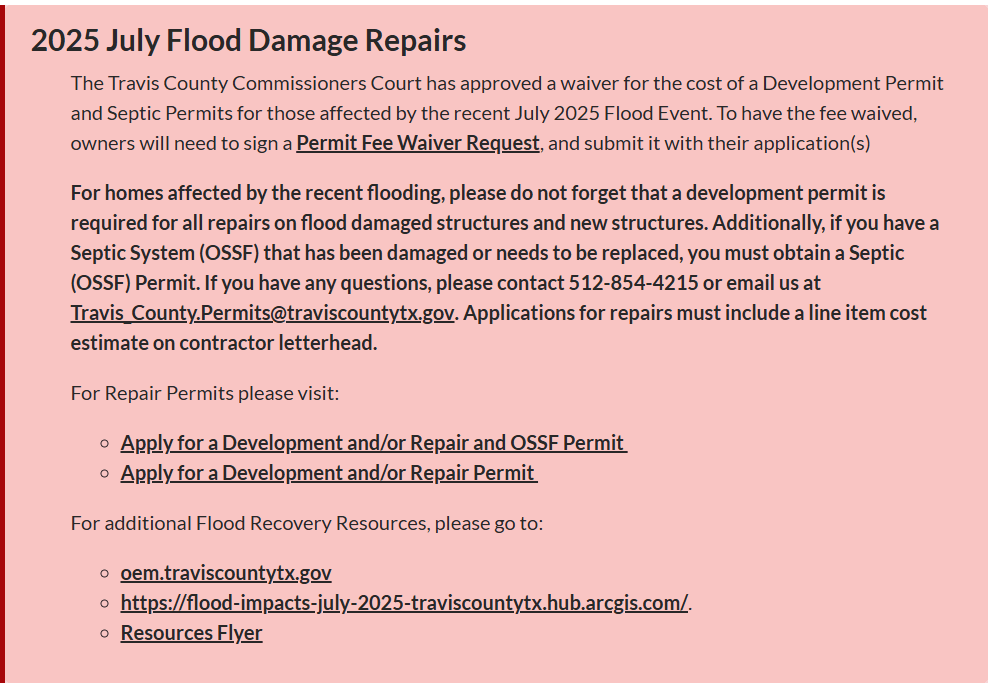
Large parts of Travis County lie within flood-prone areas. This includes land near the Colorado River, Bull Creek, Onion Creek, and many smaller waterways. If your property is located in a FEMA-designated Special Flood Hazard Area (SFHA), you must obtain a floodplain development permit before construction begins. This requirement applies even if a building permit is not needed.
Floodplain regulations cover:
Finished floor elevations for new buildings and major improvements
Fill placement and grading near waterways
Construction within floodways
Substantial improvements to existing structures
A project is generally considered a substantial improvement when the cost of improvements exceeds 50% of the building’s market value before construction begins. In these cases, the entire structure may need to meet current floodplain standards. Before work can start, the county’s floodplain administrator must review and approve the plans.
This review process is separate from the building permit review. It also follows its own timeline. Missing this requirement can lead to major delays and unexpected costs.
Check your property’s floodplain status early. You can use FEMA’s Flood Map Service Center or Travis County’s mapping tools before finalizing your site plan.
The Permit Application Process
For projects in unincorporated Travis County, permits are managed by the Transportation and Natural Resources (TNR) Development Services Division. Applications can be submitted through the county’s development services portal. The portal provides permit forms, application requirements, and fee information.
The process usually follows these steps:
1. Verify Property Requirements
Start by confirming that your property is located in unincorporated Travis County and not within a city’s jurisdiction.
You should also:
Check for floodplain restrictions
Confirm setback requirements
Review zoning regulations
Check deed restrictions and HOA rules
Completing this step early helps avoid expensive redesigns later.
2. Prepare Your Plans
Most projects require a site plan and construction drawings.
The site plan should show:
Property boundaries
Proposed structures
Utility connections
Required documents vary by project type. Incomplete plans are one of the most common reasons for permit delays.
3. Submit the Application
Submit the application along with all required documents. The county first reviews the package for completeness. If information is missing, the application will be returned for revisions. Incomplete applications do not move forward in the review process.
4. Plan Review
Once accepted, the county reviews the project for compliance with:
County regulations
Floodplain requirements, if applicable
If reviewers find issues, they will send correction comments. The speed of approval often depends on how quickly and thoroughly those comments are addressed.
5. Permit Issuance
After the project is approved, the required fees must be paid. The county then issues the permit. Construction cannot begin until the permit is officially issued.
6. Inspections
Most projects require inspections during construction.
Common inspections include:
Foundation inspections
Framing inspections
Electrical, plumbing, and mechanical rough-ins
Final inspections
Work that is covered before inspection may need to be uncovered for review. Inspections are a required part of the permitting process, not just a final step before project completion.

How Travis County Permitting Differs from Austin
Many property owners are familiar with Austin’s Development Services Department (DSD) and the AB+C portal. Travis County’s process works differently. Austin uses a multi-department review system. Building, electrical, plumbing, mechanical, fire, zoning, and environmental reviewers may review a project at the same time. This process is more complex, but simultaneous reviews can help move projects forward when applications are complete.
Travis County’s review process is usually simpler. Fewer departments are involved, and the regulatory framework is not as complex as Austin’s zoning system. However, a simpler process does not mean fewer requirements.
Projects in unincorporated Travis County often face additional reviews related to:
Floodplain regulations
On-site sewage facilities (OSSF)
Well permits
These issues are less common in Austin because most properties connect to city utilities. Many rural properties in Travis County rely on private wells and septic systems. These systems require separate permits, inspections, and approvals through county and state agencies.
Some projects face additional complexity because of location. For example, a property may sit near a city boundary or within Austin’s extraterritorial jurisdiction (ETJ).
Austin’s ETJ can extend up to five miles beyond city limits in some areas. In these cases, Austin may regulate subdivision and development standards even when Travis County issues the building permit.
Common Reasons Travis County Projects Get Delayed
Even simple projects can face delays during the permitting process.
The most common causes include:
Jurisdiction confusion — A property owner assumes Travis County has authority when a city does, or the other way around.
Floodplain issues — Flood zone restrictions are discovered after the project design is complete.
Incomplete site plans — Required details such as setbacks, utility locations, or impervious cover calculations are missing.
Septic and well permit delays — OSSF (On-Site Sewage Facility) permits follow a separate review process and timeline. These approvals are required before a certificate of occupancy can be issued.
Deed restriction conflicts — Private restrictions may prohibit work that county regulations allow.
Slow responses to review comments — Delays often increase when applicants take too long to address reviewer feedback.
Many of these issues can be avoided through early planning and careful review before submitting an application.
What Permit Fees Look Like
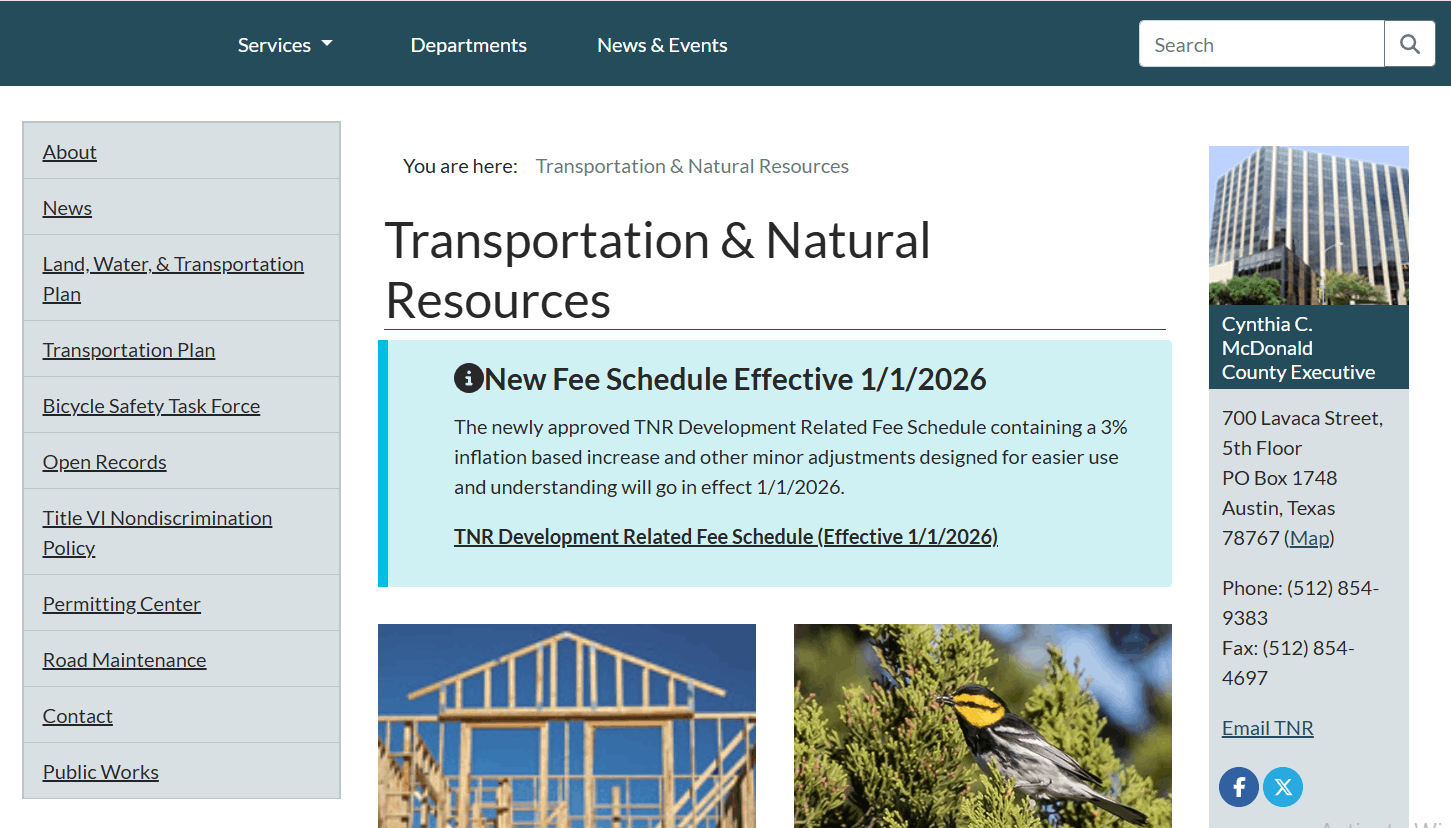
Travis County permit fees vary based on the type and value of the project. Different permit categories have different fee schedules. The county updates these fees periodically, so property owners should always confirm current rates with the TNR office before finalizing a budget. For many residential projects, permit fees range from several hundred dollars to a few thousand dollars.
Additional costs may include:
Trade permits for electrical, plumbing, or mechanical work
Floodplain review fees, when applicable
OSSF permit fees for septic systems
For larger or more complex projects, these costs can add up quickly. Commercial projects often have higher permitting costs because they may require additional reviews, inspections, and impact fees. Permit fees are calculated using several factors. Because the formulas can vary by project type, it is best to verify expected costs before construction begins.
Getting Travis County Permits Right
Good planning helps prevent permit delays. Many project issues start before an application is submitted. Property owners often discover problems during plan review that could have been identified much earlier.
Common issues include:
Jurisdiction questions
Floodplain restrictions
Utility requirements
Building code compliance
Finding these issues early can save time, money, and effort. For many homeowners, the permitting process is fairly straightforward. This is especially true for smaller projects on simple properties. Larger projects are different. They often involve more requirements, more reviews, and tighter timelines.
For contractors, investors, and developers, permit delays can affect:
Construction schedules
Financing deadlines
Contractor coordination
Project costs
Even a small delay can impact the overall timeline. An experienced permit consultant can help reduce these risks. They can identify potential issues before submission, address common review concerns, and help keep the approval process on track.
If your project is in unincorporated Travis County, or if you are unsure which agency has authority over your property, getting guidance early can help you avoid costly delays.
Our team offers free initial project assessments. We can review your project, explain the requirements that apply to your property, and help you understand the next steps before you move forward.
Ready to Start Your Project?
Not sure which permits your project requires? Our team can review your property, identify potential issues, and help you understand the next steps before you submit an application. Schedule your free consultation now!
Call us: (818) 793-5058
Email us: sales@jdj-consulting.com
Disclaimer
The information in this guide is based on Travis County Transportation and Natural Resources (TNR) Development Services requirements and procedures as of June 2026. Permit fees, review timelines, floodplain maps, regulations, and code requirements may change.
Before starting a project, confirm current requirements with Travis County Transportation and Natural Resources Development Services. You can also consult a qualified permit professional for guidance specific to your property and project.