Table of Contents
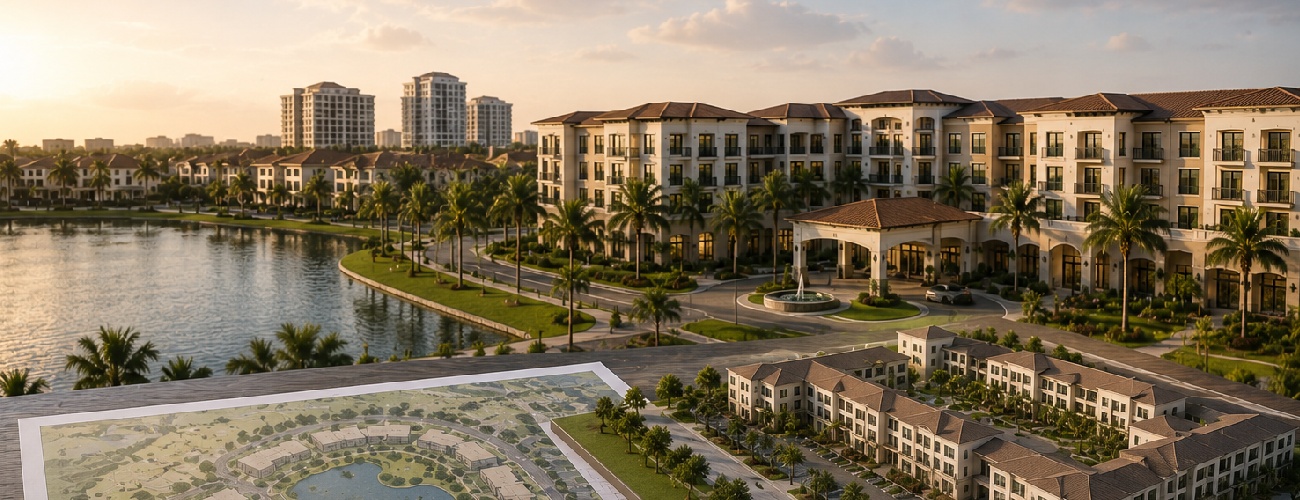
Palm Beach County has become one of the more interesting senior housing markets in Florida, though “interesting” is doing some work in that sentence. It is not a market where one playbook travels well across submarkets. Wellington and Royal Palm Beach have room to build big and phase it sensibly. Palm Beach Gardens and Jupiter have the medical infrastructure and household incomes to support premium product, if you can clear the land basis. And the coastal municipalities, frankly, are where a lot of otherwise reasonable projects go to die, not because the demand isn’t there, but because parking, height and a vocal neighborhood association will grind a large facility down to something unrecognizable.
For developers, architects and investors sizing up this asset class, the site is only ever half the story. The other half, the part that gets underestimated more often than it should, is which regulatory lane a project actually falls into. Conventional housing, congregate living, assisted living and licensed healthcare all carry different approval paths, and mixing them up early is the kind of mistake that costs a project a year, not a meeting.
Why This County, Why Now
The numbers make a reasonable case on their own. Roughly 401,800 Palm Beach County residents are 65 or older, close to a quarter of the county’s entire population. Layer that onto what’s happening nationally, where occupancy climbed to 89.1 percent in the fourth quarter, independent living cleared 90 percent, and assisted living settled around 87.7 percent, and you get a market where both the demand curve and the supply-side fundamentals are pointing the same direction.
That said, demographics tell you there’s a market. They don’t tell you where to build or what to build. That takes a submarket-by-submarket read, and a fairly honest one.
Matching the Product to the Submarket
Senior housing isn’t a single asset class, whatever the offering memorandum says. It’s at least seven: active adult apartments, independent living, assisted living, memory care, continuing-care retirement communities, skilled nursing and small community residential homes. Each one has its own construction cost profile, operating model and, critically, its own entitlement path. What determines that path is what the project actually does for residents, not what a broker calls it.
Palm Beach Gardens and the Avenir corridor are worth watching closely right now because of what’s being built around them. Avenir Health Park broke ground in mid-2026 with a planned 53,000-square-foot neighborhood hospital and nearly 75,000 square feet of medical office space attached. That kind of anchor tends to pull independent living, assisted living, memory care and continuing-care campuses in behind it. The catch is a high land basis and design review that expects real architectural effort, not a value-engineered box.
Jupiter rewards a differentiated concept more than a large one. Proximity to Jupiter Medical Center and strong household income support private-pay independent living and specialty memory care well, but developable land is scarce and the community pays close attention to height and density. A generic, oversized facility is a tougher sell here than a smaller, medically affiliated project done well.
Wellington and Royal Palm Beach are probably the best land economics in the county for a large, phased campus, with room for surface parking and a genuinely growing population base. The tradeoffs are drainage, wetlands and a site plan that has to assume everyone is driving.
West Palm Beach can work for urban independent living, age-restricted apartments and adaptive reuse of older office or hospitality stock near hospitals and walkable retail, though structured parking and heightened design scrutiny push both cost and timeline.
Lake Worth, Boynton Beach and Delray Beach are underrated for middle-market and affordable senior housing. Land is cheaper and the senior population is already established, but private-pay capacity is thinner, so rents and entrance fees need to be underwritten carefully rather than optimistically.
The Town of Palm Beach, realistically, is not a conventional-campus market. Land values, historic preservation controls and parking constraints keep most opportunities there small and boutique, or dependent on adaptive reuse of an existing building.
The Entitlement Path, In the Order It Actually Happens
Every senior housing project in Palm Beach County ends up moving through roughly the same sequence, though the specific approvals inside it vary a lot depending on what’s being built.
It starts with defining the care model, not the site. Unit and bed counts, whether meals and personal care are involved, whether memory care needs to be secured, whether residents sign leases or care agreements: these answers determine whether the project reads as apartments, congregate living, assisted living or a licensed healthcare use. Skip this step and everything downstream gets built on a guess.
From there, jurisdiction and land-use compatibility need to be confirmed parcel by parcel: Future Land Use designation, zoning district, whether assisted living is even a permitted use, density or bed-count caps, coastal or airport overlays. A parcel marketed as “multifamily” does not automatically clear the way for assisted living or memory care, and finding that out after closing is an expensive way to learn it.
A pre-application conference should follow, and it’s worth taking seriously rather than treating as a formality. This is where the county tells you whether you’re looking at a rezoning, a Future Land Use amendment, a special exception, a development order amendment, a variance, a plat or a straightforward administrative site plan approval.
Once that’s clear, the project moves onto whichever approval path fits. Age-restricted apartments with no care component generally go through standard multifamily site plan review. Assisted living and memory care more often need a special exception or conditional use approval. Skilled nursing typically requires institutional or healthcare-specific approval. And if the project doesn’t fit current zoning or Future Land Use at all, that gets sorted first, before anything else moves.
Technical review comes next, and it’s where a lot of the real engineering happens: traffic generation, emergency and ambulance access, fire and life-safety systems, drainage and flood elevation, generator noise and screening, secure courtyards for memory care.
Then there’s AHCA. Assisted living facilities need state licensing, and the specific license type, standard, extended congregate care, limited nursing services, should be locked down with the operator well before construction documents are finalized. It’s easy to forget that a Certificate of Occupancy doesn’t let you admit a single resident. That takes the state license, and that process runs on its own timeline.
Building permitting closes it out: fire-rescue review, AHCA construction review where it applies, inspections, the Certificate of Occupancy, the operating license itself, and Medicare or Medicaid certification if that’s part of the model.
The sequencing matters more than any individual step. Projects that skip the pre-application conference, or lock in a site before confirming zoning compatibility, tend to lose months reworking a concept plan that should have been right the first time.
Where This Tends to Go Wrong
The failure points repeat across projects, and across every discipline involved. Developers underestimate parking and emergency access, or buy a site before confirming the care-use zoning actually supports what they want to build. Architects sometimes start designing before the license category is settled, which forces late, expensive changes to fire, kitchen and accessibility systems. Civil engineers run into real constraints around emergency vehicle circulation and drop-off stacking on sites that also have to fit courtyards and buffers. Operators face licensing delays and staffing shortages that can stall lease-up even after the building is finished and looks great in photos.
But the most common mistake, by a wide margin, is treating “seniors” as one demand pool. Independent living, assisted living, memory care and skilled nursing draw from different age cohorts, income levels, acuity levels and payer sources. A market study that lumps them together will make almost any submarket in this county look more feasible than it actually is.
Incentives Worth a Closer Look
A handful of programs can meaningfully change the economics, particularly for affordable or mixed-income senior housing. Palm Beach County’s Workforce Housing Program can provide density bonuses up to 50 percent for qualifying projects. The county’s Impact Fee Affordable Housing Assistance Program has made funding available toward road, park and fire impact fees. Florida Housing Finance Corporation’s State Apartment Incentive Loan program offers competitive financing for affordable senior rental developments. And Palm Beach Gardens’ comprehensive plan allows for an assisted-living density bonus, up to 24 dwelling units per acre in certain mixed-use and high-density residential areas, outside the Coastal High Hazard Area.
None of this is automatic, though. Eligibility runs on unit type, affordability restrictions and ownership structure, and each of those needs to be confirmed against the actual project before it goes anywhere near a pro forma.
The Part That Actually Determines Whether a Project Gets Built
Palm Beach County is going to keep attracting senior housing capital, because the demographic and occupancy fundamentals genuinely support it. But the projects that get built on schedule are the ones where the care model, zoning classification and licensing pathway are confirmed before the land closes, not sorted out afterward under pressure. A parcel that looks entitlable on a zoning map can still need a special exception, a Future Land Use amendment or a full AHCA licensing process that adds a year or more if nobody caught it early.
This is exactly the kind of due diligence that’s easy to skip when a deal has momentum, and expensive to skip when it doesn’t work out. JDJ Consulting works with developers, architects and investors on this stage specifically, confirming zoning compatibility, running pre-application conferences, and managing the special exception and site plan process through to Certificate of Occupancy. For projects in this county, our Palm Beach permit expediting and entitlement consulting practice is built around the sequence described above.
If you’re weighing a senior housing site in Palm Beach County, it’s generally worth having a feasibility and entitlement conversation before the land goes under contract, not after. In most cases that conversation can confirm, in days rather than months, whether a site’s zoning actually supports the intended care model and what a realistic approval timeline looks like. More on how that process works is available through JDJ Consulting’s services.