Table of Contents
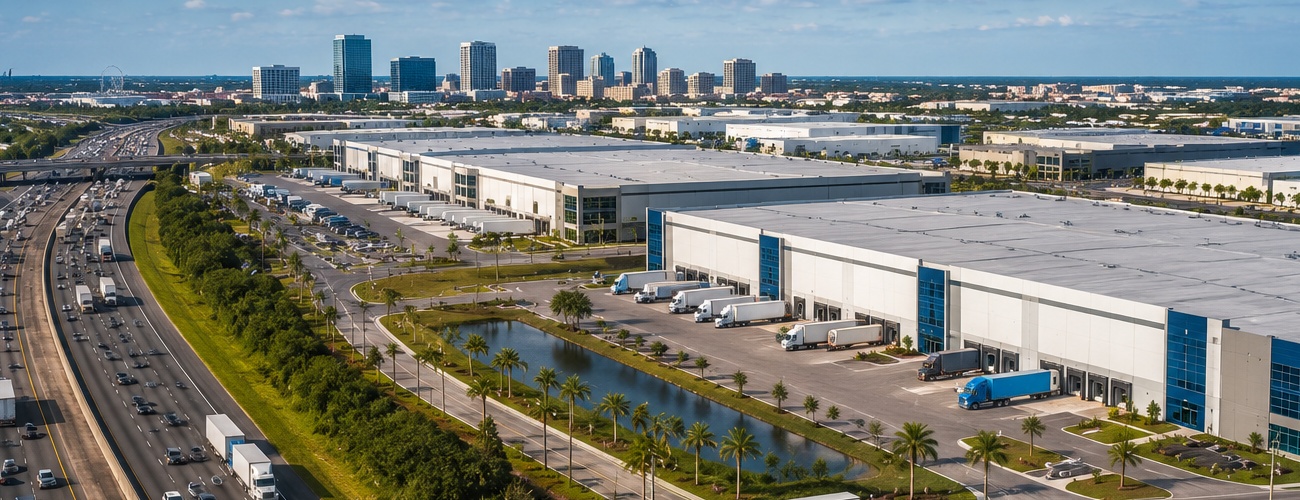
Orlando’s rise as a logistics market has surprisingly little to do with theme parks. It has to do with rooftops, e-commerce, and a stretch of interstate that planners now talk about the way they used to talk about ports. Population growth and delivery demand have turned the corridor between Orlando and Tampa into something closer to Florida’s central nervous system for freight, and for architects, developers, and investors sizing up industrial product in Central Florida, that shift matters less as a headline than as a set of practical questions. Where does a project still clear entitlements without a fight? Where has the land already been priced to reflect the corridor’s new status? And which jurisdictions will actually let you build what you’re planning?
Here’s a working sense of the process, the jurisdictional variables that decide whether a site is even feasible, and the submarkets where the opportunity still outpaces the competition for land.
What You’re Building Comes Before Where You Build It
Most logistics projects go sideways not because a site was wrong, but because the product wasn’t nailed down before the site search started. A last-mile facility wants proximity to rooftops and doesn’t need much acreage. A regional distribution center, often north of 500,000 square feet, wants direct interstate frontage and room to stack trailers. Cold chain product comes with its own power and refrigeration demands that most sites simply can’t support without upgrades, and flex industrial splits the difference between office, light assembly, and warehouse in ways that change the zoning conversation entirely.
That decision, more than anything else, sets the site criteria, narrows the zoning options, and determines which incentive programs are even on the table. It also tends to answer a question developers often ask too late: which jurisdiction actually makes sense for this project.
Jurisdiction Is Usually the First Real Wall People Hit
Two sites half a mile apart can sit under completely different rulebooks depending on whether they’re inside the City of Orlando, a smaller municipality like Winter Garden or Ocoee, or unincorporated Orange, Osceola, Polk, Seminole, or Lake County. Each one runs its own future land use map, its own planning board, and its own fee schedule, and none of them are interchangeable.
Warehouse and distribution uses generally fall under Industrial General or Light Industrial designations, though the larger custom campuses tend to move through a Planned Development process instead. A handful of corridors also allow industrial use within Activity Center or employment overlay districts, provided the project meets design and compatibility standards. Confirming both the future land use designation and the underlying zoning before a site goes under contract isn’t a box-checking exercise. It’s the difference between a permitted use that moves straight to site plan review and a rezoning or special exception that adds months of public hearings before anyone breaks ground.
This is where most timelines quietly fall apart, and it’s also where local, jurisdiction-specific guidance pays for itself many times over. Our team handles this exact terrain regularly, and for anyone comparing sites across Orange, Osceola, and Polk Counties, our Orlando permit expeditors and entitlement consultants page walks through how we shorten that process.
Trucks Bring Their Own Scrutiny
Logistics entitlements face a level of traffic review that office and retail projects rarely deal with. Traffic and level-of-service studies are often the item that decides whether a site plan moves forward, and jurisdictions frequently require off-site improvements, turn lanes, signal upgrades, or dedicated truck access before sign-off. Community pushback tends to cluster here too, especially where residential growth has crept closer to established industrial corridors. Noise, light, and truck volume are the complaints that show up at public hearings again and again, and buffering requirements near residential areas can eat into a site’s buildable footprint without anyone realizing it until the site plan comes back smaller than expected.
Environmental and infrastructure review runs on a similar track. Stormwater and wetland permitting can add real time on larger parcels, and utility capacity, particularly the electric service needed for cold storage or automated facilities, sometimes calls for off-site extensions that never made it into the original pro forma. None of this is unique to logistics as a category, but the scale of these buildings tends to make every one of these issues bigger than it would be on a smaller project.
A ground-up facility in the 200,000 to 500,000 square foot range typically takes 18 to 30 months from concept to first occupancy once entitlements, design, and construction are all accounted for. Long-lead items, switchgear, generators, racking systems, cold storage equipment, are worth locking down early, because they end up setting the pace of the schedule more often than construction itself does.
The Incentives Most Developers Leave on the Table
Logistics carries targeted-industry status in most Central Florida counties, which opens up incentive tools that other asset classes simply don’t qualify for. At the state level, programs like the Job Growth Grant Fund and Quick Response Training help offset infrastructure and workforce costs tied to expansion. County programs vary but often include property tax abatements on new capital improvements, impact fee mitigation, and matching grants toward permit fees, almost always tied to job creation and wage thresholds. Qualified Targeted Industry status can unlock additional local benefits on top of that.
The catch is that every county administers these differently, and the programs are performance-based rather than automatic. That means the incentive strategy needs to be built alongside the entitlement strategy from the start, not bolted on after the site plan is already in review.
Where Land Is Tight, and Where It Isn’t Yet
The I-4 corridor’s new role as Florida’s primary distribution hub hasn’t put even pressure on the market. Infill locations near Orlando and around the Airport Industrial Park near MCO are already land-constrained, and pricing reflects it. Those areas still make sense for air-cargo-linked and time-sensitive distribution, but available parcels are scarce and noise overlay restrictions near the airport shape what can actually get built.
Move further out and the picture changes. East Polk County and Southwest Lakeland have become some of the most active industrial submarkets in the Southeast, with far more land on the table and strong county-level incentives, even as recent construction has pushed Class A vacancy up in the short term. The Southeast Orlando Sector Plan, covering more than 19,000 acres east of the airport, is building employment and industrial uses into the same footprint as the aerospace and simulation economy already taking root there. And Sunbridge, the 24,000-plus acre master-planned community extending the Lake Nona model southeast of the city, is the longest play of all: a multi-decade runway for logistics and industrial campuses folded into a planned employment base, governed by its own master plan rather than standard zoning.
For developers and investors deciding where to put capital, the trend is pretty clearly pointing outward. Prime infill near Orlando still commands a premium and moves through entitlements with the least resistance once it’s properly zoned, but the deeper land positions, and the better incentive negotiations, increasingly sit out in Polk, outer Osceola, and the employment corridors taking shape east of the airport.
The Market Fundamentals Aren’t the Risk. The Jurisdiction Is.
Nobody’s questioning Orlando’s logistics fundamentals at this point, the population growth, the e-commerce demand, the corridor’s role in statewide distribution are all well established. What actually separates a project that clears approval on schedule from one that gets stuck for a year almost always comes down to jurisdictional detail: a future land use assumption that turns out to be wrong, a traffic study that undersold the real impact, an incentive application filed after the site plan instead of alongside it.
That’s the layer where a solid feasibility study and a clear entitlement strategy earn their keep, well before anyone’s thinking about a shovel. If you’re sizing up a logistics or industrial site anywhere along the I-4 corridor, whether that’s Orange County infill or the outer Polk submarkets, our team can walk the jurisdiction-specific path with you. Take a look at our full range of services at jdj-consulting.com, or reach out to talk through a specific site.