
Table of Contents
developers and investors paying attention, the rewrite is a generous one. Between “Orlando Unlocked,” Orange County’s “Housing for All” initiative, and a 2023 state mandate that forces administrative approval of qualifying projects, the city has put together one of the more developer-friendly incentive stacks in Central Florida. The catch is that none of it happens automatically. Every reduced impact fee, every density bonus, every expedited permit depends on a certification and review sequence that has to be followed in order, with the right documentation, in front of the right department, at the right time.
For architects sketching unit mixes, developers underwriting pro formas, and investors trying to size up entitlement risk before they commit capital, understanding that sequence, and knowing where the city’s growth capacity is actually concentrated, is often the difference between a project that clears review in months and one that stalls in committee for a year.
Why Orlando Is Worth the Extra Diligence
The numbers explain the urgency here. The city currently has roughly 9,200 units under construction, another 18,009 with approved master plans or sitting in permit review, and as many as 43,661 additional units enabled by approved future phases at Lake Nona, Sunbridge, and Everbe alone. That pipeline tells a fairly consistent story: Orlando’s largest master-planned communities and its downtown CRA infill lots are where the incentive machinery is running hardest right now, and where new applications are likely to get the most attention.
There’s a jurisdictional nuance worth flagging early too. “Workforce” and “attainable” aren’t interchangeable with “affordable” in Orlando’s program language. Workforce housing generally targets households at roughly 61 to 120 percent of Area Median Income. Attainable stretches to 120 to 140 percent AMI. Affordable housing typically serves 30 to 80 percent AMI. Which bracket a project falls into determines which incentives it can actually access, so income targeting isn’t just a policy detail buried in the fine print. It’s one of the first real entitlement decisions on the table.
The Certification-to-Entitlement Pathway
Orlando’s process for developers seeking affordable or workforce housing incentives follows a fairly defined sequence, and skipping a step usually costs more time than following it does:
- Confirm the site sits within city limits, or evaluate annexation if it doesn’t.
- Identify which incentives actually apply: impact-fee reductions or waivers, density bonuses, alternative development standards, or expedited permitting.
- Request an initial staff review with Housing & Community Development and City Planning before formal submission.
- Assemble the documentation package: survey, development plan, site control, pro formas and budgets, unit mix and income targeting, hard-cost detail, environmental review (Phase I where applicable), and a relocation plan if occupied units are affected.
- Meet with Housing and City Planning to walk through the project, then submit the formal incentive application.
- Apply for the desired incentive(s), presenting to the Housing Review Committee where required.
- Move through any additional review bodies, such as the Municipal Planning Board or Zoning Board of Adjustments, and City Council consideration if the project needs it.
Each of these stages is a checkpoint where a project can either be strengthened or quietly derailed, particularly around how unit mix, income targeting, and site documentation get framed for reviewers. This is exactly the terrain where an experienced land use consultant earns their fee: translating a development pro forma into language a certification reviewer is trained to approve on first pass rather than kick back for revisions. It’s the kind of pre-submission strategy work our team at JDJ Consulting handles regularly for clients moving through Orlando’s process. You can see how we structure that support on our Orlando permit expediting and entitlement consulting page.
What’s Actually on the Table Once a Project Is Certified
Certification unlocks a meaningful set of tools:
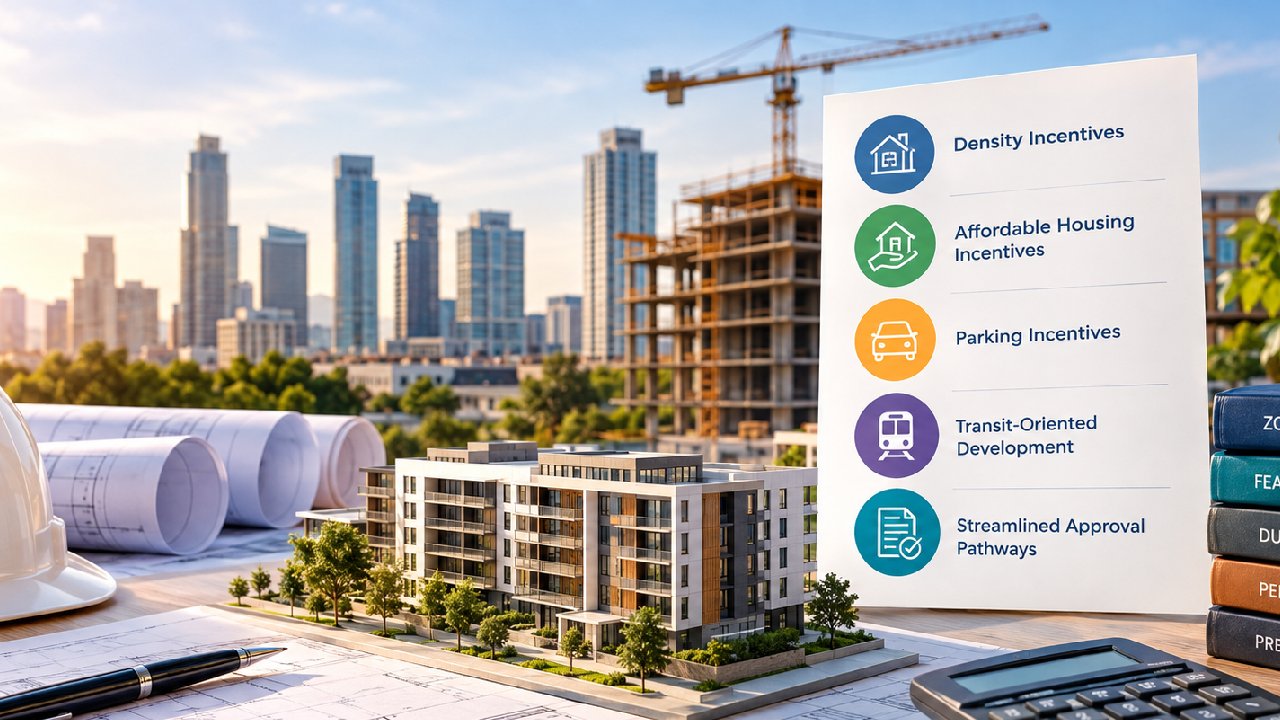
- Reduced or waived impact fees, covering transportation and parks outright, with sewer and schools reimbursement available subject to funding.
- Density and intensity bonuses, granted in exchange for on-site affordable units or an in-lieu payment to the Housing Trust Fund.
- Alternative development standards under Chapter 67, Part 6 of the Land Development Code, available to projects with at least 10 contiguous units where 20 percent or more are reserved for low- or very-low-income households.
- Expedited permitting, backed by a Florida statute and administered through a dedicated city housing expediter for certified affordable projects.
The city is also actively clearing zoning friction for smaller-footprint housing types: duplexes, triplexes, townhomes, multiplexes, tandems, ADUs, and live-work units. Many of these are now permitted by right in districts where the underlying zoning already supports them. For architects designing missing-middle product, that’s a meaningfully shorter path to approval than it was even a few years ago.
The Incentive Stack, Program by Program
City of Orlando:
- The core Affordable Housing Development Incentives program, which bundles impact-fee relief, density bonuses, alternative standards, and expedited review into a single track.
- Orlando Unlocked, the citywide initiative modernizing zoning and approvals, pairing density bonuses with permit-fee rebates.
- The Open Door Program, a pilot converting vacant residential lots in the Downtown CRA (a pipeline of more than 300 parcels concentrated around Paramore and ZIP codes 32811 and 32815) into owner-occupied homes for workforce households up to 120 percent AMI, paired with builder fee rebates and buyer down-payment assistance.
- An ADU Incentive Program offering impact-fee rebates and pre-approved plan sets to speed up accessory dwelling delivery.
- Live Local Act implementation guidance, covering the state law that requires administrative approval of qualifying affordable housing regardless of local zoning objections.
Orange County (regional layer):
- Housing for All / INVEST in Housing Initiatives, which provide countywide gap financing through the Affordable Housing Trust Fund, land donations to nonprofit developers, and preservation funding for at-risk existing stock.
- Vision 2050 and the Orange Code rewrite, aimed at reducing regulatory barriers and expanding missing-middle housing types countywide.
Where the Growth (and the Competition) Is Concentrated
If you’re scouting sites, four submarkets currently absorb the bulk of Orlando’s workforce and attainable housing activity:
- Lake Nona, expanding by thousands of future units, with recent rezonings negotiating roughly 10 percent affordable set-asides.
- Sunbridge and Everbe, both carrying approved future phases that could add tens of thousands of units combined.
- Downtown and the surrounding CRA, the focus of the Open Door Program’s vacant-lot pipeline.
- The tourism corridor and south Orlando, home to large workforce-targeted developments such as Catchlight Crossings, aimed at the 61 to 120 percent AMI band near the tourism employment hub.
Each of these submarkets carries a different entitlement profile. A greenfield master-plan phase moves through a different review lens than an infill CRA lot does, and that distinction should really shape site selection before a letter of intent ever gets signed.
The Takeaway for Developers and Investors
Orlando’s incentive framework rewards projects that are structured correctly from the start: the right income targeting, the right documentation, the right sequence through staff review and committee. Projects that show up at the Housing Review Committee without that groundwork tend to lose months making up for it later. For developers and investors evaluating Central Florida workforce housing opportunities, pairing site selection with early entitlement strategy isn’t just good practice. It’s often what turns a favorable incentive stack into an actual approved, financeable project.
JDJ Consulting works with development teams through exactly this process, from feasibility through permitting. If you’re evaluating a site in Orlando or Orange County, our entitlement and permit expediting services are built around navigating processes like this one. You can learn more about our approach at jdj-consulting.com.