Table of Contents
Two years ago, a half-acre commercial parcel on a secondary Austin corridor was a hold, not a build. Compatibility setbacks ate the buildable envelope, entitlement timelines ran long enough to blow through a rate lock, and the math on ground-floor retail plus stacked residential rarely closed. That calculus has flipped. Between the 2024 compatibility rewrite, the rollout of Equitable Transit-Oriented Development overlays, and a 2025 state law that stripped the city of its old height and density leverage on commercial parcels, corridor infill in Austin has gone from marginal to mainstream in under two years.
For developers, architects, and investors underwriting Austin deals right now, the opportunity is real but unevenly distributed. Some corridors are now effectively by-right for mid-density mixed-use. Others still carry regulating-plan overlays, station-area design standards, or neighborhood plan conditions that make the entitlement sequence the actual variable in the pro forma. Knowing which is which, before a site goes under contract, is what separates a smooth permit run from a stalled one.
What Changed: SB 840, Compatibility Reform, and ETOD
Three regulatory shifts are doing most of the work. First, the May 2024 compatibility standards reform pulled the trigger distance for height and setback restrictions from 540 feet down to 75 feet from a single-family lot. That single change freed up buildable height on a huge share of commercial corridor frontage that had previously been squeezed by adjacent residential zoning, even where the underlying commercial zoning allowed far more.
Second, and more consequential, Texas Senate Bill 840 took effect in September 2025 and preempted the city’s authority to regulate density and height for multifamily and mixed-use projects in commercial zoning districts. In practical terms, mixed-use and multifamily development is now allowed by right in districts like CS, GR, LO, and GO at a floor of 36 units per acre and 45 feet in height, without a rezoning case, variance, or conditional use permit. That is a structural shift in how corridor deals get entitled, not an incremental one.
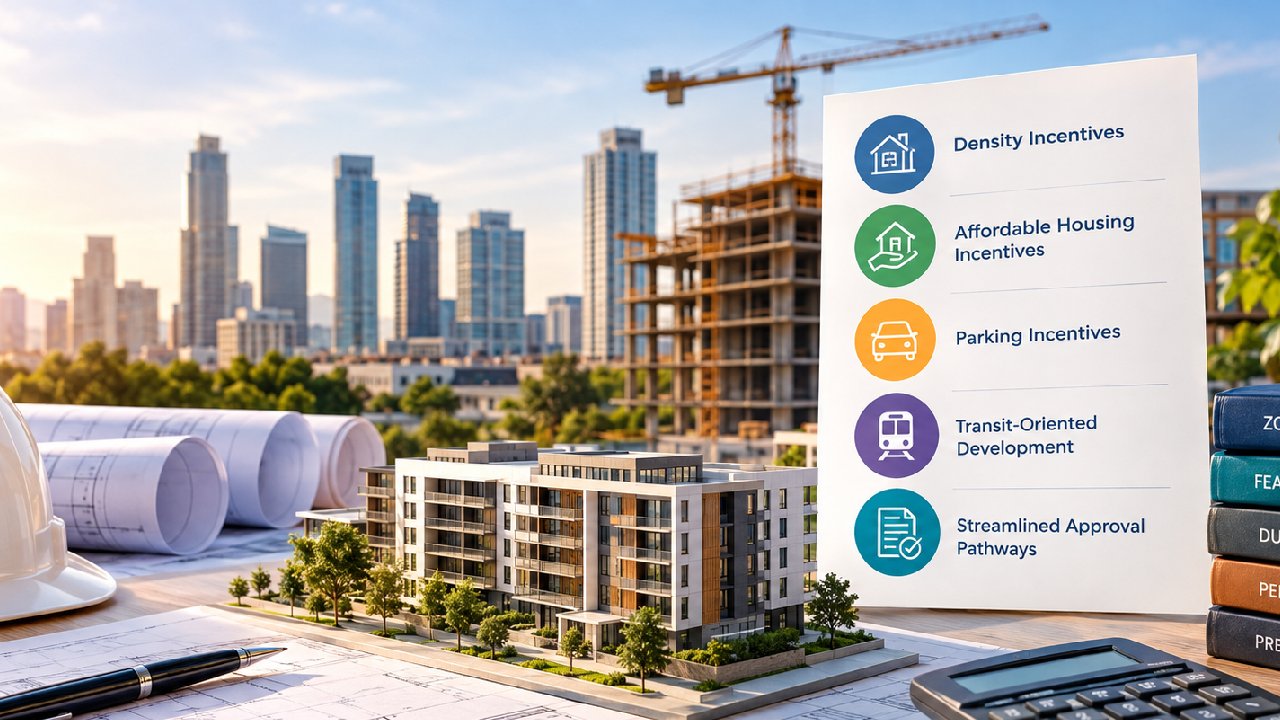
Third, the Equitable Transit-Oriented Development overlay, tied to the Project Connect light rail alignment and priority bus extensions, layers additional density bonus opportunity onto parcels within roughly a half mile of a station. Phase 1 of the ETOD overlay was adopted in 2024, station area vision plans for North Lamar and South Congress Transit Centers followed, and Phase 2 is now being coordinated with an update to the citywide density bonus framework so that VMU2, DB90, and DBETOD stop competing with each other and start stacking more coherently.
Where the Opportunity Is Concentrated
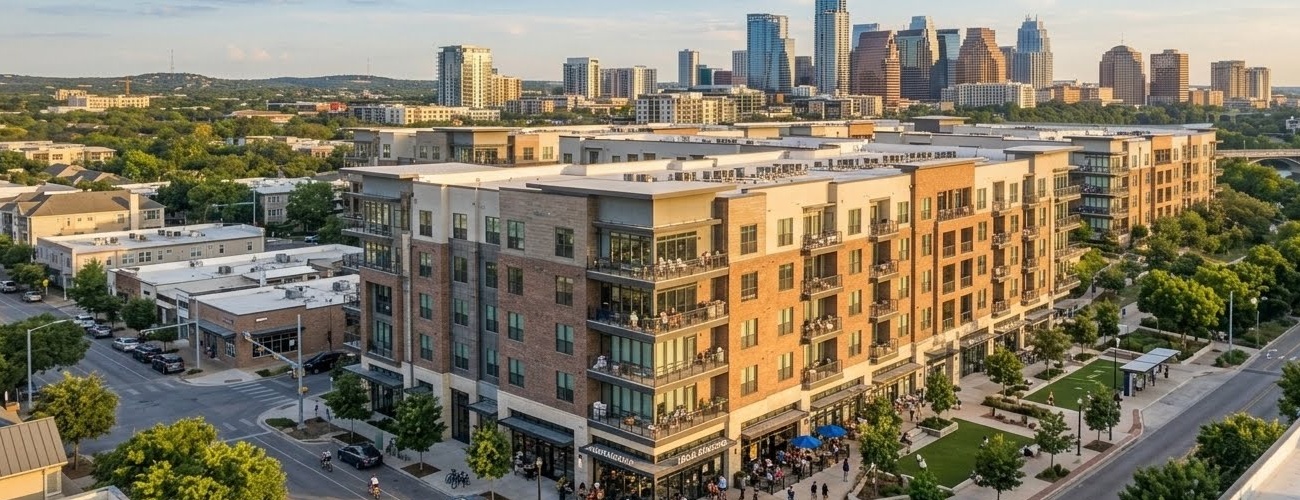
South Lamar, Burnet Road, and North Lamar remain the most active vertical mixed-use corridors in the city, and SB 840’s by-right density floor now applies underneath the existing VMU overlay on much of that frontage. East Riverside is its own case: a corridor-specific master plan already governs design and use, which means the entitlement path there runs through the regulating plan rather than a standard site plan, even with the new state preemption in play.
Corridor / Node | Entitlement Character | What to Watch |
|---|---|---|
South Lamar & Burnet Road | VMU overlay stacked with SB 840 by-right density | Parking and Subchapter E design standards still apply |
North Lamar Transit Center | ETOD overlay, station area vision plan | DBETOD affordability election required for bonus height |
South Congress Transit Center | ETOD overlay, station area vision plan | Design standards keyed to station area, not generic VMU |
East Riverside Corridor | Corridor-specific regulating plan | Use and massing governed by the master plan, not base zoning alone |
Crestview & North Burnet/Gateway | Mixed base zoning with transit adjacency | Compatibility relief strongest where 75-ft trigger applies |
Plaza Saltillo & East Austin nodes | TOD-influenced infill, active neighborhood plans | Neighborhood plan conditions can outlast base zoning entitlements |
The Entitlement Sequence for Corridor Infill
Even with SB 840 removing the rezoning requirement for many sites, corridor infill still runs through a defined sequence, and skipping a step is what turns a six-month timeline into a fourteen-month one.
Zoning and overlay verification comes first. Base zoning, VMU or VMU2 designation, ETOD overlay boundaries, and any corridor-specific regulating plan all have to be confirmed together, because they layer rather than replace one another. A parcel can be by-right under SB 840 and still carry ETOD station area design requirements that dictate ground-floor use and setback.
Site plan review follows, and this is where administrative versus commission-level review becomes the pivotal question. Projects that fit within administrative site plan thresholds move through staff review. Larger projects, or those seeking a density bonus election such as DB90, VMU2, or DBETOD, generally require additional review tied to the bonus program’s affordability documentation, which has to be recorded before permits are pulled, not after.
Compatibility and design standards review comes next, applying Subchapter E and any corridor-specific requirements to massing, articulation, and ground-floor activation. This is also the stage where most avoidable delay originates, because compatibility exceptions and design standard interpretations are handled case by case rather than by formula. Firms that work these corridors regularly, including the team at JDJ Consulting’s Austin permit expediting and entitlement practice, track which reviewers and which corridor plans tend to generate condition-heavy approvals versus clean ones, which matters more for timeline certainty than the zoning code text alone.
Public and neighborhood engagement, Board of Adjustment variance requests where needed, and building permit and construction plan review round out the sequence, ending at certificate of occupancy. Density bonus elections add a documentation layer throughout, since affordability commitments have to be recorded and monitored across the life of the project, not just at approval.
Incentive Programs Worth Underwriting Into the Deal
Program | What It Offers | Trade-off |
|---|---|---|
VMU2 | Up to 30 additional feet of height on VMU corridors | Deeper affordability set-aside than VMU1 |
DB90 | Density and height bonus outside VMU corridors | Affordability commitment recorded against the property |
ETOD / DBETOD | Additional height and reduced parking near transit stations | Ground-floor use and design tied to station area plan |
Citywide Density Bonus Program | Coordinates VMU2, DB90, and ETOD into one framework | Still finalizing as of 2026; terms may shift mid-entitlement |
S.M.A.R.T. Housing | Fee waivers for qualifying affordable units | Income-restriction period applies to affected units |
Reading the Risk by Stakeholder
Stakeholder | Primary Exposure | Mitigation |
|---|---|---|
Developer | Density bonus documentation delays permit issuance | Sequence bonus election early, before site plan submittal |
Architect / Engineer | Overlapping VMU, ETOD, and corridor plan standards conflict | Confirm which standard controls before schematic design locks |
General Contractor | Compatibility-driven design changes mid-permitting | Build float into GMP pricing for standards still in flux |
Investor | Citywide Density Bonus Program terms still finalizing | Underwrite base by-right scenario, treat bonus as upside |
Frequently Asked Questions
What zoning allows mixed-use infill development in Austin?
Vertical Mixed-Use (VMU and VMU2) zoning permits ground-floor commercial with residential above along designated corridors. Since September 2025, Texas Senate Bill 840 also allows mixed-use and multifamily development by right in commercial districts such as CS, GR, LO, and GO, at a minimum of 36 units per acre and 45 feet in height, independent of VMU designation.
Does SB 840 eliminate the need for entitlement review on corridor infill?
No. SB 840 removes the rezoning requirement for qualifying density and height, but site plan review, compatibility and design standards, and any applicable corridor regulating plan or ETOD overlay requirements still apply.
What is the ETOD overlay and where does it apply in Austin?
The Equitable Transit-Oriented Development overlay applies generally within a half mile of the Project Connect light rail alignment and priority extensions, including station area plans adopted for North Lamar and South Congress Transit Centers. It offers a density bonus option, DBETOD, in exchange for affordable housing and design commitments.
How did the 2024 compatibility standards reform affect corridor development?
The reform reduced the distance at which single-family compatibility restrictions apply, from 540 feet to 75 feet, which freed substantial buildable height and reduced setback burden on commercial corridor parcels adjacent to residential zoning.
Which Austin corridors currently offer the strongest infill mixed-use opportunity?
South Lamar, Burnet Road, and North Lamar carry established VMU overlays now layered with SB 840’s by-right density. East Riverside and the ETOD station areas around North Lamar and South Congress Transit Centers offer additional density bonus potential tied to transit proximity, though each carries its own corridor-specific design and affordability requirements.
Underwriting the Entitlement Path, Not Just the Zoning Map
The zoning map tells a developer what is theoretically possible on a parcel. It does not tell them how long approval will take, which reviewer standard controls when two overlays conflict, or whether a density bonus election is worth the affordability commitment attached to it. With SB 840, compatibility reform, and the ETOD overlay all moving at once, that gap between the map and the actual entitlement timeline has widened rather than closed. Firms bringing capital or design work into Austin’s corridor and transit-node infill market are increasingly pairing site selection with local entitlement guidance from the outset. JDJ Consulting’s Austin team works these corridors directly, tracking which parcels are genuinely by-right, which still carry regulating-plan or station-area conditions, and where a density bonus election will actually pencil against current affordability terms, so the underwriting reflects the real permitting path rather than the zoning code in isolation.