
Table of Contents
Round Rock has quietly become one of the more interesting build-to-rent markets in Central Texas, and most of the capital chasing it hasn’t figured out why yet.
The short answer: it isn’t zoned for this. Not cleanly, anyway. A build-to-rent neighborhood looks like a subdivision and operates like a multifamily asset, and Round Rock’s code was never written with that hybrid in mind. Every BTR deal in this market gets decided less by the dirt and more by how well the entitlement package answers a question the city hasn’t standardized yet: is this a subdivision or is it one rental property that happens to look like a bunch of houses?
Get that framing wrong early and you’ll spend eighteen months untangling it. Get it right, and Round Rock offers something increasingly rare in Austin’s orbit: large, master-planned tracts with utilities in the ground, institutional precedent already leasing up, and rent growth that still outpaces new-home affordability for a lot of renters who want a yard but can’t clear a down payment.
Why Round Rock, and Why Now
Build-to-rent exists because of a gap between what households want and what they can buy. Round Rock sits at the intersection of three things that widen that gap: strong employment anchored by Dell and the broader tech corridor, home prices that have outrun wage growth for the renter-by-necessity population, and a still-active pipeline of master-planned land that hasn’t been fully built out.
Stillwell at Avery Centre proved the concept locally. The 225-unit community mixes attached duplex-style one-bedroom units with detached two- and three-bedroom homes on more than 20 acres, and it leased into a market that clearly wanted the product. Azola Avery Centre followed with 359 garden-style rental units inside the same broader master-planned district, alongside higher education, medical, and employment uses that give renters a reason to stay put rather than treating the community as a waystation.
That precedent matters more than most developers give it credit for. Lenders underwrite comps. Cities calibrate expectations off what’s already been approved and how it performed. And renters, frankly, trust a neighborhood more when there’s already one next door that works.
Where the Land Works
Not every acre in Round Rock is BTR-ready, and the sites that look cheapest on a per-acre basis are usually the ones carrying the most entitlement risk.
Avery Centre remains the clearest bet. The master-planned framework already accommodates mixed residential, institutional, and commercial uses, and there’s existing market acceptance for rental product. The tradeoff is competition. With this much BTR and apartment product converging on one district, a new entrant needs genuine differentiation, whether that’s a mixed housing type strategy combining cottages, townhomes, and detached units, or an amenity package that outpaces what’s already leased.
Northeast and east Round Rock, along Old Settlers Boulevard, Gattis School Road, and toward the Teravista area, offer the strongest runway for a family-oriented rental neighborhood built around three- and four-bedroom homes. Land is available in scale, roadway and utility planning is underway, and there’s room to integrate trails and parks into the product itself rather than bolting them on. The catch is sequencing: retail and public services tend to lag residential delivery here, so the entitlement and phasing plan has to account for a community that won’t feel finished for several years.
The US 79 and SH 130 corridor brings regional accessibility and larger, cheaper tracts, but highway adjacency is a real leasing headwind. Homes facing the corridor need genuine buffering, not landscaping as an afterthought, or they’ll sit on the market longer and lease at a discount.
West and southwest Round Rock can command higher rents from renters chasing proximity to Cedar Park and North Austin employment, but entitlement is harder. Expect more neighborhood opposition, tighter topographic and tree constraints, and a product that needs to be more compact and design-forward than a sprawling detached subdivision. Townhomes and cottage courts tend to pencil better here than large-lot detached rentals.
South and southeast Round Rock is infill territory: fragmented ownership, drainage constraints, and more public scrutiny, but also proximity to downtown and a real shot at walkability. This is townhome and small-lot territory, not a garden-style play.
The Entitlement Path: Where BTR Deals Actually Get Won or Lost
This is the part of the process most out-of-market developers underestimate, and it’s where a permit expediting and entitlement partner earns its fee many times over.
The sequence typically runs through annexation review (if the land sits outside city limits or in the ETJ), Future Land Use Map consistency review, and then the entitlement question that decides everything downstream: does the project need a Planned Unit Development, and does that PUD explicitly authorize rental use, private streets, shared amenities, and the housing mix being proposed.
A standard single-family zoning district generally can’t accommodate centralized leasing, private infrastructure, reduced setbacks, or a duplex and cottage mix under one ownership structure. A PUD gives the applicant control over unit count, lot dimensions, setbacks, private street standards, common open space, and HOA obligations, but only if the document is drafted to eliminate ambiguity about what’s actually being built. Relying on the physical resemblance to a subdivision to carry the zoning argument is how projects end up stuck in review for a year longer than they should.
Round Rock requires a pre-submittal meeting before any subdivision application moves forward, and for a BTR project that meeting should resolve the structural questions up front: public versus private streets, whether homes will be individually platted, parkland dedication category, roadway impact fee exposure, and certificate-of-occupancy sequencing for a phased community. Walking into that meeting without answers to those questions is the single most common way BTR timelines slip.
From there, the path runs through concept and preliminary plat, final plat, site development permitting covering grading, stormwater, and utility infrastructure, and then a building permit strategy that ideally uses repetitive-plan review for standardized home types rather than treating every unit as a bespoke permit. None of that is unusual for residential development generally. What’s unusual is how many of those steps carry a BTR-specific wrinkle that a generalist reviewer or an out-of-market applicant tends to miss.
Developers working through this process in Williamson County often bring in local expertise early rather than relearning the city’s review culture deal by deal. JDJ Consulting’s Round Rock permit expediting and entitlement team works this exact sequence, from annexation and PUD strategy through plat recordation and building permit issuance, specifically because the cost of getting the zoning classification wrong at the outset dwarfs the cost of getting it right.
Where the Risk Actually Lives
Three risks show up on nearly every Round Rock BTR pro forma, and they’re worth underwriting separately rather than folding into a generic contingency line.
Land efficiency. BTR uses considerably more land per rentable unit than a comparable apartment project while still carrying the full cost of roads, utilities, stormwater, and amenities. A project running 10 to 15 units per acre needs a rent premium that genuinely justifies the land basis, not just a nicer clubhouse.
Absorption timing. A large community can take several years to build out fully, and later phases inherit whatever the market looks like when they deliver, not when the deal was underwritten. New apartment supply, rate-driven shifts in homeownership demand, and delayed retail or school infrastructure can all erode rent premium on phase three even when phase one leased ahead of pro forma. Size the first phase for a realistic lease-up, not the maximum entitlement.
Classification risk. This is the one that’s specific to BTR and easy to miss. If the entitlement documents don’t clearly resolve whether the city is treating the project as single-family, townhouse, or multifamily for parking, parkland, and landscaping purposes, that ambiguity resurfaces at plat, at site development, and again at certificate of occupancy. Each recurrence costs time.
Incentives Worth Exploring
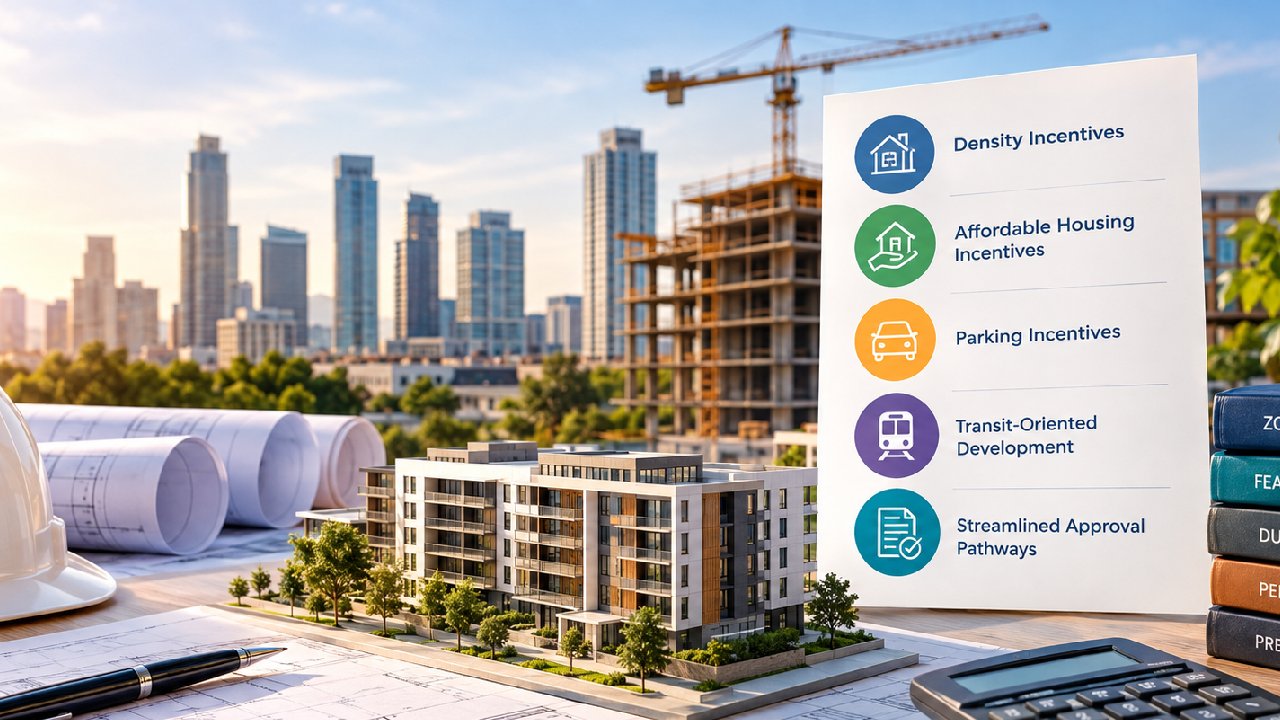
A conventional market-rate BTR project won’t automatically qualify for incentive support just because it adds housing stock, but several tools are worth evaluating depending on project structure.
Chapter 380 agreements are negotiated case by case and are more accessible when a project supports a major employer, includes workforce or attainable rental units, or finances public infrastructure the city would otherwise have to fund. Public Improvement Districts can finance and maintain roads, landscaping, and enhanced entry features, though the assessment needs to be modeled into operating expenses and disclosed to investors up front. MUD financing remains relevant for greenfield tracts needing water, wastewater, and drainage infrastructure, but the ongoing tax burden has to be weighed against competing for-sale and apartment product in the same submarket.
For projects incorporating income-restricted units, Texas Department of Housing and Community Affairs programs, including Housing Tax Credits and tax-exempt multifamily bonds, can bring in capital that a purely market-rate detached product typically can’t access. Whether a primarily detached BTR project fits those programs depends heavily on unit mix and ownership structure, which is another reason the entitlement and financing strategies need to be developed together rather than sequentially.
What Actually Wins in This Market
The Round Rock BTR projects that perform are the ones designed as neighborhoods first and rental portfolios second. That means a genuine mix of housing types rather than a single repeated floor plan, a first phase sited near an arterial, school, or employer rather than at the edge of the entitlement, and private street, stormwater, and HOA obligations resolved in the recorded documents before closing, not negotiated after the first resident moves in.
The projects that struggle tend to share a pattern too: highway-fronting land purchased for its low basis, an entitlement strategy built around hoping the city treats it like single-family, and a phasing plan sized to the maximum unit count instead of realistic absorption. Central Texas is not short on capital chasing this asset class right now. It is short on entitlement strategies that survive contact with a planning department that’s still figuring out how to classify the product.
For developers evaluating land in Round Rock, the entitlement question is worth answering before the land contract goes hard, not after. JDJ Consulting’s team in Round Rock works directly with developers, architects, and investors to pressure-test zoning classification, PUD strategy, and permitting sequence early enough that it changes the deal rather than just documenting it.
Frequently Asked Questions
Is build-to-rent housing allowed under standard zoning in Round Rock?
Not typically. Standard single-family zoning districts generally don’t accommodate centralized rental ownership, private streets, shared amenities, or reduced setbacks. Most build-to-rent communities in Round Rock require a Planned Unit Development that explicitly authorizes rental use and the specific housing mix proposed.
Does a build-to-rent project in Round Rock need to go through platting?
In most cases, yes. Build-to-rent communities typically follow the standard subdivision process, including concept plan, preliminary plat, and final plat, though whether individual homes are platted as separate lots depends on the ownership and zoning structure established during entitlement.
What is the best location for build-to-rent development in Round Rock right now?
Avery Centre has the strongest existing precedent, with two established build-to-rent communities and a master-planned framework that already accommodates the product. Northeast and eastern Round Rock offer the greatest land availability for family-oriented rental neighborhoods, while the US 79 and SH 130 corridor provides lower land basis with more highway-adjacency tradeoffs.
How long does entitlement typically take for a build-to-rent community in Round Rock?
Timelines vary by site complexity, but annexation, zoning or PUD approval, and platting can collectively take a year or more before site development permitting begins. Projects that resolve rental-use classification and street ownership early in the pre-submittal process generally move faster than those that leave those questions open.
Are there incentives available for build-to-rent projects in Round Rock?
Market-rate build-to-rent projects don’t automatically qualify for incentives, but Chapter 380 agreements, Public Improvement Districts, MUD financing, and TDHCA affordable housing programs may apply depending on project structure, workforce housing components, and public infrastructure contributions.