Table of Contents
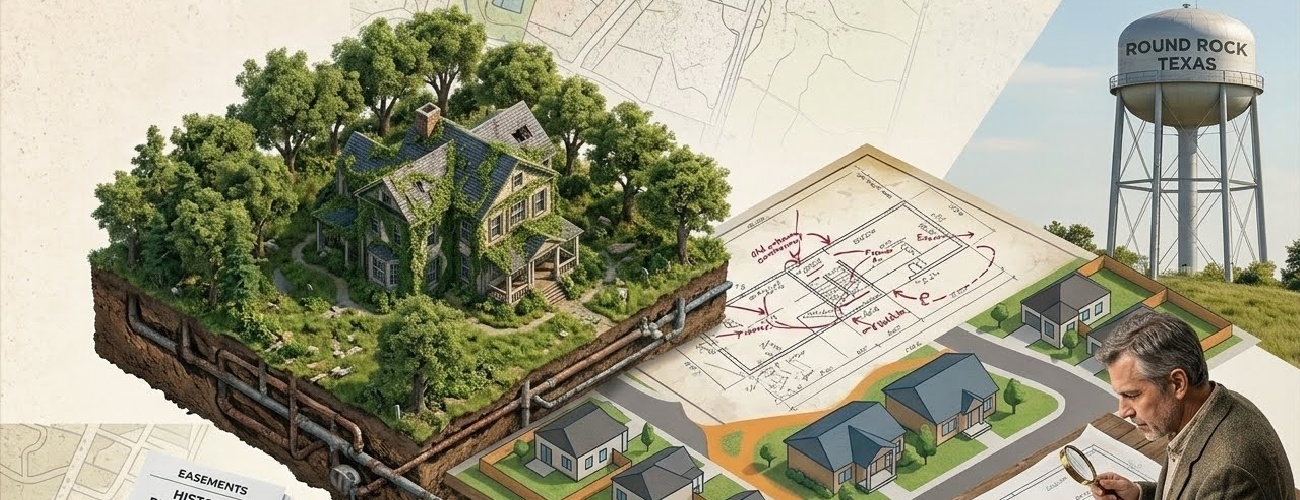
Drive the blocks south of Main Street on a Sunday morning and you’ll see the pattern before anyone explains it to you. A 1960s ranch house sits on a lot that could hold three townhomes. A boarded-up storefront on Mays Street has better bones than half the new construction going up on the edges of town. An overgrown yard near the original street grid backs up to a drainage easement nobody has touched in twenty years.
That’s the infill opportunity in Round Rock, and it’s real. It’s also a lot harder to execute than the acquisition memo usually admits.
Round Rock’s downtown and near-downtown neighborhoods carry the kind of bones that infill investors chase everywhere: a traditional block pattern, existing utilities, sidewalks, walkable retail, and a housing stock old enough to be underbuilt relative to its land value. The city’s own downtown pipeline backs this up. Monarch on Main is delivering roughly 60 townhome units on about 6.35 acres, and The Depot is planned for around 80 townhomes at buildout, both signals that the market already believes in compact, walkable product near the core.
The catch is that “infill” doesn’t mean “easy.” Lot configuration, drainage, tree preservation, historic review, parking counts, and subdivision requirements can eat a project’s margin faster than any line item on the pro forma. Understanding where the opportunity actually sits, and which regulatory path a given site falls into, is the difference between a deal that closes on schedule and one that stalls in a pre-submittal meeting six months in.
What Makes a Round Rock Site Worth a Second Look
Value-add and infill projects in this market generally fall into one of a few strategies, and each one carries a different entitlement burden.
A cosmetic renovation, new kitchen, new systems, refreshed landscaping, usually clears with a standard building permit unless the property sits in a historic overlay. A major rehab that adds square footage or reconfigures the structure pulls in setback and parking review. An accessory dwelling or garage conversion triggers lot coverage and utility questions. And a full teardown-replacement, where an obsolete home comes down and townhomes or small-lot detached units go up, almost always means a rezoning or Planned Development process, sometimes both.
The thesis behind each of these differs too. Some investors are chasing physical value-add: buy a tired house, fix it, raise the rent or the resale price. Others are playing a land game, assembling two or three parcels to unlock a unit count the individual lots couldn’t support on their own. A third group is betting on use change, taking an underused property and repositioning it for a higher-value residential use entirely.
None of these are wrong. But they need to be underwritten as different deals, because the entitlement timeline, the capital at risk, and the neighborhood reaction each one invites are not the same.
Where the Opportunity Actually Concentrates
Downtown and the original street grid
This is the strongest location in the market, and for the obvious reasons: existing infrastructure, a walkable block pattern, civic and retail uses within reach, and a housing stock old enough to be ripe for either careful rehab or compatible small-lot replacement.
It’s also the most constrained submarket to work in. Parcels are small and fragmented, historic review can apply, construction staging is tight, and neighborhood opposition tends to be organized and vocal. Downtown infill rewards a design-sensitive, assembly-driven approach. It punishes anyone trying to run a production-subdivision playbook on a block that was platted a century before subdivisions existed.
South of downtown, near Mays Street
This corridor offers a mix of older homes and genuine redevelopment sites, and it’s already proving out at scale. The Arte project near South Mays and East Logan moved through the city as a mixed-residential Planned Development combining high-density multifamily, townhomes, and attached single-family product, which tells you the city is comfortable approving density here when the plan is disciplined.
The tradeoffs are real: drainage and infrastructure gaps, parcel assembly challenges, compatibility questions with existing homes, and public-realm work (sidewalks, lighting, safe street crossings) that often falls on the developer to complete.
Older neighborhoods near the central core
The strongest candidates here share a profile: larger-than-typical lots, structurally sound but under-maintained homes, existing water and wastewater connections, and proximity to downtown, schools, or employers. The trap is that a lot can look underutilized on a windshield survey and still lack the frontage, utility capacity, or legal access needed to add a unit. That’s a title and utility question, not a design question, and it needs to be answered before the property goes hard.
Corridor sites along Mays Street, Gattis School Road, and US 79
Larger parcels with visibility and existing utility service, but usually zoned commercial, which means a use change before residential entitlements even start. Traffic noise, access management, and legacy environmental questions on older commercial sites all factor in. These sites tend to work better as townhome or small multifamily plays than as isolated detached homes.
Historic overlay areas
Round Rock requires a Certificate of Appropriateness before most exterior changes on Historic Overlay properties, covering everything from color changes to additions to demolition, and it applies to accessory structures and fences too. New infill in these districts has to match the surrounding scale, proportion, materials, and street relationship, which narrows the design box considerably.
The upside is real: the city’s local historic tax exemption offers a 75% reduction on City property taxes for qualifying properties, and income-producing rehabilitation may also qualify for the state’s 25% Texas Historic Preservation Tax Credit. Historic overlay isn’t a good fit for a yield-maximizing teardown strategy, but it’s a strong fit for a well-executed rehabilitation play.
The Entitlement Path, and Why It’s Not One Path
The mistake most out-of-market investors make is assuming every infill project follows the same permit sequence as a standard single-family build. It doesn’t. The regulatory path depends entirely on what the project actually does to the site.
A renovation with no change in development pattern usually needs only building permits. An expansion or accessory unit typically adds a site plan and zoning review on top of that. A project that creates new lots or additional primary units, the category most redevelopment infill falls into, can require rezoning, a Planned Development, a preliminary plan, final plat or replat, a site-development permit, and separately posted subdivision improvements before anyone pulls a building permit.
Round Rock requires a pre-submittal meeting before any subdivision application moves forward, and that meeting is where the real scope of a project gets defined. It’s the point to confirm whether a plat exemption applies, whether the site needs a PUD, whether shared access or private streets are permitted, and whether existing utility lines can actually serve the proposed unit count. Skipping or rushing this step is the single most common reason infill timelines blow up.
If rezoning or a PUD is required, the application needs to do more than assert compatibility. It needs to show, with a real regulating plan rather than a narrative, how the project fits the block’s scale, handles parking on-site, protects mature trees, manages drainage, and provides safe access without overloading the surrounding street network.
Getting this sequencing right from day one, rather than discovering the correct path three months into predevelopment, is exactly where a firm that works Round Rock’s process daily earns its fee. JDJ Consulting’s Round Rock team manages that pre-submittal positioning and the platting, PUD, and site-development sequencing so a project’s entitlement path is defined before capital is committed, not after.
For new single-family construction specifically, the city’s published review estimate runs about 30 business days after an accepted application, with no expedited track available, and the city does not issue a traditional Certificate of Occupancy for residential product. An approved final inspection is what permits occupancy. That timeline needs to be baked into every carrying-cost assumption in the pro forma, not treated as an afterthought.
The Hurdles That Actually Kill Deals
Parcel assembly is the most common failure point. A project can be fully viable on paper and still die because one small parcel in the middle of the assemblage won’t sell, or sells to someone else first.
Utility capacity is the second. Older neighborhoods often run on undersized water lines, aging wastewater infrastructure, and overhead electric that wasn’t sized for added density. A project adding just two or three units can still trigger a utility upgrade that wasn’t in the original budget.
Drainage is the third, and it’s often underestimated. Infill sites rarely have room for on-site detention, and downstream capacity in older neighborhoods can already be tight. A drainage solution that consumes the only usable yard or parking area can undercut a project’s economics after entitlements are already secured.
Then there’s the market itself. Round Rock’s housing indicators softened through mid-2026. Zillow reported an average home value near $405,249, down 5.8% year over year, and Redfin put the median sale price around $373,000 for the three months ending June 2026, down 5.6% over the same period. That softness may open up better acquisition pricing, but it also means no pro forma should be underwritten on the assumption of rapid appreciation or a fast resale premium.
Where Each Stakeholder Feels the Risk
| Stakeholder | Where the risk shows up |
|---|---|
| Developer | Parcel assembly, zoning uncertainty, neighborhood opposition, hidden site conditions, carrying costs |
| Architect | Context-sensitive design on irregular lots, historic guideline compliance, setback and parking constraints |
| Contractor | Unknown existing conditions, demolition logistics in occupied neighborhoods, utility conflicts |
| Investor/Lender | Cost certainty, appraisal support, exit liquidity, rent-versus-resale analysis |
| Neighbors/HOA | Density, height, parking, tree removal, construction impacts, design compatibility |
| City Staff | Code compliance, drainage capacity, fire access, tree preservation, historic character, precedent |
Every one of these groups is looking at the same site through a different lens, and a project that only satisfies the developer’s spreadsheet tends to stall in front of the group that controls the calendar: the city.
Incentive Programs Worth Underwriting
| Program | What it offers | Best fit |
|---|---|---|
| Local historic tax exemption | 75% exemption from City property taxes | Qualifying historic properties, rehab over demolition |
| Texas Historic Preservation Tax Credit | 25% of qualifying rehab costs (state program) | Income-producing historic rehabilitation |
| Chapter 380 agreements | Negotiated tax abatements, rebates, or fee reductions | Larger redevelopment adding significant taxable value |
| PID/TIRZ district financing | Streetscape, drainage, utility, and public-space funding | Multi-block or district-scale redevelopment |
| Housing tax credits and HOME funds | Financing for income-restricted units | Larger workforce or affordable housing components |
None of these programs are self-executing. Chapter 380 agreements in particular are negotiated project by project and typically require the kind of taxable-value and public-benefit case that a single house renovation rarely clears.
Frequently Asked Questions
Does infill development in Round Rock always require rezoning?
No. A straightforward renovation that doesn’t change the development pattern typically needs only a building permit. Rezoning or a Planned Development becomes necessary when a project adds units, reduces setbacks, introduces townhomes to a single-family district, or otherwise exceeds what the existing zoning allows.
What is a Certificate of Appropriateness, and when is it required?
It’s the approval Round Rock requires before most exterior changes on Historic Overlay properties, including color changes, additions, and demolition. It applies to primary structures, fences, and accessory buildings alike, and needs to be coordinated with building permits before construction begins.
How long does a new single-family building permit take in Round Rock?
The city’s published estimate is roughly 30 business days after an accepted application, with no expedited review track currently available.
Does Round Rock issue a Certificate of Occupancy for residential projects?
No. The city does not issue a conventional Certificate of Occupancy for residential product. An approved final inspection serves as permission to occupy.
What is the biggest financial risk in a Round Rock infill deal?
Underestimated utility and drainage costs. A project that looks straightforward on a site visit can trigger utility line upgrades or consume its buildable area with stormwater detention, both of which can erode a deal’s margin after entitlements are already in hand.
Are historic tax incentives available for infill rehabilitation in Round Rock?
Yes. Qualifying historic properties can receive a 75% exemption from City property taxes, and income-producing rehabilitation may also qualify for the state’s 25% Texas Historic Preservation Tax Credit, subject to separate eligibility review.
The Bottom Line for Developers and Investors
The best infill opportunity in Round Rock right now is small-scale and design-sensitive: a site near downtown or an established neighborhood where the existing infrastructure already supports a modest increase in density, and where the project respects the block instead of fighting it. The weakest opportunity is the speculative teardown that depends on multiple variances, an unbudgeted utility upgrade, and a bet on rapid price appreciation that the current market data doesn’t support.
Separating those two deals early, before a contract goes hard, is what determines whether a project is a genuine value-add play or a slow-motion entitlement problem. That’s the work JDJ Consulting’s Round Rock permit expediting and entitlement team does for developers and investors evaluating sites in this market: sorting the regulatory path, running the pre-submittal process, and keeping a project’s entitlement timeline aligned with its capital stack from the first site visit.