Table of Contents
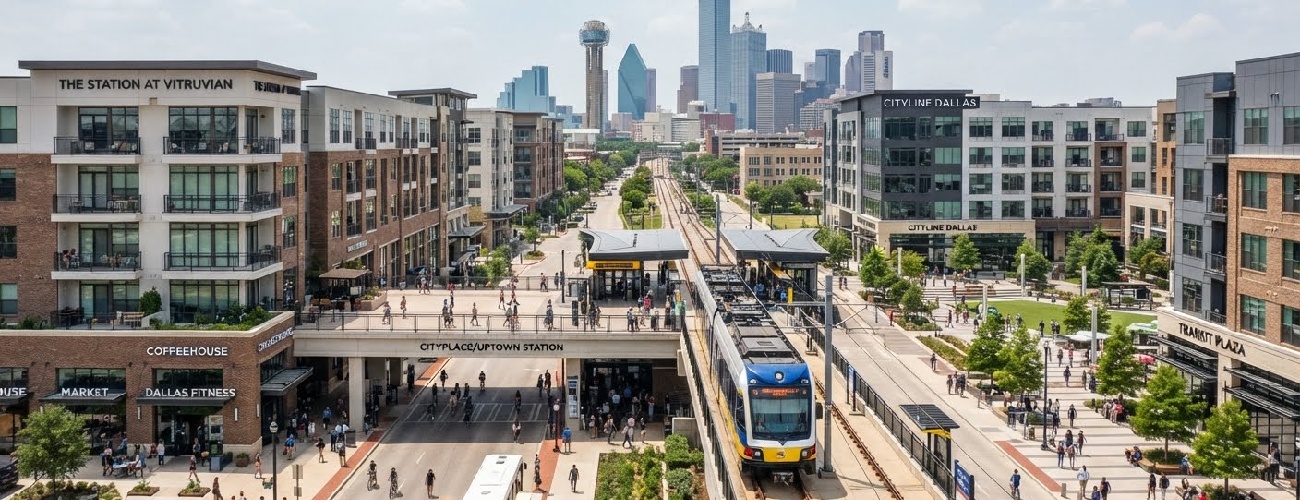
Drive along the DART Red or Blue line on any given Saturday and you’ll notice the same thing twice: a finished project drawing a line of people onto a patio, and a fenced lot two stops down doing absolutely nothing. Same rail access. Same rider base. Wildly different outcomes. The difference almost never comes down to the deal. It comes down to who understood the entitlement path before they wrote the offer.
Dallas has spent the better part of two decades building the regulatory scaffolding for transit-oriented and infill development, from mixed-use zoning that permits density by right near stations to a tax increment financing district built specifically around the rail network. The tools are genuinely good. Most of the market still treats them as an afterthought, which is exactly why the developers who don’t are pulling ahead.
Which Dallas Zoning Districts Allow Transit-Oriented Development By Right?
Three zoning categories carry most of the city’s TOD and infill activity, and all three allow mixed-use development without a rezoning fight in the ordinary case.
- Mixed-Use districts (MU-1, MU-2, MU-3): Residential, office, retail, and lodging by right, with density and height bonuses available to projects that qualify as a Mixed Use Project by combining two or more use categories. MU-3 is the heavyweight of the three, with no density cap, FAR up to 4.5, and heights reaching 270 feet, roughly 20 stories.
- Central Area (CA-1(A)): Covers most of Downtown Dallas and allows office, residential, hotel, retail, and mixed-use development either by right or through a Specific Use Permit.
- Planned Development (PD) districts: Each PD carries its own customized use table, and a number of them, including PD 708 at Pegasus Park and PD 357 downtown, were written specifically to encourage transit-oriented, mixed-use outcomes.
The practical test for any site is proximity. Properties within a quarter to half mile of a DART rail station sit in the sweet spot, and the rent data backs up why that matters: TOD product commands roughly a 10 percent premium on residential rents and 12.6 percent on commercial rents compared to non-TOD comparables. That premium is the whole argument for pursuing density near a station instead of settling for a suburban floor plate on an infill lot.
When the base zoning won’t support the density, height, or use mix a pro forma needs, there are three real paths forward: a PD amendment (typically 4 to 6 months through the City Plan Commission and City Council), a density bonus through the Mixed Income Housing Development Bonus program, or a straight zoning map amendment to a higher-intensity MU or PD district. Each has a different timeline and a different political temperature, and picking the wrong one is one of the more expensive mistakes a development team can make.
How Long Does It Take to Permit a TOD or Infill Project in Dallas?
This is the number every investment committee actually wants, and it depends heavily on whether the project fits within existing zoning or needs an amendment first.
Project Type | Typical Timeline |
|---|---|
By-right TOD or infill (MU or CA-1(A) districts) | 6 to 12 months from permit submission to issuance |
PD amendment plus permitting | 10 to 18 months (4 to 6 months for the PD amendment, then 6 to 12 months for permits) |
Development on DART-owned land | 12 to 24 months, driven by ground lease and shared-infrastructure negotiations |
Those windows assume a reasonably clean process. Site plan review alone runs 10 days to 6 weeks under normal conditions, longer if the project needs variances or waivers, and building plan review takes a minimum of three weeks for the first pass. Projects willing to pay for third-party plan review through a city-approved private engineering firm can sometimes compress that to 2 to 3 months, which is worth evaluating on any project where carrying costs are running hot.
Where Infill Sites Get Complicated
The entitlement path is only half the story on infill parcels. Aging infrastructure is the recurring theme: underground parking structures complicate below-grade connections for electrical transformers, gas service, and water entry, and Dallas Water Utilities frequently requires line extensions or upgraded meters on sites that haven’t seen new construction in decades. Add in the possibility of brownfield conditions, asbestos, or lead paint from a prior use, and Phase I and Phase II environmental studies stop being a formality and start being a scheduling dependency.
This is where a lot of otherwise well-capitalized projects lose months they didn’t budget for. Sequencing the utility, structural, and environmental workstreams alongside the zoning and site plan process, rather than after it, is the difference between a 9-month entitlement and a 15-month one.
Working through that sequencing with a firm that handles it daily, like the team at JDJ Consulting’s Dallas permit expediting and entitlement practice, tends to pay for itself well before the first inspection, simply by catching the conflicts early enough to route around them instead of stopping to fix them mid-permit.
Where Does the Friction Actually Show Up, and For Whom?
Every stakeholder on a TOD or infill deal experiences the entitlement process differently, and the friction points aren’t always where you’d expect.
Stakeholder | What Tends to Slow Them Down |
|---|---|
Developers | Zoning conflicts near single-family neighborhoods, PD rezoning delays tied to community opposition, rising construction costs, and a shrinking pool of infill sites with adequate utility capacity. |
Architects | Designing to density, FAR, and height maximums while still hitting unit and leasable area targets, and integrating separate MEP and fire systems across mixed uses without blowing the budget. |
General Contractors | Compressed schedules, supply chain lags on finishes and MEP equipment, skilled labor shortages, and infill constraints like tight staging areas and shoring around adjacent structures. |
Investors | Regulatory uncertainty around PD rezoning, layered financing across use types, tighter lending standards, and site-level risk from legacy environmental conditions. |
DART and Transit Agencies | Coordinating construction and access around live transit operations while protecting pedestrian safety and balancing development revenue against service quality. |
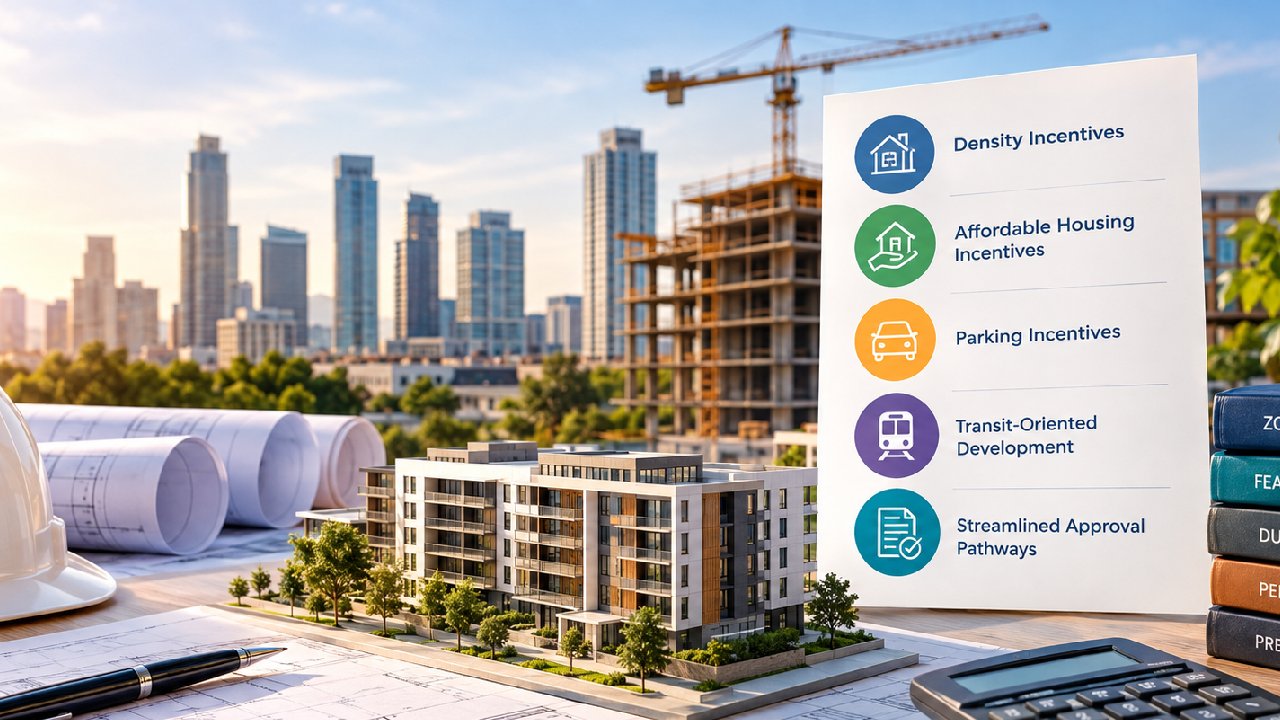
What Incentives Are Available for Transit-Oriented and Infill Development in Dallas?
Dallas has built a genuinely deep incentive stack for TOD and infill product, and most projects qualify for more than one layer.
Mixed Income Housing Development Bonus (MIHDB)
MIHDB is the single most useful tool in the stack for anyone trying to push past base zoning. Set aside units for households at or below 60 percent of Area Median Family Income, or pay a fee in lieu calculated against a square footage matrix, and the city returns density bonuses, added height, parking reductions from 1.25 spaces per bedroom down to as little as 0.5 to 1.0 spaces per unit, and reduced setbacks. In MU-3 areas within qualifying Market Value Analysis categories, the FAR bonus alone can run up to an additional 3.0 for a 5 percent affordable set-aside.
TOD Tax Increment Financing District
The TOD TIF District covers 1,641.6 acres across four sub-districts, Cedar Crest, Cedars West, Lancaster Corridor, and Mockingbird/Lovers Lane, all strung along the DART Red and Blue lines. Increment revenue funds public improvements and affordable housing, and the district deliberately transfers a share of increment from higher-value areas to Lancaster Corridor in Oak Cliff to spread development activity rather than concentrate it entirely around the strongest submarkets.
Tax Abatements and Gap Financing
- As-of-right abatements: a 10-year, 90 percent abatement on new real property taxes, or a 5-year, 90 percent abatement on new business personal property taxes, for qualifying projects in designated Target Areas with a budget under $25 million.
- Negotiated abatements for larger projects, subject to City Council approval and underwriting review.
- Chapter 380 grants and loans for projects that expand the tax base or serve low- and moderate-income communities, which have been layered into recent deals such as the Power & Light at Cedars mixed-income project and The Meadow TOD, the latter combining a $13.5 million city grant with Low-Income Housing Tax Credits.
- A Predevelopment Assistance Fund offering loans up to $50,000 for market studies, site assessments, and early design work in Target Areas.
Which Dallas Neighborhoods Are Positioned for the Next Wave of TOD?
A handful of submarkets are doing most of the heavy lifting right now, and each offers a slightly different entry point depending on a project’s risk tolerance and timeline.
- Mockingbird Station: DFW’s original TOD, opened in 2001, now expanding with a 16-acre phase adding apartments, a hotel, office space, and underground parking, targeted for late 2027.
- The Cedars: One of the fastest-moving up-and-coming districts south of downtown, anchored by large mixed-income redevelopments and supported directly by the Cedars West TOD TIF sub-district.
- Royal Lane Station: A $67.5 million mixed-income project sitting a fifth of a mile from the station, part of the city’s broader push on DART-owned parcels.
- West Dallas and Trinity Groves: Riding the momentum of Trinity Groves’ early success, with strong renter demand pulling new mixed-use projects into the ground.
- Deep Ellum and the Design District: Both drawing fresh mixed-use investment, including a 2.2-acre Design District project spanning I-30 that breaks ground in 2026.
For developers willing to negotiate directly with the transit agency, DART itself controls 37 underutilized sites near rail and bus stations, with six stations, 8th & Corinth, Hampton, Westmoreland, Lake June, Buckner, and Royal Lane, currently authorized for exclusive negotiating agreements. These deals take longer to close, typically 12 to 24 months once ground lease terms and shared infrastructure agreements are factored in, but they offer a level of site control and station adjacency that’s genuinely hard to replicate on the open market.
The Real Takeaway for Developers, Architects, and Investors
None of this is complicated in the sense of being unknowable. It’s complicated in the sense that it requires coordinating zoning strategy, utility due diligence, environmental review, and incentive stacking on a timeline that doesn’t leave much room for sequencing mistakes. Architects lose weeks reworking envelopes around parking ratios that could have been resolved with an earlier MIHDB conversation. Investors get blindsided by PD rezoning timelines that weren’t built into the underwriting. Contractors inherit shoring and staging problems that a Phase I study would have flagged months earlier.
The projects that move fastest through Dallas’s TOD and infill pipeline are almost always the ones where someone mapped the zoning, utility, and incentive picture before the site closed, not after. That’s the work our team handles day in and day out through JDJ Consulting’s Dallas permit expediting and entitlement services, from initial zoning verification and PD strategy through final certificate of occupancy. If you’re evaluating a site near a DART corridor or sitting on an infill parcel that’s been sitting a little too long, it’s worth a conversation before you’re locked into a timeline that doesn’t work. You can see the full range of our entitlement and permit expediting services across Texas and Florida markets, or reach out directly to talk through a specific site.
Frequently Asked Questions
What zoning districts allow transit-oriented development by right in Dallas?
Mixed-Use districts (MU-1, MU-2, MU-3), the Central Area district (CA-1(A)) covering most of Downtown, and many Planned Development districts near DART rail stations permit TOD by right. MU-3 is the most permissive, with no maximum density, FAR up to 4.5, and heights up to 270 feet.
How long does it take to get entitlements for a Dallas infill project?
A by-right project in an MU or CA-1(A) district typically takes 6 to 12 months from permit submission to issuance. Projects needing a Planned Development amendment should budget 10 to 18 months total, and sites on DART-owned land often run 12 to 24 months because of ground lease negotiations.
What is the Mixed Income Housing Development Bonus program?
MIHDB lets developers trade affordable housing commitments, or a fee paid in lieu, for density bonuses, added height, reduced parking ratios, and smaller setbacks. It is one of the most direct levers for pushing a project past base zoning limits near transit.
Do TOD projects in Dallas get reduced parking requirements?
Yes. Parking near DART stations typically runs 0.5 to 1.0 spaces per unit compared to the standard 1.25 to 1.5 spaces per unit citywide, and MIHDB or Mixed Use Project bonuses can push that ratio even lower.
What is the Dallas TOD TIF District?
It is a 1,641.6-acre tax increment financing district spanning four sub-districts along the DART Red and Blue lines: Cedar Crest, Cedars West, Lancaster Corridor, and Mockingbird/Lovers Lane. Increment funds public improvements and affordable housing, with a portion of revenue shared across sub-districts to support development in Oak Cliff.