Table of Contents
What actually happens between land contract and the first foundation pour, and why the entitlement stage decides more Dallas multifamily deals than the market does
Dallas doesn’t have a multifamily supply problem. It has a distribution problem. The northern suburbs are absorbing a wave of new deliveries that’s starting to soften rents, while several pockets closer to the urban core remain genuinely underbuilt relative to demand. For a developer deciding where to plant the next 250-unit deal, the zoning map matters just as much as the rent comp down the street.
And once the site is under contract, the entitlement and permitting process is what determines whether that deal delivers on schedule or bleeds carrying costs for an extra year. Dallas runs a fairly predictable system once you understand it: by-right paths for projects that fit existing zoning, and a Planned Development track for everything else. Knowing which one applies before closing on land changes the entire pro forma.
This guide walks through how multifamily projects move through the City of Dallas in 2026: which zoning districts allow apartments outright, when Planned Development rezoning becomes unavoidable, what the realistic timeline looks like end to end, and which incentive programs can offset the cost of getting there.
What Zoning Districts Allow Multifamily Development in Dallas?
Multifamily housing is permitted by right in Dallas’s MF-1 through MF-4 districts under Chapter 51A of the city’s development code, along with a number of mixed-use corridors along major arterials. The specific district determines how much a developer can build without triggering a rezoning fight.
- MF-1 (low density): up to 12 units per acre, 40-foot height limit (roughly three stories), 60 percent lot coverage.
- MF-2 (medium density): typically 20 to 30 units per acre, with 40- to 60-foot height limits depending on the subdistrict.
- MF-3: a step up in intensity between MF-2 and MF-4, used widely across East Dallas and inner-ring neighborhoods.
- MF-4 (high density): the city’s most intensive residential district, allowing 60-plus units per acre and greater building heights, common in Uptown, Oak Lawn, and Knox-Henderson.
Mixed-use corridor zoning along streets like Greenville Avenue, Henderson Avenue, and Oak Lawn Avenue often allows multifamily as part of a mixed-use program, which is why so much of Dallas’s recent apartment activity clusters along these corridors rather than in purely residential districts.
When the base zoning doesn’t support the density, height, or use mix a project needs, developers generally have three paths forward: Planned Development rezoning, a Form-Based Code district application for specific neighborhood contexts, or a formal zoning map amendment to a higher-intensity MF district. Of the three, PD rezoning is by far the most common route for urban infill.
When Does a Dallas Multifamily Project Need Planned Development Rezoning?
Most infill multifamily deals in Dallas need more density, height, or flexibility than base MF zoning provides, which is why Planned Development rezoning shows up so often on the entitlement timeline. It’s not a formality. It’s a public process with real risk attached.
A pre-application meeting with the Development Services Department is strongly recommended before filing, and skipping it is one of the more expensive shortcuts a developer can take. That meeting is where staff will flag concerns about density, traffic, or neighborhood compatibility before they become public objections at a hearing.
A complete PD application typically includes the proposed development program (unit count, unit mix, amenities), a site plan with architectural renderings and massing studies, a traffic impact analysis for projects above roughly 100 units or on higher-traffic corridors, and draft PD ordinance language defining the allowed uses and development standards.
From there, the City Plan Commission holds a public hearing, generally three to four months after the application is deemed complete, weighing the project against the ForwardDallas comprehensive plan and applicable design guidelines. City Council then votes one to two months after the CPC hearing. For an uncontroversial project, that puts total PD rezoning time at four to six months. Add real community opposition and it can run considerably longer.
This is the stage where a project’s timeline either holds or slips. Navigating Dallas’s PD rezoning process without an established read on staff posture, current CPC priorities, and neighborhood dynamics is one of the more common ways a multifamily schedule loses six months or more, often before a single foundation permit is even submitted.
How Long Does the Full Entitlement and Permitting Timeline Actually Take?
There are effectively two timelines in Dallas multifamily development, and the gap between them is significant enough to change how a deal is underwritten.
Path | What’s Involved | Realistic Timeline |
|---|---|---|
By-right multifamily | Zoning verification, site plan approval, utility coordination, building plan review, inspections and CO | 3 to 6 months from permit submission |
PD rezoning required | Pre-application, PD application, CPC hearing, Council vote, then full permitting process | 10 to 18 months total |
Third-party plan review | Optional private engineering review in place of city review | Cuts building review to roughly 2 to 3 months, at added cost |
The single biggest variable inside that range is community response during the PD process. A clean, well-scoped project in an area with existing multifamily character can move through in four months. A project seen as out of scale with adjacent single-family neighborhoods can stretch well past a year, particularly if it goes back for a revised submission.
What Site Plan, Utility, and Building Permit Approvals Should Developers Expect?
Site plan approval
Site plan review covers property boundaries, building footprints, unit layouts, parking, landscaping, drainage, and grading and erosion control. Standard parking ratios run 1.25 to 1.5 spaces per unit, though projects using the city’s density bonus program can reduce that to 0.5 to 1.0 spaces per unit near transit. Review generally takes 10 days to six weeks, longer if the project needs a variance or waiver.
Utility and infrastructure coordination
Water and wastewater capacity gets confirmed through Dallas Water Utilities, and larger projects sometimes require line extensions or pump station upgrades that aren’t obvious until the utility review is underway. Electric service runs through Oncor, and multifamily buildings typically need dedicated transformers and underground service. Stormwater management has to comply with the Dallas Drainage Design Manual as well as TCEQ requirements.
Building permit and plan review
Full construction documents, architectural, structural, mechanical, electrical, plumbing, fire protection, energy compliance under IECC, and TAS/ADA accessibility, go through a formal review that takes a minimum of three weeks for the initial pass. For a by-right project, plan on three to five months from submission to permit issuance through standard city review. Fire department review carries particular weight for multifamily given the life safety requirements around sprinklers, alarms, and egress.
Environmental permits and inspections
Depending on the site, developers may also need TCEQ stormwater discharge and erosion control permits, plus a tree preservation or removal permit if the property contains protected trees above roughly 19 inches in diameter. Construction proceeds through progressive inspections at foundation, framing, electrical, plumbing, and fire sprinkler stages, with a final inspection from Building, Fire, and Public Works required before the Certificate of Occupancy is issued.
Which Dallas Submarkets Are Oversupplied, and Which Still Have Room to Run?
Site selection and entitlement risk are connected. A project that sails through permitting in an oversupplied submarket can still underperform, while a harder entitlement in an undersupplied pocket often pencils out better over a hold period.
Where supply is catching up to demand
- Northern suburbs (McKinney, Plano, Frisco): poised to absorb the bulk of new apartment deliveries through 2026, with vacancy in some submarkets reaching 10 to 12 percent and rent concessions becoming more common.
- Northwest Dallas outlying areas: significant recent development activity, with rising competition starting to pressure rates.
- DFW Airport corridor and Irving: a mature, steady-delivery market anchored by proximity to major employment hubs.
Where opportunity is opening up
- West Dallas and Trinity Groves: one of the more active growth corridors in the metro, riding the momentum of Trinity Groves’ earlier success.
- The Cedars: large-scale mixed-income redevelopment is reshaping the submarket, including projects on former industrial and retail sites just south of downtown.
- East Dallas: growing investor interest tied to proximity to White Rock Lake, Lakewood, and downtown employment.
- Far North Dallas: strong highway access and nearby employment centers continue to draw development attention.
Across nearly every submarket, the same constraints show up: NIMBY resistance during PD hearings near single-family neighborhoods, utility capacity limits even inside MF-zoned areas, and rising land costs as multifamily competes with office, retail, and industrial uses for a shrinking pool of well-located infill sites.
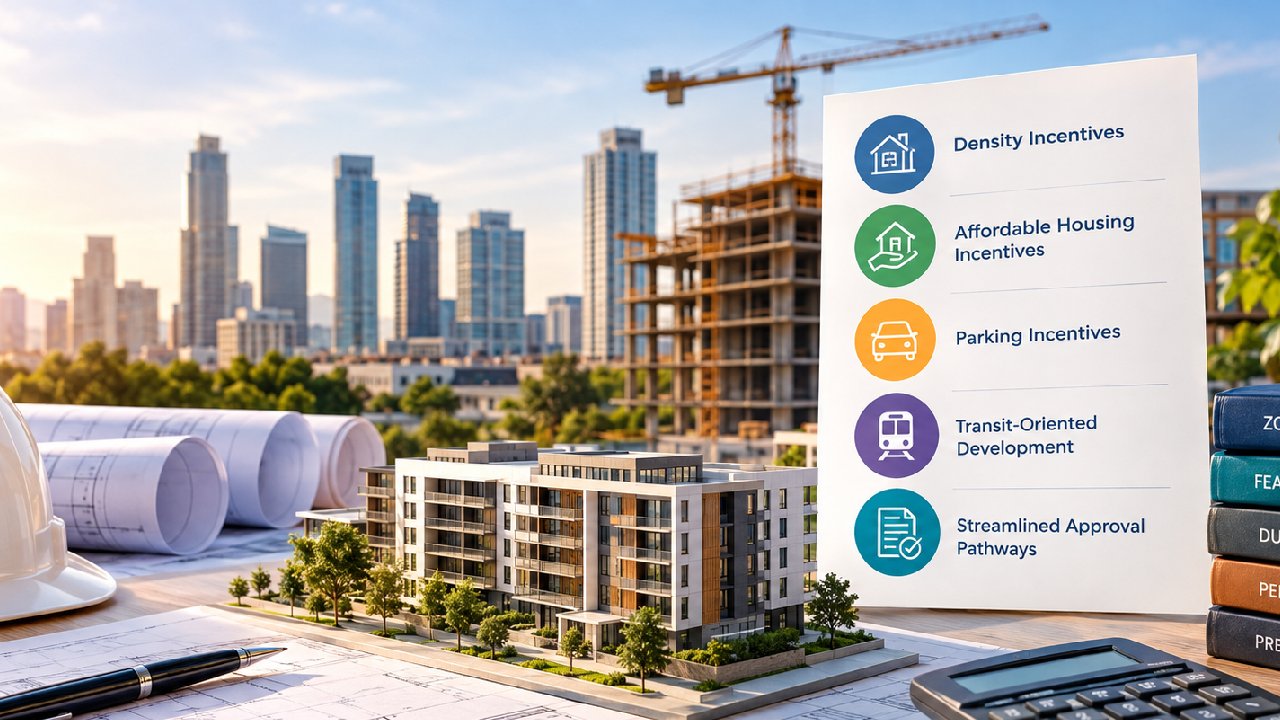
What Incentive Programs Can Offset Dallas Multifamily Development Costs?
Mixed Income Housing Development Bonus (MIHDB)
MIHDB is the workhorse incentive for Dallas multifamily infill. Developers who set aside units for households at or below 60 percent of Area Median Family Income can receive density bonuses, height bonuses, reduced parking ratios, and reduced setback or lot coverage requirements. A fee-in-lieu option exists for developers who’d rather contribute to the MIHDB Fund than build affordable units on site, calculated against building height and the property’s Market Value Analysis location. Participating projects must accept housing vouchers and report available units to local voucher providers.
As-of-right tax abatements in Target Areas
Projects located in a designated Target Area, generally Southern Dallas, the Cedars, and other state-designated Enterprise Zones, can qualify for a 10-year, 90 percent abatement on new real property taxes, or a 5-year, 90 percent abatement on new business personal property taxes, without a City Council vote. Eligibility requires a total project budget of $25 million or less, capital expenditures of at least $2 million (or creation of 10 full-time jobs), wages at or above the MIT Living Wage for Dallas County, and no residential displacement without replacement housing and relocation assistance.
Negotiated abatements, Chapter 380 grants, and other layers
Larger projects, or those outside a Target Area, can pursue a negotiated abatement through City Council, which weighs public benefits like workforce development, sustainability features, and transit connectivity. Chapter 380 loans and grants are available for projects that expand the tax base or improve lower-income communities, and can be layered with abatements and state Low-Income Housing Tax Credits. A Predevelopment Assistance Fund also offers loans up to $50,000 for emerging developers working in Target Areas, covering early costs like market studies and site assessments.
State-level programs
At the state level, the Texas Department of Housing and Community Affairs administers Low-Income Housing Tax Credits, which are frequently layered with city-level grants on affordable and mixed-income deals. The Texas Enterprise Zone Program offers sales tax refunds on construction materials in designated zones, and Chapter 312 of the Texas Tax Code allows local governments to offer up to 10-year property tax abatements within designated Reinvestment Zones
What Hurdles Should Developers, Architects, and Investors Plan For?
The entitlement process doesn’t create the same friction for every party at the table. Understanding where each stakeholder feels the pressure makes for a smoother project overall.
Stakeholder | Where the Friction Shows Up |
|---|---|
Developers | Zoning conflicts near single-family neighborhoods, PD delays from community opposition, scarcity of well-located infill sites, and rent pressure in oversupplied submarkets. |
Architects | Balancing density and height maximization against amenity space, coordinating exterior envelope with interior layouts, and meeting Form-Based Code standards without blowing the budget. |
General contractors | Compressed schedules to beat market saturation, supply chain timing on finishes and MEP equipment, and inspection delays during construction. |
Investors | Regulatory and PD rezoning risk, submarket oversupply eroding rent growth assumptions, and permitting delays quietly inflating soft costs. |
Building the Timeline Into the Deal, Not the Other Way Around
None of this is insurmountable, but it does reward developers who treat entitlement as a discipline rather than an afterthought. The projects that hit their delivery dates in Dallas tend to share a pattern: realistic PD timelines built into the pro forma from day one, utility capacity confirmed before the site closes, and an incentive stack structured around the deal rather than bolted on after the fact.
JDJ Consulting works with developers, architects, and investors on exactly this kind of groundwork across the Dallas market. If a multifamily site is on the table, JDJ Consulting’s Dallas permit expediting and entitlement consulting team is worth a call before the land goes under contract, not after the first delay hits. For a broader look at how the firm supports development projects across Texas and Florida, visit JDJ Consulting’s services page.
Frequently Asked Questions
Does multifamily development require rezoning in Dallas?
Not always. Projects that fit within the density, height, and use parameters of the MF-1 through MF-4 districts can generally move forward by right. Projects seeking higher density, additional height, or a mixed-use configuration typically need Planned Development rezoning, which adds four to twelve months to the timeline.
How long does it take to get a multifamily permit in Dallas?
By-right multifamily permits typically take three to six months from submission to issuance. Projects that require PD rezoning first should budget ten to eighteen months in total, accounting for both the rezoning process and the building permit review that follows.
What is the Mixed Income Housing Development Bonus (MIHDB) program?
MIHDB is a Dallas density bonus program that exchanges affordable housing set-asides, or a fee-in-lieu payment, for additional density, extra height, and reduced parking ratios. It’s one of the most widely used tools for urban infill multifamily projects in high land-cost corridors.
Which Dallas neighborhoods have room for new multifamily development?
West Dallas and Trinity Groves, the Cedars, East Dallas, and Far North Dallas are all seeing active investment and redevelopment interest, while northern suburbs like McKinney, Plano, and Frisco are absorbing the bulk of new supply and facing rising vacancy.
What tax incentives are available for multifamily developers in Dallas?
Dallas offers as-of-right tax abatements, up to 90 percent for ten years on real property taxes, for qualifying projects in designated Target Areas, along with negotiated abatements for larger projects, Chapter 380 grants, and access to state Low-Income Housing Tax Credits.
Does a Dallas multifamily project need a traffic impact analysis?
Projects above roughly 100 units, or those located on higher-traffic corridors, typically trigger a traffic impact analysis as part of the Planned Development rezoning application.