
Table of Contents
Real estate development incentive programs can significantly affect the feasibility, density, cost, and approval strategy of a development project. For developers evaluating multifamily, affordable housing, mixed-use, or infill opportunities, identifying available incentives early can help determine whether a site supports the intended project.
In 2026, incentive programs can include density bonuses, additional development capacity, concessions, parking reductions, fee assistance, expedited processing, and other regulatory benefits. However, eligibility varies by jurisdiction, project type, affordability level, site characteristics, and the specific program requirements.
For developers, the key is not simply finding an incentive program. It is determining which programs apply, what benefits they provide, and how those benefits affect the project’s overall feasibility.
What Are Real Estate Development Incentive Programs?
Development incentive programs are government-created policies designed to encourage specific types of development or public benefits.
Depending on the jurisdiction and program, incentives may be connected to:
Affordable housing
Mixed-income housing
Transit-oriented development
Infill development
Housing preservation
Community development
Adaptive reuse
Environmental or sustainability goals
Economic development
Development in targeted areas
The benefits can vary considerably. Some programs increase the number of units that can be developed, while others may provide concessions, reduce development standards, streamline approvals, or provide financial assistance.
For example, California’s State Density Bonus Law can provide qualifying housing developments with increased density, incentives or concessions, development-standard waivers, and parking reductions when applicable affordability requirements are met.
Why Incentive Programs Matter During Pre-Construction
An incentive program should be evaluated before significant design and entitlement decisions are made.
A developer who evaluates a site only under its base zoning may underestimate the site’s development potential. Conversely, assuming an incentive automatically applies can create unrealistic projections.
A better approach is to evaluate:
Base zoning and permitted density
Applicable overlays and special regulations
Affordability requirements
Potential incentive programs
Additional units or development capacity
Height, FAR, setback, or parking considerations
Entitlement and approval requirements
Financial and construction implications
This type of analysis is an important part of pre-construction analysis and feasibility.
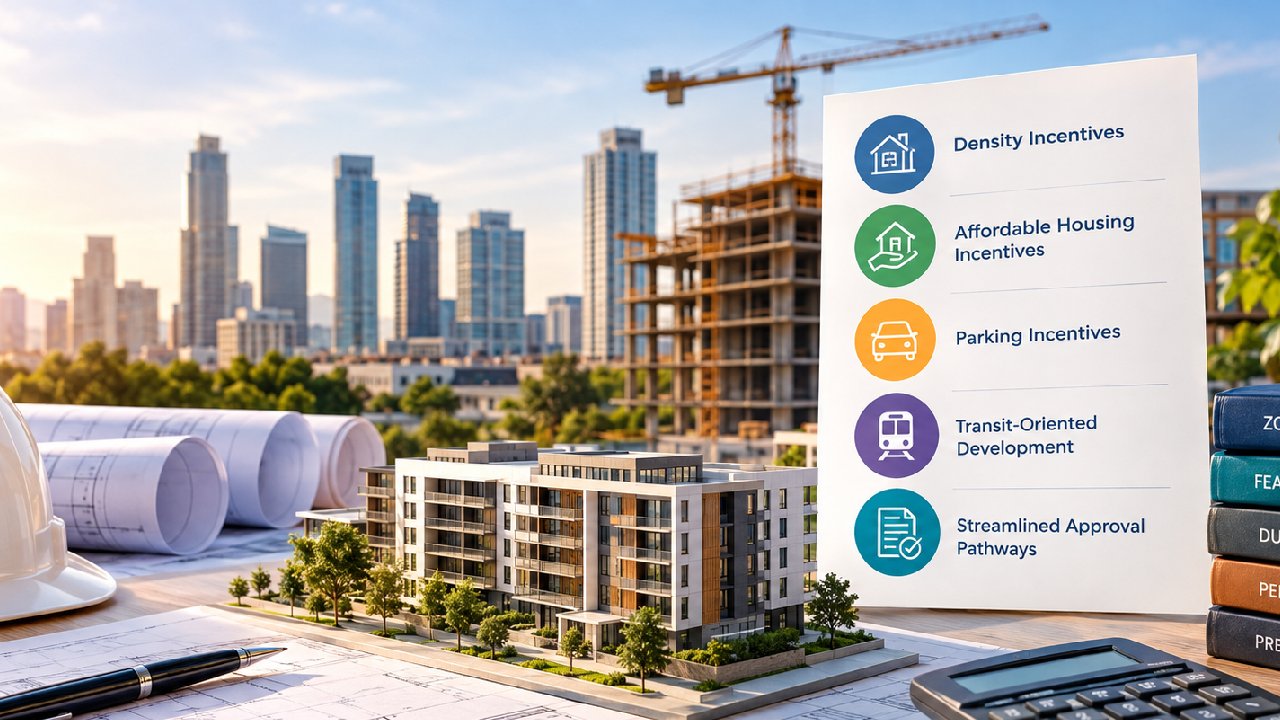
Common Types of Development Incentives
1. Density Bonuses
Density bonuses allow qualifying projects to exceed the otherwise applicable residential density when specific requirements are satisfied.
California’s State Density Bonus Law, for example, provides qualifying housing projects with additional density and may provide other benefits such as concessions, waivers of development standards, and parking reductions.
The exact benefit depends on the project’s characteristics and the applicable law.
2. Affordable Housing Incentives
Affordable housing programs can provide development benefits in exchange for incorporating qualifying affordable units into a project.
The structure varies between jurisdictions, but incentives can include additional development capacity, regulatory concessions, streamlined processing, or other benefits.
Los Angeles, for example, uses the Community Housing Incentive Program (CHIP) framework for qualifying housing projects. JDJ has previously covered how the LA CHIP program can affect permits, incentives, and project timelines.
Related reading:
How LA CHIP Program Affects Permits, Incentives, and Project Timelines
3. Mixed-Income Development Incentives
Mixed-income programs can provide development benefits when a project includes a specified level of affordable housing.
The important consideration is that the additional affordable units can affect the project’s overall development economics.
Developers should evaluate:
Number of market-rate units
Number of affordable units
Required affordability levels
Additional density
Development standards
Parking requirements
Construction costs
Operating assumptions
Approval timeline
The incentive should therefore be evaluated as part of the entire development model rather than as an isolated zoning benefit.
4. Parking Reductions
Parking requirements can have a substantial effect on multifamily feasibility.
Where a qualifying program allows reduced parking requirements, the project may be able to use the site more efficiently. Depending on the project, reducing parking can affect:
Excavation requirements
Garage construction
Building footprint
Unit count
Construction costs
Site circulation
Project schedule
Parking eligibility should be confirmed against the specific jurisdiction and project conditions before being incorporated into a development plan.
5. Expedited or Streamlined Processing
Some housing policies provide expedited or streamlined approval pathways for qualifying projects.
California’s housing policies also recognize expedited permit procedures as one mechanism jurisdictions can use to support affordable housing development.
However, an expedited process does not necessarily eliminate every zoning, design, environmental, or technical requirement.
Understanding the actual approval path is therefore critical during early feasibility analysis.
How to Determine Whether Your Project Qualifies
Eligibility should be evaluated on a project-specific basis.
A typical incentive analysis may examine:
Site
Address
Parcel size
Existing use
Existing structures
Parcel configuration
Transit proximity
Historic resources
Environmental constraints
Zoning
Base zoning
General Plan designation
Overlay zones
Specific plans
Height limits
FAR
Setbacks
Lot coverage
Density
Project
Proposed number of units
Unit types
Rental or ownership structure
Affordable unit percentage
Income restrictions
Building type
Parking requirements
Approval Path
Ministerial or discretionary review
Planning approvals
Building permits
Environmental review
Public hearings
Agency coordination
This information helps determine whether an incentive is potentially available and what conditions may apply.
Incentives Should Be Evaluated Before You Buy the Site
One of the biggest mistakes in development planning is waiting until after acquisition to investigate development incentives.
An incentive can change the development scenario substantially.
For example, a site that appears to support 20 units under its base zoning may have a different development potential under an applicable density bonus or local incentive program. But the additional development capacity may come with affordability requirements, design constraints, or other obligations.
That is why incentive analysis should be incorporated into site due diligence and feasibility analysis.
JDJ’s Due Diligence Consulting and Land Use Consulting services can be integrated into the early evaluation process.
How Incentives Affect Development Feasibility
An incentive should ultimately be measured against the entire project.
Consider these questions:
Does the incentive increase revenue?
Additional units may increase potential rental or sales revenue.
Does it reduce costs?
Parking reductions, streamlined processing, or reduced development requirements may affect project costs.
Does it add costs?
Affordable housing requirements, additional compliance obligations, or program-specific conditions can affect construction and operating economics.
Does it change the timeline?
Some programs can create a more predictable approval pathway, while others may require additional documentation or coordination.
Does the resulting project still work financially?
This is the most important question for the development team.
An incentive that looks attractive from a zoning perspective may not necessarily produce the desired financial outcome once construction costs, financing, affordability requirements, and operating assumptions are included.
Los Angeles Development Incentives in 2026
Los Angeles developers have several housing-related regulatory tools to evaluate, including the City’s CHIP framework and California’s State Density Bonus Law.
JDJ’s recent analysis of Los Angeles multifamily infill identifies CHIP, including its applicable affordable housing and mixed-income pathways, as an important part of the city’s current development landscape.
The City is also processing active projects using CHIP-related affordable housing incentives. For example, a 2026 Los Angeles Planning case describes a 40-unit, 100% affordable project using an AHIP pathway and requesting an FAR increase.
These examples demonstrate why developers should evaluate the specific program and entitlement path for each property rather than assuming that one incentive structure applies to every project.
Incentive Programs Are Not a Substitute for Due Diligence
Development incentives can improve a project’s potential, but they do not eliminate site-specific risks.
A complete evaluation should still consider:
Zoning
Existing tenants
Existing affordable units
Historic status
Environmental conditions
Utilities
Access
Fire requirements
Parking
Building code
Community or agency requirements
Construction costs
Financing
Market demand
California’s housing requirements can also impose replacement obligations in certain circumstances involving existing affordable or rent-restricted housing.
This is why incentive analysis should be performed alongside zoning, entitlement, and property due diligence.
A Practical Incentive Program Evaluation Process
Developers can use the following framework before moving forward with a project.
Step 1: Identify the Site
Start with the property address, parcel information, existing use, and jurisdiction.
Step 2: Analyze the Base Zoning
Determine what can be built under the site’s existing zoning before applying incentives.
Step 3: Identify Potential Programs
Review applicable state, city, county, and regional incentive programs.
Step 4: Test Eligibility
Compare the project’s proposed use, affordability mix, density, location, and other characteristics against program requirements.
Step 5: Model the Development Scenario
Compare the base-zoning scenario with potential incentive scenarios.
Step 6: Review Entitlement Requirements
Determine whether the project can proceed ministerially or requires discretionary approvals, hearings, or additional entitlements.
Step 7: Evaluate the Economics
Compare potential additional revenue and development capacity against construction costs, affordability requirements, financing, and other project expenses.
Step 8: Build the Approval Strategy
Once the appropriate pathway is identified, establish the permitting and entitlement strategy.
JDJ Consulting provides land use and entitlement consulting, permit expediting services, and pre-construction analysis to help development teams evaluate and navigate these processes.
Frequently Asked Questions
What is a real estate development incentive program?
A development incentive program is a government policy that provides qualifying development projects with specific benefits in exchange for meeting defined requirements. Benefits may include additional density, development-standard concessions, parking reductions, financial assistance, or streamlined processing.
What is a density bonus?
A density bonus allows an eligible housing project to exceed its otherwise applicable residential density when the project satisfies the requirements of the applicable density bonus law or program. California’s State Density Bonus Law can also provide qualifying projects with incentives, concessions, waivers, and parking reductions.
Do all multifamily projects qualify for incentives?
No. Eligibility depends on the specific program and project. Factors can include location, zoning, affordability levels, number of units, project type, existing conditions, and other requirements.
Can development incentives reduce parking requirements?
Some programs and laws can reduce or modify parking requirements for qualifying projects. The exact requirements depend on the applicable jurisdiction and program.
Should I evaluate incentives before purchasing property?
Yes. Evaluating potential incentives during due diligence can help developers understand the site’s potential development scenarios before committing substantial capital.
Can incentives increase the number of units I can build?
Potentially. Certain density bonus and local housing programs can increase allowable residential density for qualifying projects. The amount of additional density and associated requirements depend on the applicable program.
Do incentives guarantee project approval?
No. Eligibility for an incentive does not necessarily mean that every aspect of a project is automatically approved. Projects may still need to satisfy applicable zoning, building, environmental, design, and permitting requirements.
How can JDJ Consulting help with incentive programs?
JDJ Consulting can help evaluate zoning, development potential, incentive eligibility, entitlement requirements, and permitting strategy as part of a broader development feasibility process. JDJ’s land use consulting services specifically address density bonus qualifications, affordable housing requirements, and related development rules.
Final Takeaway
Development incentive programs can materially change how a real estate project is evaluated, particularly for multifamily, affordable housing, and infill development.
The most effective approach is to identify potential incentives before acquisition or major design decisions, test eligibility against the actual site and project, and compare the resulting development scenario with the base-zoning option.
For developers evaluating a property in Los Angeles, California, Texas, or Florida, a project-specific feasibility and entitlement review can provide a clearer picture of the available development pathways before moving into permitting and construction.
Need help evaluating a development site? JDJ Consulting can assist with zoning, feasibility, entitlement strategy, incentive analysis, and permit coordination.
Explore Pre-Construction Analysis
Explore Land Use Consulting
Explore Permit Expediting Services
Contact JDJ Consulting