If you’ve ever asked, “What are the 7 steps of Environmental Impact Assessments?”, you’re in the right place. Environmental Impact Assessment (EIA) is the cornerstone of sustainable development – ensuring projects are environmentally responsible – from planning to execution.
Table of Contents
In this guide, we break down each of the seven steps in a clear way. Along the way, we’ll explore real-world case studies, common questions, and practical tools to help you understand the full EIA lifecycle.
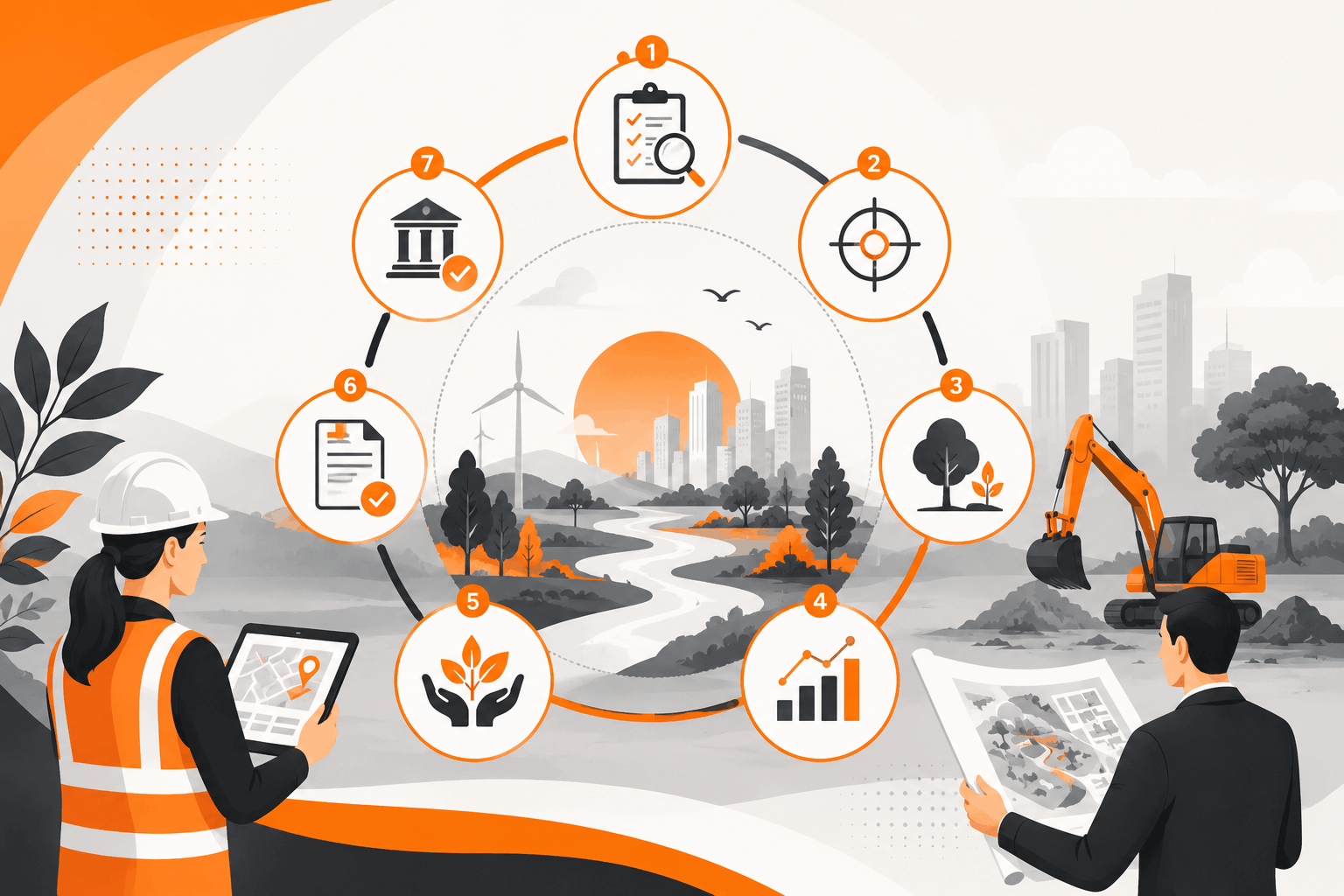
The 7 Steps of Environmental Impact Assessment (EIA)
1. Screening
Determines whether a project requires an EIA and to what extent. This filters out minor proposals that don’t need full assessment.
2. Scoping
Identifies which potential environmental impacts should be addressed, helping focus the assessment on relevant issues.
3. Impact Assessment
Analyzes the potential effects of the proposed project—both positive and negative—on the environment, people, and resources.
4. Mitigation
Outlines strategies to reduce, avoid, or offset adverse impacts. This might include redesigns or alternative methods.
5. Reporting (EIA Report)
Compiles findings in a formal Environmental Impact Statement (EIS), including baseline data, risks, and proposed mitigation.
6. Review & Public Consultation
Stakeholders, agencies, and the public review the EIA report and submit feedback before any approvals are granted.
7. Decision & Monitoring
Authorities decide whether the project can proceed. If approved, ongoing monitoring ensures compliance with EIA terms.
Need Help With Environmental Review or EIA Compliance?
JDJ Consulting helps developers, investors, and property owners navigate the Environmental Impact Assessment process with confidence. Our experienced land use consultants provide support from early screening through final compliance and approvals.
- Phone: (818) 793-5058
- Email: sales@jdj-consulting.com
- Office: 12925 Riverside Dr Suite 302, Sherman Oaks, CA 91423
1. Screening
Goal: Determine whether a project requires a full EIA.
Authorities evaluate the size, nature, and location of a project.
Project categorization (e.g., Category A, B, or exempt) depending on likely impacts.
Low-impact projects may proceed with a simplified Environmental Management Plan (EMP).
Example: In Scotland, a small urban drainage upgrade was screened and found to require only basic mitigation—saving time and resources while protecting water quality.
2. Scoping
Purpose: Identify which environmental effects to study.
This stage sets the direction for the EIA.
Developers and consultants work with communities, regulators, and environmental experts.
Key issues like noise, air quality, biodiversity, and traffic are prioritized.
Scoping Checklist
| Area of Concern | Key Question | Information Needed |
|---|---|---|
| Air Quality | Will emissions exceed safe levels? | Emission rates, dispersion models |
| Wildlife | Are protected species at risk? | Habitat surveys, mapping |
| Noise | Will there be construction noise? | Baseline dB readings |
| Traffic | Will local traffic be disrupted? | Flow patterns, trip analysis |
3. Impact Assessment & Mitigation
What it involves: A systematic evaluation of all likely environmental and social impacts—both direct and indirect, short and long term.
This includes:
Air and water pollution
Land use changes
Effects on local communities and ecosystems
Mitigation Hierarchy:
Avoid impacts where possible
Minimize unavoidable impacts
Restore affected areas
Offset residual impacts through compensation
Case Study: A renewable energy project in the UK adjusted turbine placement after surveys showed potential disruption to bird migration paths—reducing ecological harm through smart design.
4. Impact Management (Planning & Monitoring)
At this point, planners detail how mitigation actions will be implemented and monitored.
Develop Environmental Management Plans (EMPs)
Assign responsibilities and timelines
Define performance indicators
Set reporting mechanisms for compliance
Example Monitoring Table
| Indicator | Baseline Value | Target Value | Frequency |
|---|---|---|---|
| PM2.5 (µg/m³) | 18 | ≤ 25 | Weekly |
| Noise (dB) | 45 | ≤ 55 | Daily |
| pH (stream water) | 7.2 | 6.5–8.5 | Monthly |
5. EIA Report
Also known as the Environmental Impact Statement (EIS), this is the core document delivered to decision-makers.
It includes:
Detailed description of the project
Predicted impacts and mitigation strategies
Environmental baseline data
Alternatives considered
A non-technical summary for public accessibility
The report must be clear, evidence-based, and aligned with regulatory standards. Accessibility is essential for community understanding and participation.
6. Review & Decision-Making
After submitting the EIA report:
Regulatory bodies review the quality, scope, and methodology.
Public input is reviewed and addressed.
A formal decision is made—approve, deny, or request additional information.
Case Example: In Ireland, a review of a port expansion EIA led to updated runoff management systems after environmental groups flagged sedimentation risks to a nearby estuary.
7. Monitoring & Compliance
Purpose: Confirm that mitigation measures are effective and long-term impacts are managed.
Conduction of site visits and environmental audits.
Regular collection of performance data.
Adaptive management strategies allow changes when real-world outcomes deviate from predictions.
Key Point: Monitoring ensures that developers stay accountable and that environments remain protected beyond construction.
Summary Chart – EIA Process Breakdown
| Step | Key Action |
|---|---|
| Screening | Decide if full EIA is needed |
| Scoping | Identify key issues and concerns |
| Impact Assessment | Analyze risks and propose mitigation |
| Impact Management | Plan and monitor mitigation steps |
| EIA Report | Compile and submit findings |
| Review & Decision-Making | Evaluate and approve/reject |
| Monitoring & Compliance | Enforce and adjust mitigation actions |
People Also Ask
What is the purpose of an Environmental Impact Assessment?
An Environmental Impact Assessment helps identify environmental risks before a project begins and supports responsible development planning.
What projects require an EIA?
Large construction, infrastructure, industrial, transportation, and energy projects commonly require an Environmental Impact Assessment.
How long does the EIA process take?
The EIA process may take several months depending on project complexity, public consultation, and regulatory review requirements.
Who prepares an Environmental Impact Assessment report?
Environmental consultants and technical experts typically prepare EIA reports on behalf of developers or agencies.
Can a project fail an EIA review?
Yes. Projects with major environmental risks may require redesign, mitigation measures, delays, or additional review.
Does an EIA include climate change analysis?
Modern EIAs often evaluate emissions, climate resilience, environmental sustainability, and long-term climate impacts.
Explore JDJ Consulting Services
Our Los Angeles land use consultants provide tailored support for entitlement processing, feasibility analysis, permit coordination, and development planning.
- Land Use & Zoning Consulting
- Permit Expediting Services
- Development Feasibility & Due Diligence
Resource Section
Learn more about EIA regulations from MyGov Scotland
For a foundational guide, visit the Environmental Mainstreaming Initiative
Read the European Commission’s EIA Directive for the broader context
Conclusion
By now, you should have a complete understanding of “what the 7 steps of Environmental Impact Assessments (EIA) are—and why they matter. Whether you’re a developer, policymaker, or curious citizen, knowing this process helps ensure we make decisions that respect our environment and communities. A well-executed EIA isn’t a barrier—it’s a path to better, more responsible development.
If you’re planning a development and want to navigate the EIA process with confidence, JDJ Consulting can help. Our experienced land use consultants in Los Angeles provide tailored support through every stage—from screening to compliance.
- Call us at (818) 793-5058
- Email: sales@jdj-consulting.com
- Visit: 12925 Riverside Dr Suite 302, Sherman Oaks, CA 91423