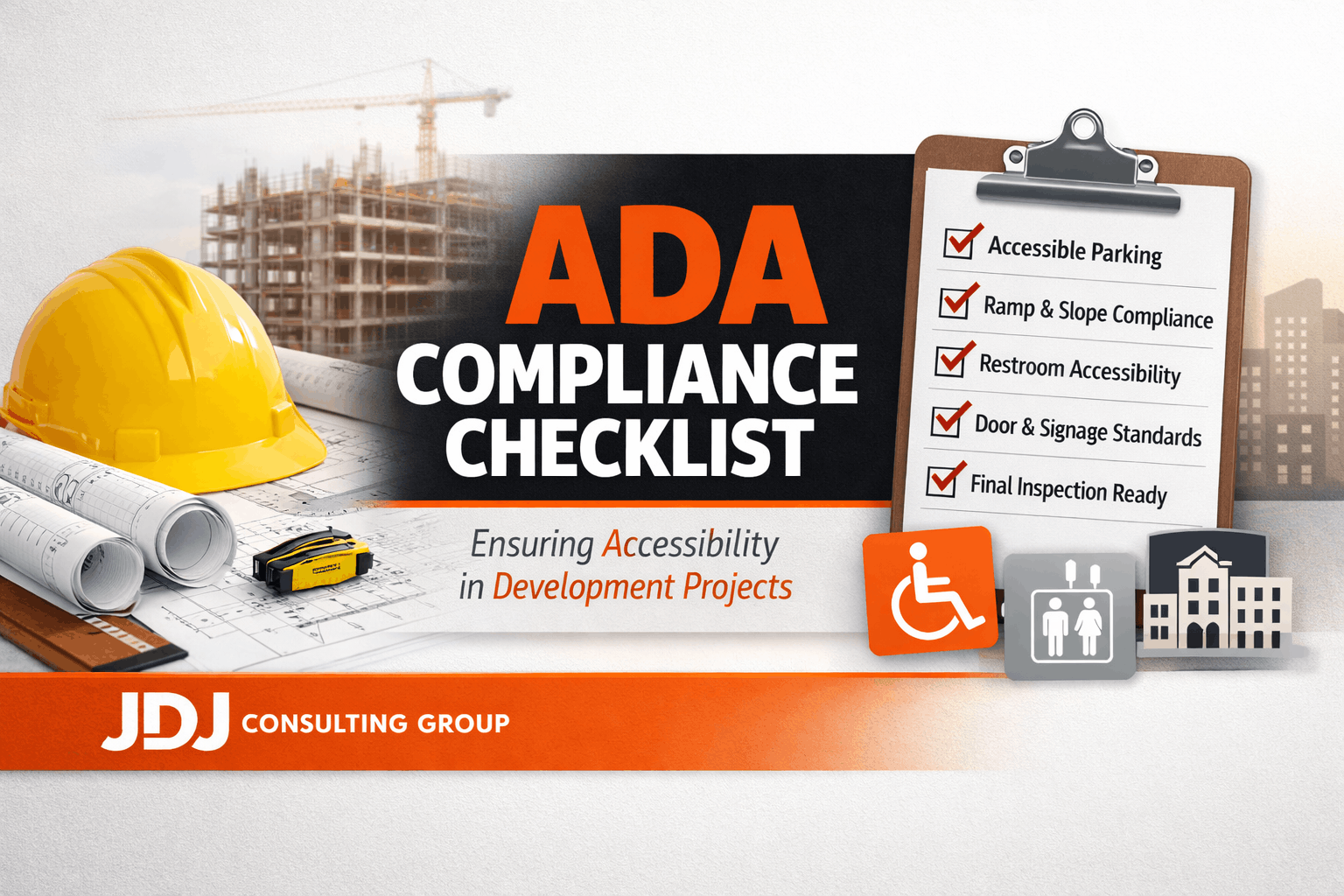
ADA compliance checklist for developers is an important part of modern commercial development. Today, projects need more than good design and strong financing. They must also meet accessibility and safety rules.
For real estate developers, ADA is more than a legal requirement. It also affects project risk, permits, and long-term liability. If accessibility is not planned early, problems can appear later. Approvals may take longer. Construction costs may increase. In some cases, legal issues may arise after the building opens.
Because of this, developers should review ADA requirements at the start of a project.
This guide provides a practical ADA compliance checklist for developers and property owners. It focuses on key stages such as planning, construction coordination, and inspection. These are the points where the right guidance can help projects move forward smoothly.
Why ADA Compliance Matters in Commercial Development
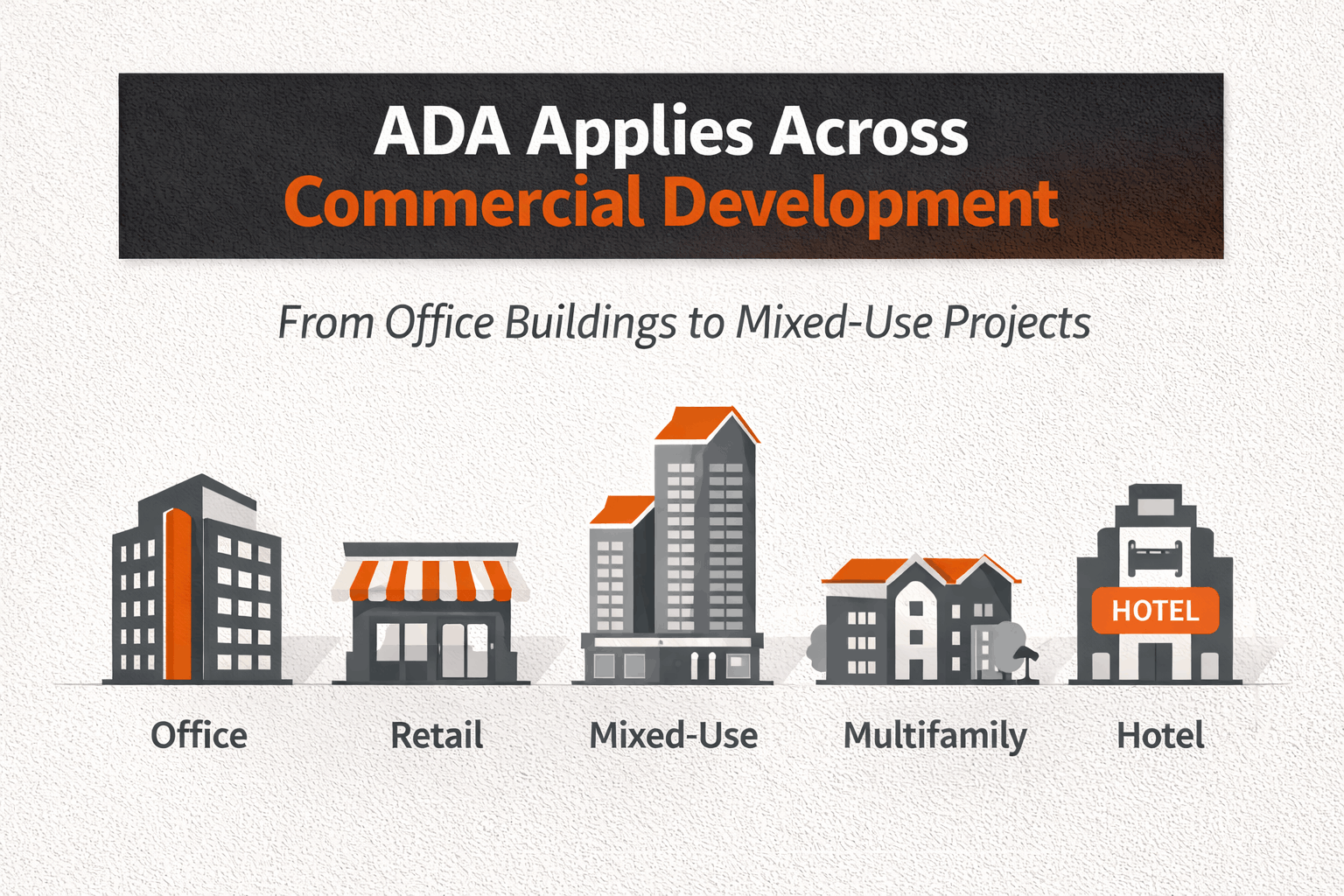
ADA compliance affects almost every commercial project. This includes office buildings, retail centers, mixed-use properties, hotels, and public facilities. In short, most developments must meet accessibility rules.
Many developers assume architects or contractors will handle ADA requirements. They do help. But, the final responsibility usually rests with the owner and development team.
Because of this, accessibility planning should start early. It should be part of pre-development, design, permitting, and construction oversight. When teams plan for ADA from the beginning, the process is much smoother.
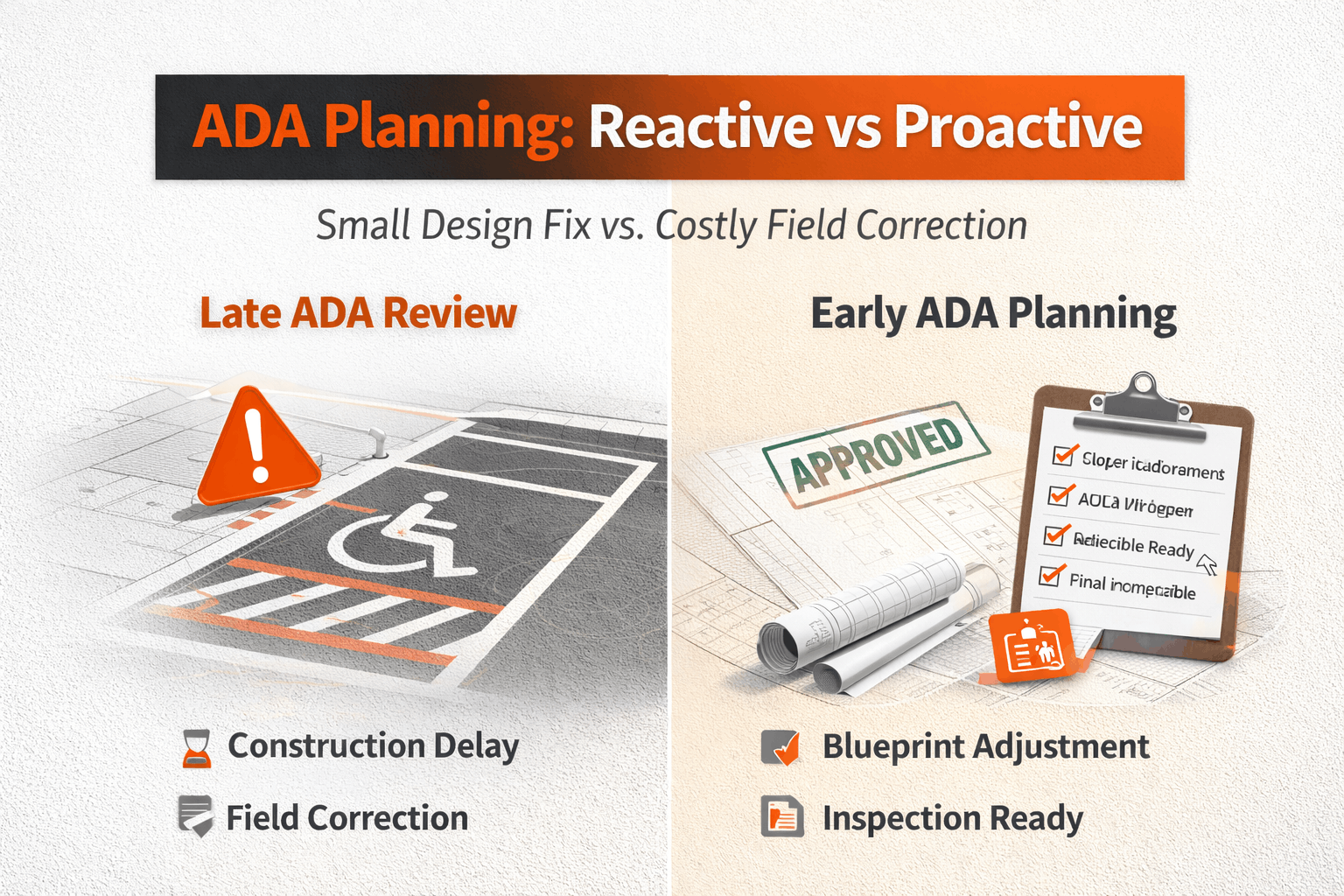
On the other hand, late planning often causes problems. Teams may need design changes. Permits may take longer. Construction costs can also increase.
In simple terms, early compliance keeps the project moving. Late compliance often turns into a costly correction process.
That is why ADA deserves attention at the developer level, not only during construction.
Understanding ADA in the Context of Real Estate Projects
The Americans with Disabilities Act (ADA) requires equal access to public places.
In commercial development, this mainly falls under Title III. This section applies to businesses and commercial buildings that serve the public.
It requires buildings to be accessible to people with disabilities. This includes entrances, walkways, parking areas, restrooms, and shared spaces.
For developers, this means accessibility must be part of the design/construction process. If teams ignore these rules, projects can face delays, redesign work, and legal risk later.
In addition, state and local building codes often follow or expand federal accessibility rules. Because of this, developers must review several requirements, including:
Federal ADA Standards for Accessible Design
State accessibility codes
Local amendments or city interpretations
Fair Housing Act rules for residential units
Accessibility affects both exterior and interior parts of a building.
For example, teams must review:
Accessible parking spaces and dimensions
The path from parking to the building entrance
Door clearances and hardware
Restroom layout and space
Elevator access
Counter height in retail areas
Signs and wayfinding
Accessibility rules do not apply only to large projects. Even small tenant improvements may trigger compliance requirements.
Next, here is a simple overview of how ADA applies to different project types.
| Project Type | ADA Applies? | Key Accessibility Focus Areas |
|---|---|---|
| Office Building | Yes | Parking, entrances, restrooms, elevators |
| Retail Center | Yes | Accessible routes, counters, tenant spaces |
| Multifamily (Public Areas) | Yes | Leasing office, amenities, parking |
| Mixed-Use Development | Yes | All public-facing components |
| Renovations | Often Yes | Path of travel upgrades may be required |
Consider the financial impact comparison:
| Scenario | Typical Cost Impact |
|---|---|
| Correcting ADA issue during design | Minimal revision cost |
| Fixing slope after concrete pour | Demolition and repour costs |
| Modifying completed restroom layout | Rework, fixture relocation, delay |
| Post-occupancy legal settlement | Legal fees plus correction costs |
How Early ADA Planning Protects Your Investment
For development firms, ADA compliance is not just about code. It is about project stability, financial protection, and reputation management.
ADA Site Accessibility Checklist for Developers
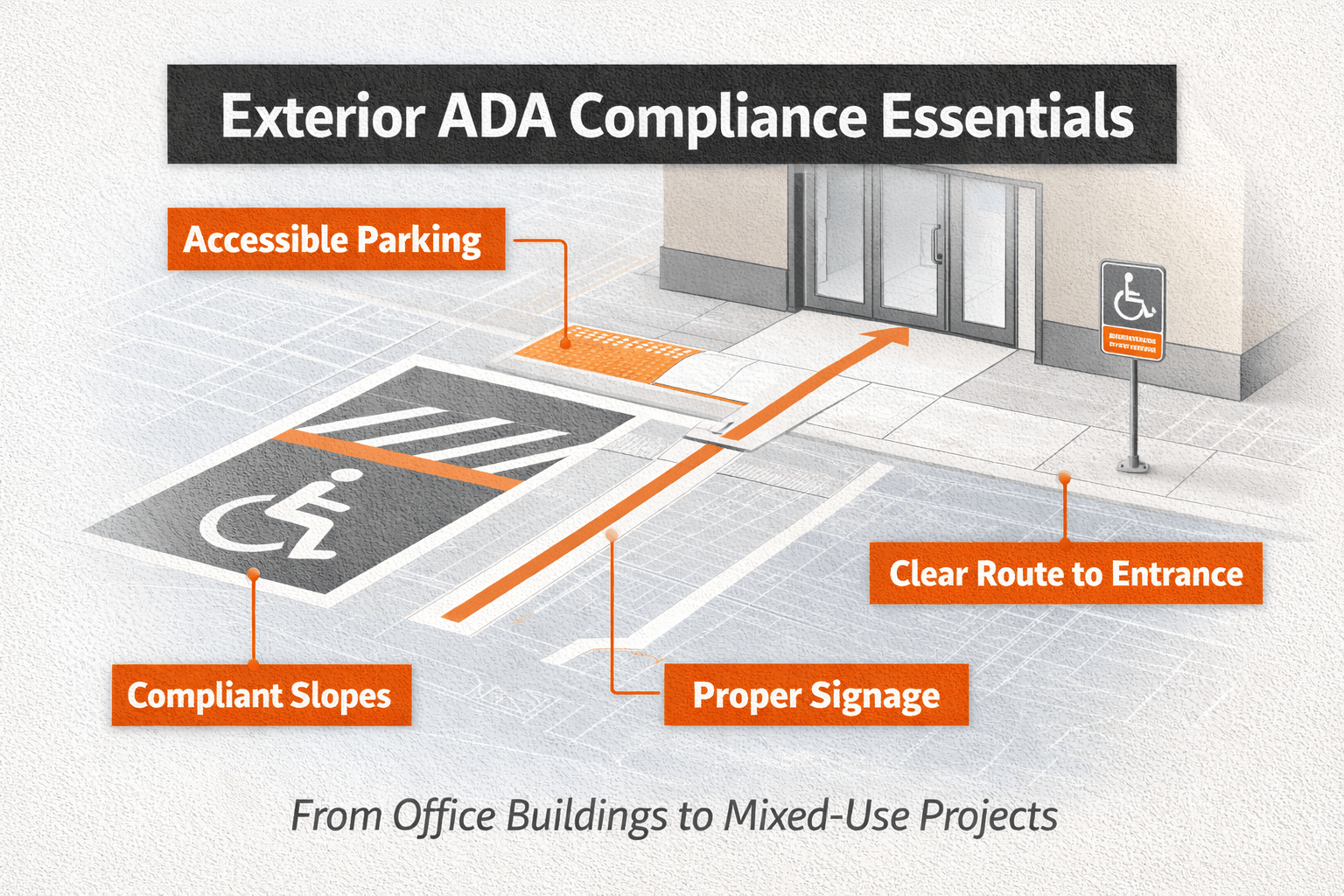
Site accessibility is one of the most common areas where projects fail inspections. It is also one of the most visible areas of compliance. Parking, accessible routes, and entrances are the first features users encounter. If these elements are not compliant, the issue is immediate.
For developers, site accessibility should be reviewed before civil plans are finalized. Once concrete is poured or striping is complete, corrections become expensive.
Below is a practical checklist focused on exterior compliance requirements.
Accessible Parking Requirements
Accessible parking is often misunderstood. It is not only about striping a few spaces near the entrance. The ADA defines the required number of spaces, dimensions, signage, and surface conditions.
The number of accessible spaces depends on the total parking count. In addition, a portion of those must be van-accessible.
Here is a general reference table:
| Total Parking Spaces | Minimum Accessible Spaces | Minimum Van-Accessible Spaces |
|---|---|---|
| 1–25 | 1 | 1 |
| 26–50 | 2 | 1 |
| 51–75 | 3 | 1 |
| 76–100 | 4 | 1 |
| 101–150 | 5 | 1 |
| 151–200 | 6 | 1 |
Van-accessible spaces require wider access aisles and proper signage. Many inspection failures occur because the access aisle is undersized or improperly marked.
Developers should confirm:
Proper stall width
Correct access aisle width
Van designation signage
Mounted sign height
Non-slip surface
Maximum slope compliance
Slope is a critical factor. Accessible parking spaces must not exceed a 1:48 slope in any direction. This includes cross-slope. Even minor grading errors can create non-compliant conditions.
It is important to field-verify slopes before final striping. Civil drawings may show compliance, but built conditions can differ. Common developer oversight issues include:
Placing accessible spaces in high-slope areas
Failing to align striping with actual grading
Missing signage installation
Incorrect van aisle orientation
Early coordination between civil engineers and site contractors reduces these risks.
Accessible Routes from Parking to Building
An accessible parking space alone is not enough. There must be a continuous, unobstructed path of travel from the space to the building entrance.
This route must meet strict requirements for:
Slope
Width
Surface stability
Curb ramp design
Detectable warnings
The maximum slope for ramps is 1:12. For every inch of vertical rise, there must be at least 12 inches of run. Landings must also be level.
Developers should verify:
Minimum clear width of 36 inches
No abrupt level changes
Proper curb ramp installation
Detectable warning surfaces where required
Drainage that does not create pooling
Grading mistakes are common during site work. Even a small variation in slope can trigger correction work.
Here is a simplified slope reference table:
| Condition | Maximum Slope |
|---|---|
| Parking Space | 1:48 |
| Accessible Route (running slope) | 1:20 (without ramp classification) |
| Ramp | 1:12 |
| Cross Slope | 1:48 |
Interior Accessibility Requirements for Commercial Buildings
Interior accessibility needs exact measurements. Even small layout errors can delay inspections. Unlike finishes, accessibility features must meet strict limits.
For developers, interior compliance affects many parts of the project. It can impact scheduling, subcontractor work, and final approval. Spaces like restrooms, elevators, counters, and common areas must meet set height and clearance rules.
Because of this, teams should check dimensions during framing. Fixing problems early is easier and cheaper. If teams wait until tile and fixtures are installed, changes can cost much more.
Below are some common interior compliance areas.
Accessible Restrooms — Developer Checklist
Restrooms are a common ADA issue in commercial buildings. They need careful design and field checks.
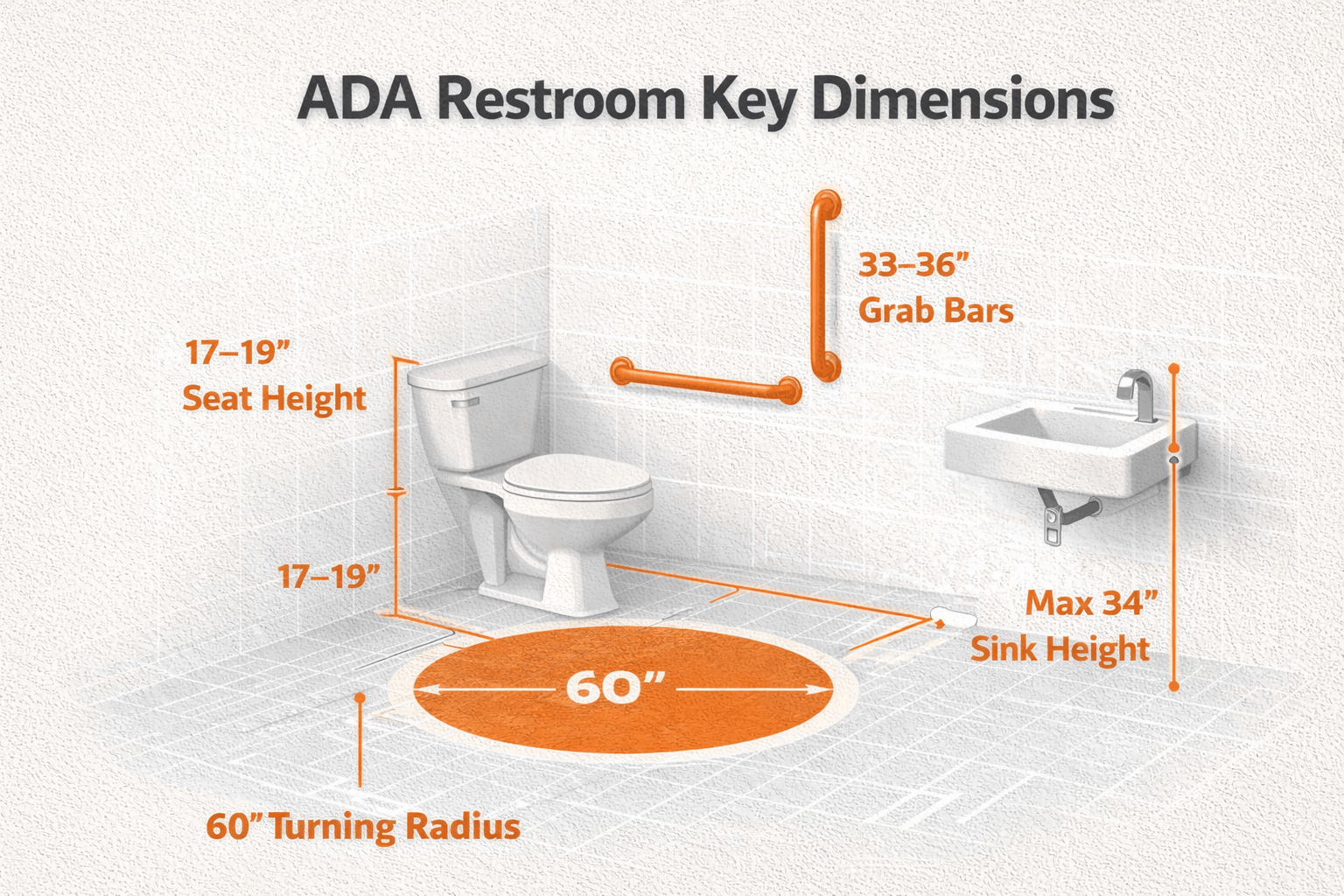
The key rule is enough turning space. Wheelchair users must be able to enter, turn, and exit safely. Most restrooms must include a 60-inch turning circle or a T-shaped turning space.
Fixture height and spacing also matter. Toilets, sinks, grab bars, and dispensers must follow clear measurement limits.
Because of this, developers should check restroom dimensions during design and construction.
Here is a reference table of core restroom standards:
| Feature | ADA Requirement |
|---|---|
| Turning space | 60-inch diameter minimum |
| Toilet seat height | 17–19 inches above floor |
| Grab bar height | 33–36 inches above floor |
| Sink height | Maximum 34 inches above floor |
| Knee clearance under sink | Minimum 27 inches high |
Developers should check the following items during design and construction:
Stall width and depth
Toilet centerline placement
Grab bars installed at the correct height
Enough side and rear clearance
Accessible sink installation
Insulated pipes under sinks
Mirror and accessory mounting height
One common problem is not enough space next to the toilet. Another issue is accessories installed too high.
Because of this, coordination is important. The architect, plumber, and general contractor should review the layout together.
When possible, teams should take field measurements before drywall is installed. This helps catch layout problems early.
During the final walkthrough, restroom accessibility should also be included on the project punch list.
Vertical Access and Elevator Compliance
In multi-story commercial buildings, vertical access is an important ADA issue.
Elevators are usually required when public spaces are on upper floors. However, some projects may qualify for limited exceptions based on building size or occupancy.
Developers should confirm:
Whether an elevator is required
If a platform lift is allowed
Control panel height compliance
Audible and visual floor indicators
Door timing and safety sensors
Elevator call buttons and interior controls must be within accessible reach ranges. Elevators must also include Braille and tactile markings.
Planning elevator space early is important. If teams forget this during design, structural changes may be needed later. Adding an elevator shaft after construction begins can be very expensive.
If a project qualifies for an exemption, the team should document it during the permitting stage.
Common Areas and Public Amenities
Common areas must also meet accessibility rules. This includes spaces such as:
Lobbies
Leasing offices
Conference rooms
Fitness centers
Pools
Retail service counters
Each space has its own requirements.
For example:
Service counters must include a lowered accessible section.
Fitness centers must have clear routes between equipment.
Pool areas may need pool lifts.
Conference rooms must provide wheelchair seating within the main seating area.
Clear floor space is also required in public areas. Furniture should not block accessible routes.
Developers should also check:
Thermostat and switch mounting heights
Drinking fountain accessibility
Sign placement
Door width along hallways and corridors
Even small construction changes can create compliance problems. Because of this, teams should perform periodic accessibility checks during construction. This helps catch issues before final inspection.
ADA Requirements for Mixed-Use and Multifamily Developments
Mixed-use and multifamily projects add another layer of complexity to ADA compliance. Developers must understand how accessibility laws overlap.
In many cases, both the Americans with Disabilities Act (ADA) and the Fair Housing Act (FHA) apply. The ADA governs public and commercial spaces. The FHA applies to residential dwelling units in most multifamily housing built after 1991.
Mixed-use and multifamily projects make accessibility more complex. This is because different accessibility laws can apply at the same time.
In many projects, both the Americans with Disabilities Act (ADA) and the Fair Housing Act (FHA) apply.
The ADA covers public and commercial areas. This includes spaces such as lobbies, leasing offices, retail areas, and shared amenities.
The FHA applies to residential units in most multifamily housing built after 1991. It focuses on accessibility features inside housing and within residential common areas.
Because of this overlap, developers must review both laws during planning and design. Ignoring one set of rules can create compliance problems later.
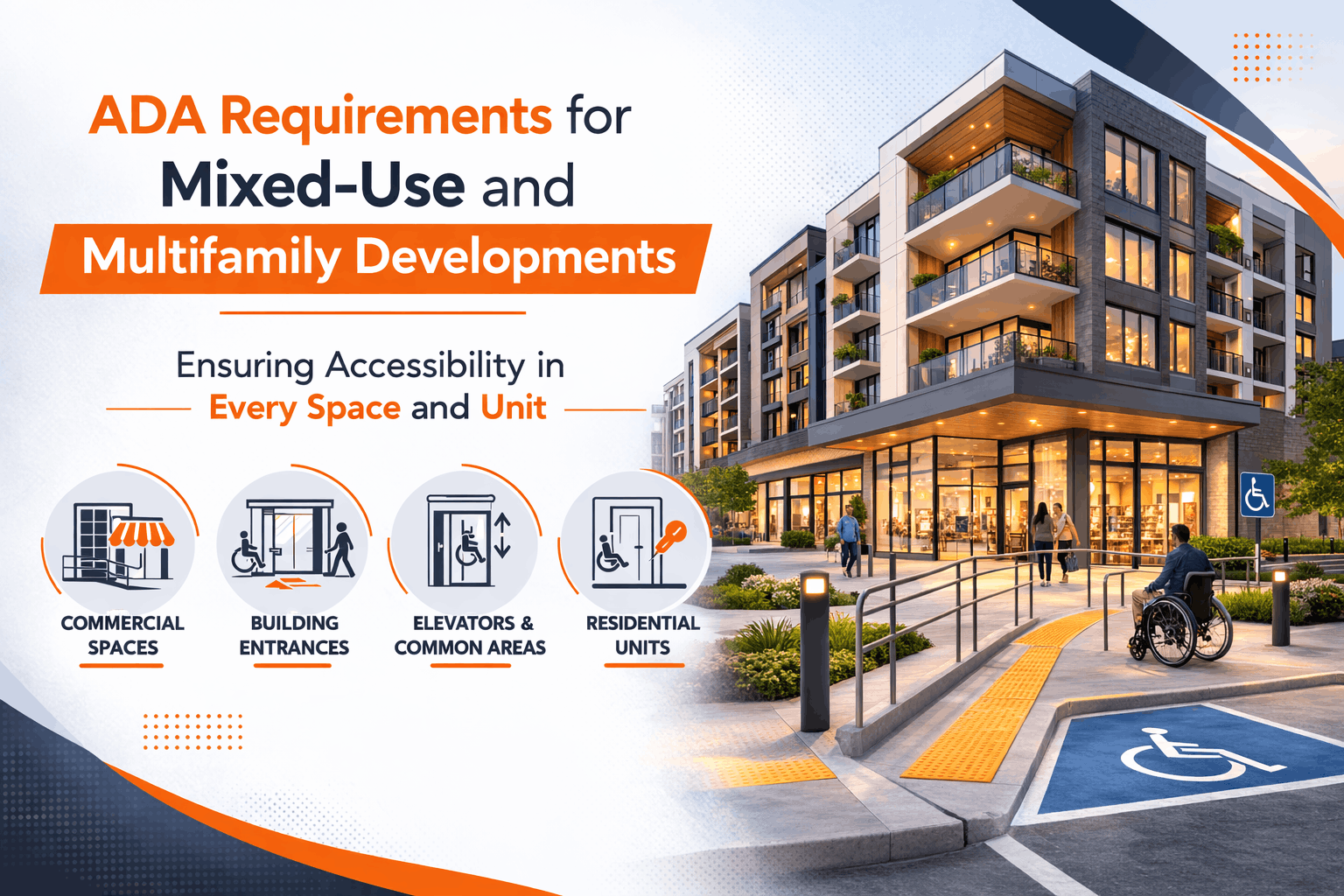
Confusion between these laws often leads to design mistakes. For developers, it helps to separate the project into clear categories:
Public-facing areas
Leasing and management spaces
Residential units
Shared amenities
Each category may follow different accessibility rules.
Accessibility in Multifamily Housing
In multifamily projects, ADA rules mainly apply to public areas, such as:
Leasing offices
Clubhouses
Fitness centers
Pool areas
Parking lots
Sidewalks and access routes
Residential units usually fall under the Fair Housing Act (FHA). FHA rules focus on adaptable design, not full ADA specifications.
Developers should confirm:
The required number of accessible parking spaces
Accessible routes to building entrances
Accessible paths to amenity areas
Proper restroom design in leasing offices
For residential units under FHA, common requirements include:
An accessible building entrance
An accessible route into and through the unit
Reinforced bathroom walls for future grab bars
Usable kitchens and bathrooms
Accessible switches and controls
A common mistake is applying ADA restroom rules to private residential bathrooms. In most cases, FHA rules apply to units, while ADA rules apply to shared public spaces.
Because of this, clear coordination between architects and code consultants is important.
Retail and Office Tenant Build-Out Considerations
In mixed-use buildings, accessibility responsibility can become unclear. Developers should define:
Which items are the landlord’s responsibility
Which items the tenant must address during build-out
How lease agreements handle accessibility compliance
For example:
Base building accessible routes are usually the owner’s responsibility.
Interior tenant layouts must meet ADA rules.
Service counters and checkout areas must include an accessible section.
If a tenant creates barriers during renovations, both the tenant and the property owner may face liability.
Developers can reduce risk by adding:
Accessibility reviews during tenant improvement approvals
Clear lease language about compliance
Plan review checklists for retail and office tenants
Early oversight helps reduce long-term risk.
Ongoing Property Management Compliance
ADA compliance does not end after the certificate of occupancy. Ongoing maintenance is also important.
Property managers should maintain:
Clear accessible routes
Correct parking striping and signs
Working automatic doors
Functional pool lifts (if required)
Accessible paths free of obstacles
Weather and site conditions can also create barriers. Snow, debris, or damaged pavement may block access.
Developers who keep ownership should schedule regular accessibility reviews to protect property value.
A simple ongoing checklist includes:
Inspect accessible parking slopes each year
Repaint faded striping
Check sign height and visibility
Test door hardware operation
Review common areas for blocked routes
Accessibility should be part of routine property maintenance, not just a one-time construction task.
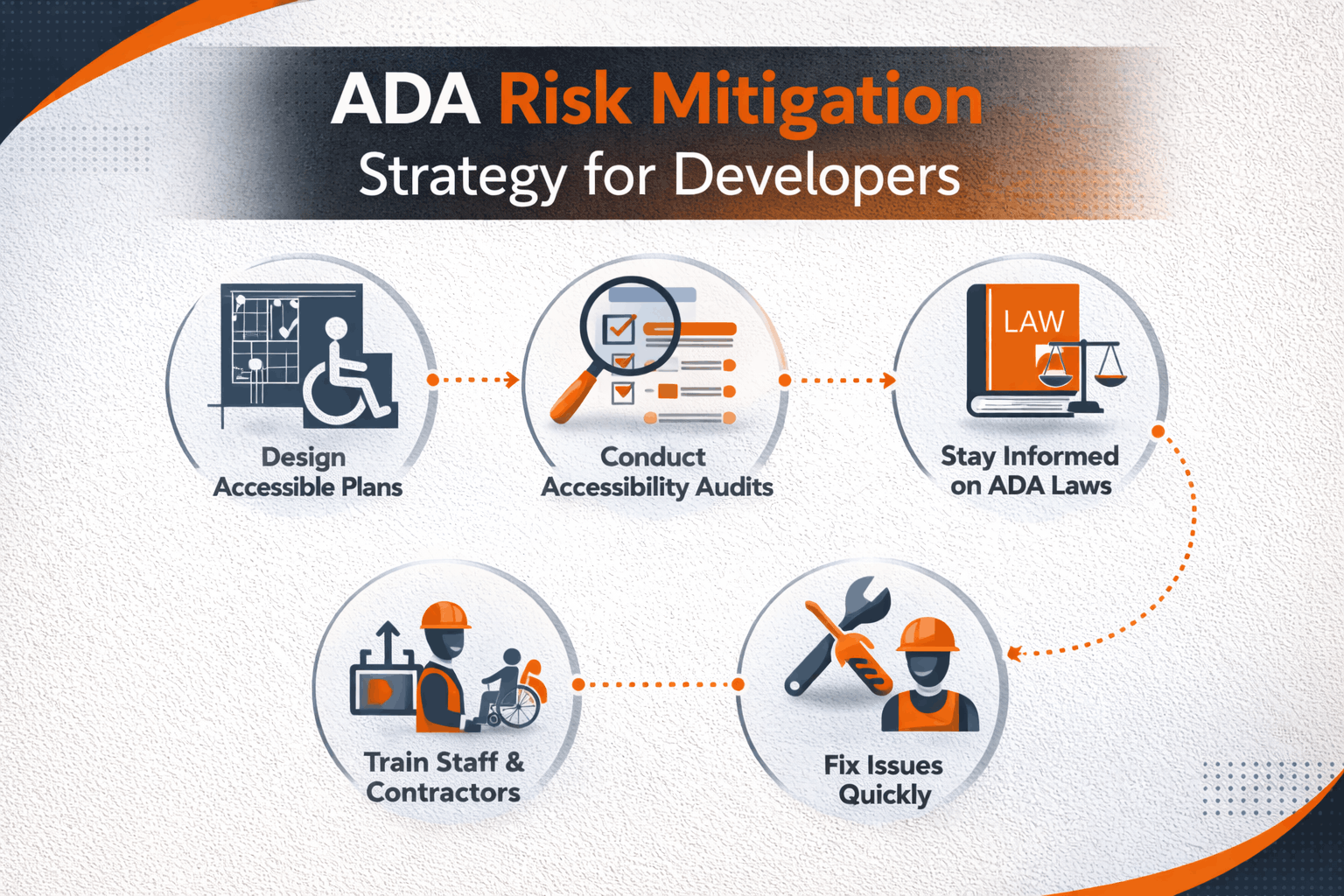
ADA Risk Mitigation Strategy for Developers
ADA compliance is not just a code issue. It is a risk management issue. For developers, accessibility affects schedule, cost, liability, and long-term asset value. A structured risk strategy helps reduce exposure at every stage of the project.
Instead of reacting to inspection comments or complaints, proactive planning keeps projects stable. Below are practical ways developers can reduce ADA-related risk.
Here is a comparison of proactive versus reactive budgeting:
| Approach | Cost Impact | Schedule Impact |
|---|---|---|
| Planned accessibility during design | Predictable | Minimal disruption |
| Late design revisions | Moderate | Plan review delays |
| Post-construction retrofit | High | Major disruption |
| Post-occupancy legal correction | Very high | Potential operational interruption |
From an investor standpoint, predictable cost control strengthens project performance.
Responding to ADA Complaints or Claims
Even with good planning, accessibility complaints can still happen. Developers and property owners should know how to respond.
If someone raises an accessibility concern, take these steps:
Document the issue right away
Inspect the site
Measure and verify the conditions
Consult legal or compliance advisors
Create a corrective action plan if needed
Ignoring complaints can increase legal risk. A quick response shows a good-faith effort to address the issue.
For properties held long term, regular accessibility checks can reduce the chance of complaints. Small problems—like faded parking striping or a broken door closer—can create unnecessary risk.

ADA Compliance Checklist by Project Phase
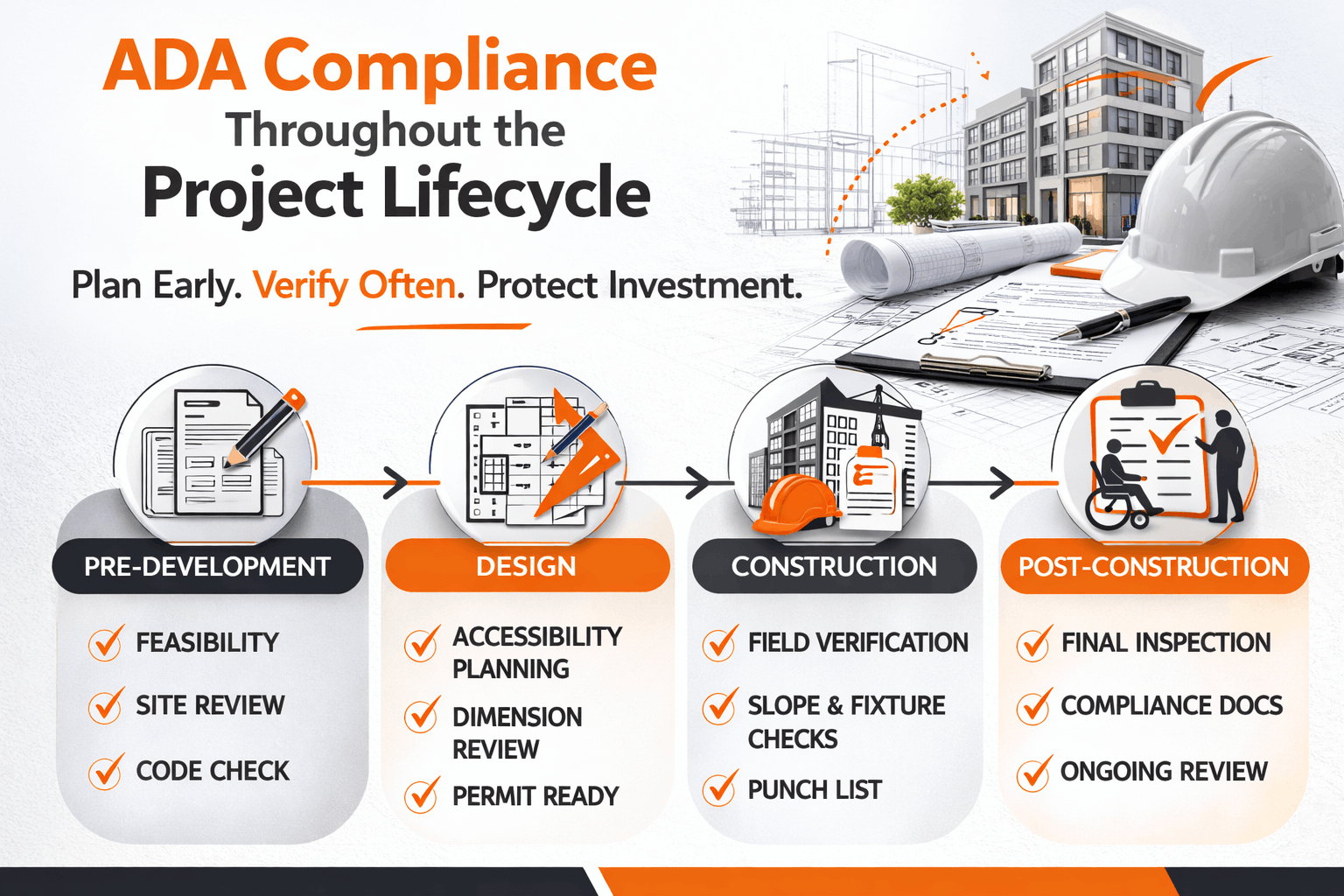
ADA compliance should follow the whole project process. If teams check accessibility only at the end, problems appear late. If they review it at each stage, risk stays lower.
Developers often use a checklist for four phases:
Pre-development
Design
Construction
Post-construction
Below is a simple overview of each phase.
Pre-Development Phase
The pre-development phase sets the base for accessibility planning. Site choice, feasibility studies, and early approvals can affect compliance.
Before land purchase or early design, developers should review:
Federal ADA rules
State accessibility codes
Local code changes
Zoning limits that affect grading
Site slopes and terrain
Parking layout options
If a site has steep slopes, accessible routes may need ramps or grading work. Finding this early can prevent redesign later.
During feasibility, developers should also review:
Elevator needs for taller buildings
Effects on floor layout
Required accessible parking
Amenity layout and circulation
Accessibility limits can affect building layout and site design. Because of this, teams should review compliance during early planning.
A simple pre-development checklist includes:
Confirm the correct accessibility codes
Review grading limits
Check vertical access needs
Identify public areas
Flag high-risk areas
Early review helps lower approval risk.
Design Phase
During design, accessibility rules become more detailed. Plans must clearly show accessibility features.
Drawings should include:
Accessible parking sizes
Van-accessible parking spaces
Ramp slopes and landings
Door clearances
Restroom turning space
Fixture heights
Elevator details
Developers should ask for clear dimensions, not just notes.
Coordination between teams is also important. Civil grading must match the accessible paths shown on architectural plans. Structural plans must also allow space for elevators when needed.
Accessibility should be discussed in design meetings. Some developers also request a third-party accessibility review before permit submission.
A simple design checklist includes:
Confirm parking counts
Check slope limits
Review restroom layouts with dimensions
Check retail counter heights
Confirm elevator needs
Review accessibility signs
Fixing these issues during design helps avoid costly changes later.
Construction Phase
During construction, teams must verify that work follows the plans. Even good drawings can lead to problems if work is not checked.
Developers should include accessibility checks during site visits.
Key checks include:
Measure parking slopes before striping
Confirm van-accessible signs
Verify ramp slopes after concrete pours
Check restroom blocking before drywall
Measure fixture heights
Confirm door hardware type
Test automatic doors
Slope checks are very important. Small grading changes can exceed the 1:48 limit for accessible parking.
Accessibility should also be part of the punch list. Waiting until final inspection can lead to costly fixes.
A simple construction checklist includes:
Check site slopes
Measure door clearances
Confirm restroom dimensions
Coordinate elevator inspection
Walk the full accessible route
Regular checks help keep the project on schedule and reduce compliance risk.
Post-Construction Phase
Accessibility does not end after the certificate of occupancy. Buildings must stay accessible over time. Ongoing checks help protect property value and reduce risk.
After construction, developers and property managers should:
Keep accessible paths clear
Check parking striping and signs
Test door hardware
Confirm elevators work well
Maintain accessible amenities
Over time, wear can create barriers. Pavement may settle. Signs may fade. Paths may become blocked.
Because of this, owners should schedule regular accessibility checks. These reviews are also useful before refinancing or selling the property.
Post-construction records should include:
Approved accessibility drawings
Field measurement notes
Inspection approvals
Accessibility consultant reports, if used
Keeping these records helps show ongoing compliance and supports due diligence.
Common ADA Mistakes Developers Make
Even experienced development teams face accessibility issues. Most problems do not come from lack of effort. They usually come from assumptions, poor coordination, or late review.
Knowing common mistakes helps developers avoid delays and extra costs. Below are several issues often seen in commercial and mixed-use projects.
Incorrect Slope Calculations
Slope problems are one of the most common inspection failures. Accessible parking and paths must meet strict limits. Even small grade changes can exceed the 1:48 slope limit for parking spaces.
Common slope mistakes include:
Relying only on drawings without field checks
Changing grades during paving work
Striping spaces on uneven surfaces
Ignoring cross-slope measurements
Once concrete is poured, fixing slope issues can require demolition. This can increase both cost and schedule.
Developers should require slope measurements before striping and before inspection.
Improper Parking Striping and Signage
Accessible parking requires more than the correct number of spaces. Striping and signs must also meet rules.
Common parking mistakes include:
Access aisles that are too narrow
Missing van-accessible markings
Signs mounted at the wrong height
Striping that does not match the final grade
Signs must include the correct symbol and height placement. Missing or incorrect signs often cause inspection failure.
Developers should review the entire parking layout before requesting inspection.
Restroom Layout Errors
Restrooms must meet very precise dimensions. A small error can cause non-compliance.
Common restroom problems include:
Not enough turning space
Toilet placed at the wrong centerline
Grab bars installed at the wrong height
Sinks mounted too high
Accessories placed outside reach range
These problems often happen when field work does not match the drawings.
Developers should confirm grab bar blocking during framing. If teams wait until tile is installed, corrections become harder.
A restroom measurement checklist during construction can help prevent rework.
Overlooking Tenant Spaces
In mixed-use and retail projects, developers sometimes assume tenant work is only the tenant’s responsibility. However, property owners can still face risk if base building conditions limit accessibility.
Common issues include:
Entry thresholds between common areas and tenant spaces
Service counters without accessible sections
Shared restroom compliance
Accessible routes through common corridors
Developers should require an accessibility review during tenant improvement approval. Lease agreements should also explain who is responsible for compliance.
Treating ADA as a Final Inspection Item
One costly mistake is waiting until final inspection to review accessibility.
Accessibility should be reviewed:
During feasibility
During design
During construction
Before final inspection
If teams wait until the end, correction costs rise. Early planning helps protect both schedule and budget.
How JDJ Consulting Group Supports ADA Compliance
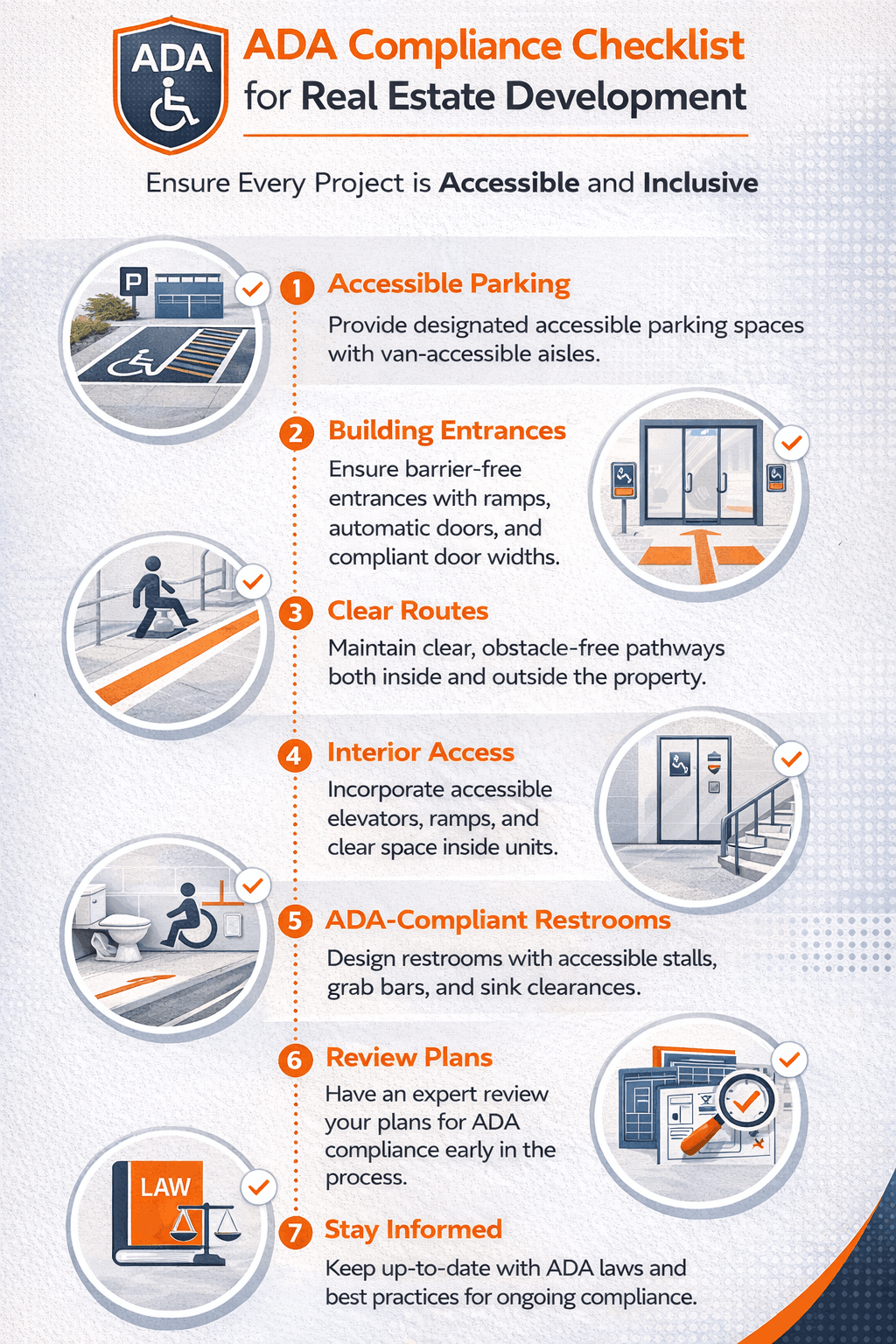
A step-by-step ADA compliance checklist covering parking, entrances, routes, interior access, restrooms, and ongoing regulatory oversight for developers.
FAQs About ADA Compliance Checklist for Developers
Even experienced developers have questions about ADA rules. Accessibility laws can overlap, and responsibilities are not always clear.
Below are common questions developers ask during commercial projects.
When Is ADA Compliance Required?
ADA rules apply when a project includes public spaces.
This often includes:
Office buildings
Retail centers
Restaurants
Hotels
Medical offices
Mixed-use buildings with commercial areas
New buildings must follow current accessibility standards.
Renovations can also trigger ADA requirements. In some cases, upgrades to the path of travel are required when major changes happen.
Developers should confirm requirements early in planning instead of assuming older rules apply.
Does ADA Apply to Renovations?
Yes, in many cases.
When an existing building is altered, accessibility upgrades may be required. The amount of work usually depends on:
The scope of the project
The renovation cost
Which areas are being changed
For example, if a retail tenant remodels part of a store, that area must meet current accessibility rules. In some cases, upgrades to access routes may also be required.
Developers should review renovation plans carefully to avoid surprise requirements.
Who Is Responsible for ADA Compliance?
The property owner is ultimately responsible for compliance. However, several parties play a role.
These may include:
Developer
Architect
Civil engineer
Contractor
Tenant (in some cases)
Good coordination is important. Developers should confirm that:
Accessibility features are shown clearly in plans
Contractors understand installation requirements
Tenant improvements follow accessibility rules
Lease agreements should also define accessibility responsibilities for tenant spaces.
What Is the Difference Between ADA and Fair Housing Act Requirements?
The ADA mainly covers public and commercial spaces.
The Fair Housing Act (FHA) covers residential units in most multifamily housing built after 1991.
In mixed-use projects:
Leasing offices and shared amenities follow ADA rules
Residential units usually follow FHA standards
Confusing these rules can lead to design mistakes. Developers should confirm which law applies to each part of the project.
How Often Do Accessibility Standards Change?
Federal ADA standards do not change often. However, state rules and local code updates can change.
Developers should:
Confirm current codes at the start of a project
Check state accessibility rules
Review local city amendments
Using outdated standards can delay plan review.
What Is Title II of the ADA?
Title II of the Americans with Disabilities Act applies to state and local governments. It requires public services and programs to be accessible to people with disabilities.
This includes:
Public buildings and facilities
Government websites and web content
Public transportation systems
Digital services and mobile applications
What Does Title III Cover in ADA Compliance?
Title III focuses on businesses that serve the public. These places are called public accommodations.
Examples include:
Retail stores
Hotels
Restaurants
Medical offices
Entertainment venues
Under Title III, businesses must remove architectural barriers when possible and follow ADA Standards in new construction. The goal is to make spaces usable for everyone, including wheelchair users and people with other disabilities.
Final ADA Compliance Checklist Summary
Below is a simple checklist developers can use during different project stages.
Site and Exterior
Confirm the required number of accessible parking spaces
Verify van-accessible stall sizes
Measure slopes (maximum 1:48 in parking areas)
Provide an accessible path from parking to the entrance
Confirm curb ramp compliance
Install proper parking signs at the correct height
Building Entrance
Provide at least one accessible public entrance
Verify door clear width
Install compliant lever door hardware
Confirm maneuvering space near doors
Check threshold height limits
Interior Spaces
Confirm restroom turning space
Verify toilet and grab bar placement
Measure sink height and knee clearance
Confirm elevator needs if required
Provide accessible service counters
Maintain accessible routes through common areas
Mixed-Use and Tenant Areas
Review accessibility during tenant improvement approval
Confirm compliance in shared corridors
Clarify landlord and tenant responsibilities
Construction Oversight
Measure slopes before striping
Confirm restroom blocking before drywall
Verify hardware installation
Complete an accessibility punch list review
Post-Construction and Operations
Keep accessible routes clear
Inspect parking striping and signs
Test automatic doors
Review the property regularly for accessibility issues
Conclusion: Building Accessibility Into Your Development Strategy
ADA compliance is not only a code rule. It is part of responsible development.
For developers, accessibility affects permitting, construction schedules, inspections, and long-term property value. When teams plan early, projects move forward with fewer problems. When accessibility is delayed, costs and risks increase.
Successful projects treat ADA compliance as part of the full development process.
This includes:
Reviewing accessibility during site feasibility
Coordinating details during design
Verifying measurements during construction
Maintaining accessibility after occupancy
Even small measurement errors can cause big problems. A few inches in slope or clearance can lead to failed inspections or expensive fixes.
Strong planning helps avoid these risks.
Accessibility also protects a project’s reputation. Investors, lenders, and buyers often review compliance during due diligence. Clear documentation supports smoother property transactions.
At its core, ADA compliance helps make development more predictable. It reduces risk, protects capital, and supports long-term value.
When compliance is proactive, projects move forward smoothly. When it is reactive, delays follow.
Accessibility is not just a checklist. It is part of responsible project management.
Ready to Strengthen Your ADA Compliance Strategy?
If you are planning a commercial, mixed-use, or multifamily project, think about accessibility from the start. Early planning helps prevent delays and avoid costly fixes later.
JDJ Consulting Group helps developers plan for compliance, manage permits, and reduce project risk. Our team works with you to keep your timeline on track and protect your investment.
Call: (818) 793-5058
Email: sales@jdj-consulting.com
Let’s make your next project compliant, efficient, and inspection-ready.