Table of Contents
An accessory dwelling unit sounds like the simplest project in this category: one secondary structure on an existing lot. In Austin, it is also the project most likely to be designed against outdated numbers, because the rules governing ADU size changed from a flat square-footage cap to a coverage-based formula that behaves differently on every parcel.
An accessory dwelling unit, or ADU, is a secondary residential structure on the same lot as a primary home, and in Austin it can now be built without owner-occupancy of the main house, without a dedicated parking space, and without a fixed maximum square footage, subject instead to building coverage and impervious cover limits. That last part is where most feasibility mistakes happen.
ADUs are one of three interlocking Austin policies covered in our pillar guide to HOME, ADU rules, and small-lot housing; this piece goes deep on ADU rules specifically.
What Changed Under HOME-Era ADU Policy
Austin’s ADU rules moved in three directions at once over the past three years, and all three matter for a developer’s pro forma.
Owner-occupancy is no longer required. Previous Austin ADU rules tied eligibility to the owner living in the primary residence. That requirement is gone. An investor or developer can build and rent both the primary unit and the ADU without occupying either.
Parking minimums were eliminated. Austin removed minimum parking requirements for new residential construction, including ADUs, in November 2023. A design no longer needs to reserve a dedicated space to clear zoning review on parking grounds alone.
The fixed size cap was replaced by coverage math. For several years, Austin capped ADUs at 1,100 square feet or 15% of lot area, whichever was smaller, with a 550-square-foot limit on any second story and a 30-foot height ceiling. Current HOME-era guidance removes that flat cap and instead governs ADU size through building coverage (commonly cited around a 40% maximum of all structures combined) and impervious cover (commonly cited around 45% maximum). In practice, that means the buildable ADU footprint depends on how much of the lot the primary house, driveway, and other impervious surface already occupy, not on a single number that applies citywide.
Because that coverage math varies lot by lot, and because published guidance on the exact percentages varies across sources, this is the single most important figure to confirm against your specific parcel before finalizing a design, rather than working from a generic size assumption.
Setbacks and Placement
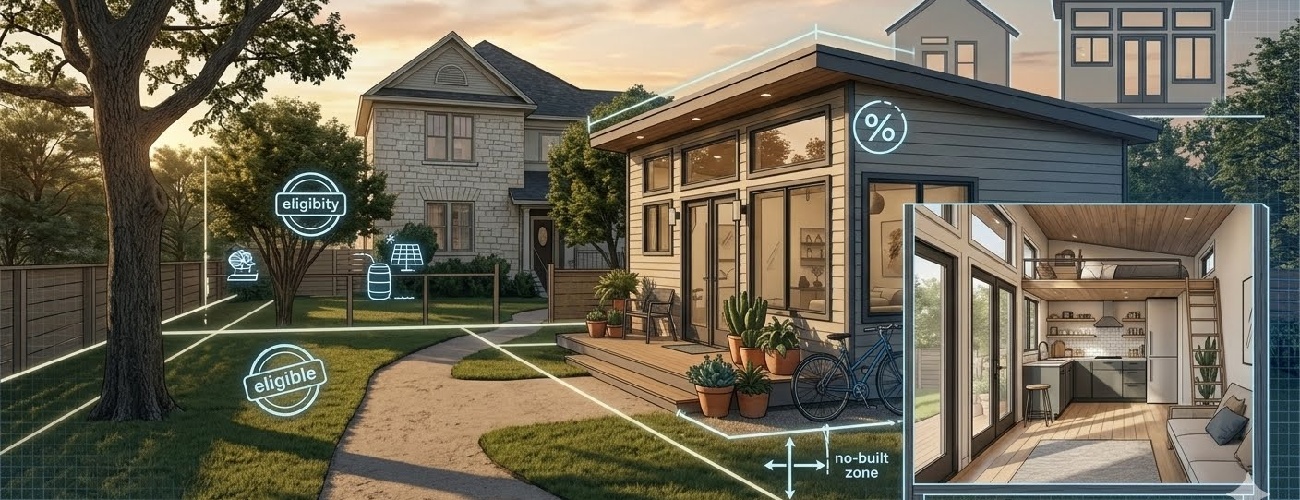
Detached ADUs must sit apart from the main house and observe setbacks that vary by zoning district and by whether the lot backs onto an alley or a multifamily zone. Commonly cited standards include a 25-foot front setback, 5-foot side setbacks, and a 10-foot rear setback, with more flexibility, sometimes 15 feet front and 5 feet rear, on lots adjacent to an alley or multifamily district. There is generally no required separation between the ADU and the main house itself beyond what fire code requires.
Detached ADUs are typically required to sit in the rear or side yard. Attached ADUs, which share a wall with the primary residence, are treated differently in building coverage calculations even though the same floor-area-ratio and height limits apply.
Zoning Eligibility
ADUs are permitted across Austin’s core single-family districts, SF-1, SF-2, and SF-3, as well as select multifamily zones. Under HOME Phase 2, the minimum lot size threshold that governs eligibility for additional units, including ADU configurations, dropped substantially from the previous 5,750-square-foot standard, though the exact minimum a given ADU project needs depends on which specific unit configuration (ADU alone versus ADU plus HOME Phase 1 units) is being pursued on that lot.
A property can now reach up to three total residential units under HOME Phase 1, and current reporting indicates some configurations allow more than one ADU per lot. Whether a specific lot can actually support that many units, once setbacks, coverage limits, and site constraints are applied, is a site-specific feasibility question rather than a citywide guarantee. On larger lots, it’s also worth weighing an ADU against subdividing into separate small lots instead of adding a secondary unit to the existing parcel.
Trees, Floodplain, and Utilities
Heritage trees remain one of the most common ADU-killing surprises. Construction within a protected tree’s critical root zone triggers a separate review process regardless of what the underlying ADU rules otherwise allow, and Austin’s tree protection standards are strict enough that a poorly sited ADU can lose significant buildable area to a single oak.
Utility connections are a second common bottleneck. If an ADU will carry its own unit number and separate utility service, that requires coordination with Address Management Services, Austin Water, and Austin Energy well before permit submittal, not as an afterthought during construction.
Short-Term Rental Restrictions
ADUs built after October 1, 2015 are limited to 30 days per calendar year as a short-term rental. Long-term leases of 30 days or more carry no such restriction. Developers modeling an ADU as short-term rental income rather than a long-term unit need to build that cap into the pro forma from the start, and should account for the city’s short-term rental licensing enforcement, which platforms like Airbnb and Vrbo have been required to comply with as of mid-2026.
Property Tax Treatment
An ADU does not create a separate tax parcel. It remains part of the underlying property’s assessment, and existing homestead protections, including the homestead exemption, the school district exemption, and the 10% annual appraisal cap, continue to apply to the property as a whole. This matters for owner-developers weighing an ADU against a small-lot subdivision, which does create separate parcels and separate tax treatment. See our companion piece on small-lot housing strategy for that comparison.
Deed Restrictions Are a Separate Problem From Zoning
City approval of an ADU does not override private deed restrictions or HOA covenants. Older Austin neighborhoods in particular carry covenants that predate current zoning and can prohibit accessory structures, cap the number of dwelling units on a lot, or restrict rental activity, independent of what the city’s code allows. Confirming deed restriction status is a standard part of a feasibility screen and should happen before, not after, a design is finalized.
Where an ADU Fits in a Broader Site Strategy
An ADU is rarely the only option available on a lot that qualifies for one. Each path, ADU addition, HOME Phase 1 unit count, or small-lot subdivision, produces a different unit count, a different cost basis, and a different construction timeline. Comparing them before committing to a design is the difference between an ADU that adds modest rental income and a configuration that maximizes the lot’s actual entitlement.
Get a Coverage-Specific Read
Generic size figures for Austin ADUs vary across public sources because the underlying rule is now a formula, not a flat number. JDJ’s Feasibility & Entitlement Eligibility Report calculates your specific lot’s building coverage and impervious cover ceiling, confirms setback and tree constraints, and compares ADU yield against HOME Phase 1 and small-lot alternatives, delivered in 48 to 72 hours, flat fee. Order a Feasibility Report or book a free consultation with our entitlement team. For how ADU rules fit alongside HOME and small-lot subdivision on a single site.