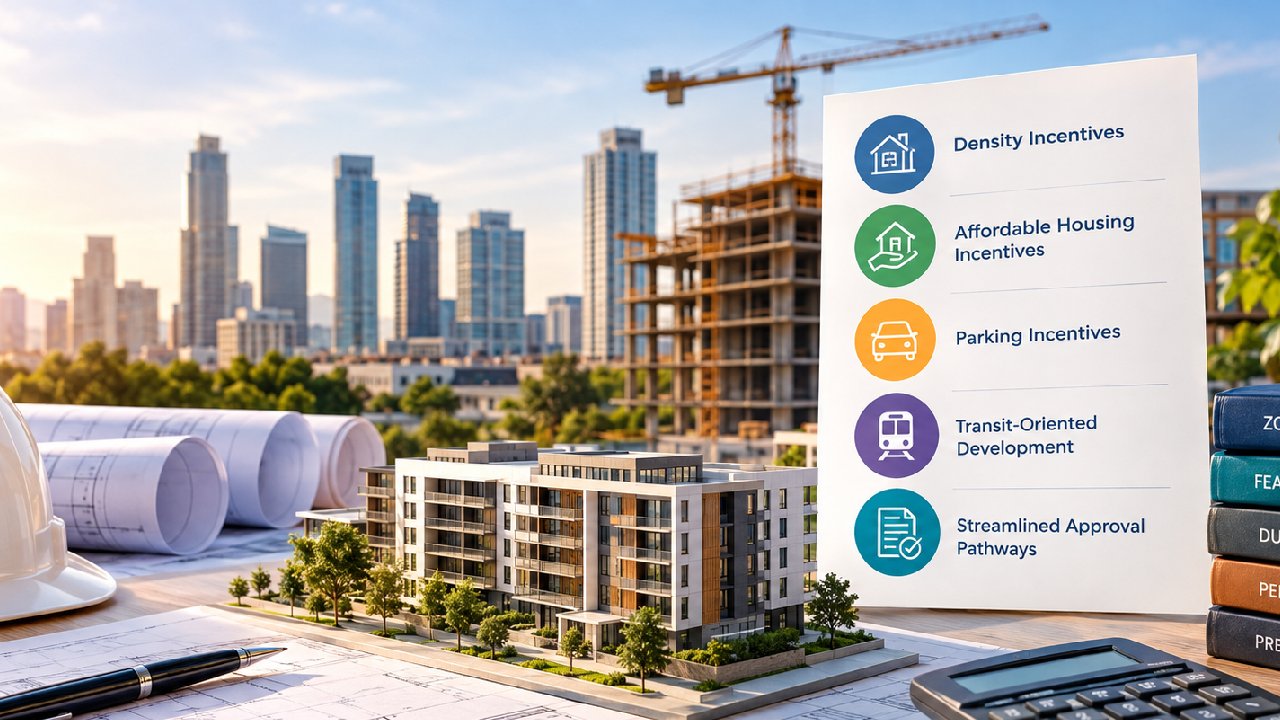
Table of Contents
Austin’s Citywide Density Bonus Program is, on its face, a simple trade. A qualifying project gives up a portion of its units to affordability, and in return the city gives up some of its height and density limits. In practice, the trade is anything but simple, and the gap between the ordinance as written and a specific parcel as it actually sits on the ground is where most of the value, and most of the risk, in a DBC project lives.
The program was adopted by Austin City Council on May 21, 2026. It replaces new applications under the city’s former DB90 and Vertical Mixed Use programs with five new combining districts, DBC-Base through DBC60, available to qualifying commercial-zoned property in exchange for an affordable housing set-aside and compliance with a set of design and compatibility standards. That much is a matter of public record. What the ordinance doesn’t tell a developer is which of those five tiers a given site can actually support, what the affordability obligation costs in real terms, or whether an otherwise promising parcel is carrying tenant-protection exposure that changes the entire calculus. Those are the questions this guide, and the six articles beneath it, are built to answer.
What “Citywide” Actually Means
The name invites an assumption the program doesn’t support. “Citywide” describes where the program applies across Austin’s geography, not that every property within that geography qualifies. DBC is available only within a defined set of commercial base zoning districts, and even inside those districts, eligibility is not the same as entitlement. The five DBC combining districts are what Austin’s own planning staff describe internally as “paper” districts: they exist in the adopted code, but they attach to a specific parcel only through an individual rezoning application, or through a future city-initiated area-wide rezoning that has not yet reached most eligible corridors.
| Base zoning category | Potentially eligible? |
|---|---|
| Neighborhood Office (NO) | Yes |
| Limited Office (LO) | Yes |
| General Office (GO) | Yes |
| Neighborhood Commercial (LR) | Yes |
| Community Commercial (GR) | Yes |
| General Commercial (CS / CS-1) | Yes |
| Commercial Highway Services (CH) | Yes |
| Single-family residential zones | No |
| Multifamily residential zones | No |
| Industrial zones | No |
| Downtown or special-purpose districts | Generally no |
For a developer underwriting a site, this distinction is not academic. Treating eligibility and entitlement as the same thing is the single most common way a promising DBC deal loses months it didn’t need to lose. A full walkthrough of which zoning categories qualify, and what the rezoning step actually involves, is covered in Which Austin Properties Qualify for the Citywide Density Bonus Program.
Five Tiers, and a Ceiling That Moves
DBC’s incentive structure is built around five combining district tiers, each adding a defined amount of height on top of whatever the underlying base zoning already allows.
Translated into real numbers, an eligible LO or LR site might run from roughly 45 feet at the base tier to roughly 105 feet at DBC60. A GO or CS site might run from roughly 60 feet to roughly 120 feet. CH sites vary more widely still, since their base height is tied to impervious cover rather than a fixed figure.
| Additional height | |
|---|---|
| DBC-Base | 0 feet |
| DBC15 | Up to 15 feet |
| DBC30 | Up to 30 feet |
| DBC45 | Up to 45 feet |
| DBC60 | Up to 60 feet |
Those ranges describe a ceiling, not a forecast. A parcel that qualifies on paper for DBC60 is not necessarily a parcel that should be underwritten at DBC60, and the difference between the two is usually where a deal’s real economics get decided. The mechanics of each tier, and how site conditions narrow the realistic band, are laid out in full in Austin’s DBC Height Tiers Explained: From Base to +60 Feet.
The Price of the Bonus
Every additional foot of height under DBC is tied to an affordability obligation, and that obligation is not uniform. It splits sharply along ownership and rental lines.
| Project type | Affordable housing obligation |
|---|---|
| Ownership | 10% of total units affordable to households earning 80% MFI or below; fee-in-lieu may be available |
| Rental | 10% of total units affordable to households earning 50% MFI or below; units generally required on-site |
Ownership affordability generally runs for at least 99 years. Rental affordability generally runs for at least 40 years, at a materially deeper income band, and generally without the fee-in-lieu flexibility available to ownership deals. A 200-unit rental project, for instance, would generally need to deliver on the order of 20 income-restricted units, though the precise figure depends on final unit count and a handful of program-specific rules that shouldn’t be assumed from a rule of thumb. The full ownership-versus-rental comparison, including where the two tracks diverge in ways that matter to underwriting, is the subject of Affordable Housing Requirements Under Austin’s Citywide Density Bonus Program.
Where the Tier Meets the Site
This is the part of the ordinance that a code summary tends to flatten and a feasibility study tends to unpack. DBC offers genuine flexibility to a complying project: no maximum floor-area ratio, no maximum density or minimum site-area requirement under the program’s stated standards, relief on certain setbacks, and a compatibility framework that caps height at 90 feet within 25 to 50 feet of a triggering property and drops those standards entirely beyond 50 feet.
Set against that flexibility is a second list, the one that actually determines what gets built: lot geometry, fire access, floodplain and watershed limits, tree preservation, airport and environmental constraints, parking and loading conflicts, and a requirement that at least 65% of the project remain residential while 75% of principal-street frontage carries pedestrian-oriented commercial or civic uses. A site can clear the residential threshold comfortably and still fail on frontage. It can be eligible for DBC60 on paper and still only support DBC30 once a triggering property and a narrow lot are factored in. How those constraints interact with a project’s design is covered in Mixed-Use, Frontage, and Compatibility Rules That Shape a DBC Project.
For sites carrying existing multifamily housing, there’s a further and often larger variable: Austin’s tenant-protection and unit-replacement requirements, which in some circumstances can expose a redevelopment project to replacement obligations reaching 20% of the new unit count, well above the 10% affordability set-aside DBC itself requires. That exposure needs to be modeled before a rezoning strategy is set, not discovered after, and it’s addressed in full in Tenant Protections and Unit Replacement: What Redevelopment Projects Must Know.
One Tool Among Several
DBC is Austin’s newest density bonus program, but it isn’t the city’s only one, and it isn’t a substitute for all of them. A downtown parcel falls under the separate Downtown Density Bonus Program, with its own site-plan-review process and negotiated community benefits. A transit-adjacent site may fit more naturally under DBETOD. Properties that already carry a DB90 or Vertical Mixed Use combining district sit in a different analysis altogether, one that starts with the existing entitlement rather than a new DBC rezoning.
| Program | Best fit |
|---|---|
| Citywide Density Bonus Program (DBC) | Commercial sites seeking new combining-district tiers with broader citywide applicability |
| DB90 | Legacy program; relevant mainly for properties that already carry the combining district |
| Vertical Mixed Use (VMU) | Legacy program and historical comparison |
| DBETOD | Transit-oriented properties evaluated under the applicable ETOD framework |
| Downtown Density Bonus Program | Downtown properties seeking additional height and density through a separate site-plan-review process requiring Great Streets compliance, Austin Energy Green Building participation, Urban Design Guidelines review, and negotiated community benefits |
Mistaking one of these pathways for another is a slower and more expensive error than it sounds, since it tends to surface only after a rezoning strategy has already been built around the wrong program. A full comparison, and a framework for determining which pathway actually fits a given site, is covered in DBC vs. DB90 vs. Vertical Mixed Use vs. Downtown Density Bonus: Choosing the Right Austin Pathway.
How JDJ Approaches a DBC Project
JDJ’s process runs in four stages, applied specifically to density bonus strategy rather than treated as generic permitting.
Consultation. We confirm base zoning and overlays, and identify whether a property sits in an eligible commercial district or carries a conflicting combining district.Is the Downtown Density Bonus Program the same as DBC?
Feasibility & Zoning. We test the site’s baseline capacity under existing zoning, model realistic DBC tiers against market demand and construction economics, run the affordability math against both the ownership and rental tracks, and screen for tenant-protection and unit-replacement exposure if the site has existing multifamily housing.
Application & Submittal. We prepare the rezoning strategy, coordinate with Austin Planning and other city departments, and align zoning, site plan, transportation, utility, and housing requirements before filing.
Approval & Closeout. We manage the rezoning process through staff review, Planning Commission, and City Council, and carry the project to entitlement closeout.
Frequently Asked Questions
What is Austin’s Citywide Density Bonus Program?
It’s a voluntary zoning incentive, adopted May 21, 2026, that allows qualifying commercial-zoned projects to obtain additional height and development flexibility in exchange for affordable housing and other obligations, through five new DBC combining districts.
Which zoning districts qualify for the Austin density bonus?
NO, LO, GO, LR, GR, CS, CS-1, and CH are generally eligible base zoning categories, subject to a rezoning that applies the DBC combining district. Residential, industrial, and downtown or special-purpose districts are generally not eligible.
How much additional height does DBC allow?
Up to 60 feet above the base zoning’s existing allowance, depending on the tier (DBC15, DBC30, DBC45, or DBC60), and subject to compatibility and site-specific constraints.
What affordable housing is required under DBC?
Ownership projects generally need 10% of units affordable at 80% MFI or below, with fee-in-lieu potentially available, for at least 99 years. Rental projects generally need 10% of units affordable at 50% MFI or below, generally on-site, for at least 40 years.
Does DBC replace DB90 and Vertical Mixed Use?
DBC replaces new applications under both legacy programs. Properties that already carry a DB90 or VMU combining district are evaluated separately.
Is the Downtown Density Bonus Program the same as DBC?
No. The Downtown Density Bonus Program is a separate site-plan-review process with its own requirements, including Great Streets compliance and negotiated community benefits, and applies to downtown properties rather than the citywide commercial districts covered by DBC.
Do all DBC projects have tenant-protection obligations?
Only projects redeveloping sites with existing multifamily housing that trigger Austin’s tenant-protection and unit-replacement rules under Chapter 4-18. This should be screened early, before a rezoning strategy is finalized.

Is Your Austin Property a DBC Candidate?
The Citywide Density Bonus Program can unlock real development capacity, but only for the right site, under the right tier, with the affordability and compatibility math worked through in advance. JDJ’s entitlement team runs that analysis before a client commits capital to a rezoning strategy.
Request a Preliminary Zoning and Entitlement Assessment covering eligibility, development capacity, bonus tier options, affordability obligations, and rezoning risk.