Table of Contents
The best industrial and logistics sites in Austin share four traits: direct highway access, a labor pool that can actually reach the building, utility capacity that doesn’t require a multi-year upgrade, and enough separation from residential neighbors to run trucks around the clock without triggering a fight at the next zoning hearing. That combination sounds simple. In practice, it eliminates most of the parcels developers bring to the table.
It also matters more than usual right now. Austin’s industrial market isn’t undersupplied across the board. The city absorbed a wave of speculative logistics construction over the past few years, and vacancy in large-box product has climbed into the mid-teens in some submarkets. That doesn’t mean the opportunity has disappeared. It means the opportunity has gotten narrower, and it now favors tenant-backed, divisible, well-located buildings over the generic 300,000-square-foot spec box sitting on cheap dirt at the edge of the metro.
For developers, architects and investors evaluating Austin industrial sites in 2026, the question isn’t whether the market has room. It’s whether a specific site, on a specific corridor, with a specific product type, can clear the entitlement, infrastructure and absorption hurdles fast enough to matter.
What Makes an Austin Industrial Site Actually Work?
A site works when it can support the operation the tenant actually runs, not the operation the pro forma assumes. That means three-phase power and reliable fiber on site or close to it, water and wastewater capacity (or a credible path to get it), truck turning and queueing that doesn’t dump traffic onto residential streets, and an entitlement that permits warehouse, distribution or manufacturing use without a discretionary rezoning fight baked into the schedule.
Highway frontage gets the most attention, and it deserves it, but it’s not sufficient on its own. A parcel can sit a quarter mile from SH 130 or I-35 and still be a poor logistics site if the only access is through a signalized intersection with a tight turning radius, or if the frontage road can’t accommodate a 53-foot trailer without encroaching on an adjacent lane. Developers who screen on proximity to a highway number, without pressure-testing the actual truck movement, tend to discover the problem after they’ve already closed on the land.
The product mix worth screening for in Austin right now includes last-mile and urban distribution, regional distribution centers, flex industrial and light manufacturing, e-commerce fulfillment, cold storage and food distribution, contractor and building-material yards, data-center support and technology manufacturing, and automotive, aviation and advanced-manufacturing supply chains tied to the region’s semiconductor and aerospace employment base.
How Does the Entitlement and Permit Process Work in Austin?
Austin’s process generally moves through zoning verification, Land Development Code review, site and environmental research, preliminary design, and formal application, followed by zoning, subdivision, site-plan, building-plan and permit review before construction and inspection. Where a project lands on that sequence depends heavily on the existing entitlement.
Sites that already carry industrial or warehouse zoning, and that can meet current development standards, often move through an administrative site-plan and building-permit pathway. Sites that allow industrial use in principle but need a conditional overlay or a modification to development standards face a discretionary review layer. And sites that are currently zoned commercial, residential or agricultural, with no industrial entitlement in place, are looking at a rezoning process, which is where schedules tend to slip.
That risk is highest when a proposed industrial use sits near existing residential neighborhoods. The objections are predictable: 24-hour operations, diesel idling, refrigeration and generator noise, headlight glare from truck yards, queueing that spills onto public streets, and concern about losing employment land to a future residential conversion. None of these issues are unusual on their own, but stacked together they can turn a straightforward site-plan submission into a multi-hearing process.
Subdivision is a separate track from zoning and site-plan review, and for a multi-building logistics park, platting and public-infrastructure obligations can end up being the longest lead item on the schedule rather than the building permit itself. Transportation diligence, meanwhile, needs to address driveway spacing, TxDOT access permits on state-controlled roadways, sight distance, gate queue storage, turning templates for the largest vehicle expected on site, and whether a traffic-impact analysis triggers roadway or signalization improvements before a certificate of occupancy is possible.
This is the stage where local process knowledge earns its keep. Teams working through zoning verification, subdivision sequencing, TxDOT coordination and site-plan approval in Austin often bring in a firm that has already mapped these dependencies. JDJ Consulting’s Austin permit expediting and entitlement team works through exactly this kind of jurisdictional layering, identifying which approvals can run in parallel and which ones are true critical-path items before a developer is locked into a closing date that the permit timeline can’t support.
Once site-plan approval is in hand, the building-permit stage brings its own list: structural, architectural, MEP and energy review, fire and life-safety review, fire-line and sprinkler approvals, electrical service and transformer coordination, water and wastewater taps, tree permits, and, where applicable, hazardous-material storage permits, industrial wastewater discharge permits and underground-storage-tank permits. Austin’s own guidance notes that its published permit list may not capture every approval a specific project needs, which is a reasonable warning for any industrial user with an unusual operational footprint.
Which Austin Submarkets Actually Support Industrial Growth?
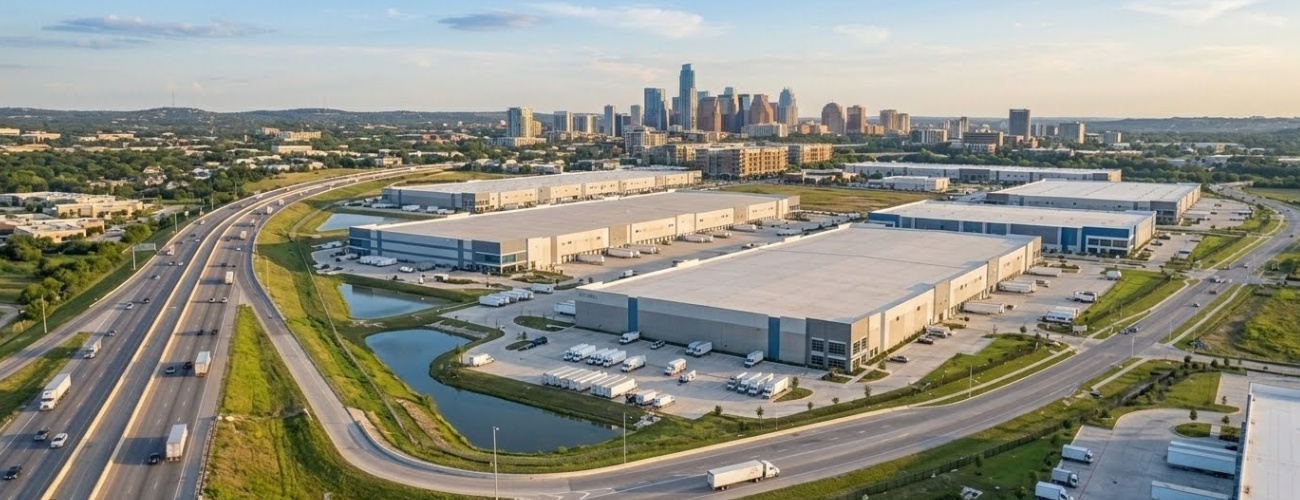
Southeast Austin and the airport corridor remain one of the strongest areas to screen first. Access to SH 71, US 183, SH 130 and Austin-Bergstrom International Airport supports regional distribution, aviation suppliers, cold storage and flex industrial, and parcels here tend to run larger than anything available closer to the urban core. The tradeoffs are real: new supply has been substantial, some sites carry floodplain or drainage complications, and labor access can be difficult for workers without a car. Recent market data pointed to positive absorption in this submarket even as the broader Austin market absorbed elevated vacancy, which suggests the location fundamentals are holding even where the overall numbers look soft.
Northeast Austin, the SH 130 corridor and the Parmer area benefit from proximity to semiconductor and technology employment, including Samsung’s manufacturing presence, and from a highway network that connects both to Austin proper and to the broader Central Texas region. The competitive risk here comes from Hutto, Pflugerville, Georgetown and Taylor, which offer similar access with lower land costs and their own incentive structures, plus a large speculative pipeline that depends on future employment growth rather than demand that already exists on the ground.
Round Rock, Hutto and Taylor sit outside Austin’s municipal jurisdiction, which is precisely why they matter. Larger parcels, lower land costs, and real separation from established neighborhoods make these nodes attractive for semiconductor-adjacent manufacturing and large distribution campuses, though the entitlement, MUD and utility framework has to be evaluated independently, since a site marketed loosely as “Austin” may in fact be far more competitive somewhere else entirely.
North Austin, along the I-35 and US 183 interface, offers a large employment base and strong access, but land costs and traffic make it a better fit for smaller, higher-value flex and last-mile product than for bulk logistics. Southwest Austin and the Oak Hill and Brodie corridor face real environmental sensitivity, including watershed constraints, and are generally a better match for infill, contractor and medical-device uses than for major distribution. South Congress and the St. Elmo area carry real redevelopment potential for urban industrial, food production and creative-production users, but displacement pressure and high land costs limit how much large-scale logistics can realistically happen there.
Where Is the Austin Industrial Market Overbuilt?
Generic large-box speculative logistics is the segment carrying the most risk. Market data has shown industrial vacancy in the low-teens and logistics-specific vacancy climbing higher, with several million square feet of logistics space still under construction. That doesn’t make every large building a bad bet, but it does mean unleased, remote, 300,000-square-foot-plus product competing purely on asking rent is a harder story to underwrite than it was two years ago.
Peripheral bulk distribution carries similar exposure, particularly where a project depends on a small number of future tenants rather than demand that already exists. Urban industrial conversion sites near the core can be valuable but are frequently complicated by contamination, small lot sizes and pressure to convert to residential use instead. Cold storage, meanwhile, delivers strong rents where it works, but the power consumption, refrigeration noise, backup generation and limited pool of creditworthy tenants make it a specialized play rather than a default strategy.
What Incentive Programs Apply to Austin Industrial Projects?
Austin’s Chapter 380 Business Expansion Program can support performance-based wage grants and property-tax reimbursement for qualifying relocation or expansion projects, but it’s structured around the occupying company, not a speculative developer. The strongest applications involve a named employer, new or retained jobs at defined wage levels, meaningful capital investment and a demonstrable financial gap that the incentive helps close. Smaller incentive packages may clear at the staff level; larger agreements typically require City Council approval and a public process.
Beyond the city program, the toolkit includes the Place-Based Enhancement Program for legacy and small-business industrial space, the Texas Enterprise Zone Program for sales-and-use-tax refunds in eligible areas, the Texas Enterprise Fund for competitive, large-scale job-creation projects, and the Jobs, Energy, Technology and Innovation Act alongside federal CHIPS-related programs for capital-intensive semiconductor and advanced-manufacturing projects. Industrial revenue bonds remain a viable tax-exempt financing tool for eligible manufacturing, processing and distribution projects, and for sites outside Austin’s city limits, county-level Chapter 381 agreements, MUD participation and school-district tax treatment can shift the underwriting meaningfully. None of these programs are self-executing. Eligibility, current terms and application timing all need verification well before a pro forma gets finalized.
What Should Developers and Investors Screen For Before Closing?
The fatal-flaw list is long, but it comes down to a manageable set of categories: confirmed industrial-use entitlement, workable highway and driveway access, adequate truck turning and queueing, sufficient power and utility capacity, drainage and floodplain constraints, tree and environmental requirements, fire-flow and emergency access, labor and transit access, tax and incentive eligibility, and a realistic read on competing deliveries in the same submarket.
Civil engineering deserves more weight in early due diligence than it typically gets. For an industrial building, the truck court, detention design, dock ratios and utility alignment often determine the usable building envelope more than the architectural plan does. A site that looks clean on a zoning map can still fail on grading, drainage capacity or fire-access conflicts with trailer parking, and those issues surface late if they aren’t priced into the acquisition.
The developers finding traction in this market right now are running three underwriting cases side by side: a tenant-backed build-to-suit, a divisible speculative building sized for multiple mid-size users, and a smaller flex or service-industrial fallback. That structure hedges against the exact risk the current market is pricing in, which is a large, unleased building competing against a deep pipeline of similar product.
Frequently Asked Questions
What is the strongest submarket for industrial development in Austin right now?
Southeast Austin, particularly the area around Austin-Bergstrom International Airport, currently shows the strongest combination of highway access, available parcel size and positive absorption, even as the broader Austin industrial market works through elevated vacancy.
Does Austin require a separate subdivision process for industrial projects?
Yes. Subdivision, including platting, right-of-way dedication and public-infrastructure obligations, runs as a separate track from zoning and site-plan review, and for multi-building logistics parks it can become the longest lead item in the entitlement timeline.
Are Austin’s industrial incentive programs available to speculative developers?
Most of Austin’s incentive tools, including the Chapter 380 Business Expansion Program, are structured around a named occupying company with job-creation and wage commitments rather than a developer building on spec. A speculative project may benefit indirectly if it secures a qualifying tenant.
Is large-box speculative logistics still a viable strategy in Austin?
It’s viable in specific cases, particularly tenant-backed or divisible product in strong-access submarkets, but generic, unleased, remote large-box space is competing against significant existing vacancy and a substantial pipeline still under construction.
What causes the longest delays in Austin industrial permitting?
Rezoning for sites without existing industrial entitlement, subdivision and platting for multi-building projects, and TxDOT coordination for state-controlled roadway access tend to create the longest and least predictable schedules.
Bringing a Site Through Austin’s Process
Austin’s industrial market rewards specificity. A site with genuine highway access, workable truck circulation, power capacity and an entitlement path that doesn’t depend on a contested rezoning is still a strong bet, even in a market carrying elevated vacancy. A site that only looks good on a highway-proximity map is a harder story to defend to a lender, a tenant or a planning commission.
Getting a project from acquisition through zoning verification, subdivision, site-plan approval and building permit in Austin’s current review environment takes coordination across departments that don’t always move on the same timeline. JDJ Consulting’s Austin team works alongside developers, architects and investors to sequence that process, flag jurisdictional and infrastructure risk before it shows up mid-construction, and keep industrial and logistics projects moving toward a certificate of occupancy on a schedule the underwriting can actually support.