
Table of Contents
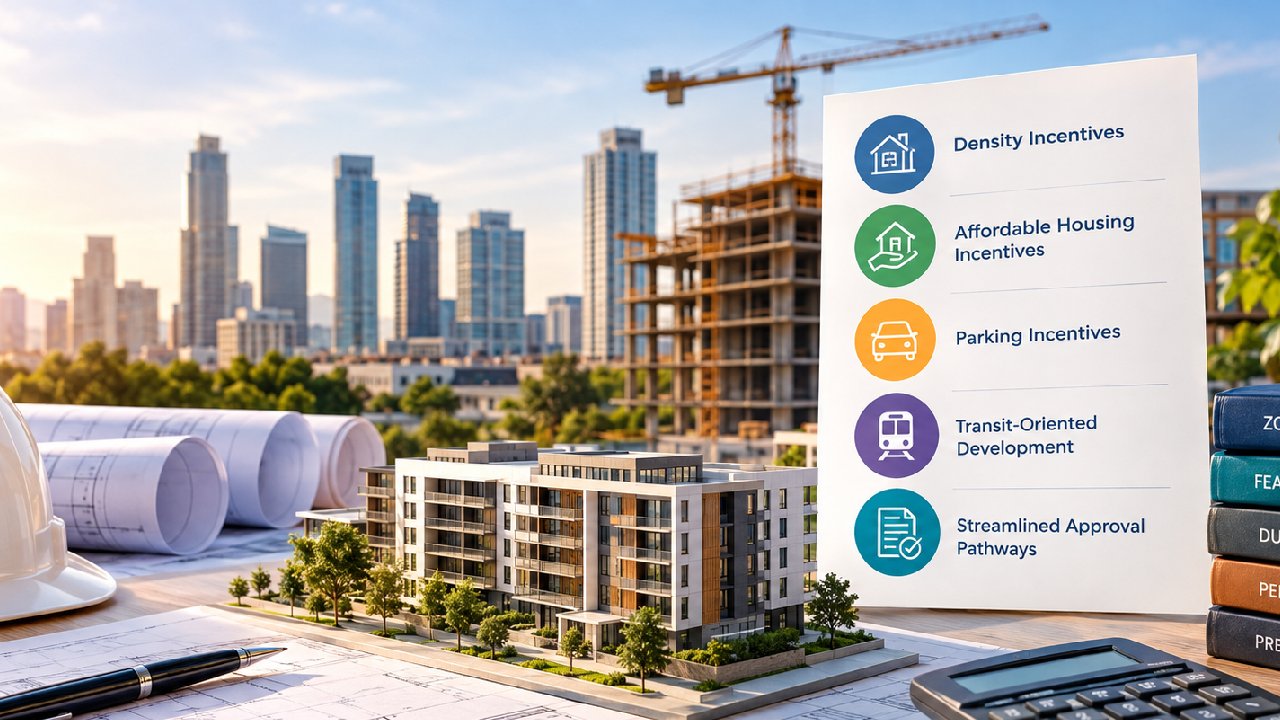
Every DBC project’s additional development capacity comes with an affordable housing obligation, and that obligation is not the same for ownership and rental projects. The two tracks diverge on income threshold, delivery method, and covenant duration, and the gap between them is large enough to shape which tier and which project type make sense for a given site.
Ownership Projects
Ownership projects generally must set aside 10% of total units as affordable to households earning 80% of median family income (MFI) or below. Fee-in-lieu may be available as an alternative to providing units on-site, subject to program rules. The affordability covenant on ownership units generally runs for at least 99 years.
Rental Projects
Rental projects also generally must set aside 10% of total units as affordable, but at a deeper income threshold: households earning 50% MFI or below. These units are generally required to be provided on-site, without the same fee-in-lieu flexibility available to ownership projects. The affordability covenant on rental units generally runs for at least 40 years.
Project type | Affordable housing obligation |
|---|---|
Ownership | 10% of total units affordable to households earning 80% MFI or below; fee-in-lieu may be available |
Rental | 10% of total units affordable to households earning 50% MFI or below; units generally required on-site |
Why the Rental Track Carries More Weight
Both tracks land on the same headline number, a 10% set-aside, but the obligations underneath that number are not equivalent. The rental track targets a lower income band, 50% MFI versus 80% MFI, which generally means smaller unit rents and a larger affordability gap to subsidize. It generally requires on-site delivery rather than offering a fee-in-lieu alternative, which removes a flexibility option available to ownership projects. And its compliance period, while shorter than ownership’s 99 years, still runs 40 years, which is long enough to factor meaningfully into a project’s long-term operating pro forma.
For a rental developer, this means the 10% set-aside should be modeled early and specifically, not treated as a fixed line-item percentage that behaves the same way regardless of project type.
A Worked Example
Consider a 200-unit rental project pursuing a DBC rezoning. At a 10% set-aside, the project would generally need to provide approximately 20 units affordable to households at 50% MFI or below. Those 20 units would generally need to be delivered on-site, and the affordability covenant would generally run for at least 40 years from the point of occupancy.
This example is illustrative only. The actual number of required units depends on final unit count, applicable rounding rules, and whether the project separately triggers replacement-unit obligations tied to Austin’s tenant-protection requirements, which is a distinct calculation covered in this guide’s tenant-protections spoke. It is not a substitute for an Austin Housing compliance determination on a specific project.
How Affordability Interacts With Tier Selection
The affordability obligation is generally tied to total unit count rather than to the specific DBC tier selected, which means a project using DBC15 and a project using DBC60 on the same site would generally carry the same 10% set-aside percentage, applied to different total unit counts. In practice, this changes the economics of tier selection: a higher tier that adds more units also adds more required affordable units in absolute terms, even though the percentage obligation stays constant. This is one of several reasons tier selection and affordability modeling should be run together rather than as sequential, independent steps.
Where This Fits in Project Feasibility
Affordability modeling belongs in the feasibility phase of a DBC project, alongside tier selection and site constraint analysis, not after a rezoning has already been filed. Running the ownership-versus-rental comparison, the on-site-versus-fee-in-lieu question for ownership projects, and the long-term compliance obligation against a project’s underwriting early gives a developer the information needed to decide whether DBC’s added capacity is worth its affordability cost on a specific site, and whether an ownership or rental structure makes more sense given that cost.
Model Your Affordability Obligation Before You Commit
The difference between an 80% MFI ownership obligation and a 50% MFI rental obligation can change a project’s underwriting significantly. JDJ models both tracks against a site’s specific unit count and tier before a client commits to a rezoning strategy.
Related reading: Austin Citywide Density Bonus Program: Eligibility, Height Tiers, Affordable Housing Requirements, and Development Strategy | Austin’s DBC Height Tiers Explained: From Base to +60 Feet | Tenant Protections and Unit Replacement: What Redevelopment Projects Must Know