Table of Contents
Ask any developer working infill sites in Broward right now what keeps a deal from penciling, and the answer rarely has anything to do with construction costs. It comes down to entitlement path. Broward’s 31 municipalities each run their own zoning and building departments, and the county only has jurisdiction over unincorporated land in the Broward Municipal Services District. So before a pro forma means anything, the real first question isn’t “what can I build here.” It’s “who actually has authority over this parcel, and what process do they require.”
That question matters more this year than it has in a while, because Florida just changed the rules for a specific category of infill sites. Below is the entitlement path most projects still have to follow, what’s different for qualifying brownfield and golf course parcels under the new state law, where the multifamily pipeline has gotten crowded, where land basis still makes sense, and the incentive programs sponsors are actually stacking to protect their returns.
Why Multifamily Keeps Getting Pushed Toward Infill
Three things are happening at once in Broward, and they’re reinforcing each other.
The county is more or less built out along its major corridors. In a lot of submarkets, roadway capacity has hit real limits, and that’s pushing both planners and capital toward redeveloping underused parcels near existing infrastructure instead of pushing further out.
At the same time, the fundamentals for rental housing haven’t softened. Vacancy sat at 6.9 percent in the first half of 2025, one of the tighter readings anywhere in Florida, and Class A demand grew more than 8 percent annually even as new supply kept hitting the market. Annual absorption has been running around 5,400 units, well ahead of the five-year average of roughly 3,900, which tells you population and job growth are still outrunning the pace at which housing gets delivered.
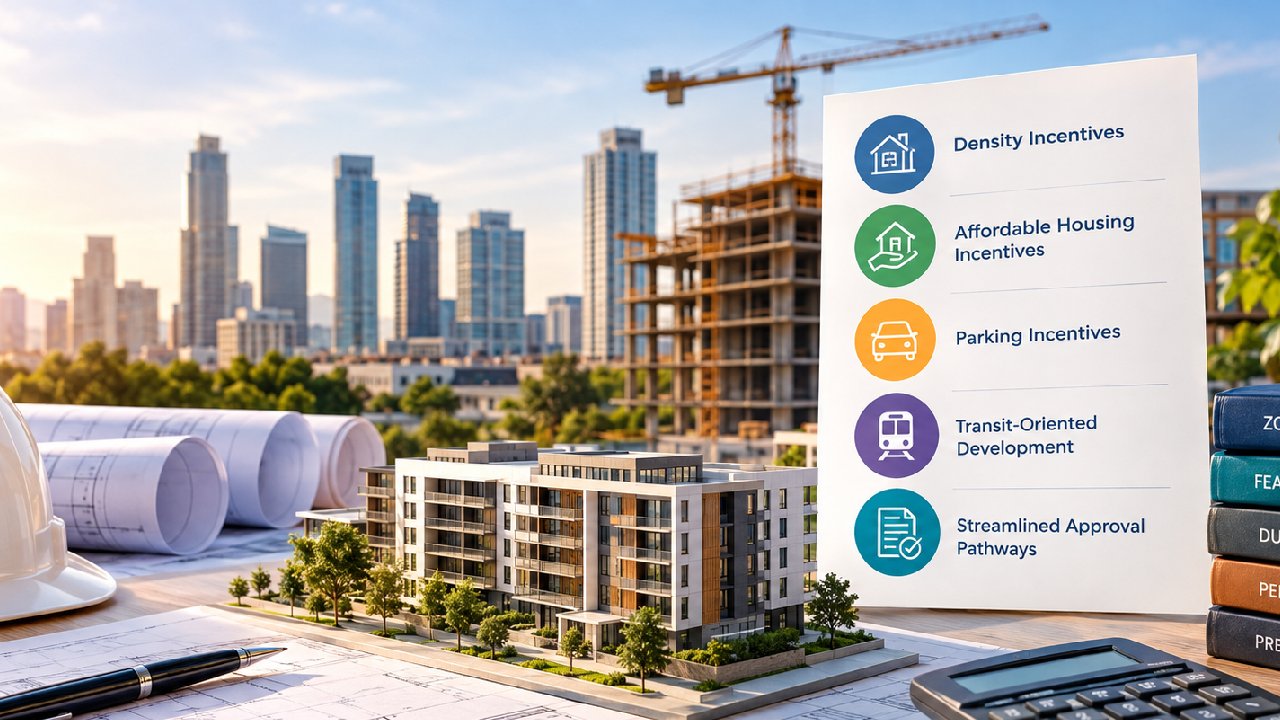
And policy has shifted in the same direction. Density bonus programs, impact fee waivers, and now a new state law that removes the public hearing requirement for a specific category of sites have all lowered entitlement risk for sponsors who do the site-selection work upfront.
The Entitlement and Permit Path, Step by Step
For any site that doesn’t qualify for the new administrative process covered below, this is roughly what to expect, whether you’re working in an incorporated city or inside the unincorporated BMSD.
Start with pre-application and due diligence. Confirm the zoning district and what residential uses are actually permitted there, from single-family RS designations up through the medium and high-density RM-10/RM-15 categories, and check that against the Future Land Use Map. This is also the point to screen for concurrency issues, traffic, drainage, water and sewer capacity, schools, parks, fire and police, and to flag any overlay districts like coastal zones, historic districts, CRAs, or transit-oriented development areas. BMSD projects go through County pre-application meetings and ePermits; city projects go through whatever pre-submittal or Development Review Board process that particular municipality runs.
Then comes entitlement, assuming the project isn’t already by-right. If the density and use you’re proposing are already allowed under the FLUM and zoning code, you can move straight to site plan review. If not, you’re looking at rezoning, a conditional use or special exception, a planned development designation, or variances, most of which mean public hearings in front of a Planning Board and then a City Commission or Council. Infill sites next to established single-family neighborhoods almost always draw extra design review on height, setbacks, buffering, and parking, along with formal findings on compatibility with the surrounding area.
Site plan and development review follows. This is where conceptual and final site plans get evaluated on building massing, unit mix, parking strategy, landscaping, buffering, trash and loading, and stormwater. Multifamily proposals in particular get scrutinized on traffic generation, whether parking actually covers demand, and how well the project fits with what’s already there.
Engineering and utility approvals run on a separate track. Drainage, roadway access, water and sewer capacity, and utility easements all get reviewed independently of the land-use approval, and honestly, this is often the slower part of the process even when the zoning itself is straightforward.
Building permits come after land-use approval is secured. That means signed and sealed plans, a survey, zoning and DER approval, a notice of commencement for anything over $2,500, and sub-permits for electrical, plumbing, and the rest, all submitted through ePermits. Permits stay valid for 180 days, and extensions aren’t guaranteed, so timing matters.
Inspections and the Certificate of Occupancy close things out. Inspections get scheduled through ePermits, and multifamily projects face particular attention on life safety systems, fire separation, elevators where relevant, and common area finishes before a CO is issued.
The New Lever: Florida’s Infill Redevelopment Act
Senate Bill 1434 took effect for applications submitted on or after May 21, 2026, and it’s the biggest change to infill entitlement in Broward, Miami-Dade, and Palm Beach counties in years. The law preempts local zoning to allow residential development, administratively, on qualifying environmentally impacted parcels.
To qualify, a site generally has to be:
- Five acres or larger
- Classified as environmentally impacted, meaning a brownfield or a site with contamination above cleanup thresholds, or located within a designated brownfield area
- Adjacent to land zoned residential as-of-right
Where those boxes are checked, the local government has to approve the application administratively. No Planning Board vote, no Commission hearing. Density is capped at whichever is lower: the average density of adjacent residential districts, or 25 dwelling units per acre. If the site is surrounded by single-family or townhome development on all sides, it needs a 20-foot open-space or passive recreation buffer.
There’s also a specific carve-out for closed golf courses and recreational facilities. If one of these sites is ringed by single-family homes, the facility has to have been out of operation for at least 12 months, the developer pays double the standard parks and recreation impact fees, and adjacent property owners get a 90-day window to buy the land themselves and keep it as open space instead.
What this means in practice is that shuttered golf courses, old industrial or brownfield parcels, and underused recreational land sitting inside otherwise residential neighborhoods just became a lot more interesting. These sites can skip the public hearing process entirely, which shortens entitlement timelines and takes a lot of the political risk out of a deal that used to die at the Commission level.
Where the Pipeline Has Already Gotten Crowded
Not every infill submarket in Broward still offers a good risk-adjusted return, and it’s worth being honest about that upfront. Central Fort Lauderdale, the Hollywood and Dania Beach corridor, and Pompano Beach and Deerfield Beach account for most of the construction activity since 2025, with over 8,800 units underway countywide. Coral Springs, Plantation, Sunrise, and Hollywood and Dania Beach have also seen some of the sharpest vacancy increases as more than 2,100 combined units delivered since 2023, which points to near-term supply pressure in those specific pockets.
Downtown Fort Lauderdale and the Las Olas corridor remain the toughest land markets in the county, full stop. A reported $637,000 per unit sale at Veneto Las Olas gives some sense of how compressed basis has gotten in the core. In these areas, the real constraint isn’t entitlement risk anymore, it’s land cost, structured parking requirements, and community pushback on height and traffic, all of which eat into yield unless a sponsor can capture meaningful incentives to offset it.
Where There’s Still Room
Three types of sites still offer a decent balance of basis and entitlement risk.
Secondary infill corridors along major arterials, older commercial strips, and underused parcels near activity centers but outside the core submarkets tend to carry lower land costs while still holding onto reasonable transit and job access.
Brownfield, golf course, and recreational parcels that qualify under the Infill Redevelopment Act are probably the most direct opportunity right now, since the administrative path can unlock up to 25 dwelling units per acre without the timeline and political exposure that used to come with a public hearing.
Western and northern Broward still have more available land at a lower basis, though it’s worth weighing that against longer commutes, weaker transit connections, and in some spots, infrastructure that hasn’t caught up yet.
Across all three, the recurring risks look similar: concurrency items like traffic level of service, drainage, and school or park capacity that can gate a project; political and community pushback where infill sits next to established single-family neighborhoods; and, for brownfield sites specifically, remediation costs and timelines that need to be underwritten before you buy, not after.
What’s Actually in the Incentive Stack
Beyond the Infill Redevelopment Act, there are several state, county, and city programs that experienced sponsors layer together rather than rely on any one of them alone.
Florida’s Density Bonus Law is the foundation, allowing density and height bonuses in exchange for affordable units, and most local bonus programs in the county are built on top of it.
Broward County’s Affordable Housing Density Bonus Program offers tiered bonuses depending on the income level served: roughly six bonus units per affordable unit at moderate income, up to 120 percent of median family income, nine-for-one at low income, up to 80 percent MFI, and nineteen-for-one at very-low income, up to 50 percent MFI. These come with 30-year deed restrictions and tend to be more generous near transit and job centers.
Fort Lauderdale’s density bonus ordinance, C-22-18, allows up to a 100 percent increase over the underlying FLUM density, capped at 50 units per acre on residential parcels and 100 on non-residential parcels, with no cap at all inside Regional Activity Center parcels, in exchange for similar affordable ratios and 30-year restrictions.
Expedited permitting is available for qualifying affordable housing projects through Fort Lauderdale’s Permit Solutions Team, which targets initial plan review within 30 days.
Impact fee waivers of up to 100 percent on county-imposed road, park, and transportation concurrency fees are available for certified very-low and low-income projects, and school impact fee waivers up to $50,000 are possible with School Board approval.
There’s also room on the parking side, with reduced ratios for affordable projects and administrative parking reductions for developments with at least 10 percent affordable units, plus surplus public land offered at 75 percent of appraised value to qualifying affordable housing proposals.
The pattern that works best isn’t picking one of these. It’s stacking them: qualify for the Infill Redevelopment Act where you can, layer in an affordable unit ratio to capture bonus density, apply for the impact fee waivers, and request expedited review. Done right, that combination can move IRR meaningfully and take a lot of the entitlement risk out of the underwriting.
A Few Questions Worth Answering Directly
What is the Florida Infill Redevelopment Act? It’s a 2026 state law, Senate Bill 1434, covering Broward, Miami-Dade, and Palm Beach counties. It allows administrative, hearing-free approval of residential development on environmentally impacted parcels of five acres or more that sit next to residentially zoned land, up to 25 dwelling units per acre.
Does the county or the city control zoning on my site? It depends on where the site is. Broward County only regulates the unincorporated Broward Municipal Services District. All 31 municipalities run their own separate zoning and building departments, so jurisdiction needs to be confirmed before any entitlement strategy gets set.
How long is a Broward building permit valid? 180 days from issuance. Extensions exist but aren’t automatic, so it’s worth sequencing sub-permits and inspections carefully once the permit is in hand.
Which Broward submarkets have the most infill multifamily competition right now? Central Fort Lauderdale, the Hollywood and Dania Beach corridor, and Pompano Beach and Deerfield Beach currently hold most of the active construction, with more than 8,800 units underway countywide as of 2025 data.
Getting the Strategy Right Before You Buy
The difference between an infill deal that works in Broward and one that stalls almost always comes down to decisions made before closing, not after. Does the site actually qualify for administrative approval under the new state law. Does concurrency capacity exist for the unit count you’re proposing. Was the incentive stack underwritten accurately, or just assumed. These aren’t steps to shortcut, especially now that the Infill Redevelopment Act has changed the math for brownfield and former recreational sites across the county.
If you’re evaluating a specific Broward parcel, whether it’s a shuttered golf course, a brownfield redevelopment, or a standard infill lot in an established neighborhood, it’s worth getting an entitlement read before the site goes under contract rather than after. JDJ Consulting’s Broward permit expediting and entitlement consulting team works directly with developers and investors to confirm the applicable process, screen for Infill Redevelopment Act eligibility, and manage the permitting timeline from pre-application through Certificate of Occupancy.