Table of Contents
A site looks perfect until someone asks whether the crane can go up. In Fort Worth’s aerospace corridor, that single question has stopped more projects than zoning ever has.
Picture a developer under contract on a parcel near Meacham International. The zoning checks out. The utilities are close enough. The pro forma pencils. Then, three weeks before closing, someone finally asks the question that should have come first: does this site sit inside an airport overlay, and if so, whose permission does the project actually need to break ground? What follows is not a permit delay. It is a renegotiation, a redesign, and in some cases a dead deal, because the site was never evaluated as airport-adjacent land in the first place. It was evaluated as industrial land that happened to be near a runway.
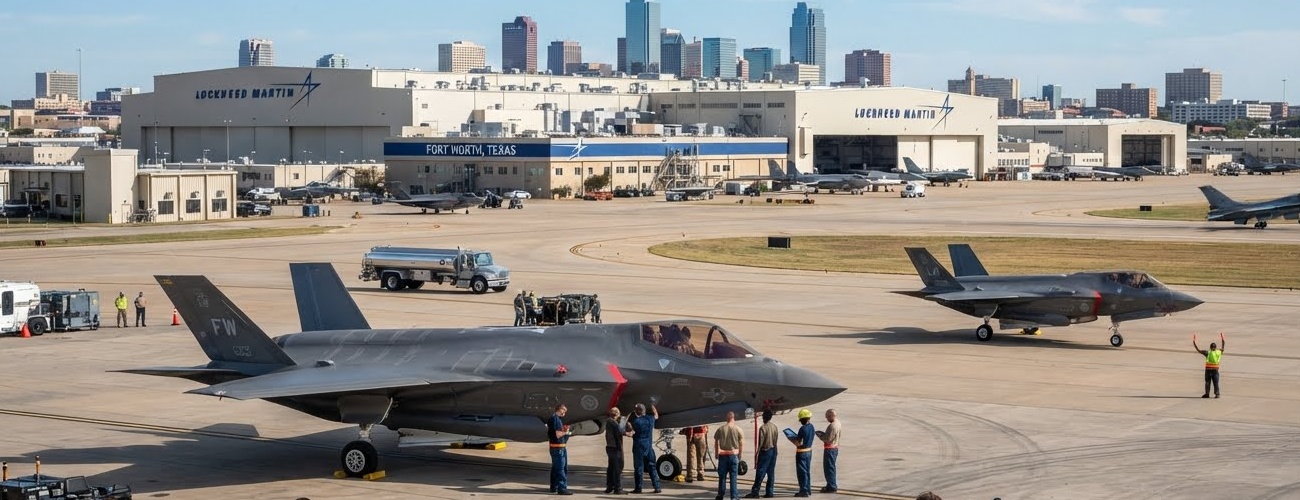
That distinction, airport-controlled land versus ordinary private industrial property, is the fault line running through nearly every aviation and aerospace project in Fort Worth right now. The city has more than 600 aerospace and defense-related companies on its rolls, anchored by Lockheed Martin and Bell, and the pipeline behind that number keeps growing. Bell’s planned aircraft-parts factory at Alliance carries a reported price tag near $632 million. Modern Aviation’s 2026 expansion at Meacham adds a 78,400-square-foot hangar and nearly 187,000 square feet of ramp. The demand is real and it is not slowing down.
What the market coverage tends to skip is the mechanism underneath all of it. Aviation entitlement in Fort Worth is not a variation on standard commercial permitting with a hangar bolted onto the end. It runs on a separate track entirely, one that layers FAA airspace review, airport lease negotiation, and federal environmental process on top of everything a conventional industrial building already requires. Understanding that track before land goes under contract is the difference between a project that breaks ground on schedule and one that stalls in the exact spot where the runway question should have been asked first.
Does the Project Actually Need Airport Access?
This is the question that should get answered before anything else, and it is the one most pro formas skip. Not every aerospace use needs a runway. Component manufacturing, precision machining, and composite fabrication can often locate on conventional industrial land with no airside requirement at all. MRO, FBO operations, cargo terminals, and aircraft storage cannot. They live or die on direct taxiway and apron access, which means they live or die on an airport’s willingness to lease.
- On airport-owned land, subject to a ground lease and airport-sponsor approval.
- On privately owned land inside an airport overlay or compatible land-use zone.
- Near a public airport but outside any overlay, where standard zoning controls.
- Near NAS Fort Worth JRB or DFW Airport, where military or federal coordination applies.
- A non-airport aerospace facility with no runway or taxiway dependency at all.
Each category triggers a different mix of city, FAA, and sometimes military review. A developer who misclassifies the site at the outset is not looking at a minor correction later. Fort Worth’s municipal code carries specific airport regulations for DFW, Meacham, Alliance, and the city-owned airports, covering height limitations, use restrictions, FAA notice requirements, and hazard marking. Those rules exist independently of, and on top of, standard zoning.
Why the Entitlement Path Runs on Two Tracks at Once
Every airport-adjacent project in Fort Worth is really running two entitlement processes in parallel: the municipal one, familiar to any industrial developer, and the aviation one, which most industrial developers have never touched. The aviation track includes FAA airspace review, airport lease negotiation, compatible land-use screening, and often coordination with NAS Fort Worth JRB depending on proximity. Missing either track does not just slow the project. It can invalidate work already done on the other.
This is precisely where local permit expediting earns its fee. A team that understands how Fort Worth Development Services, the Aviation Department, and the FAA’s OE/AAA system interact, and knows which approvals have to sequence before which, is the difference between a coordinated submission and a stack of applications that contradict each other. JDJ Consulting’s Fort Worth permit expediting and entitlement team works this exact intersection for aviation and industrial clients navigating both tracks at once.
The airspace filing that catches developers off guard
Structures, cranes, temporary equipment, and even light poles can trigger FAA Form 7460-1, the Notice of Proposed Construction or Alteration, if they penetrate applicable airspace surfaces. Fort Worth’s development guidance directs applicants to submit that notice, along with associated environmental information, through the FAA’s OE/AAA system well before construction. If the FAA objects, the applicant either redesigns or negotiates a reimbursable agreement with the Airport Manager to resolve it. Neither option is fast, which is exactly why this filing needs to happen at the concept stage, not after the crane is scheduled.
Tall hangars, construction cranes, exhaust stacks, solar glare, and even mature landscaping near runway ends can all trip this review. A general contractor who treats the crane plan as a construction-phase detail, rather than an entitlement-phase filing, is the single most common source of schedule slippage on Fort Worth aviation projects.
The Eleven-Phase Path, Condensed
The full process runs deeper than any single table can capture, but the sequence below is the spine of it. Projects that follow this order rarely get stuck. Projects that skip ahead, usually by finalizing a site plan before the airport consultation, usually do.
| # | Phase | What it requires |
|---|---|---|
| 1 | Jurisdictional screen | Confirm airport ownership, Part 77 surfaces, noise contours, and underlying zoning before land goes under contract. |
| 2 | Airport consultation | Define aircraft type, hangar size, apron needs, and meet with Airport Management and city development staff. |
| 3 | Concept and questionnaire | Submit a hangar development questionnaire and concept plan separating airside, landside, and secured areas. |
| 4 | FAA Form 7460-1 | File airspace review early for any structure, crane, or light standard near approach or departure paths. |
| 5 | Environmental review | Screen for wetlands, floodplain, noise, contamination, and wildlife hazard, even when no formal federal review applies. |
| 6 | Ground lease negotiation | Negotiate rent, term, capital-investment minimums, reversion, and assignment rights with Legal and the Aviation Advisory Board. |
| 7 | Zoning reconciliation | Match permitted uses, height limits, and compatible land-use rules against the airport overlay. |
| 8 | Platting and civil design | Design aircraft-rated pavement, fuel containment, and separated airside and landside circulation. |
| 9 | Building, fire, specialty permits | Address hangar doors, fire suppression, hazardous-material areas, and specialized structural systems. |
| 10 | Operational permits | Secure TCEQ air authorization, stormwater permits, and fueling or hazardous-material approvals as applicable. |
| 11 | Construction and airport safety | Coordinate crane heights, dust control, and temporary closures through a pre-construction airport safety meeting. |
Note the position of the ground lease. It sits after zoning reconciliation begins but before the building permit can be submitted, because Fort Worth’s process requires lease authorization before Development Services will release a permit on airport-owned land. That sequencing detail alone reshapes how a development schedule should be built.
Which Fort Worth Submarket Actually Fits the Project?
Fort Worth’s aviation geography is not interchangeable, and treating it as one market is where a lot of site selection goes wrong. Alliance is the flexible industrial-airport platform. The NAS Fort Worth JRB corridor is the defense-manufacturing core. Meacham serves corporate and executive aviation. Spinks handles general aviation and training. Each has a different capacity ceiling, a different regulatory posture, and a different competitive set.
| Submarket | Best fit | Strength | Watch-out |
|---|---|---|---|
| Alliance / Perot Field | Aircraft manufacturing, MRO, cargo, aerospace suppliers | FTZ No. 196, Freeport exemption, rail/road/air intermodal access | Rising land competition, congestion, need to justify airside cost |
| NAS Fort Worth JRB corridor | Defense production, F-35 supply chain, precision components | Deepest aerospace labor pool, Lockheed and Bell ecosystem | Limited unconstrained land, security overlays, federal-budget exposure |
| Meacham International | Corporate aviation, FBOs, business-jet MRO, flight training | Executive-aviation demand, active midfield development solicitation | Airside capacity limits, urban adjacency, higher lease costs |
| Spinks Airport | General aviation, flight schools, light MRO, rotorcraft | Lower land basis, room in the airport master plan | Fewer aerospace anchors, encroaching residential growth |
Alliance, home to Perot Field, the world’s first industrial airport, remains the strongest all-around platform for a new aviation-industrial campus, backed by Foreign-Trade Zone No. 196 and a Triple Freeport exemption for qualifying export inventory. But it is also the most competitive, and the question every Alliance prospect should answer honestly is whether the operation genuinely needs airside access or is simply paying a premium for proximity. A less expensive off-airport industrial site often performs just as well for a use that never touches the apron.
What Incentive Stack Actually Applies to an Aerospace Project?
Fort Worth treats aerospace manufacturing and design as an emerging target industry for Chapter 380 economic development agreements, which can weigh capital investment, job creation, wages, and research and development spending. The city has already used this tool for aerospace: a prior Chapter 380 R&D credit for GKN Aerospace involved up to $7 million in credits tied to $40.5 million in local R&D expenditures over five years. That is the scale of commitment the city is willing to make for the right project.
- City tax abatement, potentially covering up to 100 percent of the increase in appraised value for up to ten years.
- Chapter 380 agreements, with aerospace named as a target industry for R&D and manufacturing credits.
- Foreign-Trade Zone No. 196 and Triple Freeport exemption at Alliance for qualifying export inventory.
- Texas Enterprise Fund grants, but only if filed before any lease, land purchase, or public location announcement.
- Texas Workforce Commission Skills Development Fund for CNC, composite, avionics, and nondestructive testing training.
The Texas Enterprise Fund detail matters more than it sounds like it should. Eligibility depends on demonstrating that Texas is competing against a credible out-of-state site, and signing a lease or announcing the location publicly before applying can disqualify the project entirely. Sequencing the incentive application ahead of the real estate decision, not after it, is not optional if this fund is in play.
Where These Projects Actually Break Down
The failures that recur across Fort Worth aviation projects are rarely dramatic. They are sequencing mistakes, made by capable teams who applied conventional industrial logic to a site that never followed conventional industrial rules.
- Treating airport land like ordinary industrial land, when a ground lease and FAA review control the actual schedule.
- Filing FAA Form 7460-1 late, discovering a height conflict only after design is locked.
- Ignoring a documented future taxiway, runway protection area, or airport master plan project affecting the site.
- Underestimating aircraft-rated pavement costs, which do not behave like truck-rated pavement.
- Assuming every aviation use is compatible, when an FBO, an MRO, and an aircraft-painting facility carry entirely different impacts.
- Starting construction before Chapter 380 or tax abatement applications are filed, after the incentive window has already closed.
None of these are exotic risks. They are process risks, and process risk is the one variable a development team can actually control if the entitlement path is mapped before the land closes rather than after.
Frequently Asked Questions
Does an aerospace component manufacturer in Fort Worth need to be located on airport property?
Not necessarily. Component manufacturing, composite fabrication, and precision machining can often operate on conventional industrial land with no runway dependency. Direct airport access is generally required only for uses that move aircraft, such as MRO, FBO operations, cargo terminals, and aircraft storage.
What triggers FAA Form 7460-1 review for a Fort Worth project?
Any structure, crane, temporary equipment, or tall landscaping that penetrates applicable airspace surfaces near a runway approach or departure path can trigger this filing. It should be submitted through the FAA’s OE/AAA system early in design, since an objection can force a redesign or a negotiated resolution with the Airport Manager.
How long does an airport ground lease typically take to finalize in Fort Worth?
The process runs through preliminary proposal review, site and operational review, lease negotiation, legal review, Aviation Advisory Board consideration, and City Council approval before a building permit can be submitted. Each stage adds time, which is why lease negotiation should start well ahead of any construction deadline.
Is Alliance always the best location for an aerospace project in Fort Worth?
It is the strongest platform for aviation-dependent operations that need direct airside access, intermodal connectivity, or Foreign-Trade Zone benefits. Projects without a genuine airside requirement often perform better, and more cost-effectively, on off-airport industrial land elsewhere in the metro.
Can a developer apply for Texas Enterprise Fund incentives after signing a lease?
Generally no. The fund is designed for projects still actively deciding between Texas and a competing out-of-state site, and signing a lease, purchasing land, or publicly announcing the location can affect eligibility. The application needs to precede the real estate commitment.
The Real Advantage Isn’t the Site. It’s the Sequence.
Fort Worth is not short on aerospace demand, land, or incentive tools. What separates the projects that break ground on schedule from the ones that stall is whether the team mapped the airport question, the FAA filing, the lease negotiation, and the zoning reconciliation into one coordinated sequence before the land closed. Get that sequence right and Fort Worth’s aerospace corridor is as favorable a market as exists in Texas. Get it wrong and the site that looked perfect on paper becomes the deal that quietly falls apart three weeks before closing.
JDJ Consulting has guided developers, architects, and general contractors through Fort Worth’s airport, FAA, and municipal entitlement layers on aviation and aerospace projects across the metro. For a site-specific read on jurisdiction, airspace exposure, and permitting sequence, connect with
JDJ Consulting’s Fort Worth permit expediting and entitlement team before the next site goes under contract.