
Table of Contents
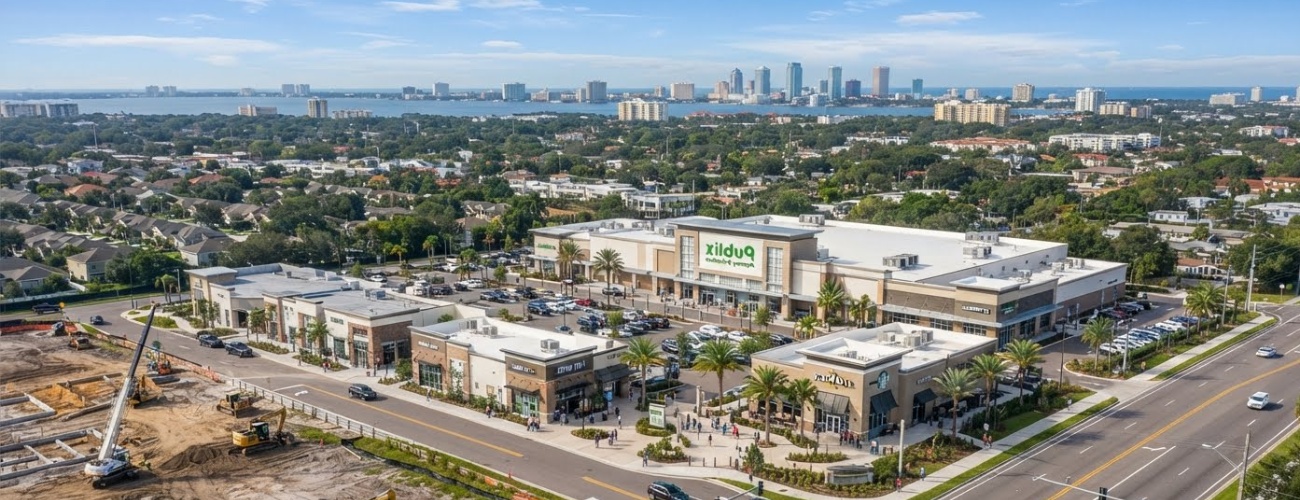
Grocery-anchored retail is one of the few commercial real estate categories in Tampa Bay that has kept its footing through rate volatility, construction inflation, and the slow reshuffling of national retail brands. Vacancy across the region’s grocery-anchored centers sits in the low single digits, rents keep climbing, and institutional capital keeps chasing the product type because the underlying demand, people buying groceries, does not go away in a downturn.
The catch is that very little new supply is being delivered. Land is scarce in the submarkets where rents are strongest, entitlement timelines can stretch a project’s carry costs past what the pro forma assumed, and anchor tenants impose design and operational standards that ripple through every part of a site plan. For developers, architects, and investors evaluating a grocery-anchored deal in Hillsborough or Pinellas County, understanding the entitlement and permitting path is not a back-office detail. It is the variable that determines whether a promising site pencils.
This article walks through how the process works in Tampa, where competition is heaviest, where the next opportunities are likely to surface, and what separates a project that clears review smoothly from one that stalls.
Where Grocery-Anchored Retail Fits in Tampa’s Land Development Code
Grocery-anchored retail is classified as a commercial use under Tampa’s Land Development Code (LDC). Most projects are sited in CG (Commercial General) or CI (Commercial Intensive) zoning districts, and some fit within neighborhood commercial designations depending on the corridor. If a parcel is already zoned for commercial use and the proposed center meets the LDC’s standards for setbacks, height, coverage, parking, and loading, the project generally proceeds through a ministerial review path rather than a discretionary one.
That distinction matters more than most first-time Tampa developers expect. A ministerial, by-right project can move from site plan submission to permit issuance in a matter of weeks. A project that requires rezoning, a special use approval, or a Planned Unit Development (PUD) to secure relief from a standard, whether that is height, setback, or parking ratio, adds months to the timeline and introduces a Planning & Zoning Commission hearing and City Council readings into the critical path.
Typical development parameters in CG/CI districts:
- Setbacks generally range from 0 to 10 feet at the front and side, with larger rear setbacks and buffering required where a commercial parcel abuts residential property.
- Maximum height is typically capped around 45 feet, or three to four stories, though certain corridors permit additional height with added review.
- Lot coverage allowances are generous, often 70 percent or higher, with FAR varying by district and overlay.
- Parking ratios for a grocery anchor commonly run 4 to 5 spaces per 1,000 square feet, with inline shop space requiring roughly 1 space per 200 to 250 square feet. Shared parking calculations are available and frequently used to reduce total stall count.
The Entitlement and Permitting Sequence
For a grocery-anchored project, the path generally runs through the following stages.
1. Pre-application due diligence
Before a single drawing is submitted, the site itself needs to be vetted. That means confirming zoning and Future Land Use designation, verifying that truck and delivery access can physically work on the parcel, and checking utility capacity for water, sewer, power, and grease interceptor needs. Grocery anchors are unusually specific about loading dock geometry, trash compactor placement, and delivery hours, and those requirements shape the site plan before the building footprint is even finalized. Larger sites, particularly those on higher-traffic corridors, may also trigger a traffic study and require coordination with the Florida Department of Transportation if the access point touches a state road.
2. Entitlements, if the site needs them
If the parcel is already zoned CG or CI and the project meets every LDC standard as written, no separate entitlement action is required and the project proceeds directly to site plan and permitting. If the site is not zoned for retail, or if the design needs relief from a development standard, the developer will need to pursue rezoning, a special use approval, or a PUD. In urban corridors and neighborhood commercial plan areas, an Architectural Review Commission or similar design review may also weigh in on massing, materials, and street-level treatment, particularly where the center faces residential neighbors.
3. Site plan and building permits
Tampa processes permitting through its Accela-based e-permitting system, and the city currently allows site plans to be submitted independently from building permits. That flexibility is genuinely useful for multi-tenant retail centers, since it lets horizontal civil work begin while the architectural package for the building shell and tenant spaces is still being finalized. Review touches building, structural, fire, and MEP disciplines, along with energy code, landscaping, and any applicable flood or historic overlay requirements. Larger commercial projects may also route through the Environmental Protection Commission and Development Services for land development and environmental review.
Hillsborough County’s Competitive Sites and Priority Economic Development (PED) designation can shave two to six weeks off review time for qualifying commercial projects by allowing dual horizontal and vertical review. It requires pre-qualification with the Economic Development Department and early coordination meetings, so the earlier a project is positioned for PED consideration, the more of that time savings it actually captures.
4. Inspections and certificate of occupancy
Standard phased inspections apply through construction, followed by a certificate of occupancy. Tenant build-outs for inline shop space typically require separate permits, and grocery anchors add another layer of review through health department inspection of food service and refrigeration areas.
Where the Friction Points Actually Show Up
Every stakeholder on a grocery-anchored deal experiences the entitlement and permitting process differently, and it is worth naming the pressure points by role.
Developers face the sharpest land scarcity problem. Parcels in CG or CI zoning with enough frontage and depth to accommodate a grocery pad plus inline shops are limited in core submarkets, which pushes many projects to edge sites that require rezoning or infrastructure extension before they are viable. Layer on construction cost inflation and extended entitlement timelines, and it becomes clear why most new grocery-anchored product in the market today is small, preleased, and largely build-to-suit rather than speculative.
Architects absorb the complexity of circulation design. Grocery-anchored centers have to choreograph car traffic, delivery trucks, and pedestrians on a single site, and shared parking calculations and drive-aisle widths have direct consequences for gross leasable area. Loading dock and trash enclosure placement has to satisfy both the anchor’s operational standards and the municipality’s screening and noise requirements simultaneously, which is a tighter needle to thread than it sounds.
General contractors manage sequencing risk. Foundation, slab, and roof systems have to accommodate multiple tenant demising walls, and a late change from the anchor tenant can cascade into rework across utilities and storefronts. Grocery tenants also expect rigorous MEP and refrigeration commissioning, which adds inspection milestones beyond a typical retail build-out.
Investors and owners carry lease-up concentration risk. The anchor drives the center’s overall viability, so an anchor closure or relocation can spike vacancy and soften demand for inline space almost overnight. On the upside, grocery-anchored centers continue to trade at a premium relative to other retail formats specifically because that anchor relationship provides a level of stability e-commerce has not been able to erode.
Where Tampa’s Grocery-Anchored Market Stands Today
Tampa Bay’s retail market remains one of the tightest in the country, with vacancy hovering in the 3 to 4 percent range and rent growth running well ahead of the national average. But that strength is concentrated, and the geography matters for anyone underwriting a new project.
Where competition is heaviest:
- Westshore and South Tampa command some of the highest retail rents in the metro, with corridors like Kennedy Boulevard pushing past $40 per square foot. Grocery-anchored centers here are tightly held and trade at premium valuations, leaving little room for new entrants without a redevelopment angle.
- Southeast Hillsborough and South Pinellas are seeing active new grocery development, including projects tied to Walmart in Apollo Beach and Sprouts Farmers Market, which signals real developer confidence in the growth trajectory of those suburban corridors.
- Legacy centers and malls, such as Britton Plaza and the broader Westshore Plaza area, represent redevelopment opportunities where existing retail footprints could be reconfigured for a grocery anchor, though timelines on these larger repositioning plays tend to be less predictable.
- Pasco County and North Tampa are drawing discount and off-price retail expansion, and grocery-anchored centers in these corridors benefit from population growth colliding with genuinely limited new supply.
Where the shortcomings show up: land assembly costs in high-growth corridors, traffic impact requirements that can force signal or roadway commitments, design review overlays in urban and historic districts, and neighborhood pushback on traffic, lighting, and trash enclosures when a site sits near residential property. None of these are disqualifying on their own, but they are exactly the kind of issues that turn a six-month entitlement estimate into a twelve-month one if they are not identified during due diligence.
Incentive Programs Worth Evaluating
Grocery-anchored retail does not have a dedicated incentive category of its own, but several Tampa and Hillsborough County programs apply to qualifying projects.
The Priority Economic Development (PED) designation offers the most direct benefit for a retail developer: expedited review that can compress timelines by two to six weeks through dual horizontal and vertical processing. It requires pre-qualification with the Economic Development Department and early pre-submittal meetings with the relevant review agencies, so the application needs to happen well before drawings are finalized.
Community Redevelopment Agency (CRA) districts, including Downtown, East Tampa, and West River, can offer grants, infrastructure improvements, or tax increment financing participation for projects that support job creation or neighborhood revitalization goals. Retail development that fits within a CRA’s adopted plan may qualify, though eligibility is district-specific and worth confirming early rather than assuming.
State-level workforce and capital programs, while not retail-specific, can also support grocery anchors and larger employers within a center when coordinated through the city’s economic development team.
Grocery-Anchored Retail Compared to Other Retail Formats
Against power centers, which carry more exposure to e-commerce displacement and national retailer bankruptcies, grocery-anchored centers hold a defensive advantage rooted in necessity-based spending. Against lifestyle centers, which lean on dining and experiential tenants that are more sensitive to discretionary spending cycles, grocery anchors deliver more consistent daily foot traffic. Against mixed-use development, which layers in residential or office components that can strengthen a retail base but add real cost and delivery complexity, a standalone grocery-anchored center is simply a more straightforward asset to finance and deliver.
That relative simplicity is part of why the format continues to attract capital even as overall retail construction activity stays muted.
A Practical Approach to De-Risking a Tampa Grocery-Anchored Project
The developers who move these deals through entitlement and permitting cleanly tend to follow a similar sequence. They target CG or CI zoned sites, or established neighborhood commercial parcels, in corridors with demonstrated growth, rather than betting on a rezoning to make a marginal site work. They lock in anchor tenant design requirements early, before the site plan is finalized, so loading, trash, signage, and parking do not force a redesign mid-process. They commission traffic studies at the front end rather than waiting for a review agency to require one. And where a project qualifies, they pursue PED designation or CRA participation early enough to actually benefit from the time savings those programs offer.
The common thread across all of these is timing. Nearly every friction point in Tampa’s grocery-anchored entitlement process, whether it is a zoning gap, a traffic trigger, or an anchor design conflict, is manageable when it is identified before submission and expensive when it surfaces after.
Frequently Asked Questions
Is grocery-anchored retail allowed by right in Tampa?
Yes, in most CG and CI zoned parcels, provided the project meets the Land Development Code’s standards for setbacks, height, coverage, parking, and loading. If the site is not zoned for retail or needs relief from a standard, rezoning or a PUD is required instead.
How long does entitlement and permitting take for a grocery-anchored center in Tampa?
A by-right project on properly zoned land can move through site plan and permit review in a matter of weeks. A project requiring rezoning or a PUD typically adds several months due to Planning & Zoning Commission review and City Council hearings.
What parking ratio should a grocery-anchored center in Tampa plan for?
Grocery anchors commonly require 4 to 5 spaces per 1,000 square feet, with inline shop space requiring roughly 1 space per 200 to 250 square feet, though shared parking calculations can reduce the total stall count.
Are there expedited permitting options for retail projects in Hillsborough County?
Yes. The Priority Economic Development (PED) designation allows dual horizontal and vertical review for qualifying commercial projects, potentially cutting review time by two to six weeks.
Working Through the Process
Every one of these steps, from zoning confirmation through PED qualification, has a direct effect on how long a grocery-anchored project takes to reach groundbreaking and how much it costs to get there. JDJ Consulting works with developers, architects, and investors on the entitlement and permitting side of Tampa Bay retail projects, helping teams sequence due diligence, navigate rezoning or PUD processes when they are unavoidable, and pursue expedited pathways where a project qualifies. If you’re evaluating a grocery-anchored site in Tampa, our Tampa permit expeditors and entitlement consultants team can help you scope the timeline before you’re locked into a purchase agreement.