Table of Contents
seems to lead with that fact. No zoning, less friction, faster path to steel in the ground. It’s not wrong. It’s also not the whole story, and for manufacturing projects in particular, planning a schedule around “no zoning means no process” is how a pro forma loses four to six months before anyone pours a foundation.
The real bottleneck for manufacturing in Houston rarely sits with land use approval. It sits with everything that comes after: TCEQ air and stormwater permits, CenterPoint Energy transformer lead times now stretching past a year on large loads, and a Chapter 42 review that still has to clear setbacks, drainage, and parking before the Houston Permitting Center will touch a building permit application. Developers who assume the absence of zoning means an absence of scrutiny are getting caught off guard, and it’s happening often enough that it’s become a recognizable pattern in the market.
Below is what the process actually looks like for a manufacturing project in Houston, where the industrial market still has room to move, and which incentive programs can meaningfully change the economics.
Why “No Zoning” Doesn’t Mean No Process
Chapter 42 of the Houston City Code governs lot sizes, building setbacks, parking ratios, and subdivision standards, and it applies whether or not a use-based zoning map exists. For manufacturing sites, that typically means a 25-foot setback along major thoroughfares and roughly 10 feet along collector or local streets, plus parking requirements under Chapter 26. Deed restrictions, historic district overlays, and TIRZ boundaries can layer additional conditions on top, and none of that shows up until someone actually pulls the plat and title work.
Floodplain status is the other early filter. Houston’s Chapter 19 drainage requirements typically call for finished floor elevations at least two feet above the 500-year flood level, with detention obligations that can eat meaningfully into a site’s buildable footprint. For manufacturing users with heavy equipment loads and tight floor-to-ceiling tolerances, that elevation requirement isn’t cosmetic. It changes foundation design, loading dock grades, and sometimes the site plan entirely.
None of this is disqualifying. It’s just work that has to happen before the Houston Permitting Center will move a project forward, and the firms that build it into the front end of due diligence are the ones that keep their schedules intact.
How a Manufacturing Project Moves Through the Houston Permitting Center
Most manufacturing projects route through the Houston Permitting Center, either via the iPermits/ProjectDox platform or in person at the HPC office on Washington Avenue. The sequence generally runs as follows.
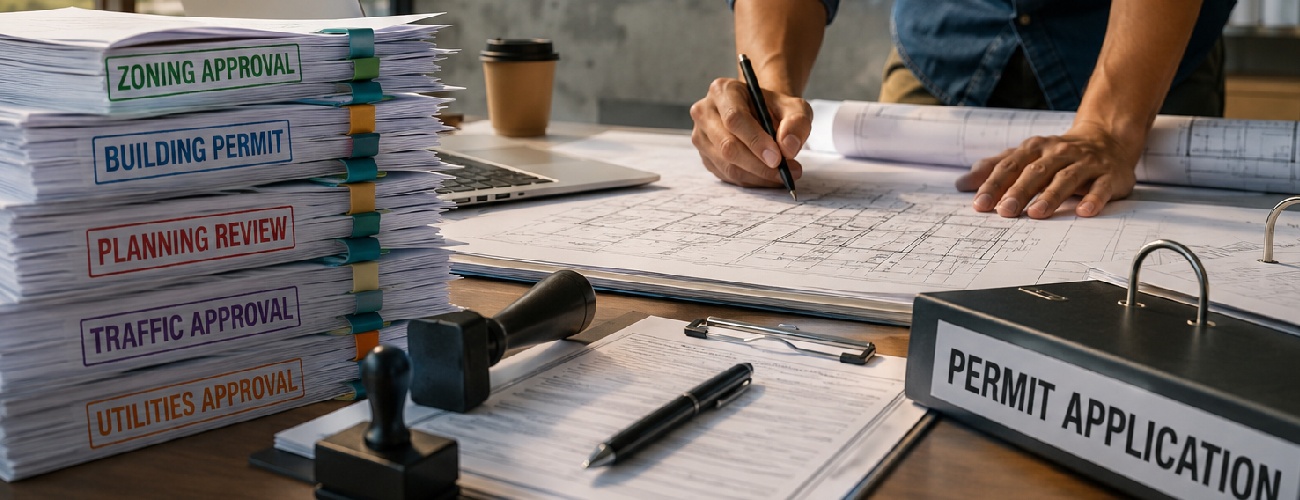
A pre-application meeting, sometimes called Planner of the Day, confirms Chapter 42 setbacks, parking counts, drainage obligations, and any overlay district rules specific to the parcel. From there, the project team submits a full package: architectural, civil, structural, and MEP plans, fire and life safety documentation, process-related drawings for manufacturing equipment, and a site plan showing boundaries, setbacks, footprint, parking, loading, drainage, and utility easements.
Plan review happens across four departments simultaneously rather than sequentially, which is one reason turnaround times vary so widely between projects. Planning and Development checks setbacks and lot standards. Building Code Enforcement reviews structural and life safety. Public Works confirms drainage, utilities, and right-of-way conditions. The Fire Department evaluates fire protection, site access, and hazardous materials handling where applicable. A project sitting in a historic district needs a Certificate of Appropriateness from the Houston Archaeological and Historical Commission before any of this even starts.
Once fees are paid and the permit is issued, inspections follow through foundation, structural, MEP, and fire and life safety milestones, and the certificate of occupancy closes out the process. On paper, it’s a clean sequence. In practice, the timeline is set less by the city and more by whichever external agency is slowest, and for manufacturing, that’s almost always TCEQ or the utility.
What TCEQ Adds to the Timeline
Manufacturing is where Houston’s permitting process stops being a purely local matter. The Texas Commission on Environmental Quality regulates air emissions, industrial stormwater, and waste handling for any facility that processes, fabricates, or produces at scale, and none of that runs through the Houston Permitting Center.
Air permits are required once a facility’s emissions cross certain thresholds, and the permit type, whether standard, minor source, or major source, depends entirely on the production process. Industrial stormwater typically falls under a Multi-Sector General Permit, and any facility generating hazardous or special waste needs separate waste management authorization. Sites near the Ship Channel or older industrial corridors often carry additional exposure from prior land uses, which is why a Phase I environmental site assessment, and sometimes a Phase II, belongs at the front of due diligence rather than the middle of construction.
Harris County Pollution Control Services coordinates with TCEQ but doesn’t issue air permits itself, and within city limits, air quality questions route through 311. Projects near navigable waters or involving dredge and fill work add USACE Galveston District and TCEQ Section 401 certification into the mix. None of these processes move on the same clock as the city’s, and none of them wait for a building permit to be issued before they start their own review.
The projects that stay on schedule are the ones that open TCEQ and utility conversations in parallel with the city submission, not after it.
The Utility Constraint Nobody Budgets For
CenterPoint Energy’s own forecasts show Houston’s peak electrical load growing by roughly 50 percent over six years, and transformer lead times on large industrial loads have stretched to 40 to 60 weeks or longer in some cases. For a manufacturing facility with a heavy power draw, that lead time can dwarf every other item on the critical path combined.
This is the single most common miscalculation among developers new to Houston manufacturing. Entitlement and permitting can move in months. Utility energization for a large load can take more than a year, and the process needs to start well before the building permit is even submitted. Architects and engineers designing for year-one load rather than year-ten load are setting up a facility for an expensive retrofit the moment the client wants to expand a production line.
Natural gas coordination follows a similar logic for facilities using process heat, and water and wastewater capacity needs early confirmation with the City of Houston Public Works or the relevant municipal utility district for sites outside city limits.
Where the Market Still Has Room
Houston’s industrial base skews heavily toward logistics, but manufacturing has its own mature corridors and its own emerging ones, and the two behave very differently.
The Southeast submarket around Port Houston and the Ship Channel remains the center of gravity for heavy industrial and petrochemical-adjacent manufacturing, with land prices and competition to match. East Houston carries a traditional manufacturing and fabrication base close to port and rail infrastructure. Katy and the I-10 corridor, along with Sugar Land and southwest Houston, host a diversified mix of food processing, advanced manufacturing, and distribution that has been steadily filling in over the past several cycles.
The more interesting story right now runs along the US 290 corridor toward Cypress, Prairie View, and the Waller County edge, where new manufacturing parks are absorbing large tracts that simply don’t exist anymore closer to the Ship Channel. Inland nodes with rail and highway access along I-45, Beltway 8, and Highway 6 offer similar upside for developers priced out of the traditional industrial core.
The tradeoff is real. These emerging corridors often carry more exposure to infrastructure that hasn’t caught up with growth yet, meaning roads, utilities, and public services can lag behind the pace of new industrial construction. It’s a different risk profile than a Ship Channel infill site, not a lower one, just a different one to underwrite.
Risk by Stakeholder
Stakeholder | What Tends to Go Wrong |
|---|---|
Developers and investors | Utility energization delays and TCEQ permitting timelines pushing production start well past the pro forma, plus financing structures that assume industrial-standard rather than manufacturing-standard capital cycles |
Architects and engineers | Structural bay spacing and column grids that don’t match the production process map, and HVAC systems undersized for Houston’s heat and humidity in facilities with tight temperature tolerances |
General contractors | Long-lead process equipment arriving out of sync with structural and civil sequencing, and phased construction around an operating facility that adds real safety and scheduling complexity |
Lenders | Environmental liability on infill or brownfield sites near older industrial corridors, and entitlement timing risk that affects the entire draw schedule |
Incentive Programs Worth Underwriting Into the Deal
Houston and the state of Texas both offer incentive programs that can materially change manufacturing project economics, and most are underused simply because teams don’t build the application timeline into their schedule early enough.
At the local level, Chapter 312 property tax abatements can reach up to 100 percent on the added value of real and personal property for as long as ten years, generally requiring a minimum $5 million investment (or as little as $500,000 within a Texas Enterprise Zone) and job creation thresholds that drop significantly inside a designated zone. Chapter 380 economic development agreements offer more flexible, negotiated terms, including grants, infrastructure commitments, and sales tax sharing arrangements.
At the state level, the Texas Enterprise Fund provides cash grants for projects hitting significant job and investment thresholds, averaging roughly $7,500 per job created. The Texas Enterprise Zone Program refunds sales and use tax on qualified expenditures in distressed areas. The Skills Development Fund underwrites workforce training, and the state’s manufacturing sales tax exemption removes sales and use tax on machinery and equipment used directly in production. Facilities using more than half their utility consumption for manufacturing can also apply for a utility sales tax exemption, though it requires a predominant-use study to support the application.
Federal and special-district programs round things out: Opportunity Zone capital gains treatment, Foreign Trade Zone duty deferral for import- or export-heavy operations, and industrial revenue bonds for eligible projects through local industrial development corporations. Layered correctly, these programs can shift a project’s return profile meaningfully, but only if the applications are timed to run alongside entitlement rather than after it.
Getting the sequencing right, TCEQ applications running in parallel with the city submission, utility requests filed before the building permit, incentive applications aligned with the construction timeline, is less about any single approval and more about coordinating agencies that don’t naturally talk to each other. That coordination work is exactly where a permit expediting and entitlement consulting team earns its fee, keeping TCEQ, CenterPoint, and the Houston Permitting Center moving on parallel tracks instead of a sequential one that adds months to the schedule.
Frequently Asked Questions
Does Houston require zoning approval for manufacturing facilities?
No. Houston has no use-based zoning code. Manufacturing projects are instead governed by Chapter 42 development standards covering setbacks, lot size, parking, and subdivision requirements, along with any applicable deed restrictions or overlay districts.
How long does TCEQ air permitting take for a Houston manufacturing facility?
Timelines vary by permit type and emissions profile, but air and stormwater permits from the Texas Commission on Environmental Quality are commonly the longest lead item on a manufacturing project’s critical path and should be initiated during pre-construction, well before the building permit application.
Why do CenterPoint Energy transformer lead times matter for manufacturing projects?
CenterPoint has forecast roughly 50 percent peak load growth across the Houston region over six years, and transformer lead times for large industrial loads have stretched to 40 to 60 weeks or more. For power-intensive manufacturing users, utility energization can take longer than every other permitting step combined.
What is the minimum investment for a Chapter 312 tax abatement in Houston?
Standard projects generally require a minimum $5 million investment and 25 permanent jobs, though thresholds drop to $1 million for deteriorated or demolished property and as low as $500,000 within a Texas Enterprise Zone.
Which Houston submarkets have available industrial land for manufacturing?
The US 290 corridor toward Cypress and Prairie View, along with inland nodes near I-45, Beltway 8, and Highway 6, currently offer more available large-parcel inventory than the Ship Channel and East Houston submarkets, which remain the most built-out and competitive.
JDJ Consulting Group provides permit expediting and entitlement consulting services for developers, architects, and investors navigating manufacturing, industrial, and mixed-use projects across Texas and Florida markets. Learn more about how our Houston team supports manufacturing developments.