Table of Contents
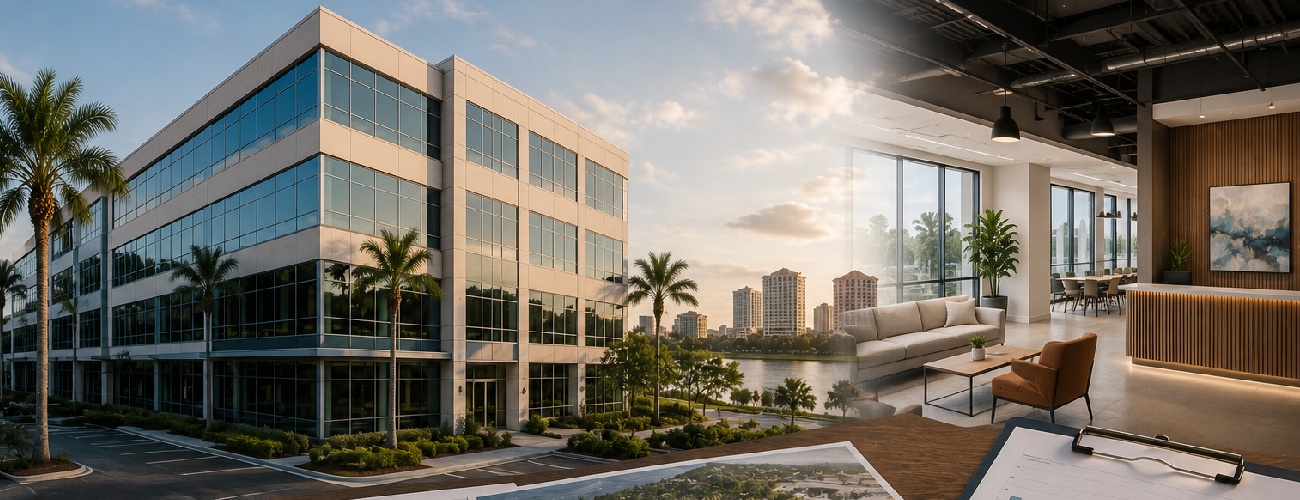
Office repositioning in Palm Beach County succeeds more often as a targeted upgrade, adaptive reuse or change-of-use strategy than as a wholesale office-to-residential conversion. West Palm Beach is currently one of Florida’s tightest office markets, and industry analysis points to single-digit vacancy as achievable before 2030. That tightening changes the calculus for owners of aging office stock: many buildings are better positioned for medical office, boutique office, hospitality, education, senior housing or mixed-use than for outright removal from the office inventory.
For architects, developers and investors evaluating an underperforming office asset in Palm Beach County, the question is rarely whether to act. It is which repositioning path the building, the site and the jurisdiction will actually support, and what it will take to get there.
What Is Office Repositioning?
Office repositioning is the process of upgrading, adapting or converting an existing office building to improve its market performance, whether by modernizing it for continued office use or by transitioning it, in whole or in part, to a different use such as medical office, hospitality, residential or mixed-use. Unlike ground-up development, repositioning works within an existing structure, which means the strategy is shaped as much by the building’s physical bones as by market demand.
The Institutions Actually Driving Demand
Scripps Research’s Florida campus sits on 30 acres in Jupiter’s Abacoa Development of Regional Impact. The original phase brought roughly 365,000 square feet of bioscience space online, and a later phase has floated as much as 1.6 million additional square feet on nearby county-controlled land. A few miles away, the Max Planck Florida Institute for Neuroscience opened in 2012 on the FAU Jupiter campus, notable as the Max Planck Society’s first institute outside Europe. Palm Beach State College rounds this out with a 90,000-square-foot bioscience and technology complex in Palm Beach Gardens that feeds the local talent pipeline.
What these institutions do isn’t just occupy square footage, it’s generate demand around themselves. Research support firms, contract research organizations, equipment vendors and startup incubator space all tend to cluster nearby. The Business Development Board of Palm Beach County counts more than 668 life science companies across the county, spanning biotech, medical devices and pharmaceuticals. That’s a real number, but it’s not evenly spread. A site five miles from Scripps behaves very differently in leasing terms than a site next door to it, and that distance matters more than most pro formas give it credit for.
Why Blanket Office-to-Residential Conversion Rarely Works in Palm Beach County
The office-to-residential narrative dominates national headlines, but it does not translate cleanly to this market. Two forces work against it locally.
First, the office fundamentals are comparatively strong. A tightening vacancy trajectory in West Palm Beach means well-located office buildings still have a viable future as office, particularly after targeted capital improvements.
Second, the physical conversion math is difficult. Deep floor plates, central cores, limited window lines and plumbing stacks positioned for office use rather than residential units all raise construction cost and reduce unit efficiency. Financial institutions researching the national office-to-residential trend note that these projects generally require rezoning or other land-use approvals and that conversion typically demands major physical changes rather than simply adding kitchens and bathrooms.
The better framework is a conversion feasibility matrix: comparing each potential use, office upgrade, medical office, hospitality, residential, senior housing or mixed-use, against zoning, floor-plate efficiency, parking, construction cost, licensing requirements, achievable rent, financing and entitlement risk before committing to a direction.
Which Repositioning Strategy Fits Which Building?
| Strategy | Typical Improvements | Entitlement Intensity |
|---|---|---|
| Class B to Class A office | Lobby, façade, HVAC, elevators, amenities, conference facilities | Low to moderate |
| Office to medical office | HVAC, plumbing, electrical, accessibility, parking, clinical systems | Moderate |
| Office to hospitality | Guest rooms, kitchens, life safety, parking, service areas | Moderate to high |
| Office to senior housing | Residential layouts, accessibility, kitchens, life safety, care infrastructure | High |
| Office to apartments | Residential layouts, plumbing, windows, balconies, parking, life safety | High |
| Office to mixed-use | Residential, retail, office, public space, structured parking | High |
| Office to education/institutional | Classrooms, assembly space, accessibility, fire and parking upgrades | Moderate to high |
| Partial redevelopment | Retain office while adding residential, retail, hotel or medical use | High, but often more capital-efficient |
The strongest candidates for any conversion strategy share several traits: an under-amenitized but well-located building, excess parking, below-market rents, sound structural systems and a use that does not demand a full gut renovation to become viable.
Where the Opportunities Are Concentrated
Downtown West Palm Beach
Downtown remains the strongest market for high-quality office repositioning, particularly for buildings near Clematis Street, Flagler Drive, CityPlace, the Brightline station and the core employment corridor. Boutique Class A office, medical office, hotel or extended-stay conversion, and mixed-use ground-floor retail with office above all have credible paths here.
The advantages are real: a deep employment base, walkability, transit access and strong value for upgraded product. The constraints are equally real: expensive construction and land, costly structured parking, difficult loading access and heavy competition from new trophy office towers. Downtown is also absorbing more than 60% of the region’s expected 2026 multifamily deliveries, which sharpens both the mixed-use opportunity and the competition for tenants.
Northwood, Broadway and North Flagler
These corridors offer a lower cost basis for creative office, medical office, small professional suites, restaurant and retail conversion, and boutique hospitality. The tradeoff is that a repositioned building here often has to build its own identity, parking solution and tenant ecosystem rather than borrowing one from an established district.
Airport and Belvedere / Southern Boulevard Corridors
Medical office, corporate back-office, professional services, training and flex office all fit these corridors, provided the building has strong access, visibility and parking. Airport-related height, lighting, noise and traffic constraints require early due diligence.
Palm Beach Gardens and Jupiter
Medical office, corporate office, financial and professional services, and wellness or senior-related uses perform well here, especially where a building can integrate into a master-planned town center. Avenir Town Center in Palm Beach Gardens is one example of commercial, professional-office and hotel uses developed within a larger master-planned community. The principal risk in these submarkets is that a physically upgraded building can still underperform if the surrounding office employment base is thin.
Lake Worth, Boynton Beach and Delray Beach
These markets support medical office, government and nonprofit office, education, affordable or incubator space, and residential or mixed-use corridor redevelopment. Older properties often carry a lower basis but also a higher likelihood of unresolved parking, flood, drainage, accessibility or utility issues that need to be priced into the deal early.
What Does the Entitlement Path Look Like?
The entitlement complexity of office repositioning tracks closely with how much the project changes, not just physically but legally. A straightforward interior renovation with no change of use typically moves through building and trade permits alone. A change of use, particularly to medical office, hospitality, senior housing or multifamily, moves into a different tier entirely.
Step 1: Due diligence on the existing building
Before any strategy is chosen, an owner needs clarity on current zoning, Future Land Use designation, the existing Certificate of Occupancy, legal use of each floor, approved parking count, structural systems, HVAC and electrical capacity, flood zone status and any open code violations. The existing Certificate of Occupancy is often the single most consequential document in this list. A building may be physically capable of a new use and still require a formal change of use, site-plan amendment or new Certificate of Occupancy before that use is legal.
Step 2: Confirm the new use is permitted
West Palm Beach’s Planning Division offers a research tool for checking proposed construction against the zoning code and identifying required permits. In unincorporated Palm Beach County, the applicable Unified Land Development Code use matrix, Future Land Use designation, parking standards and any overlay or planned-development conditions govern what is allowed.
Step 3: Determine the approval pathway
A Class A upgrade with no use change may only require building, site and façade permits. A conversion to medical office typically triggers change-of-use, building permit, parking and fire review. A conversion to multifamily is the most demanding pathway, often requiring rezoning, Future Land Use review and site-plan approval or a Live Local Act analysis.
Step 4: Understand administrative versus discretionary review
Projects that change use, density, intensity, height, parking, access or residential unit count are far more likely to require discretionary, public-hearing-level review than administrative approval. This is precisely where an experienced entitlement team earns its value, structuring an application to minimize the number of discretionary triggers and anticipating the questions a planning board or zoning staff will raise.
Steps 5 through 7: Change-of-use package, technical permits, operating approvals
These stages involve coordinated submissions covering floor plans, parking, ADA compliance, fire and life safety, traffic, utilities and, for medical or senior-housing conversions, state licensing through agencies such as AHCA. A medical or senior-housing repositioning cannot be treated as an ordinary tenant improvement; licensing timelines need to be built into the project schedule from day one.
This is where the process most often stalls for owners and design teams who are unfamiliar with Palm Beach County’s specific submission requirements, review sequencing and staff expectations across its municipalities. JDJ Consulting’s Palm Beach permit expediting and entitlement services are built around exactly this kind of jurisdiction-specific navigation, sequencing due diligence, change-of-use applications and permitting so that repositioning timelines stay predictable rather than reactive.
What Incentives Can Improve Repositioning Feasibility?
Several financing and incentive tools can materially change the economics of a repositioning project, though eligibility depends heavily on the specific address and proposed use.
- CRA programs. West Palm Beach’s Community Redevelopment Agency has funded building improvement grants for rehabilitation and expansion of existing commercial buildings within designated redevelopment boundaries.
- Live Local Act. For office-to-residential conversions on commercial, industrial or mixed-use land, qualifying affordable multifamily projects generally must reserve at least 40% of units as affordable for at least 30 years, subject to current statutory criteria, in exchange for meaningful density and use flexibility.
- Historic Rehabilitation Tax Credit. A qualified rehabilitation of a certified historic income-producing building may qualify for a federal credit equal to 20% of eligible rehabilitation costs, valuable for older downtown buildings but constrained by preservation standards that limit façade, window and floor-plan changes.
- County economic development incentives. Palm Beach County’s Economic Development Incentive Ad Valorem Tax Exemption is oriented toward projects that create higher-wage jobs or bring a regional headquarters, not toward a conventional renovation without measurable employment growth.
Recommended Approach
For most Palm Beach County office owners, the defensible order of operations looks like this:
- Commission a conversion feasibility matrix before selecting a use.
- Prioritize Class B to Class A upgrades and office-to-medical-office conversions where the office and healthcare fundamentals remain strong.
- Reserve full office-to-residential conversion for buildings with shallow floor plates, adequate windows, workable plumbing and a genuinely low basis.
- Evaluate partial redevelopment, retaining office on the most efficient floors while converting obsolete portions, as a capital-efficient middle path.
- Confirm the entitlement pathway and required licensing early, before capital is committed to design.
Frequently Asked Questions
Is office-to-residential conversion easy to permit in Palm Beach County?
No. Office-to-residential conversion is typically the most entitlement-intensive repositioning strategy in the county, often requiring rezoning, Future Land Use review and site-plan approval, in addition to significant physical changes to plumbing, windows, balconies and life safety systems.
What is the fastest office repositioning strategy to entitle?
A Class B to Class A office upgrade with no change of use generally moves through building, site and façade permits without triggering discretionary review, making it the fastest path when the building’s existing use remains unchanged.
Does West Palm Beach have a tight office market?
Yes. Industry analysis indicates West Palm Beach could reach single-digit office vacancy before 2030, which supports repositioning strategies that keep buildings in office or medical office use rather than converting them out of the office inventory entirely.
For owners and design teams evaluating a specific building, the entitlement pathway is rarely obvious from the zoning code alone. JDJ Consulting works with architects, developers and investors across Palm Beach County to assess feasibility and manage the permitting and entitlement process from due diligence through Certificate of Occupancy.