Table of Contents
In short: Broward County’s aging commercial corridors, tired strip retail, functionally obsolete office buildings, half-empty industrial sites, have quietly become the county’s most active redevelopment product type. The path to entitlement runs through one of 31 separate municipal planning departments, or, if the land is unincorporated, through the Broward Municipal Services District (BMSD). Pair the right zoning strategy with brownfield credits, a CRA/TIF district, or the Live Local Act, and a project’s timeline and returns can improve considerably. The real risks are land assembly, concurrency review, and the neighbors.
Why aging commercial parcels are having a moment
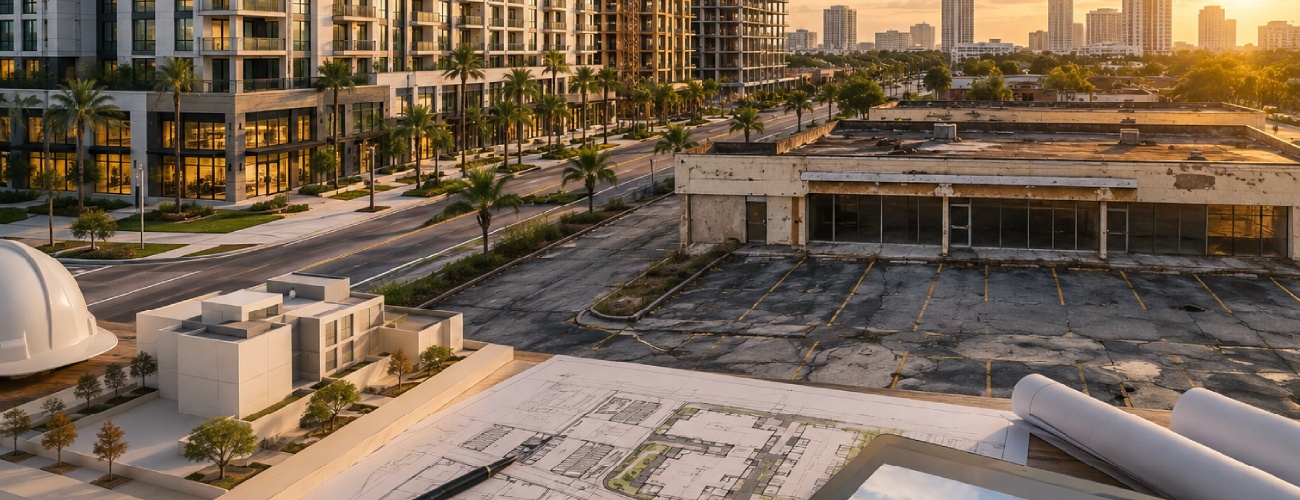
There’s nothing mysterious about why owners of older commercial buildings in Broward are suddenly fielding unsolicited offers. Southeast Florida keeps adding people and jobs, and that demand for office, medical, retail, industrial, and mixed-use space has to land somewhere. Increasingly, it’s landing on redevelopment sites rather than raw land, because raw land in Broward is essentially gone.
At the same time, a lot of the county’s older commercial stock simply isn’t competitive anymore. Tenants are moving toward newer, amenity-heavy buildings and leaving 1980s office parks and dated strip centers behind, which is pushing owners toward renovation, adaptive reuse, or a full teardown. And there’s a hard physical ceiling on top of all this: much of Broward’s road network is already at capacity, so infill redevelopment isn’t just the fashionable choice, it’s often the only one that works.
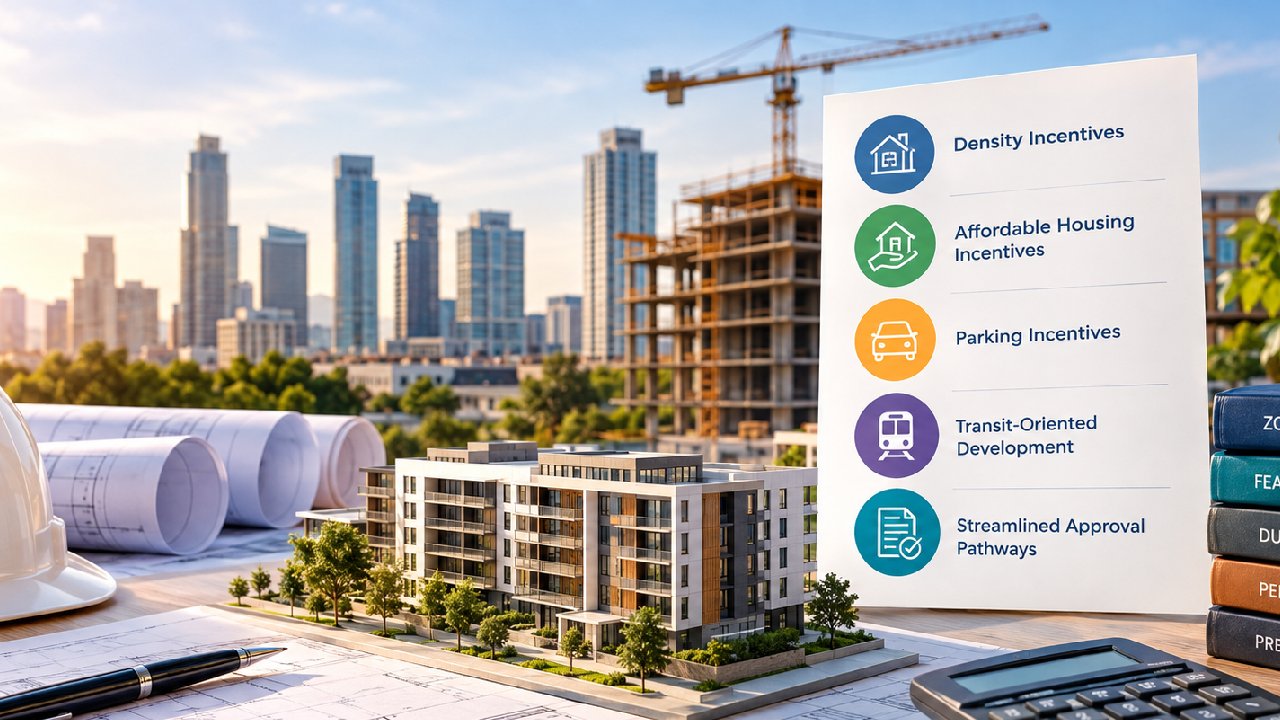
None of that would matter much if the regulatory environment were hostile to it. It isn’t. Brownfield programs, Community Redevelopment Agency (CRA) districts funded through Tax Increment Financing (TIF), and the state’s Live Local Act for commercial-to-residential conversions have all lowered entitlement risk and made the numbers pencil on sites that would have been dead deals a decade ago. So a property type that used to be a management headache, the aging strip center nobody wanted, is now one of the more actively chased acquisition targets in the county.
The entitlement and permitting process, step by step
Here’s the fact that matters more than any other on this list: jurisdiction determines almost everything. Broward County itself only regulates unincorporated land within the BMSD. Every one of the county’s 31 municipalities runs its own zoning code, planning department, and approval process, and what’s administrative in one city can require a full public hearing two miles away in the next.
Pre-application and due diligence. Before anyone draws a building, confirm the zoning district, permitted uses, and consistency with the jurisdiction’s Future Land Use Map (FLUM). This is also when you screen for concurrency, traffic, drainage, water and sewer capacity, schools, parks, and check for overlay districts like coastal, historic, CRA, or transit-oriented development zones. If there’s an existing structure coming down, confirm the demolition and historic preservation requirements now, not after the site is cleared.
Entitlements, if the use isn’t already by-right. If the redevelopment is consistent with zoning and the FLUM, it may go straight to site plan review. If not, expect a rezoning, conditional use or special exception, planned development approval, or variance, most of which mean public hearings in front of a planning board and city commission. Commercial-to-residential and mixed-use conversions almost always trigger design review on height, setbacks, buffering, and parking, along with a compatibility finding relative to whatever is next door.
Site plan and development review. Conceptual and final site plans need to show massing, unit mix, parking strategy, landscaping, buffering, loading and trash areas, and stormwater management. Multifamily and mixed-use conversions get the closest look on traffic generation and neighborhood compatibility, so don’t skimp on that analysis.
Engineering and utility approvals. Drainage, roadway access, water and sewer capacity, and utility easements are usually reviewed separately from the building permit itself. Drainage and traffic capacity are the recurring headaches across Broward, even in jurisdictions where the city handles most of the permitting directly.
Building permit issuance. With land use approval in hand, the building permit requires signed and sealed plans, a survey, zoning approval, a notice of commencement for anything over $2,500, and coordination of sub-permits for electrical, plumbing, and mechanical work. Permits are generally good for 180 days, and extensions aren’t automatic, so sequencing is a real schedule risk, not paperwork.
Inspections and certificate of occupancy. Inspections get scheduled as work progresses, and for mixed-use or multifamily conversions, expect a close look at life safety systems, fire separation, elevators, and common areas before a CO is issued.
A few special paths worth knowing about
- Brownfield redevelopment. Sites with actual or suspected contamination can be designated a Brownfield Area and Site, opening the door to state and county cleanup programs and tax credits that offset remediation costs.
- CRA and TIF districts. A lot of Broward’s older commercial corridors sit inside Community Redevelopment Areas, where TIF financing can fund public infrastructure, facade grants, and job-creation incentives.
- The Live Local Act. For commercial-to-residential or mixed-use residential conversions on commercially, industrially, or mixed-use zoned parcels, Live Local can mean administrative approval, maximum allowable density and height, parking reductions, and property tax exemptions where affordability thresholds are met.
Where the activity is concentrated
Central Fort Lauderdale, along Federal Highway, Broward Boulevard, and Andrews Avenue, is seeing the heaviest redevelopment interest right now, with a steady stream of mixed-use and residential conversion proposals. Hollywood and Dania Beach, Pompano Beach and Deerfield Beach, Coral Springs, and Plantation and Sunrise have all absorbed significant new deliveries since 2023, with several thousand units still under construction countywide. Dixie Highway and Federal Highway have been a focus of municipal redevelopment planning for years now, largely because aging commercial buildings sit right up against real infrastructure limits, sewer capacity in the northern stretches being the one that comes up most.
The tradeoff in these corridors is what you’d expect: land costs more, neighbors have more to say about height and traffic, and infrastructure capacity gets tighter the more desirable the location.
Where the opportunity still is
If the core corridors are priced above your comfort level, three categories are still underexploited. Secondary commercial corridors with decent access but a lower land basis, older arterial strips and nodes near activity centers but outside the hottest submarkets, leave more room to underwrite a real return. Brownfield-designated areas, and Broward has more than a dozen, pair cleanup incentives and job-creation bonuses with sites everyone else has passed on. And the western and northern edges of the county still have available land at a lower basis, at the cost of a longer commute and weaker transit access.
The risks don’t go away in these areas, they just shift shape. Concurrency and infrastructure capacity can gate a project outright. Opposition tends to intensify near established neighborhoods where height and parking are contested. And environmental constraints, from brownfield remediation to floodplain rules, add cost and time no matter how good the land basis looks on paper.
Stacking the incentives that actually move the needle
The developers who do best in this market rarely lean on one incentive. They stack several.
Voluntary Cleanup Tax Credits (VCTC) under the state Brownfields Redevelopment Program can offset up to half of qualified remediation costs against Florida corporate income tax. Brownfield Site Redevelopment Agreements (BSRAs) unlock those credits along with regulatory guidance, and Broward has issued substantial credits behind hundreds of millions of dollars in redevelopment capital over the years. The Live Local Act offers administrative approval, density and height bonuses, parking reductions, and property tax exemptions, up to 100 percent for units serving households under 80 percent of area median income, for qualifying residential components. Qualified Target Industry (QTI) Tax Refunds apply where the redevelopment lands a targeted-industry tenant, office, tech, logistics, or manufacturing. And CRA and TIF programs, including facade grants, commercial property enhancement funds, and per-job cash incentives in some cities, help pay for the public realm improvements tied to a project.
A structure that works well in Broward pairs brownfield tax credits, where eligible, with CRA/TIF-funded public improvements, a Live Local residential component, and QTI incentives for anchor tenants. Stacked together, this combination can meaningfully improve IRR while taking real risk off the table.
Where projects actually get stuck
Every party in a Broward redevelopment deal has its own version of this headache. Developers and investors run into land assembly friction most often, non-contiguous parcels, unwilling sellers, title issues, plus the challenge of underwriting an obsolete asset against a pro forma that depends on incentives coming through. Architects and engineers lose time to code and design misalignment during plan review, and to the buffering and shadow-study work that Live Local or mixed-use projects require when they rise well above the surrounding context. General contractors have to manage the 180-day permit clock and the sequencing of sub-permits and inspections, on top of confirming that demolition clears historic preservation review before new permits get issued. Lenders and investors scrutinize appraisal comps hardest on nonstandard use mixes or affordability-restricted units, since long-term affordability covenants can limit both the exit and the rent growth assumptions everyone built the deal around.
A due diligence checklist before you commit
- Confirm jurisdiction, zoning, and FLUM consistency, and screen for Brownfield, CRA, and Live Local eligibility early.
- Run a full concurrency screen, traffic, drainage, water and sewer, schools, parks, fire and police, before locking in a purchase price or a design direction.
- Design for neighborhood compatibility from the start: height transitions, buffering, parking strategy, service access for mixed-use components.
- Map available incentives against the intended use mix and build them into the pro forma, not treat them as upside if they happen to come through.
- Budget real time for plan review cycles and the 180-day permit window, and line up sub-permits early so they don’t become the bottleneck.
Jurisdiction is what makes or breaks the timeline
The theme that runs through all of this is that Broward isn’t one market to entitle in, it’s 31 of them, plus the unincorporated BMSD. A path that’s purely administrative in one city can mean a full rezoning and public hearing cycle two miles away in another. For architects, developers, and investors looking at aging commercial parcels, the entitlement strategy needs to be built around the specific municipality, and its concurrency, incentive, and hearing requirements, from the first site visit, not adjusted after the property is already under contract.
This is usually where local expertise earns its keep several times over. JDJ Consulting’s Broward permit expediting and entitlement consulting practice works directly with development teams to navigate municipal zoning review, structure the entitlement path around brownfield, CRA, and Live Local eligibility, and keep permitting on schedule through the building department, so acquisition decisions get made against a real, jurisdiction-specific picture of timeline and risk, not a generic one.
Frequently asked questions
Does Broward County regulate zoning and permitting for redevelopment projects?
Only within the unincorporated Broward Municipal Services District. Every one of the county’s 31 municipalities runs its own zoning code, planning review, and building permit process, so requirements shift from one city to the next.
What’s the fastest path to entitlement for an aging commercial parcel in Broward?
If the proposed use is already permitted by-right under the site’s zoning and consistent with the jurisdiction’s Future Land Use Map, a project can usually move straight to site plan review without a rezoning or public hearing.
How long is a Broward building permit valid once it’s issued?
Generally 180 days, and extensions aren’t automatic. That makes permit sequencing a real schedule risk on redevelopment projects, not just paperwork.
What incentives come up most often on redevelopment of aging commercial parcels?
Voluntary Cleanup Tax Credits for brownfield sites, CRA and TIF-funded public improvements, Live Local Act density and tax benefits for residential conversions, and Qualified Target Industry refunds for projects that land targeted-industry tenants.